Content Repurposing: The Complete Strategy Guide
Content repurposing turns one idea into weeks of posts. The mindset, the workflow, format by format, batching, and the tooling to do it in 5 minutes.

You did the hard part already. You recorded the video, hosted the podcast, gave the talk, or wrote the idea down at 6am before it slipped. Then it ran once and sank to the bottom of a feed.
That is the quiet waste in most content operations. Not a shortage of ideas, a shortage of leverage on the ideas you already had. Content repurposing is how you fix it: you stop treating every post as a fresh act of creation and start treating your best work as raw material you mine again and again.
Content repurposing is taking one thing you already made, a video, a podcast, a talk, or a single strong idea, and reshaping it into many native posts for every platform instead of starting each one from a blank page. That is the whole discipline. Not recycling, not spamming the same link everywhere, but extraction: pulling the dozen posts that were already sitting inside one piece. The one-to-many version of this move has its own name, content atomization, and it is the sharpest way to think about getting a week of posts from a single idea.
This is the pillar guide. It covers the mindset, the repurposing workflow, what each source format actually turns into, how to batch it, and the tooling that collapses hours into minutes. Where a section has its own deep dive, I link to it so you can go as deep as you want.
I build CaptureFlow, so I have a bias to declare. CaptureFlow is an AI content agent that turns your expertise into weeks of on-brand content for every platform. But everything in the mindset and workflow below works with nothing more than a transcript and a notes app. The tooling section is where the agent earns its keep, and you can skip straight there if you already know the moves.
Why content repurposing beats making more
The instinct when your feed goes quiet is to make more. More ideas, more posts, more nights at the keyboard. That instinct is the trap.
The math runs the other way. When you talk for an hour, teach a workshop, or think an idea all the way through, you do not produce one post. You produce a thesis, a contrarian take, two or three stories, a framework, a stat, and a handful of lines clean enough to put on a graphic. Each of those is a different asset with a different hook, not the same thing chopped up. The reframe that makes repurposing click: one idea is not one post, it is a dozen.
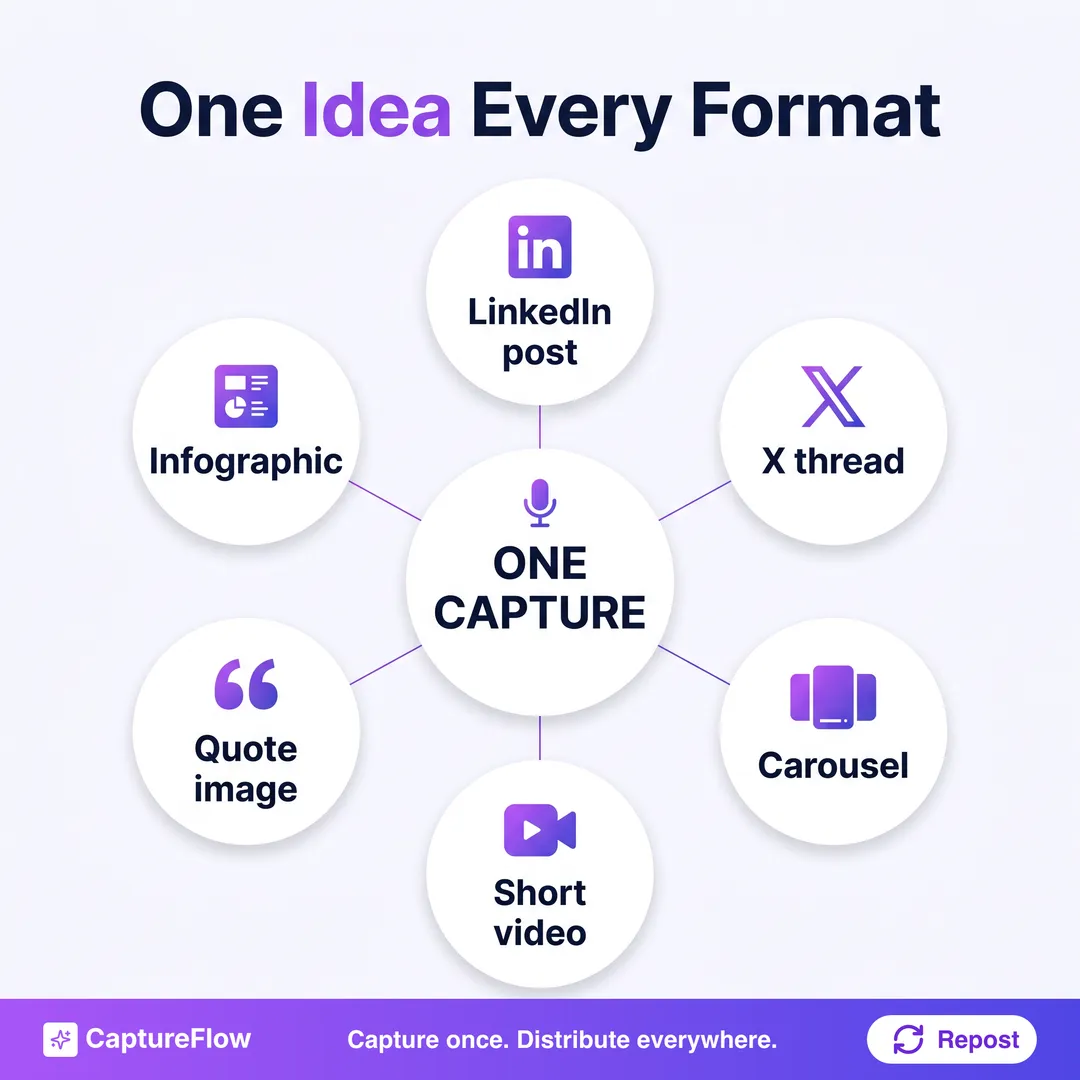 One capture, every format. The same idea, reshaped for each feed it lands in.
That fan-out is the core of the whole capture once, distribute everywhere idea. The capture is the thing you already made. Everything after is distribution. And the reason it beats generating fresh posts is not just speed. It is quality. When the raw material is your own voice, the output has a real point of view baked in, instead of the flat, averaged take you get when AI writes from a blank prompt about your topic.
There is a real audience cost to skipping this too. Video is the clearest case: 91% of businesses use video as a marketing tool and 82% of marketers say it delivers a good return, per Wyzowl's 2026 survey. If you record video and post it once, you are getting a fraction of a channel your peers treat as their best one.
How to repurpose content: the five-step workflow
Here is the repeatable part. The reason repurposing feels overwhelming is that people try to do it as one messy blob. Split into five moves, it stops being a mood and starts being a process you run the same way every time.
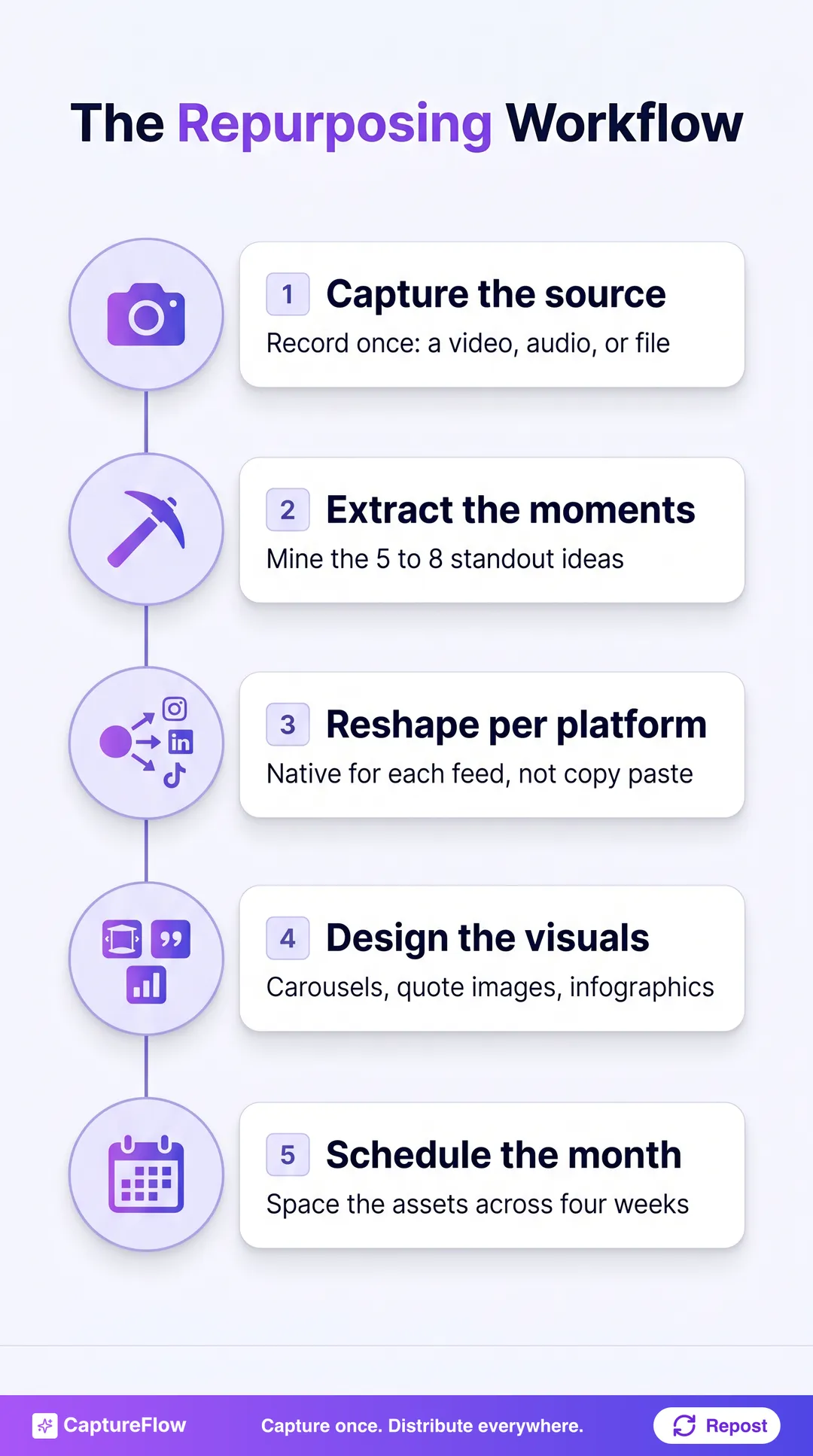 The repurposing workflow. Step two, extraction, is where the real work lives. The rest is fast once you know the moments.
This is the answer to how to repurpose content in five steps you can run on anything.
1. Capture the source. You cannot repurpose a blank page. So the first move is to have one dense source: a long video, a podcast episode, a recorded talk, a voice note, or a document. The richer the source, the more it yields. A rambling ten-minute clip gives you a couple of posts. A focused hour gives you dozens. CaptureFlow ingests all of it through multimodal capture, video, audio, PDFs, links, or plain text, but any recorder plus a transcript works.
2. Extract the standout moments. This is the stage everyone skips, and it is the one that matters most. Read or listen through and mark the 5 to 8 spots where you said something worth its own asset: the thesis, the spicy contrarian take, a story, a named framework, a surprising stat, a clean one-liner. You are not hunting for thirty things. You are hunting for a handful of strong ones, because each one becomes several posts.
3. Reshape each moment native per platform. The word that matters is native. A LinkedIn post is not an X thread is not an Instagram caption. Copy-pasting the same paragraph everywhere is the fastest way to sound like a bot. Take one moment and rebuild it in the shape each platform rewards.
4. Design the visuals. Turn the frameworks into carousels, the one-liners into quote images, the data into infographics, and the standout moments into short video clips. Visual formats get saved and shared, which is why they punch above their weight.
5. Schedule across the month. Thirty assets dumped in one week is a firehose. Spread across four weeks, one source quietly becomes a full content calendar.
Do the extraction before you touch a single platform. If you jump straight to writing a LinkedIn post, you burn the best moment on one format and forget the other seven. Mark all the moments first, then decide which format each one deserves. The order is the whole trick.
Format by format: what turns into what
Every source has a natural yield. A long video is clip-heavy. A podcast is quote-heavy and thread-heavy. A single written idea is lighter but faster. Knowing the yield up front means you stop staring at a source wondering what to do with it.
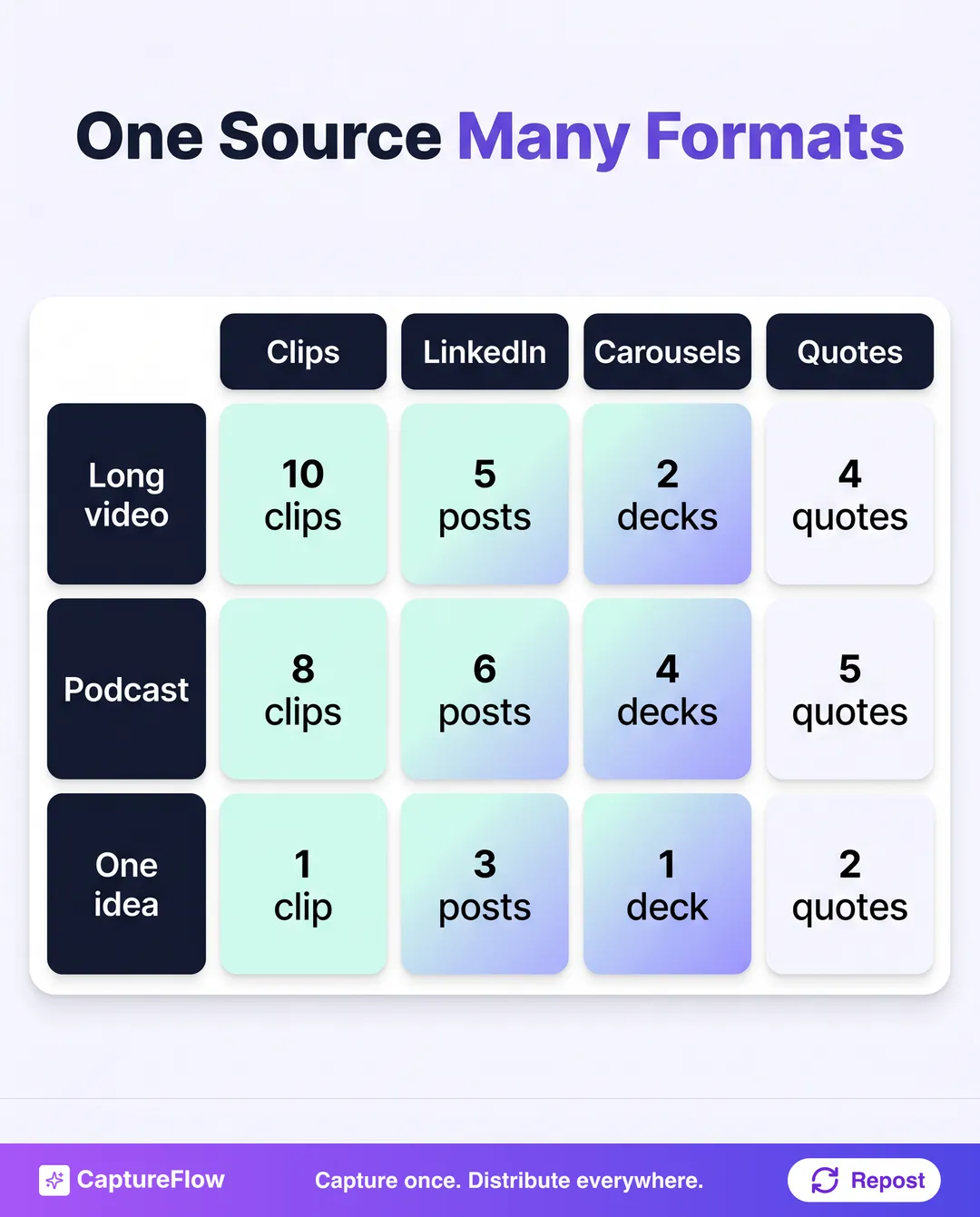 Rough yields per source. Treat these as a floor, then skew the mix toward the platforms you actually care about.
Here is the same idea as a quick reference, then a deeper look at the three most common sources.
| Source | Best first output | Roughly yields |
|---|---|---|
| Long video | Vertical clips | ~10 clips, a week of posts, a carousel or two |
| Podcast episode | Clips of standout moments | ~30 assets across every format |
| One written idea | A LinkedIn post | A week of posts across platforms |
Turn a long video into clips and posts
A recorded video is the densest source you own, because it carries both the words and the footage. The standout moments become vertical clips, captioned for silent autoplay and sized for Reels, Shorts, and TikTok. Then each clip and its transcript seed a written post on the same idea.
The full walkthrough lives in our guide to turning one video into ten LinkedIn posts, which breaks down exactly how to mine a single recording for a week of text posts. Any framework you explained on camera also becomes a swipeable deck, and it is worth learning how to make a LinkedIn carousel properly, because carousels get saved and reshared more than almost anything else.
The reason video repurposes so well is that it fails silently otherwise. Most feeds autoplay on mute, so an uncaptioned clip is a clip most people scroll past before they ever hear your best line. Burn in captions, open on the hook, and cut the runway so the first second earns the next five. Get that right and the same footage that ran once as a long video becomes ten short assets that each reach a different slice of the audience.
Turn a podcast episode into a month of posts
Audio is the most under-mined source of all. A focused 45 to 60 minute episode holds roughly 30 assets: clips of your best moments, LinkedIn posts, X threads, carousels, and quote images, each pulled from a different beat of the conversation.
The demand is there. 80% of Americans age 12 and up have now listened to a podcast, an all-time high per Edison Research, yet most of an episode reaches only the sliver who already subscribe. Reshaping it is how you reach everyone who would have loved it and never pressed play. The step-by-step system is in how to repurpose one podcast episode into 30 posts, and if you want the two visual formats specifically, here is how to turn one podcast into carousels and short videos.
Turn one idea into a week of content
Not every source is an hour long. Sometimes it is a single strong thought you had in the shower. That still fans out.
Take the idea and write the sharp LinkedIn post first. Then unroll the same argument as an X thread, one beat per post. Pull the core claim into a quote image. If there is a process inside it, sketch a three-slide carousel. One genuine insight, written the way you actually think, is a week of posts across platforms. This is the heart of a capture-first content system: the idea is the capture, everything after is distribution, and the substance stays yours because it started as content that sounds like you.
The rule that makes repurposing workKeep your own phrasing. The entire reason repurposing beats writing from scratch is that the raw material is something you genuinely said or thought. The moment a post starts sounding like a template, you have thrown away the only edge the source gave you.
Batch it: repurpose a month in one sitting
Repurposing one source at a time is good. Repurposing in batches is what actually keeps a calendar full without eating your week.
The enemy is context switching. Gloria Mark's research at UC Irvine found it takes an average of 23 minutes to fully refocus after a single interruption, and that the time we hold attention on one screen has fallen from about two and a half minutes in 2004 to 47 seconds today. Doing content in scattered five-minute bursts between meetings means you pay that refocus tax over and over. Batching pays it once.
The move: pick a single block, run the workflow on two dense sources back to back, and lay the output across four weeks. One recording session plus one repurposing session equals a month live.
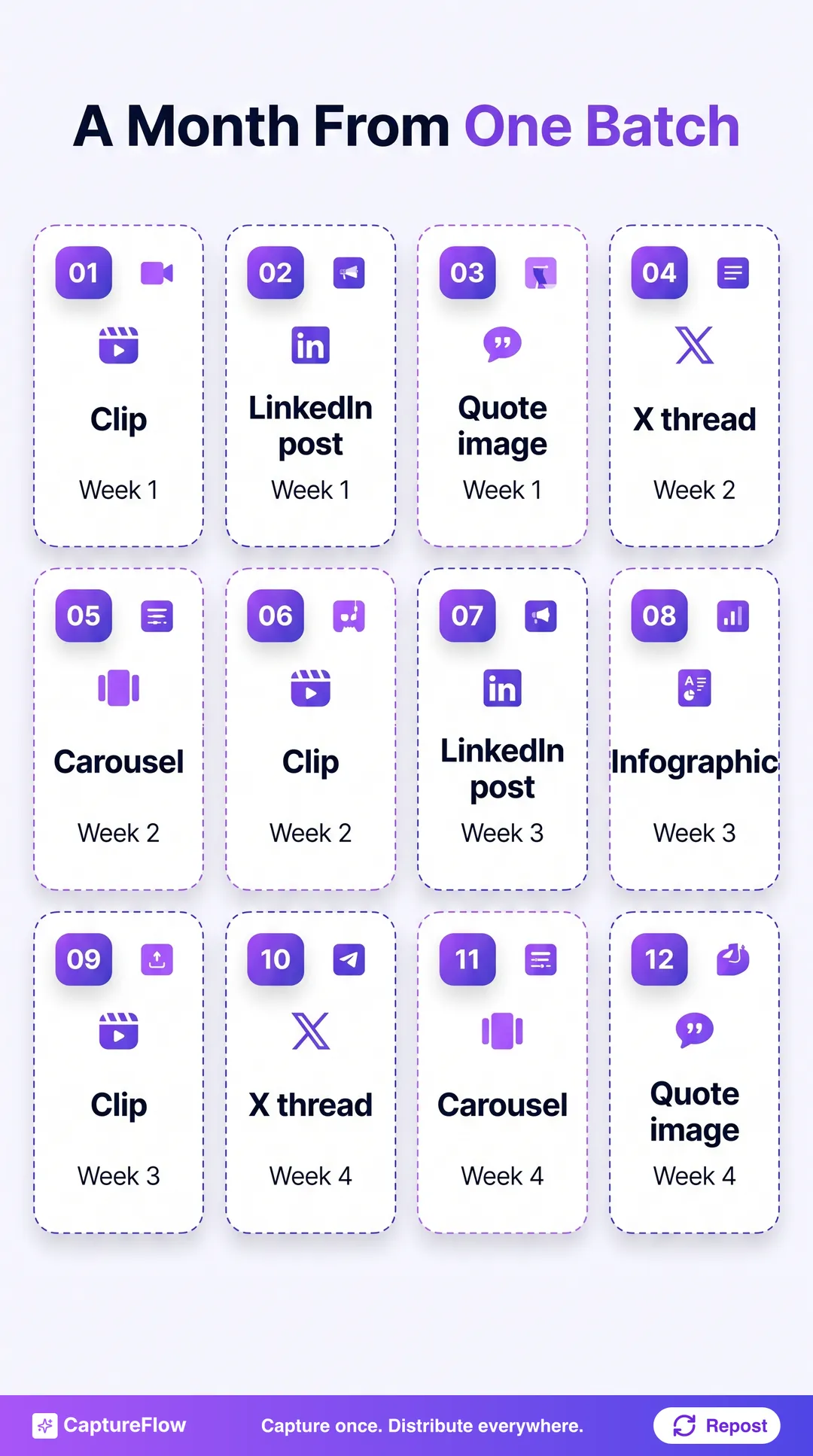 One batch, a month of posts. Space the assets from the same source apart so they reinforce, not repeat.
The full batching system, including how to schedule so assets from the same moment do not stack on the same day, is in how to batch a month of content. The short version: lead each week with your strongest clip and your spiciest take, save the stories for mid-week, and let the queue outlast your motivation.
Batching by hand has a failure mode: you set aside a whole Saturday, mine two sources, write two dozen posts, and burn out before you schedule them. If the batch is so big it needs a full day, that is the signal you have outgrown the manual version and the tooling below is what keeps the habit alive.
The tooling: doing it in 5 minutes
Everything above works with a transcript, a notes app, and discipline. It also takes hours per source. That gap between the method and the time it costs is exactly why repurposing tools exist.
We ranked the landscape honestly, including where each option beats us, in the best AI content repurposing tools guide. Some tools are specialists: great at slicing a video into clips, or at turning audio into raw text assets, and nothing else. Others try to run the whole workflow. If you only need one step, a sharp specialist will often beat a generalist, and I would rather you use the right tool than a worse one.
Where a content agent changes the game is that it runs all five workflow steps at once. You drop the source in, and it transcribes, mines the standout moments, drafts each post native to its platform, and grounds the writing in your past posts so it stays in your voice rather than generic. You review the batch, tweak what you want, and schedule the month. About 5 minutes instead of an afternoon.
The important part is that it is the same method, not a shortcut around it. The agent does not invent opinions you never held. It extracts the ones you already recorded and reshapes them, which is the difference between posting one clip from a video and turning that video into a month of content.
A content repurposing strategy that compounds
Here is the shift a real content repurposing strategy gives you. You stop asking "what should I post today" and start asking "what did I already make that I can mine". The blank page, the thing that quietly kills most posting habits, disappears.
Every source you capture becomes an asset that pays out for weeks. Do it consistently and the effect compounds: a back catalog of videos, episodes, and ideas that you can re-mine whenever the calendar gets thin. That is the difference between grinding out content and running a system that works while you do other things.
It also changes what "consistent" costs you. Posting daily on five platforms sounds like a full-time job because, done the hard way, it is. Done as repurposing, it is one dense capture a week feeding every channel at once. You are not five times busier for being on five platforms, you are mining the same source five ways. That is the only version of an always-on presence that a founder or a small team can actually sustain, and it is why the operators who last treat capture, not posting, as the real habit.
Start with one source. Take your most recent video or podcast episode, run the five steps, and watch one piece fill your calendar for a month. When you want the 5-minute version instead of the afternoon one, see how CaptureFlow fits your flow or start a free trial and turn your next capture into weeks of posts.
Sources
- Wyzowl, Video Marketing Statistics 2026 (video adoption and ROI).
- Edison Research, The Infinite Dial (US podcast listening).
- Gloria Mark, UC Irvine, Attention Span research (refocus time and screen attention).
Frequently asked questions
What is content repurposing?+
Content repurposing is taking one piece you already made, a video, a podcast, a talk, or a single idea, and reshaping it into many native posts for every platform instead of writing each one from scratch. The substance is something you already said, so it stays in your voice.
How do you repurpose content without it feeling repetitive?+
Give each asset a different moment and a different angle, then shape it native to the platform it lives on. You are not posting the same idea ten times, you are surfacing the several distinct ideas that were already inside the source and dressing each one for a different feed.
How long does content repurposing take?+
By hand, a long video or a podcast episode is a few hours to fully mine, rewrite, and schedule. With a content agent trained on your voice it is about 5 minutes to a full draft set that you review and approve before it goes out.
Where should you start with a content repurposing strategy?+
Start with the highest-density source you already own: your most recent long video or podcast episode. Run the five-step workflow on that one piece, schedule the output across a month, and only then worry about batching multiple sources.
Chris is the founder and CEO of CaptureFlow, which he builds so founders can turn their expertise into content without hiring a team. After 10+ years building products and growing audiences from scratch, he writes about founder-led content, AI, and distribution from inside the problem he is solving: distributing consistent, on-brand content as a team of one.
Founder & CEO of CaptureFlow · 10+ years building products and audiences
One playbook a week from founders who actually create and distribute lots of content. No spam, unsubscribe anytime.
Keep reading

How to Turn Meeting Recordings Into Content
Your best ideas get said out loud in meetings, then vanish. Here is how to turn a single recording into a week of social posts, in about 5 minutes.

Content Operations for B2B Teams: Build a Scalable System
More content is demanded than any B2B team can produce, so the work fragments across five tools and quality slips. Content operations is the fix. Here is the system.

How to Build a LinkedIn Content Strategy That Generates B2B Leads
Most B2B LinkedIn strategies chase reach and wonder why no leads show up. Here is one built to generate pipeline: the mix of voices, a weekly plan, and how to measure leads instead of likes.