How to Repurpose One Podcast Episode into 30 Posts
A repeatable workflow to repurpose a podcast episode into 30 native posts. The 5 stages, the 30-asset breakdown, and how to run it in 5 minutes with AI.

You already recorded an hour of gold. Then you let it sink to the bottom of a feed.
That is the quiet tragedy of podcasting. You prep, you record, you edit, you publish, and the whole episode gets one listen from the people who already subscribe. The best line you said all week, the framework you explained perfectly on the second take, the story that made your guest lean in, all of it disappears after Thursday. It is an iceberg where only the tip ever shows.
The demand is not the problem. 80% of Americans age 12+ have now listened to a podcast, an all-time high per Edison Research. The problem is that a single upload only ever reaches the sliver who already pressed play.
So here is the honest answer to how to repurpose a podcast: one focused episode holds roughly 30 posts, and the only thing between you and all 30 is a repeatable system to mine the audio. This workflow is that system. The manual version first, so you understand the moves, then the 5-minute version with AI.
Podcast repurposing is taking one episode you already recorded and reshaping it into dozens of native posts, clips, and graphics for every platform, instead of letting the audio disappear after a single listen. That is the entire game: not making more, mining what you already made.
I run CaptureFlow, so I have skin in this. CaptureFlow is an AI content agent that turns your expertise into weeks of on-brand content for every platform. But everything below works with nothing more than a transcript and a notes app. The tool just makes it fast, and the podcasters we build for tend to feel the difference the first week.
Why one episode is worth 30 posts
A blank page is the enemy. A 60-minute transcript is the opposite of a blank page.
When you talk for an hour about something you know, you do not produce one idea. You state a thesis, argue against a common belief, tell two or three stories, name a framework, drop a stat, and land a handful of quotable lines. Each of those is a different asset with a different hook, not the same episode chopped up. That is the reframe: you are not stretching one idea across 30 posts, you are surfacing the 30 assets that were already sitting in the audio.
And each asset can meet a different slice of a huge audience. Roughly 58% of Americans age 12+ listen to podcasts monthly, about 167 million people, but most of them will never scroll back to one old episode. Reshaping it into native posts is how you reach the ones who would have loved it and never saw it.
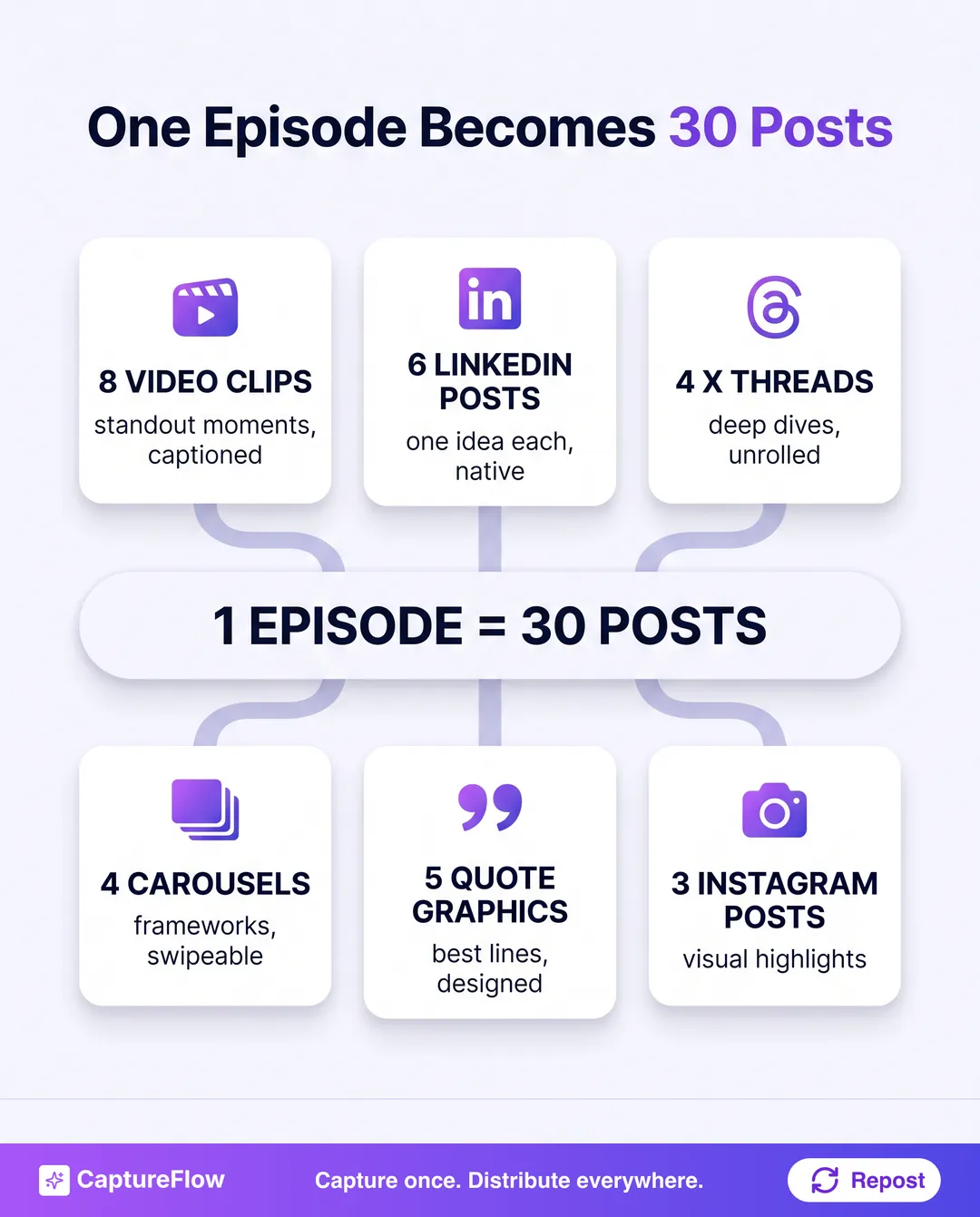 One episode, 30 assets. Each one is a different moment shaped for a different feed.
This is why capture once, distribute everywhere is not a slogan for us, it is the math. A podcast is one of the densest sources in the wider content repurposing strategy, and the same extraction logic works on a video, a talk, or a single idea. The episode is the capture. Everything after is distribution. And the reason it works is that the raw material is your own voice, so when you repurpose podcast content the substance is real, not a generic AI take on your topic.
How to repurpose a podcast in 5 stages
Here is the repeatable part. Run it the same way every episode and it stops feeling like a second job.
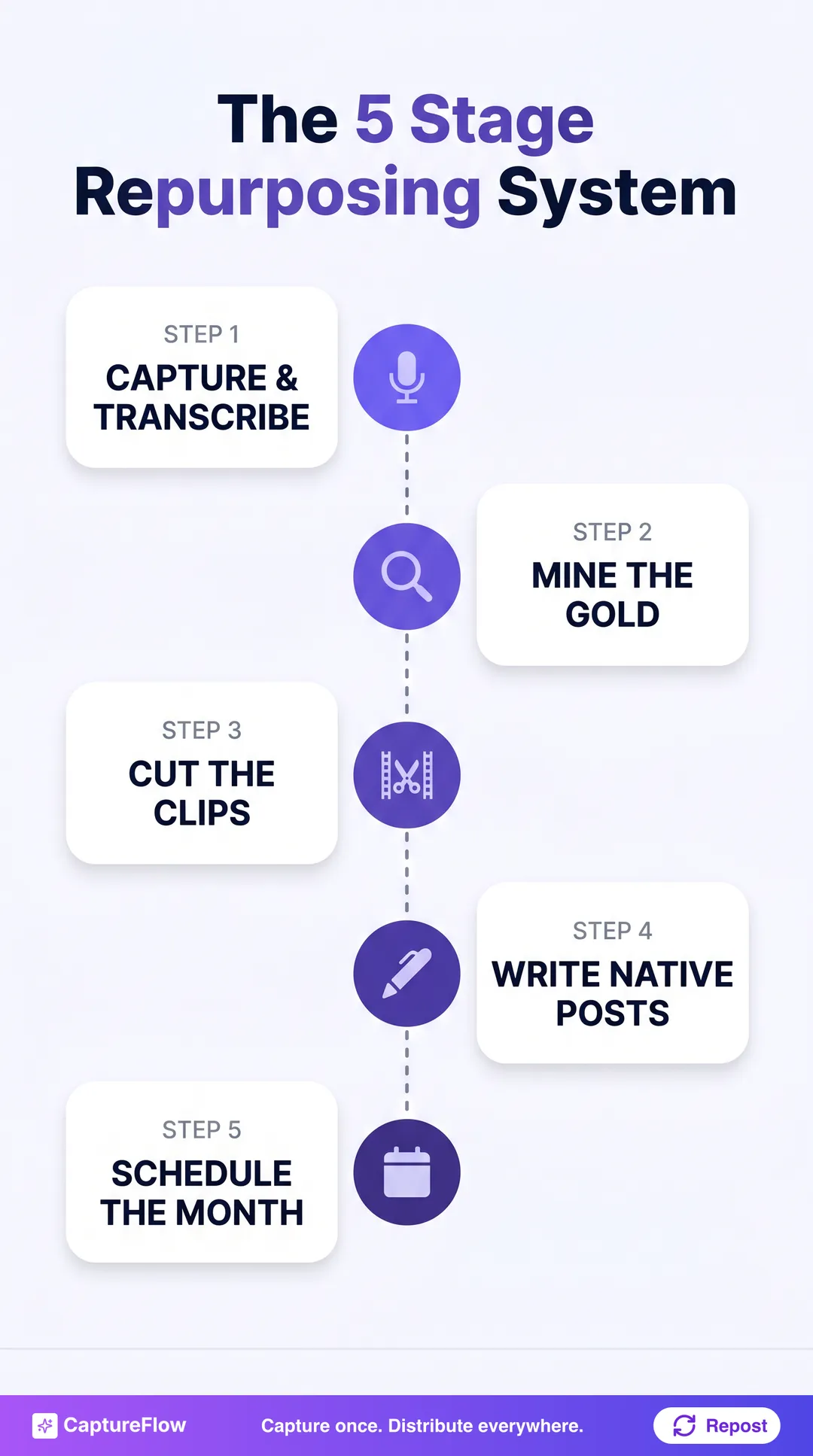 The five stages. Stage two, mining, is where the work is. The rest is fast once you know the moments.
The overview: one episode goes in, and it moves through capture and transcribe, mine the gold, cut the clips, write native, and schedule the month. Thirty assets come out the other side. Let me walk each stage.
Stage 1: Capture and transcribe the episode
You cannot mine audio, you can only mine text. So the first move is always to turn the episode into a clean, searchable, timestamped transcript.
The best source is 45 to 60 minutes of real conversation on a focused theme, a solo monologue, an interview, or a co-hosted deep dive. A 10-minute segment does not hold 30 assets. A rambling three-hour marathon holds them, but buried too deep to mine by hand without losing your afternoon.
Get the transcript with timestamps, because you will need them at the clip stage to find the exact seconds. Any transcription tool works, and most multimodal capture turns the recording into clean, timestamped text automatically when you drop the file or a link in.
Read the whole transcript once, top to bottom, before you cut a single thing. You are looking for the shape of the episode, where the energy spikes and where you went deep. Mark those spots now and stage two gets twice as fast.
Stage 2: Mine the gold, find the 5 to 8 standout moments
This is the real work, and it is the stage people skip. Everything else in podcast repurposing depends on it.
Go through the transcript hunting for standout moments, the 5 to 8 spots where you said something worth its own asset. You are not looking for 30 things. You are looking for 5 to 8 great ones, because each strong moment becomes several posts across formats.
Hunt for these six flavors of gold:
- The thesis. The one big idea you kept circling back to.
- The contrarian take. The spiciest 60 seconds, where you disagreed with the consensus. These travel furthest.
- The story. A personal anecdote or a customer example, the parts that made the conversation feel human.
- The framework. Any mental model you named out loud, even casually. A label makes it shareable.
- The stat or surprise. A number, a result, or a fact that made your guest react.
- The one-liner. A sentence so clean it belongs on a graphic.
Tag each one with its timestamp and its flavor. By the end you should have 5 to 8 marked moments. That marked list is the raw ore for everything that follows.
Do not force it to eight. Five genuinely strong moments beat eight where three are filler. A weak clip or a limp quote graphic does more damage to your feed than a smaller batch of assets that all land.
Stage 3: Cut the clips
Video travels further than anything else, so your standout moments become clips first. Each of the 5 to 8 moments is a 15 to 60 second vertical clip, captioned for silent viewing and sized for Reels, Shorts, and TikTok.
Pull the exact in and out points from the timestamps you marked, trim the runway so the clip opens on the hook, and burn in captions because most of the feed watches on mute. A strong contrarian moment or a tight story is the ideal clip: it has tension and a payoff inside a minute.
Aim for around eight clips from a full episode. The best two or three earn their own dedicated push. The rest seed the written posts in the next stage, because a clip and its transcript are the perfect prompt for a LinkedIn post on the same idea. (For the clip-by-clip decision rule and captions, see how to repurpose podcast clips.)
Caption every clip, always. Silent autoplay is the default across every platform now, so an uncaptioned clip is a clip most people scroll past before they hear your best line. The caption is not an accessory, it is the hook.
Stage 4: Write each post native per platform
Now the marked moments become written posts, and the word that matters is native. A LinkedIn post is not an X thread is not an Instagram caption. Reshaping the same moment for each platform is the whole skill.
- LinkedIn posts: one idea each, a strong first line, short paragraphs, a clear takeaway. Your thesis, a framework, a story, and a contrarian take are four different posts. If the hook is where you stall, borrow a structure from our guide on turning one recording into ten LinkedIn posts.
- X threads: take your deepest moments and unroll them step by step, hook on line one, one beat per post.
- Carousels: any framework you named becomes a swipeable carousel, one point per slide. These get saved and shared, which is why they punch above their weight.
- Quote graphics: your cleanest one-liners, set on-brand. Instant social proof from your own mouth.
- Instagram posts: the visual highlights, native to the feed as a single image or a carousel.
The trap at this stage is the transcript's spoken rhythm. Speech rambles, written posts are tight. Cut the filler, keep the point, and above all keep your phrasing. CaptureFlow can spin one moment into a post in every format at once, but the same rule holds whether a human or an agent writes it.
Write to the platform, not to the transcript. Copy-pasting a spoken paragraph into LinkedIn is the fastest way to sound like a robot reading a script. Take the idea, drop the ums and the tangents, and rebuild it in the shape the platform rewards.
The one ruleKeep your own words. The entire reason repurposing works is that the raw material is something you genuinely said on the mic. The moment a post starts sounding like a template, you have thrown away the only edge the episode gave you.
Stage 5: Schedule the month
Thirty assets dumped in one week is a firehose nobody wants. Spread across a month, one episode quietly becomes a full content calendar.
Queue the clips, posts, threads, carousels, and graphics across four weeks. Lead with your strongest clip and your contrarian take, save the stories for mid-week, and let each asset breathe with a day or two between the ones that share a moment. One episode can carry your entire posting cadence until the next one drops.
This is where batching a month of content stops being aspirational. Record two episodes, run this system on both, and you have a queue that outlasts your motivation.
Space the assets that came from the same moment. If your clip, your LinkedIn post, and your quote graphic all pull from the same 90 seconds, do not stack them on the same day. A week apart they reinforce the idea. Back to back they feel like reruns.
How to turn a podcast into LinkedIn posts, carousels, and short video
LinkedIn deserves its own note, because it is where most B2B podcasters see the biggest return, and the three formats it rewards all come from the same episode.
To turn a podcast into LinkedIn posts, pull your five to eight standout moments and rebuild each as a native post: a strong first line, one idea, a clear takeaway. To turn it into LinkedIn carousels, take any framework or numbered list a guest walked through and put one point per slide (our guide to making a LinkedIn carousel covers the format). For short video, cut your two or three most quotable 30 to 60 second moments, caption them, and post them native to the feed.
Our focused walkthrough on how to turn one podcast into carousels and short videos goes step by step, but the short version is to work from the transcript and the clips together: the transcript gives you the words, the clips give you the visuals, and one strong moment often becomes a post, a carousel, and a clip at once. Space them a few days apart so they reinforce rather than repeat, and cross-platform publishing sends the same set to your other channels.
The 30-asset breakdown
So where does the number 30 actually come from? Here is the standard yield from one focused 45 to 60 minute episode.
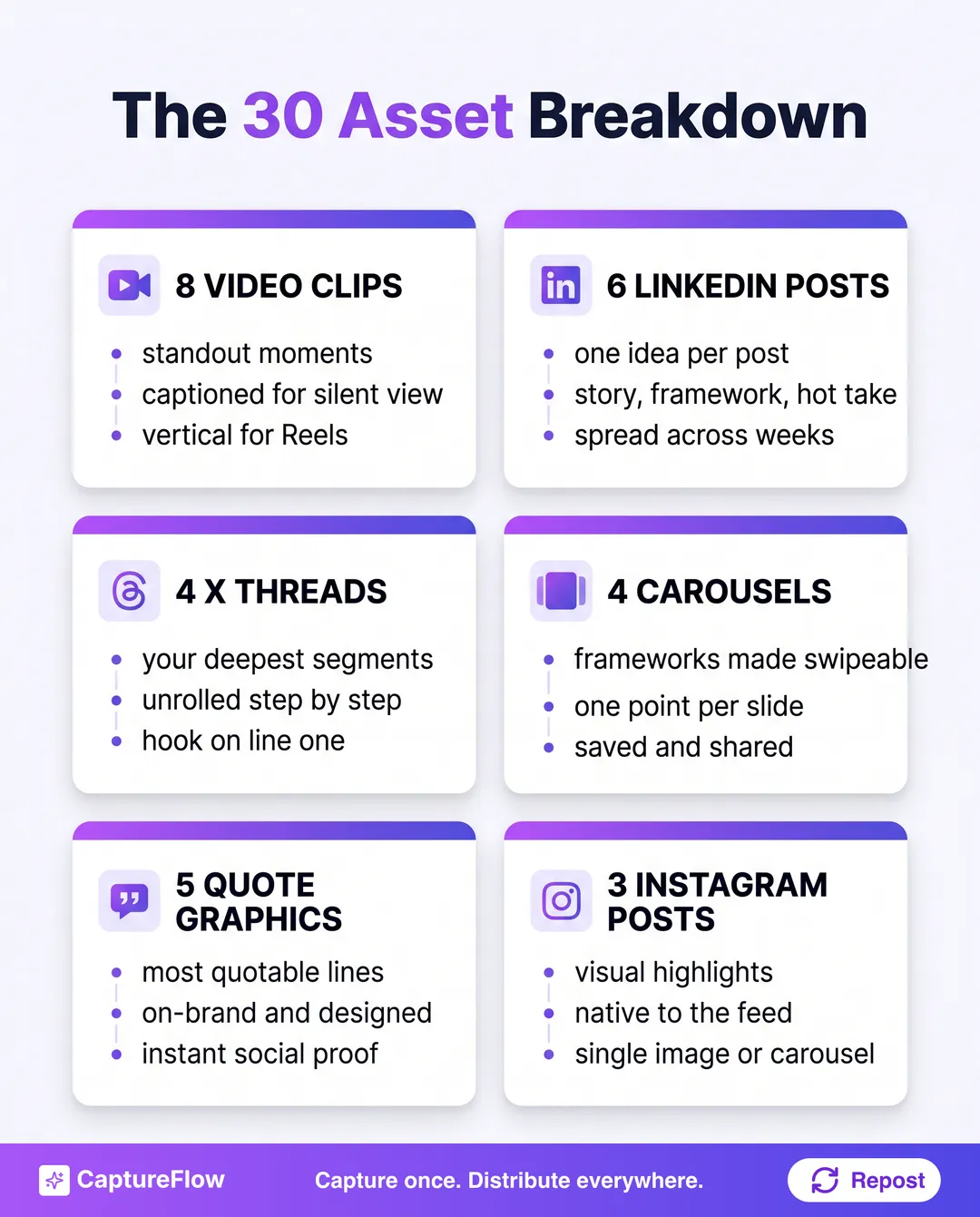 The 30-asset breakdown. Adjust the mix to the platforms you actually care about.
- 8 video clips, your standout moments, captioned and vertical.
- 6 LinkedIn posts, one idea each, spread across the weeks.
- 4 X threads, your deepest segments unrolled.
- 4 carousels, frameworks made swipeable.
- 5 quote graphics, your best lines designed on-brand.
- 3 Instagram posts, the visual highlights.
That is 30 native assets, and you have not even touched the show notes, your own newsletter, or the episode's own chapter markers yet, all channels you already own. Treat 30 as the floor, not the ceiling. Shift the mix toward wherever your audience actually lives: heavier on clips if short-form video is your channel, heavier on threads if X is where you grow.
The honest math: a full day by hand
Run this system manually and it works. It also eats a day.
Transcribe, read the whole thing, mark 5 to 8 moments, cut and caption eight clips, write and edit two dozen posts so each one sounds like you and not like a transcript, then schedule all 30 across a month. Realistically that is the better part of a working day per episode. Do it weekly and it is a real job, which is exactly why most podcasters publish the episode, post one clip, and abandon the other 29 assets.
That gap is the whole reason repurposing tools exist. If you want the landscape, we ranked the best AI content repurposing tools honestly, including where each one beats us. For audio specifically, a tool like Castmagic is genuinely strong at turning a podcast into raw text assets, and I would rather you use the right specialist than a worse generalist.
The 5-minute version with AI
Here is where a content agent earns its keep. The five stages do not change, the agent just does the slow ones.
You drop the episode file or a link, and CaptureFlow transcribes it, mines the transcript for your standout moments, and drafts the full set, clips, LinkedIn posts, threads, carousels, and quote graphics, each native to its platform and written in your voice because it is grounded in your past posts and phrasing. You review the batch, tweak what you want, and schedule the month. About 5 minutes instead of a full day.
The important part is that it is the same method, not a shortcut around it. The agent is not inventing opinions, it is extracting the ones you already recorded on the mic. That is the difference between repurposing one episode into one clip and turning one episode into a month of content.
Start with your last episode
You do not need to record more. You need to stop wasting the episodes you already published.
Pick your most recent episode, run the five stages, and watch one recording fill your calendar for a month. If you want the 5-minute version instead of the full-day one, see how the multimodal capture works or start a free trial and turn your next episode into 30 posts.
Frequently asked questions
How many posts can you really get from one podcast episode?+
Around 30 from a focused 45 to 60 minute episode: roughly 8 clips, 6 LinkedIn posts, 4 X threads, 4 carousels, 5 quote graphics, and 3 Instagram posts. A tight 20-minute episode gives you fewer, a two-guest deep dive gives you more. The limit is your extraction system, not the raw material.
How do you repurpose a podcast without it sounding repetitive?+
Give each asset a different standout moment and a different angle. You are not posting the same idea 30 times, you are surfacing the 5 to 8 distinct ideas that lived in the episode and shaping each one for the platform it fits best.
How long does it take to repurpose one podcast episode?+
By hand it is close to a full day: transcribe, read, mark the moments, cut clips, write and edit every post, then schedule. With a content agent trained on your voice it is about 5 minutes to a full draft set you review and approve.
What is the best format to repurpose podcast content into first?+
Start with clips of your 5 to 8 standout moments, because video travels furthest and each clip seeds a written post. From there the same moments become LinkedIn posts, threads, carousels, and quote graphics.
Chris is the founder and CEO of CaptureFlow, which he builds so founders can turn their expertise into content without hiring a team. After 10+ years building products and growing audiences from scratch, he writes about founder-led content, AI, and distribution from inside the problem he is solving: distributing consistent, on-brand content as a team of one.
Founder & CEO of CaptureFlow · 10+ years building products and audiences
One playbook a week from founders who actually create and distribute lots of content. No spam, unsubscribe anytime.
Keep reading

The Founder's Content Operating System (5 Minutes a Day)
You do not have a discipline problem. You have a missing system. Here is the content operating system that runs on 5 minutes a day, from one capture to every platform.

How to Batch a Month of Content in One Afternoon
Daily content is 30 cold starts a month. Batching is one warm afternoon. Here is the hour-by-hour workflow for producing a month of posts in a single session.
The Capture-First Content System: A Complete Workflow
Consistency does not come from discipline. It comes from a system where the hard part happens once a week. Here is the full capture-first workflow, step by step.