The Founder's Content Operating System (5 Minutes a Day)
A founder content system that runs on 5 minutes a day: capture one idea, let your AI agent draft it, review, distribute everywhere, and learn from what performed.


Every founder runs the company on systems. Sales has a pipeline. Finance has a monthly close. Hiring has a funnel with stages and a scorecard. Then there is content, which most founders run on vibes, guilt, and the occasional 11pm burst of motivation that lasts about nine days.
That is the whole problem, and it is not a character flaw. You do not have a discipline problem. You have a missing system. A founder content system is what turns "I really should post more" into something that runs quietly in the background, the way your phone runs its operating system without asking you to rebuild it from scratch every morning.
This article is that operating system, and its whole premise is time. It runs on 5 minutes a day. Not five minutes of writing, five minutes of talking, because the writing is not your job anymore.
This is the daily-habit version of the loop. If you would rather batch it into one deeper weekly session than a little every day, the capture-first content system runs the same idea as a weekly workflow. Same loop, different rhythm: pick the one that fits your flow. And if your angle is sharing the journey itself, what to post when building in public covers exactly what to capture.
What is a content operating system?
A content operating system is a repeatable loop that turns one small daily input into finished, on-brand content for every platform, so publishing runs on rails instead of willpower.
That is the definition worth remembering. An operating system does not ask you to make a hundred decisions to open an app. It handles the machinery so you handle the intent. A founder content workflow should work the same way: you supply the idea, the system handles everything between the idea and the calendar.
The reason most content plans fail is that they are not systems at all. They are daily acts of willpower dressed up as a calendar. Every morning starts at the hardest possible place, a blank page, and willpower is a resource that runs out. A system removes the blank page entirely.
The related idea we have written about before, the capture-first content system, is the philosophy underneath this: start from something you already said, not a blank page. The operating system here is how you run that philosophy on a daily loop instead of a weekly one.
The founder content system in five stages
The loop has five stages. You only touch two of them.
- Capture. Speak one idea into your phone in about 5 minutes: a voice note, a quick video, a link, or a file.
- Create. An AI agent trained on your voice drafts native content from that capture.
- Review. You approve the drafts or nudge them, in a couple of minutes.
- Distribute. The approved content schedules itself to every platform, formatted natively.
- Learn. What performed feeds back into the next capture, so the loop sharpens over time.
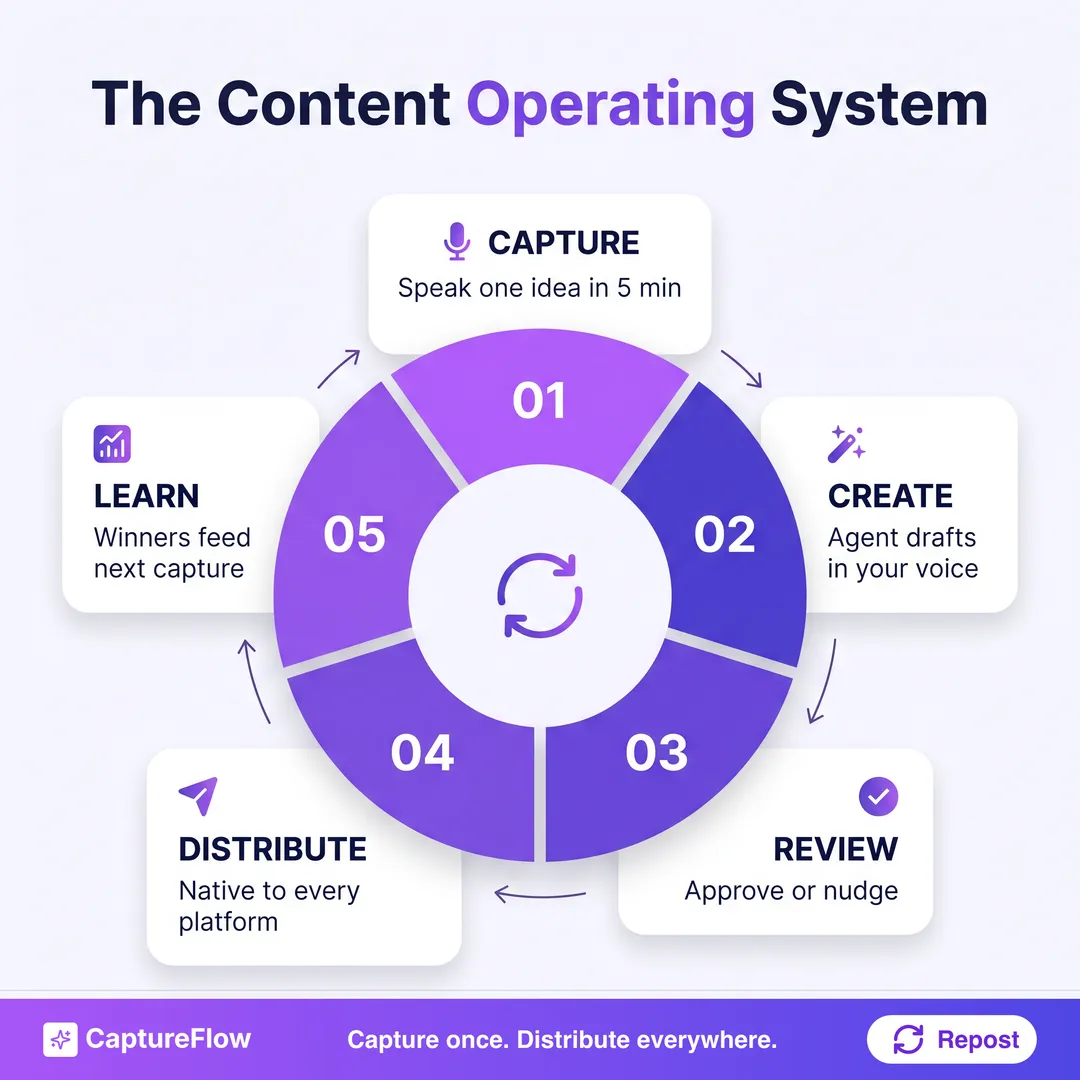 Five stages, one loop. You run stages one and three; the system runs the rest.
Notice which stages are yours: Capture and Review. Speaking an idea and approving a draft. Everything expensive in the middle, the drafting, the reformatting, the scheduling, the cross-posting, is machine work. That split is the entire point, and it is why the loop fits in 5 minutes a day.
You are not the writer anymore. You are the source and the editor. The blank page was never your job, it was just the only tool you had. If hiring a writer is off the table, that swap is the whole fix, spelled out in how to create content as a busy founder without hiring a writer.
Stage 1: Capture (5 minutes, any input)
The loop starts with one idea, captured in whatever form is fastest for you in the moment. A voice note on a walk. A 60-second video to your phone camera. A link to an article you have opinions about. A PDF of the deck you just presented. The input is multimodal on purpose: the point is to remove every reason to not start.
What makes a good capture is not production quality, it is substance. Talk about a decision you made this week and why. Answer a question a customer asked twice. Explain the thing you changed your mind about. If you are doing the work, you already have the material; you just have not said it out loud yet.
Five minutes is the ceiling, not the target. A focused two-minute voice note about one real idea beats ten rambling minutes across five. Density is what lets the next stage fan a single capture into a week of posts. For a deeper look at what raw material is rich enough to reuse, how to turn one video into 10 LinkedIn posts breaks down the angle types hiding in any single recording.
Keep a running voice-note habit instead of scheduling a "content session." The best captures happen right after the moment that prompted them: a call that went well, a problem you just solved, a hot take you almost tweeted. Capture it in 5 minutes while it is fresh, then let the system take it from there. This is what multimodal capture is built for.
Stage 2: Create (the agent drafts in your voice)
This is the stage that used to cost you a morning, and now costs you nothing but the wait. Once the idea is captured, an AI agent trained on your voice and your past posts drafts the content for you.
The distinction that matters: this is not a blank-prompt tool guessing what a founder might say. CaptureFlow is an AI content agent that turns your expertise into weeks of on-brand content for every platform. It drafts from your actual captured idea, grounded in how you actually write, which is the difference between content that sounds like you and content that sounds like everyone.
That grounding is the whole game. A generic model fills the gap between prompts with averages, so it produces competent, forgettable text. An agent that has learned your brand voice starts from your phrasing, so the draft already carries your fingerprints. If you want the mechanics of why this works, AI content that sounds like you covers how voice training changes the output, and the best AI tool for a founder to create LinkedIn content covers how to choose one.
The leverage here is real and measured. Most teams in HubSpot's 2026 State of Marketing report say AI saves them at least 10 hours a week. The catch in that data is that generic AI drafting produces generic results; the savings only compound when the AI is drafting from your own material instead of a cold prompt.
Do not try to prompt the agent into your voice with instructions. Feed it examples instead. A handful of posts you are proud of teaches it more about your voice than any prompt ever could. The content agent learns from what you have already published, so the more you feed it, the more it sounds like you.
Stage 3: Review (approve or edit)
The agent drafts; you decide. Review is the second and last stage that is yours, and it is deliberately fast: read the drafts, approve the ones that land, nudge the ones that are close, and cut the ones that miss.
The quality test is simple. Read the draft the way you would say it to a customer. If a sentence is not something you would actually say, change it or delete it. That one filter removes almost everything that makes AI-assisted content feel detectable. You are not rewriting, you are ratifying.
Over time this stage gets faster, because the agent learns from your edits. The posts you approve untouched teach it what to repeat; the ones you rewrite teach it what to avoid. Review is where your taste trains the system, which is why it is worth keeping human even as everything around it automates.
Batch your review into one daily pass rather than reacting to drafts as they arrive. Approving a set together keeps your voice consistent across the week and stops content from becoming another notification that interrupts your day. Two minutes, once a day, is the entire review budget.
Stage 4: Distribute (native content, every platform)
Approved content does you no good sitting in a draft folder. Stage four is where one capture becomes a week of content, spread across every platform in the format each one rewards.
The same idea is not the same post everywhere. Distribution means reshaping it natively: a text post with a strong hook on LinkedIn, a threaded version on X, a carousel if the idea has distinct beats, a short video if the capture had a good moment on camera, an infographic if the idea is a framework. Same substance, five native shapes.
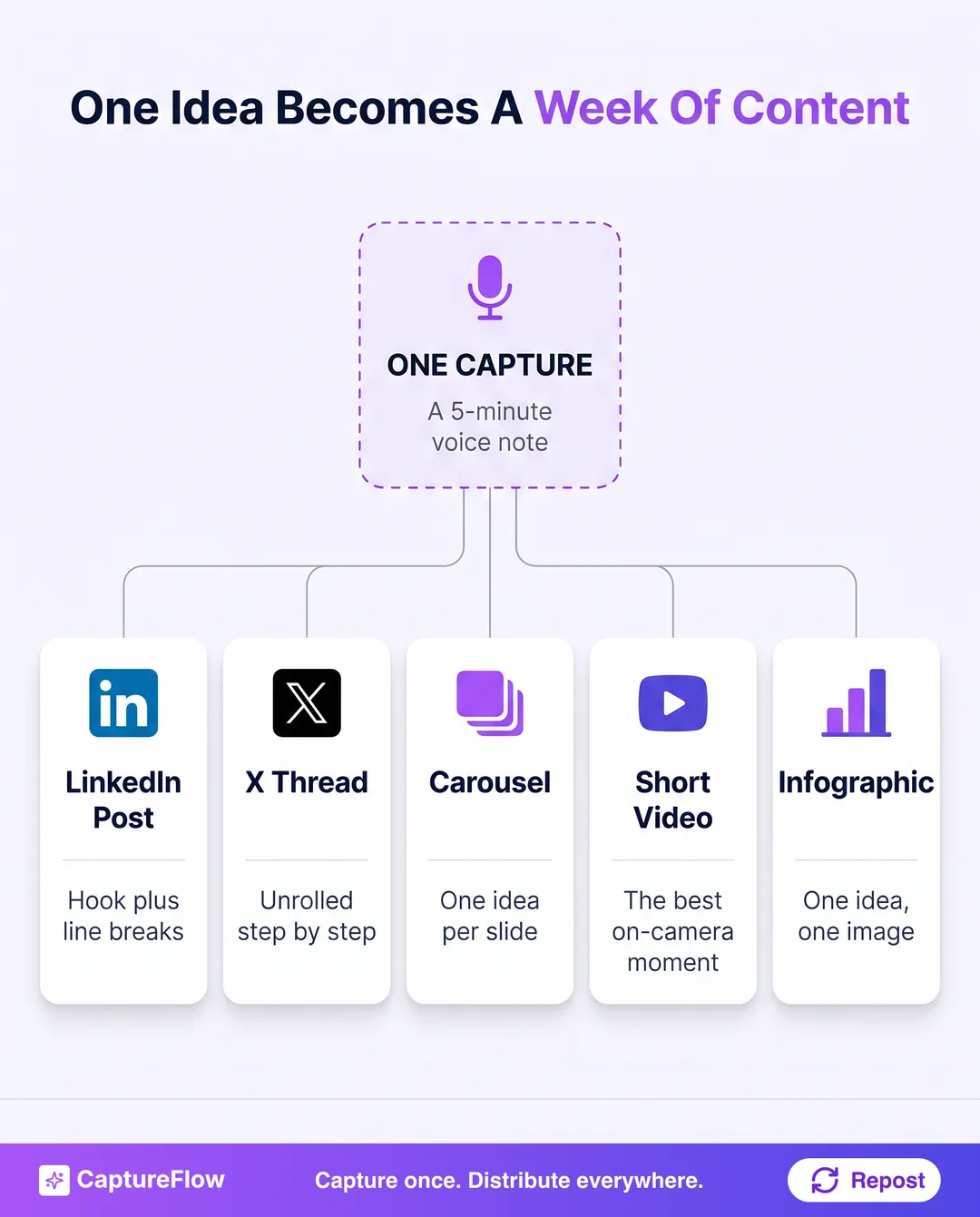 One capture at the top, a week of native content below it. Nothing gets used only once.
Timing is the other half of distribution, and it should be handled by data, not a guess. Start from proven windows, then let your own analytics take over. Our best time to post on LinkedIn guide has the consensus slots, how often to post on social media covers cadence per platform, and once you understand how the LinkedIn algorithm works, the scheduling stops being superstition. A content strategy layer keeps the week from accidentally being five versions of the same idea.
Distribution is also where the system quietly scales. Once the loop is a habit, the exact same mechanics let you batch a whole month of content in one sitting instead of one capture at a time.
Do not hand-tune every post for every platform yourself, that is the labor the system exists to remove. Let the agent produce the native versions, then spend your review time on the hook, because the hook is what decides whether anything after it gets read. Our LinkedIn hook writing guide and the free hook generator both help here.
Stage 5: Learn (what performed feeds the next capture)
Most content systems stop at "publish." This one has a fifth stage, and it is the one that makes the loop compound instead of plateau.
After posts go out, the results come back: what got saved, what sparked replies, what fell flat. That signal is not just a scoreboard, it is an input. The topics that performed become prompts for your next capture. The angles that landed tell you which of your ideas the audience actually wants more of. The loop closes, and the next turn is sharper than the last.
This is why a founder content workflow beats a burst of motivated posting over any real timeframe. A motivated burst gets less effective as you run out of your best ideas. A system that learns gets more effective, because it keeps pointing you back at what works. After a few weeks, you are not guessing what to capture; the last cycle told you.
Run a short learning pass once a week, not after every post. Look at the two or three pieces that outperformed, note the topic and the angle, and drop them into your capture queue. Five minutes of looking back sets up the next five days of looking forward.
Your 5-minutes-a-day routine
Here is the whole system on a daily clock. The point is how little of it is yours.
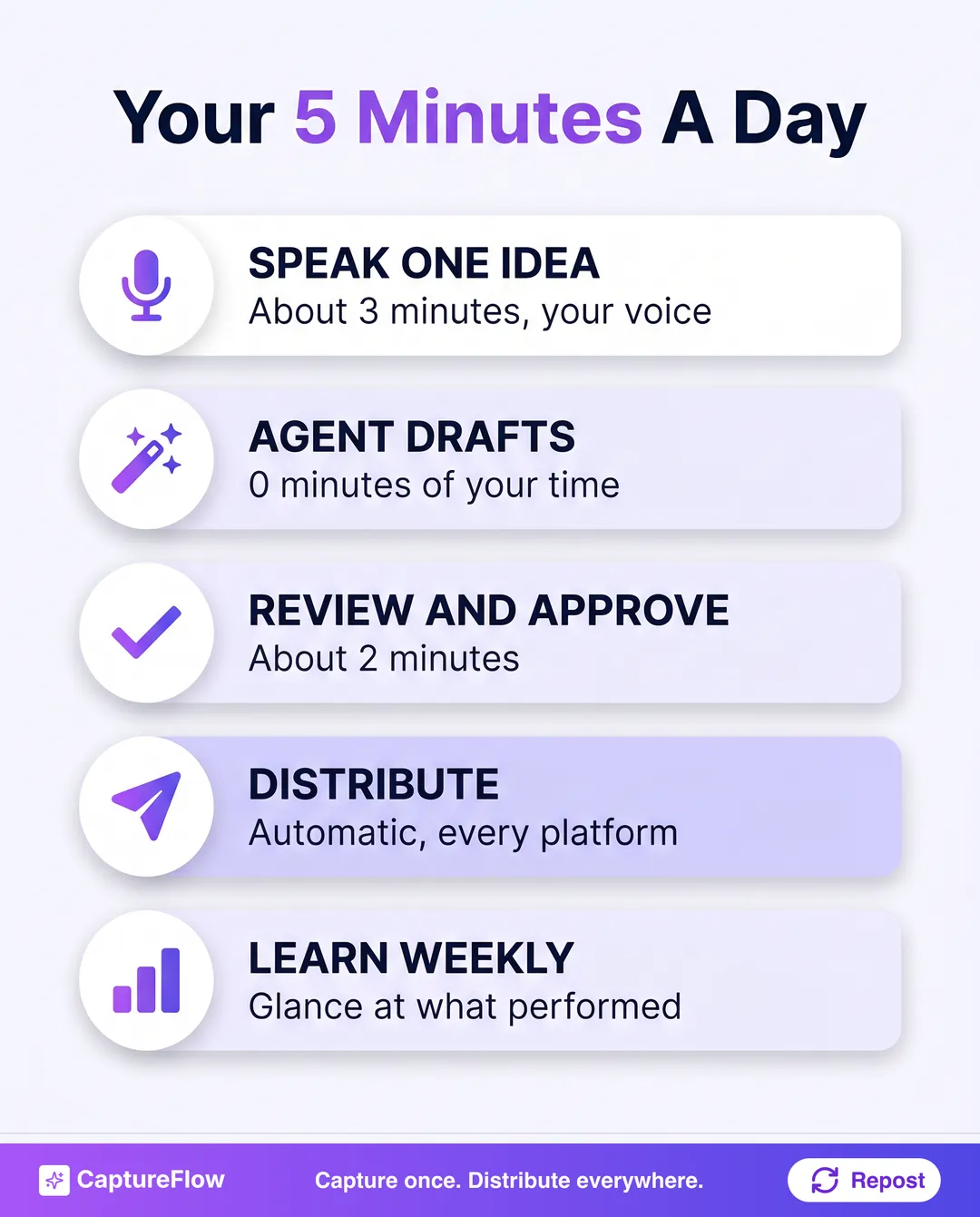 The two human steps total about 5 minutes. Everything else is the system running.
- Morning, 3 minutes: speak one idea into your phone. Whatever prompted you, capture it while it is fresh.
- Machine time, 0 minutes of yours: the agent drafts native versions across platforms.
- Later, 2 minutes: review the drafts, approve or nudge, done.
- Machine time again: the approved set schedules and distributes itself.
- Once a week: glance at what performed and feed it into next week's captures.
That is the operating system. Two small human touches a day, one weekly look back, and a loop that runs the expensive middle for you. The by-hand version of this works too and costs you a morning a week; the tooled version costs about 5 minutes a day.
If you want the loop with the labor removed, see how CaptureFlow works or what it costs. You already have the ideas. The only thing missing was the system to run them, and now you have it. Capture something today.
Frequently asked questions
What is a founder content system?+
It is a repeatable loop that turns one small daily input into finished content for every platform. Instead of deciding what to post each day, you capture one idea in 5 minutes, an AI agent drafts it in your voice, you review, and it ships everywhere. The system replaces willpower with a process.
How can content really take only 5 minutes a day?+
Because you only do the two human stages: speak one idea for about 5 minutes, and later approve the drafts. The drafting, formatting, scheduling, and cross-posting are handled by an AI content agent trained on your voice, so your time goes into the idea, not the production.
Do I need to post every day for this to work?+
No. The 5 minutes a day is the capture and review habit, not the publishing cadence. A single capture produces a week or more of posts across platforms, so you can distribute on whatever schedule fits your audience while only spending a few minutes at the top of the loop.
What makes this different from just using ChatGPT?+
A blank-prompt tool starts from nothing and fills the gap with averages, so it sounds generic. A content operating system starts from your own captured idea and an agent trained on your past posts, so the output sounds like you and runs as a scheduled loop, not one draft at a time.
Chris is the founder and CEO of CaptureFlow, which he builds so founders can turn their expertise into content without hiring a team. After 10+ years building products and growing audiences from scratch, he writes about founder-led content, AI, and distribution from inside the problem he is solving: distributing consistent, on-brand content as a team of one.
Founder & CEO of CaptureFlow · 10+ years building products and audiences
One playbook a week from founders who actually create and distribute lots of content. No spam, unsubscribe anytime.
Keep reading
The Capture-First Content System: A Complete Workflow
Consistency does not come from discipline. It comes from a system where the hard part happens once a week. Here is the full capture-first workflow, step by step.
How to Repurpose Podcast Clips, Voice Memos, and Automate Social Content: One System for Founders
Your podcast episode and the voice memo you recorded on the train are the same raw material. Here is one system that turns both into a week of native posts, then distributes them for you.
How to Repurpose One Podcast Episode into 30 Posts
You already recorded an hour of gold. Most of it dies after one listen. Here is the exact system to turn one podcast episode into 30 native posts for every platform.