How to Train AI on Your Brand Voice (Step by Step)
Train AI on your brand voice in 6 steps: collect a voice corpus, extract your markers, write a voice guide, load it, blind-test it, and keep it fresh.

Ask AI to write in your voice and you usually get back a LinkedIn influencer with amnesia: confident, polished, and sounding like nobody in particular. The reason is boring: the model has never heard you. It cannot imitate a voice it has no record of.
So here is how to train AI on your brand voice, properly, in six steps. Training AI on your brand voice means giving it a persistent, structured record of how you actually talk, your phrases, opinions, and rhythms, so it drafts from your patterns instead of the internet's average. No fine-tuning, no code, roughly an afternoon to set up and 20 minutes a month to maintain.
Why bother? Because voice is the whole game in AI content creation now. When everyone drafts with the same models, output converges: research in Science Advances found AI-assisted writers produce measurably more similar work than unassisted ones. That convergence compounds once a whole team is drafting, which is its own discipline: scaling content with AI without losing your brand voice. The founders who stay distinctive are the ones who feed the model something distinctive. That is trainable, and this is the training manual.
The system at a glance
- Collect a voice corpus: 20 to 50 samples of you at your most you.
- Extract your voice markers: phrases, rhythm, stances, banned words.
- Write the voice guide: structured, example-driven, one page.
- Load it into your tool: chat instructions or a persistent knowledge base.
- Test with blind drafts and the read-aloud check.
- Refresh monthly, because your voice drifts.
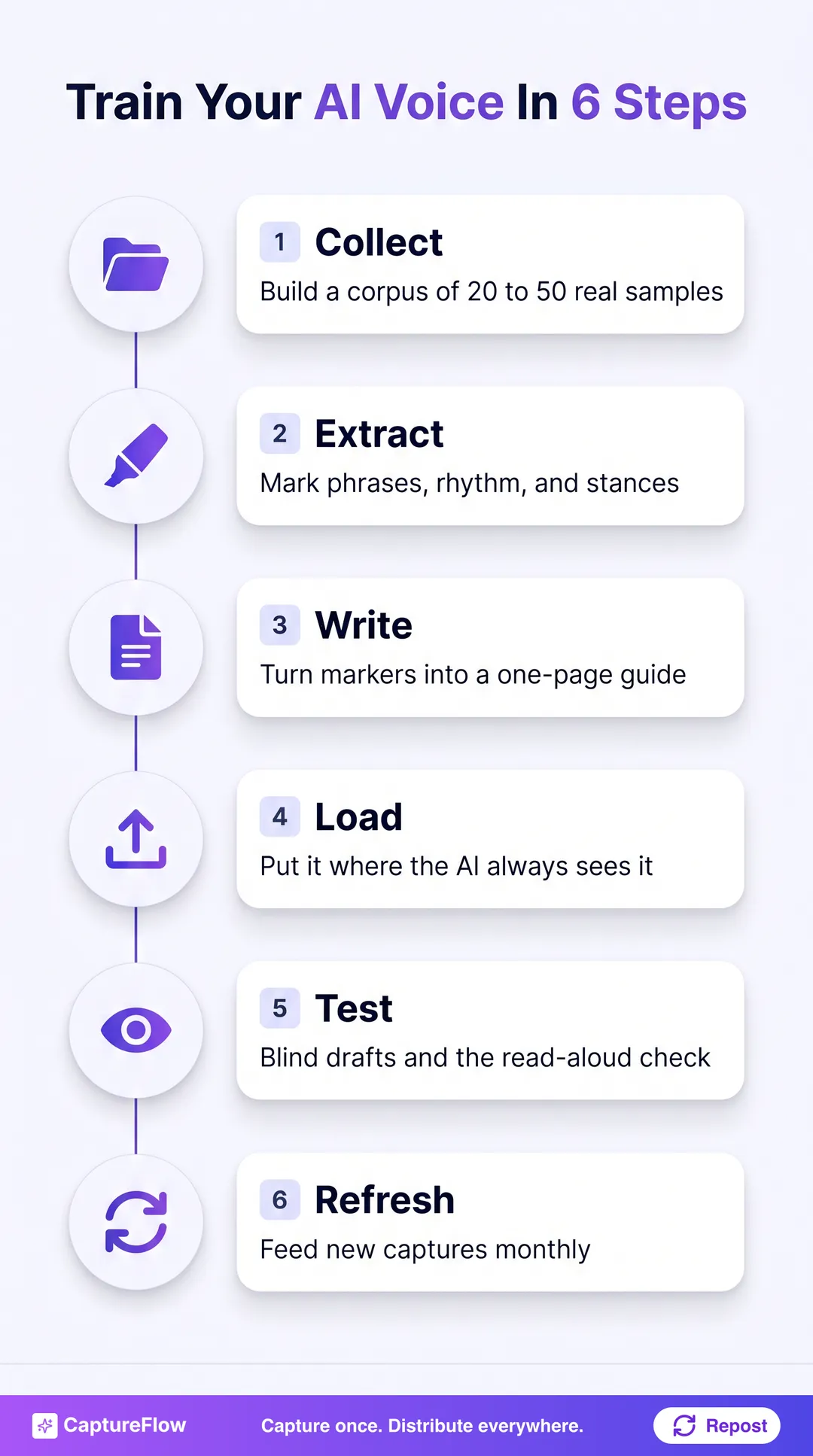 Six steps, one afternoon. The compounding happens in step 6.
Step 1: Collect your voice corpus
Gather 20 to 50 samples of you communicating when you were not performing. The goal is your natural register, not your press-release register.
Three sources, in order of value:
- Your speech. Transcripts of you talking: podcast appearances, sales calls, conference talks, voice notes, the 15-minute captures if you already run a capture loop. Speech is the richest source because it carries your rhythm before you self-edit it away.
- Your writing at its best. The 10 to 15 posts or emails that felt effortless and performed. Not your most formal work, your most you work.
- Your opinions. Stances you keep repeating, hills you die on, common advice you think is wrong. Voice is not just style; it is a worldview with recurring vocabulary.
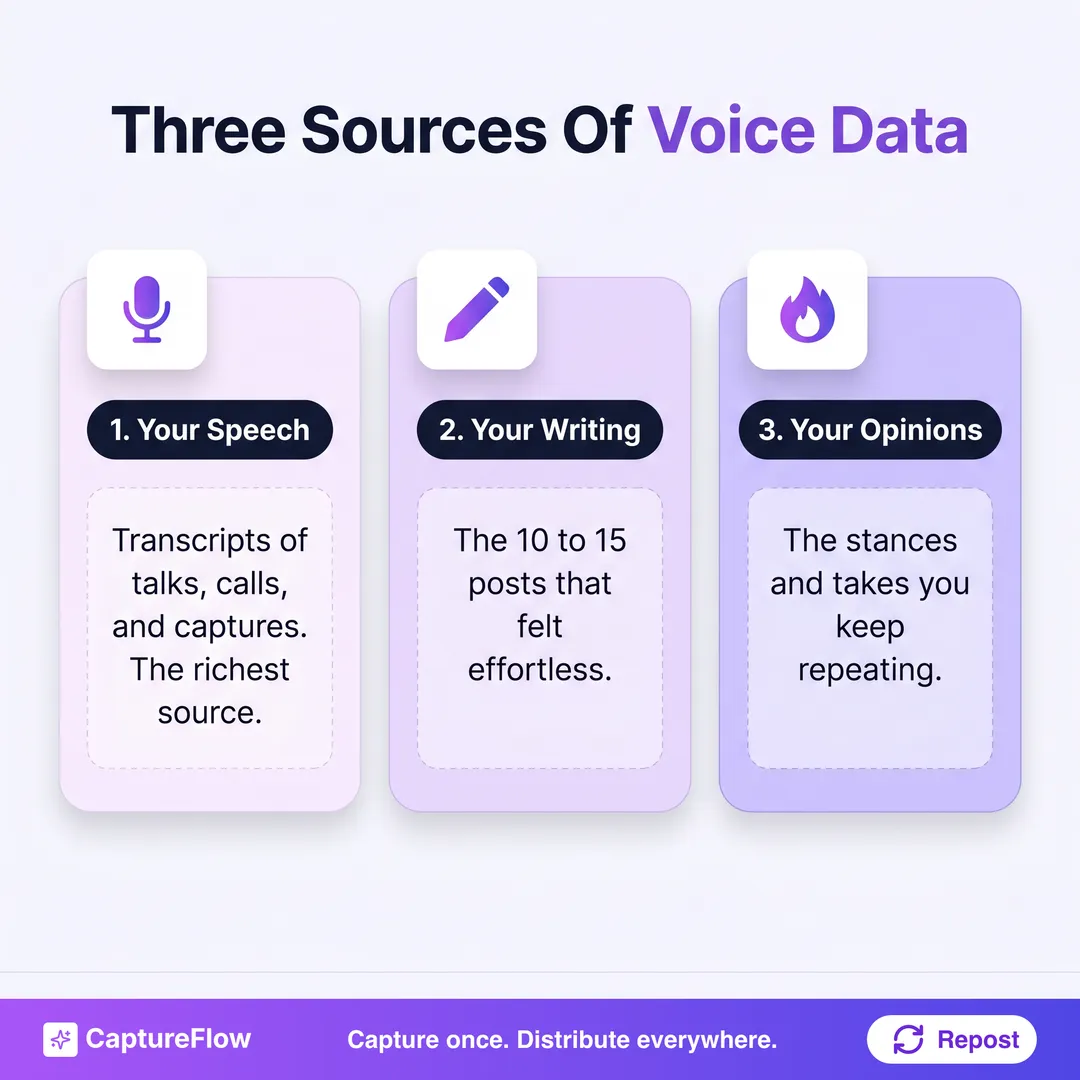 Speech first. You sound most like yourself when you talk.
Quality filter: for every sample ask, "would a friend recognize this as me with my name removed?" If not, it does not go in the corpus. Twenty unmistakable samples beat two hundred bland ones.
Step 2: Extract your voice markers
Now read the corpus like a linguist and pull out the concrete, imitable patterns:
- Signature phrases. The expressions you reach for constantly. Write down the exact wording.
- Sentence rhythm. Short and punchy? Long with asides? Do you open with questions? One-line paragraphs or dense ones?
- Stances. The 5 to 10 positions that show up everywhere in your thinking. A model that knows your opinions stops inventing beige ones for you.
- Vocabulary boundaries. Words you love, and words you would never say. Both lists matter; the banned list usually matters more.
- Structural habits. How you open (story? blunt claim?), how you close (question? challenge?), how you use numbers and examples.
This is the step people skip, and it is why their AI still sounds generic. Models imitate patterns, not intentions. "Confident but approachable" is an intention. "Never opens with a question, loves the phrase 'here is the uncomfortable part', caps sentences at 15 words" is a pattern.
A worked example, so this is not abstract. Suppose your corpus shows you:
- open posts with a blunt claim ("Most onboarding emails are apologies"),
- use numbers as punchlines, not decoration ("We cut it to 4. Retention went up."),
- say "the boring answer is" before your actual advice,
- never use exclamation marks, and never say "excited to share".
That is four extracted markers, and they are already more useful than any adjective. A model given these produces drafts that open bluntly, land numbers hard, and reach for your signature setup phrase. A model told you are "direct and data-driven" produces a LinkedIn-shaped shrug.
Step 3: Write the voice guide
Turn the markers into a one-page structured guide. The format that works:
| Section | What goes in it |
|---|---|
| Identity | Two sentences: who you are, who you write for |
| Stances | 5 to 10 opinions, stated bluntly |
| Signature phrases | 10 to 15 exact expressions, quoted |
| Rhythm rules | Sentence length, paragraph shape, openers and closers |
| Banned list | Words, phrases, and moves you never make |
| Example pairs | 8 to 12 lines of "we say X, never Y" |
The example pairs are the highest-leverage section. One line like "We say: this broke, here is what we changed. We never say: we apologize for any inconvenience" teaches the model more than a paragraph of tone description.
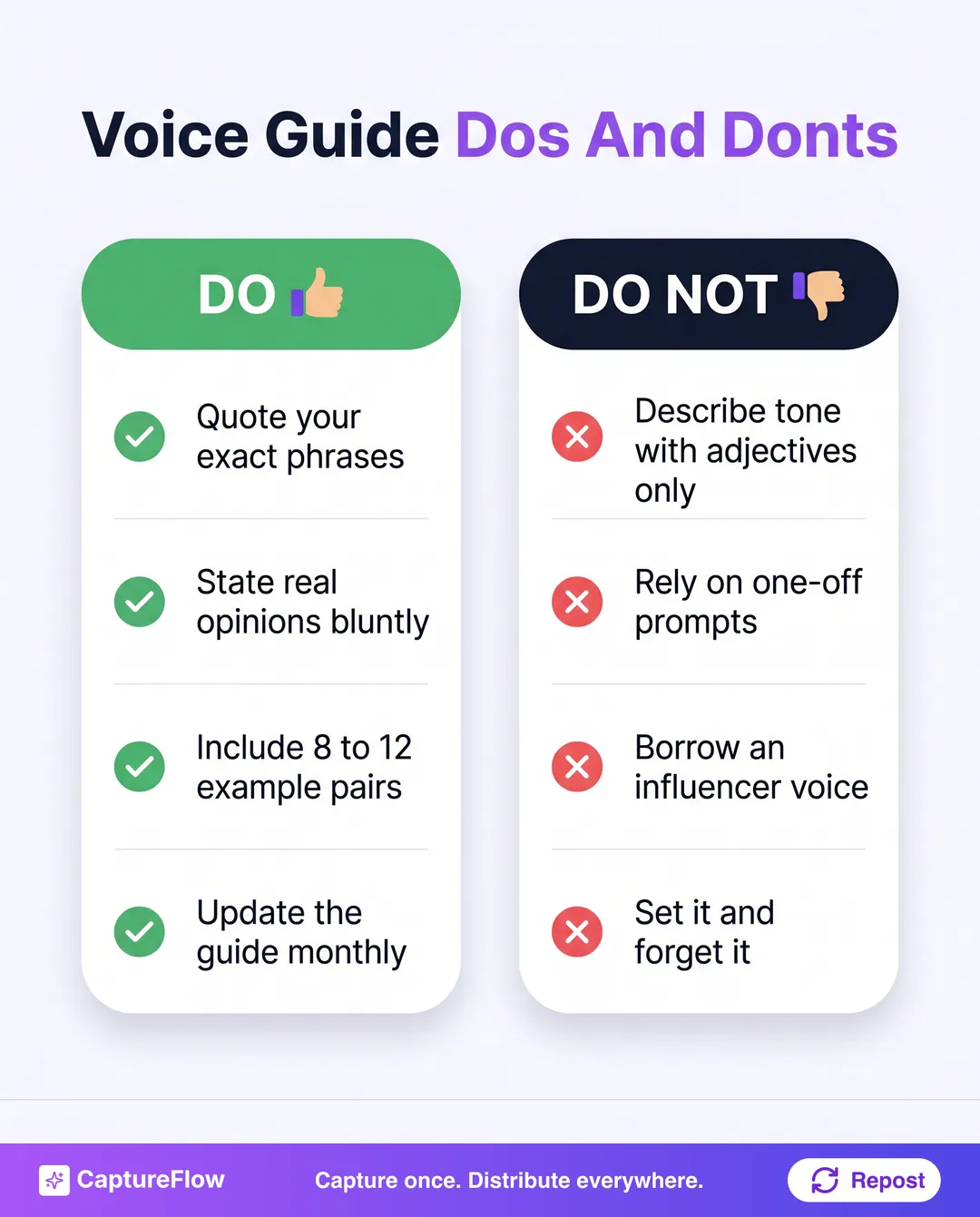 Show, don't describe. Adjectives train nothing.
Step 4: Load it where the AI can always see it
Two honest paths here.
The chat-tool path. Paste the guide into ChatGPT custom instructions or a dedicated project. This genuinely improves output, and if you are testing the waters, start here. The limits are the ones we covered in ChatGPT vs a content engine: capped context, manual upkeep, and nothing compounds. You are the database, and the database gets tired.
The engine path. A tool with a persistent voice and knowledge base stores the guide, your corpus, and everything you approve going forward, and applies it to every draft automatically. CaptureFlow is an AI content agent that turns your expertise into weeks of on-brand content for every platform, and the voice layer is exactly this: your transcripts and edits keep teaching it, so the training from this article happens continuously instead of once.
The guide you wrote in step 3 works in both. Write it once, and it travels with you even if you switch tools.
Step 5: Test it blind
Do not trust your first impression; test like you mean it.
- The blind test. Generate three drafts on a topic you have posted about before. Mix in the post you actually wrote. Ask a colleague to spot the real one. If they can't, the voice layer is working.
- The read-aloud test. Read each draft out loud. Every sentence you would not say to a customer gets marked. More than two marks per draft means the guide is missing a rhythm rule or a banned phrase; add it and regenerate.
- The cringe archive. Keep every AI phrase that made you wince ("game-changer", "in today's landscape") and append them to the banned list. This list is the fastest-improving part of the whole system.
Expect the first round to be 80% right. The gap between 80% and unmistakable is almost always in the banned list and the example pairs, not the identity section. Fix by adding examples, not adjectives.
Step 6: Refresh monthly, because voice drifts
Your voice this quarter is not your voice last year. New metaphors enter, opinions sharpen, old catchphrases retire. A voice layer trained once and never updated slowly becomes an impression of who you used to be.
The maintenance loop is 20 minutes a month:
- Add your 3 to 5 best new pieces (or fresh capture transcripts) to the corpus.
- Move anything that felt off into the banned list or rewrite the relevant rule.
- Re-run the blind test once.
If you run the weekly capture loop, this happens almost for free: every capture is new voice data, and the corpus feeds itself.
AI does not have a voice problem. It has an input problem. Feed it the internet and it sounds like the internet. Feed it you, structured and current, and it sounds like you on your best day.
What changes when the voice layer works
Three shifts, usually within the first two weeks:
- Editing time collapses. You stop rewriting drafts and start approving them. The realistic target is drafts where you change a phrase or two, not the spine. If you are still restructuring every draft, the guide is missing rhythm rules.
- Your opinions show up unprompted. Because the stances live in the guide, drafts arrive already taking your positions instead of hedging into "it depends". This is the single biggest perceived-quality jump.
- Consistency stops costing willpower. When every draft starts 90% right, publishing 3 to 5 times a week stops being a writing job and becomes a review job. That is the practical unlock that makes a weekly content system sustainable for a founder with an actual company to run.
One warning while calibrating: do not over-fit to your worst habits. If your corpus shows you ramble, the guide should not enshrine rambling. The goal is you on your best day, so curate the corpus toward the samples you are proud of, not just the ones that exist.
The one-afternoon version
If you want the compressed to-do list: pull 20 samples (favor transcripts), highlight phrases and stances for an hour, fill the six-section guide, paste it into your tool of choice, and run one blind test this week. Block the afternoon, put your phone in a drawer, and do the extraction pass in one sitting; voice markers are much easier to spot when you read fifteen samples back to back than when you spread them across a week. That alone puts you ahead of nearly everyone fighting generic AI output with better adjectives.
And if you would rather the training, storage, and compounding happen automatically from things you already say, that is the product we build. See how the voice layer works or what it costs. Either way: the model is not the moat. Your voice is. Train it like one.
Frequently asked questions
How do you train AI on your brand voice?+
Collect 20 to 50 samples of your real communication (transcripts of you speaking are the richest), extract concrete voice markers (signature phrases, sentence rhythm, stances, banned words), write them into a structured voice guide with example pairs, load that guide into your AI tool, then blind-test and refine monthly.
How many writing samples does AI need to learn my voice?+
Quality beats volume. Twenty strong samples that actually sound like you outperform two hundred bland ones. Prioritize spoken transcripts and your best-performing posts, and skip anything you wrote on autopilot.
Can ChatGPT learn my brand voice?+
Partially. Custom instructions and projects let you paste a voice guide, and it helps. The limits are structural: the context is capped, you maintain it by hand, and it does not compound as you create. A tool with a persistent voice and knowledge base owns that layer for you.
Why does AI content still sound generic after I gave it my style guide?+
Usually because the guide describes your voice in adjectives instead of showing it in examples. Models imitate patterns, not intentions. Swap 'we are bold and conversational' for 10 example pairs of 'we say this, never that' and the output changes immediately.
Chris is the founder and CEO of CaptureFlow, which he builds so founders can turn their expertise into content without hiring a team. After 10+ years building products and growing audiences from scratch, he writes about founder-led content, AI, and distribution from inside the problem he is solving: distributing consistent, on-brand content as a team of one.
Founder & CEO of CaptureFlow · 10+ years building products and audiences
One playbook a week from founders who actually create and distribute lots of content. No spam, unsubscribe anytime.
Keep reading

How to Scale Content With AI Without Losing Your Brand Voice
The fastest way to make your brand sound like everyone else is to scale content with generic AI. Here is how a team scales output and keeps one voice.

AI Content Creation: The Complete Guide for Founders
Anyone can generate content with AI now. That is exactly the problem. Here is how founders create content with AI that still sounds like them.
Make AI Content That Sounds Like You
The difference between AI slop and content that sounds like you comes down to three inputs: your voice, your knowledge, and your point of view.