Make AI Content That Sounds Like You
Generic AI sounds like generic AI. Here is how to train and prompt AI on your voice, knowledge, and point of view so the output is unmistakably yours.

The complaint about AI content is always the same. It sounds like AI. And most of the time that is fair, because most people hand the model a blank prompt and a topic and hope for the best.
Here is the reframe. AI slop is not a model problem. It is an inputs problem. Give a model nothing about you and it returns the average of the internet. Give it your voice, your knowledge, and your point of view, and the output becomes unmistakably yours. Getting that input right is what separates real AI content creation from generic filler.
Why generic AI sounds like slop
A model with no context defaults to the average of the internet. That average is competent, safe, and completely forgettable. It is the writing equivalent of stock photography.
You already know the sound of it. The post that opens with "In today's fast-paced world." The one that hedges every claim, names no one, cites no real number, and ends with a tidy moral nobody asked for. It is grammatically perfect and says nothing. That is not the model failing. That is the model doing exactly what a blank prompt asks: producing the safest possible version of a generic topic.
This is what happens with a blank prompt in ChatGPT: genuinely capable writing, but zero memory of how you actually sound. The model is not the bottleneck. The missing context is. We unpack the full argument in ChatGPT vs a content engine, and voice is the exact axis we rank tools on in the 9 best AI content tools for founders.
The tells of slop are consistent, and once you see them you cannot unsee them:
- It opens with a throat-clear instead of a point.
- It hedges. Everything is "can be" and "may help" and "in many cases."
- It has no specific numbers, names, or dates, because it knows none of yours.
- It reaches for a neat conclusion that restates the intro.
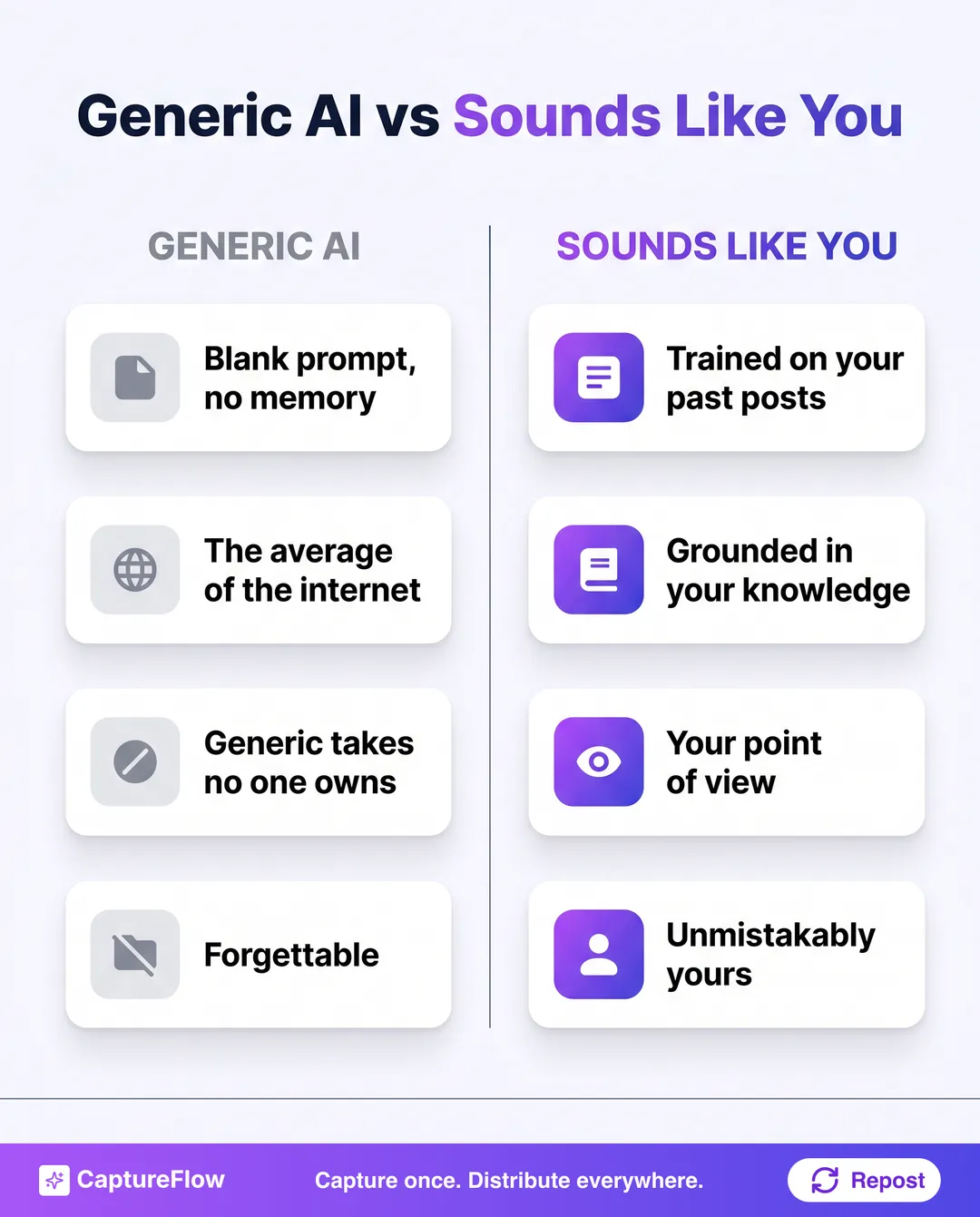
The reframeA model with no context returns the average of the internet. To get your voice, you have to feed it your signal.
The fix is not a cleverer prompt. A longer instruction on a context-free model just produces a more elaborate average. The fix is more signal about you.
The three inputs that make AI sound like you
Three inputs turn a generic model into one that writes like you. Miss any of them and the output drifts back toward slop.
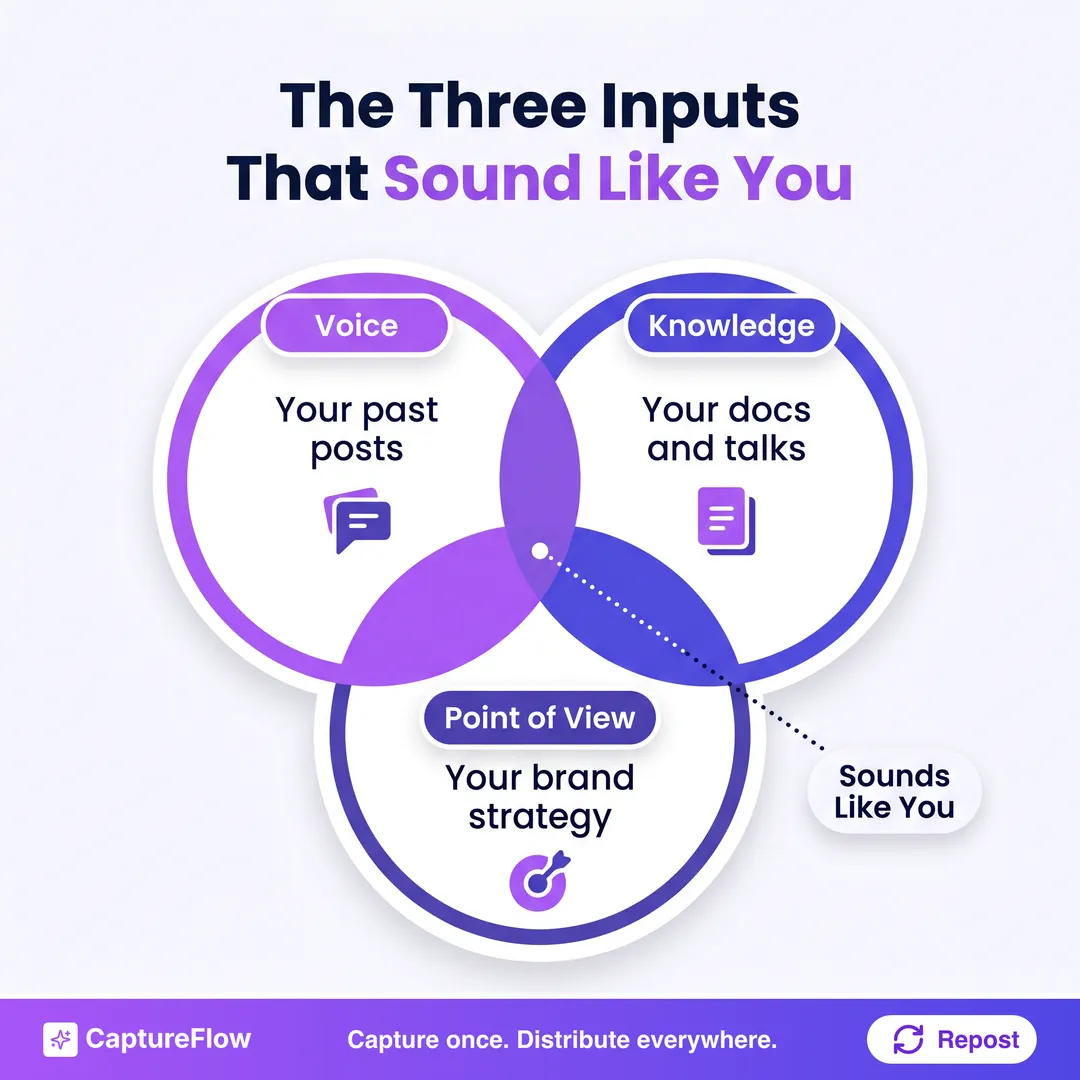
- Voice. Your past posts, so the phrasing, rhythm, and word choice match how you actually write.
- Knowledge. Your docs, talks, and transcripts, so the substance is real instead of invented.
- Point of view. Your brand strategy, so the takes are ones only you would make.
The fastest way to give a model your voice is to stop typing and start talking. A 5-minute voice note carries more of your real phrasing than an hour of prompt engineering.
Step 1: Feed it your voice
Start with 10 to 20 of your best past posts. Not all of them, your best ones, the posts that sound like you at your sharpest. That is enough for the model to learn your patterns: how long your sentences run, how you open, whether you use fragments, the words you reach for, and the ones you never use.
A content agent trained on your voice and knowledge base then matches your rhythm instead of defaulting to the same LinkedIn cadence everyone else posts. If you write in short, blunt lines, it stops padding. If you tell stories, it opens with a scene instead of a definition. This is the input most people skip, and it is the one that does the most work.
Refresh it as you go. Your voice a year from now will not be your voice today, so add new posts as they land and let the model track how you actually sound now, not how you sounded when you set it up once.
Step 2: Ground it in your knowledge
Voice without substance is style with nothing to say. The second input is what you actually know.
Feed the model your call transcripts, your talks, your onboarding docs, even the long answer you typed in a customer thread last week. The best way to get them in is multimodal capture: record a 5-minute voice note, drop a link, or upload a call, and the raw material becomes something you already said out loud. That is the capture-first premise, and it is why the substance comes out real instead of hallucinated.
The payoff is specificity. Grounded in your knowledge, the model reaches for the actual number from your case study and the actual objection you hear on sales calls, instead of a plausible-sounding average. Specific is what makes writing believable, and it is the first thing a blank prompt loses.
Step 3: Give it your point of view
The last input is the one no tool can fake: your actual opinion. Your content strategy encodes your positioning, your contrarian takes, and the hills you will die on, so the output argues the way you argue instead of both-sidesing everything into mush.
Point of view is also what you refuse to say. A strong voice has edges: claims it will make plainly and claims it will not touch. Encode those and the model stops hedging, because it knows where you actually stand.
This is where generic AI writers stop. Tools like Jasper produce fluent marketing copy, but they carry no persistent memory of your voice or your point of view from one piece to the next, so everything reverts to the mean. Concede the strength, then see the gap: fluent is not the same as yours.
The mistakes that keep AI sounding generic
Most people who say "AI content does not work for me" are making one of these:
- Prompting instead of training. A longer instruction on a blank model is still a blank model. Give it inputs, not adjectives. The full setup is in how to train AI on your brand voice.
- Feeding everything. Dumping every post you have ever written dilutes your best voice with your worst. Curate the sample.
- Over-editing into blandness. The specific detail that felt too niche is usually the thing that made it sound like you. Sanding it off to be "professional" is how you rebuild the slop by hand.
- Letting it invent numbers. If a stat did not come from your knowledge, cut it. One made-up figure costs you more trust than ten good posts earn.
- Setting it up once. Voice drifts. A model trained on last year's posts slowly stops sounding like this year's you.
Here is the test that catches all of them. Read the draft out loud. If it sounds like a press release, your inputs are thin. If a colleague could guess it was you with the byline removed, it is working.
The bar is not "could a human have written this." It is "would I actually say this, in these words." If the answer is no, do not ship it, fix the inputs.
Scale your voice, do not replace it
Used well, AI is not a ghostwriter inventing opinions for you. It is an editor who has read everything you have ever published.
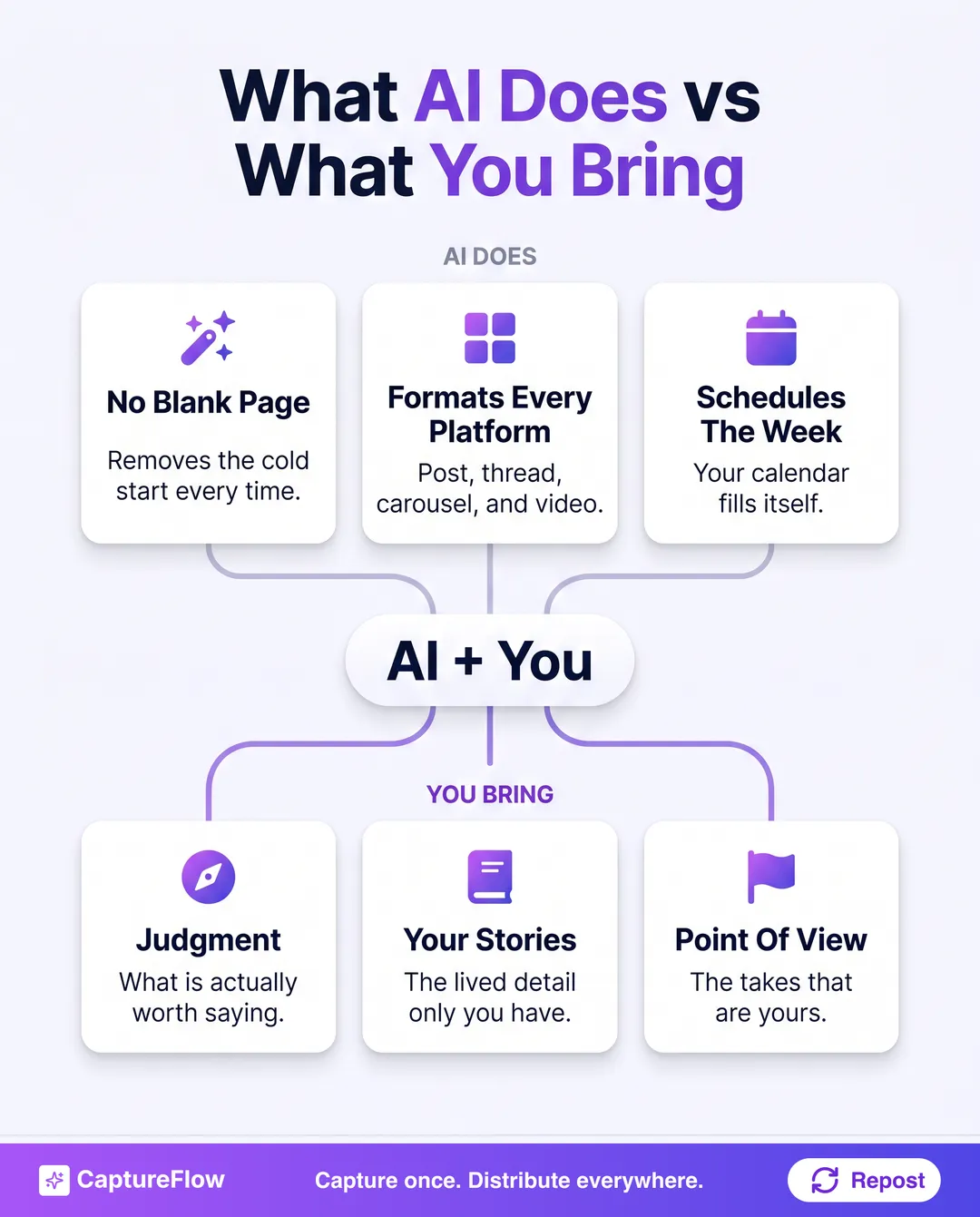
AI removes the blank-page tax, formats every platform into its native content format, and schedules the week. What stays human is the part that matters: your judgment, your stories, and your point of view. Because the raw material is your own words, the output still sounds like you no matter how many places it goes. That is the whole point of capture once, distribute everywhere.
Start with your own voice
You do not fix AI slop with a better prompt. You fix it with better inputs: your voice, your knowledge, and your point of view.
That is the model behind CaptureFlow, an AI content agent that turns your expertise into weeks of on-brand content for every platform. See how the voice engine works, or start a free trial and train it on your own posts so the first draft already sounds like you.
Frequently asked questions
Will readers be able to tell it is AI-assisted?+
Not if it is grounded in your real expertise and trained on your voice. The goal is to scale how you already sound, not to fabricate a new persona.
What inputs matter most?+
Your past posts (voice), your knowledge base (substance), and your brand strategy (point of view). With those three, the output stops sounding generic.
Is better prompting enough?+
No. A clever prompt on a blank model still averages the internet. The fix is more signal about you, fed in as training inputs, not a longer instruction.
How many past posts do I need to train a voice?+
About 10 to 20 of your best ones. You are not after volume, you are after a clear sample of how you sound at your best. Add more over time as your voice evolves.
Chris is the founder and CEO of CaptureFlow, which he builds so founders can turn their expertise into content without hiring a team. After 10+ years building products and growing audiences from scratch, he writes about founder-led content, AI, and distribution from inside the problem he is solving: distributing consistent, on-brand content as a team of one.
Founder & CEO of CaptureFlow · 10+ years building products and audiences
One playbook a week from founders who actually create and distribute lots of content. No spam, unsubscribe anytime.
Keep reading

AI Content Creation: The Complete Guide for Founders
Anyone can generate content with AI now. That is exactly the problem. Here is how founders create content with AI that still sounds like them.

How to Use AI Content Tools (Without Sounding Like a Bot)
Most people disappointed with AI content tools started with the tool instead of the problem. Here is the workflow that actually works: find the gap, match the tool, train it on your voice, and ship.

How to Scale Content With AI Without Losing Your Brand Voice
The fastest way to make your brand sound like everyone else is to scale content with generic AI. Here is how a team scales output and keeps one voice.