Content Atomization: Turn One Idea Into Many Posts
What content atomization is, how it differs from repurposing and reposting, and the tools and workflow that turn one idea into a week of native content in 2026.


Here is how most people create content: they think of an idea, they write one post about it, they publish it, and then they go looking for the next idea. Blank page, fill it, blank page again. It is exhausting, and it treats every idea as worth exactly one post.
The best creators and teams do something different. They treat one idea as raw material for a dozen pieces. Same idea, many outputs, each shaped for where it lands.
That practice has a name, and it is quietly becoming the whole game. Content atomization is breaking one idea into many native pieces of content, a post, a thread, a carousel, a clip, each built for its own platform, from a single capture. This is what it means, why it works, and the tools and workflow that make it possible in 2026.
What content atomization actually means
The word comes from the idea of splitting something whole into its smallest useful parts. Applied to content, it means taking one substantial idea, a talk, a strong opinion, a customer story, a recorded call, and pulling out every distinct piece worth publishing.
One 20-minute podcast is not one show-notes post. It is a strong quote for a graphic, three separate opinions worth their own posts, a how-to worth a carousel, and two or three clips worth a short video each. Atomization is the discipline of seeing the many inside the one.
It is easy to confuse with two things it is not.
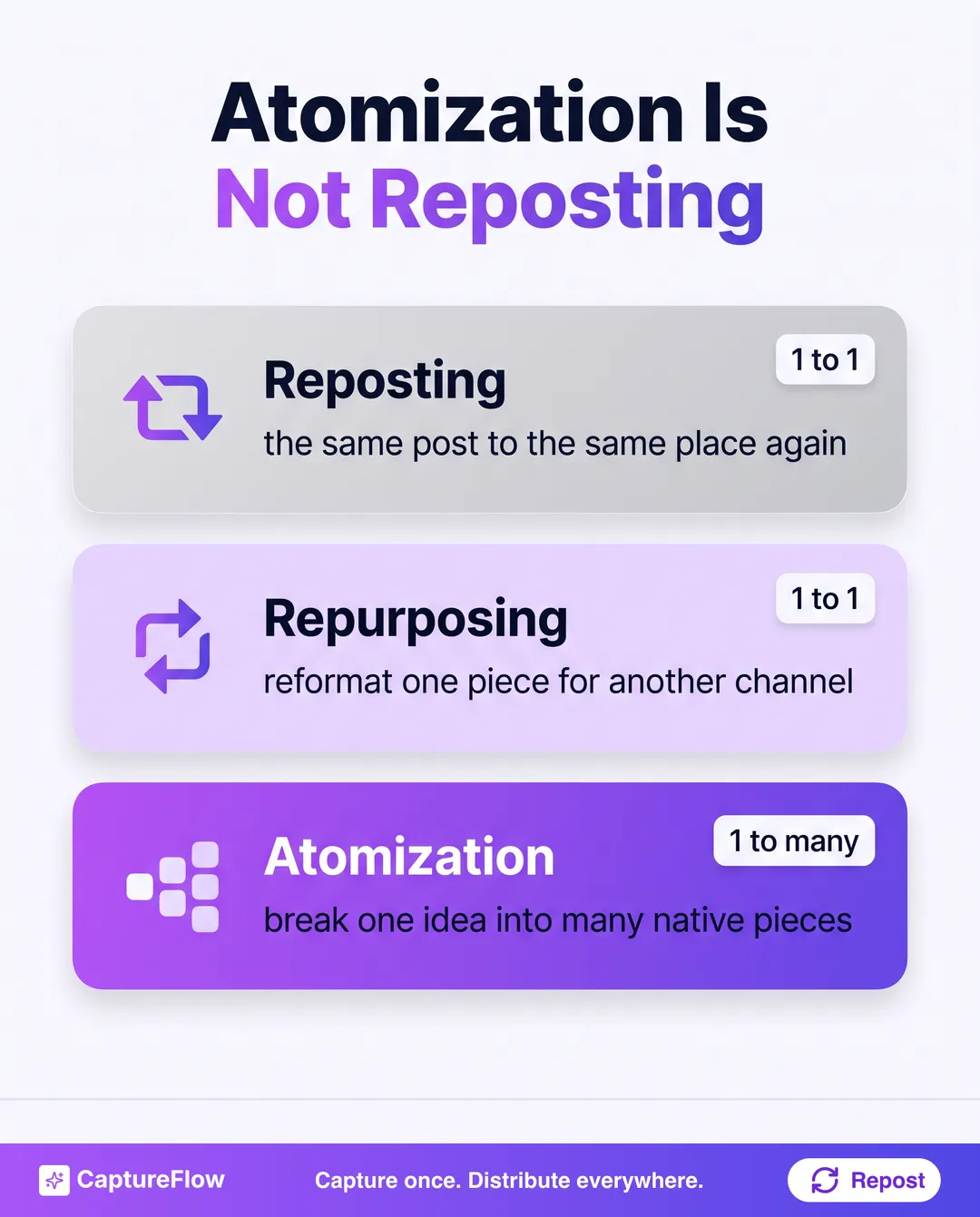 Reposting recycles. Repurposing reformats. Atomization multiplies.
Reposting is publishing the same thing again, to the same place or another. Repurposing is reformatting one finished piece for a new channel, a one-to-one move, like turning a video into a written recap. Useful, but still one in, one out. Our content repurposing strategy guide covers that discipline in full.
Atomization is one-to-many. You do not reformat a finished asset; you mine a single idea for all the distinct pieces hiding inside it, then build each one native to its platform. That is the difference between getting one more post and getting a week of them.
Why atomization is the highest-leverage move in content
Think about where your content actually bottlenecks. It is almost never the physical act of typing. It is two things: having enough good ideas, and having the time to turn each one into finished pieces across platforms.
Atomization attacks both. It multiplies the return on every good idea you already have, so you need fewer of them, and it collapses "make a week of content" into "capture one thing and shape it." The scarce resource was never words. It was ideas and time, and atomization stretches both. A creator who atomizes is not more prolific than everyone else, they are just getting far more out of each idea than the person posting once and starting over.
This is also why it is suddenly everywhere. AI made the reshaping step cheap. In HubSpot's 2026 State of Marketing report, 74 percent of marketers now use AI to repurpose a single asset into many formats. The manual version of atomization, sitting down to hand-cut one talk into fifteen pieces, was always too slow to sustain. The AI-native version is fast enough to run every week, which is what turns it from a nice idea into a system.
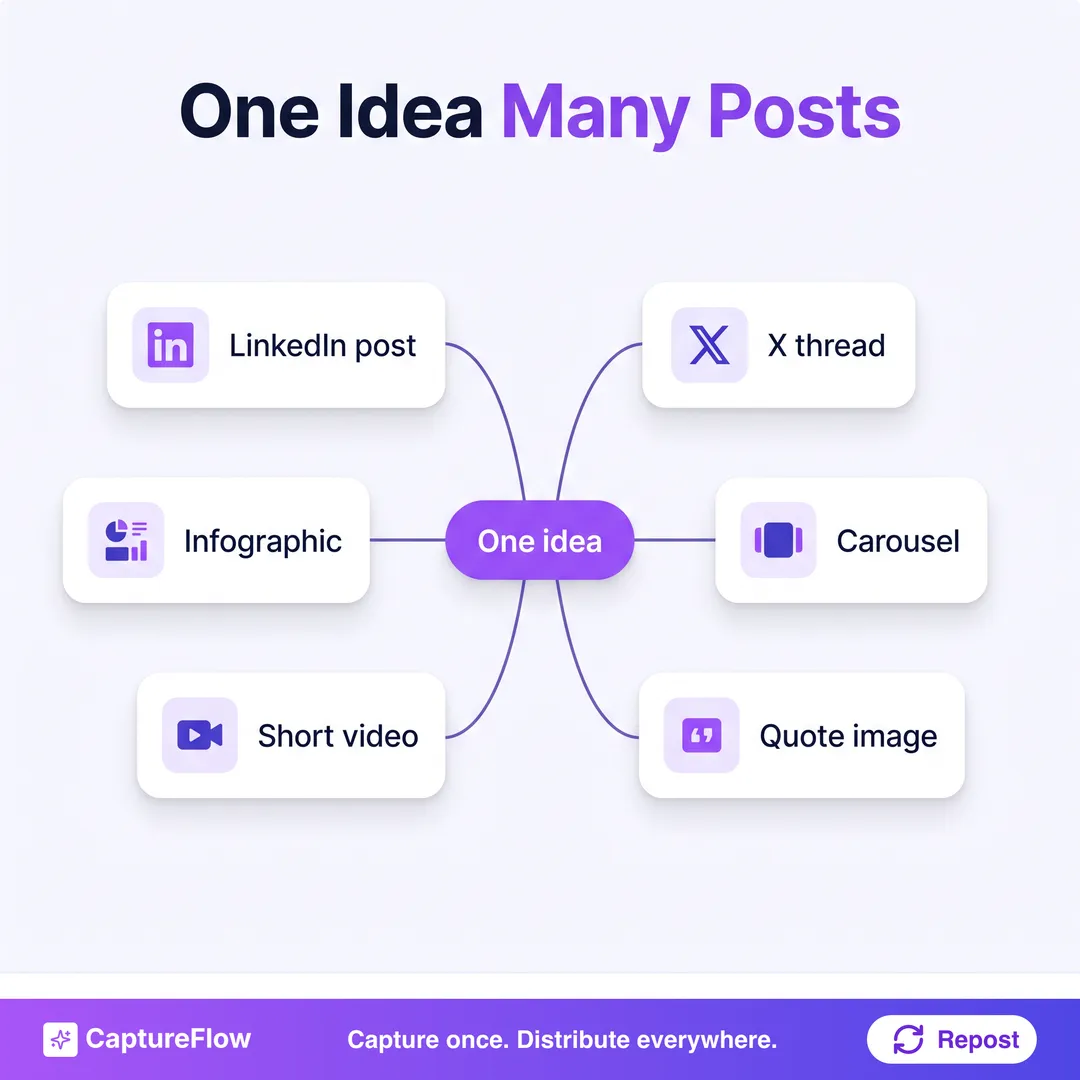 One idea, spoken once, becomes six native pieces. That is the atomization math.
What content atomization looks like in practice
The practice is a short, repeatable loop, not a one-off heroic editing session.
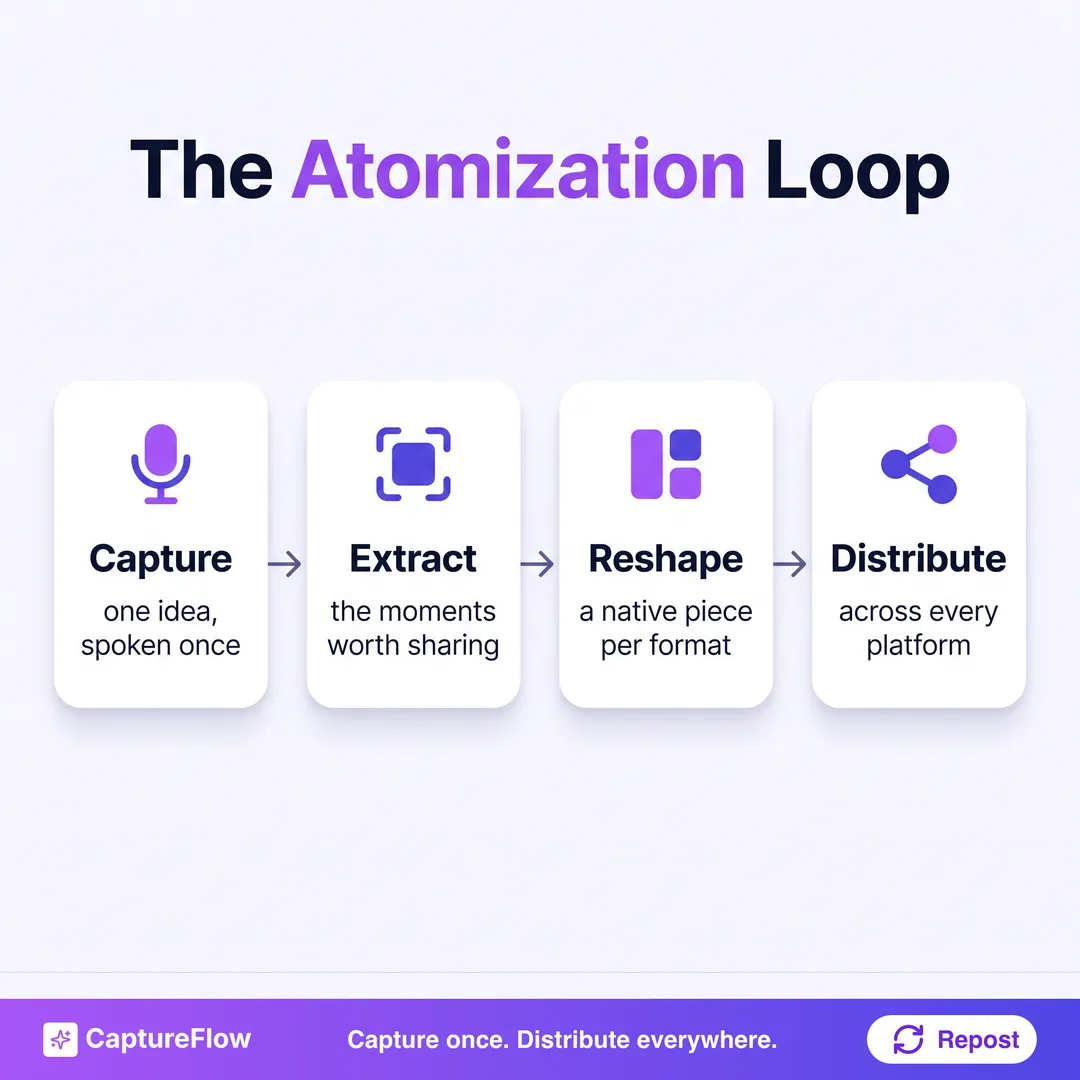 Capture, extract, reshape, distribute. Run it weekly on one good idea.
- Capture one idea when it is fresh: speak a strong opinion into your phone, record a customer call, save the talk you just gave. Start from something real, not a blank page. This is the core of capture-first content.
- Extract the moments worth sharing: the sharp lines, the specific numbers, the stories, the contrarian takes. One good source usually holds five to ten.
- Reshape each moment into a native piece: a LinkedIn post, an X thread, a carousel, a quote image, a short video, each written for its platform, not copy-pasted across all of them.
- Distribute across your channels on a schedule, so one capture fills a week instead of a day.
Atomize your highest-effort content first. A conference talk, a webinar, a long podcast, or a detailed customer call already contains a week of posts. If you made it once, do not let it live as a single asset. Mine it.
The key discipline is native, not identical. Atomization done badly is just cross-posting the same paragraph everywhere, which reads as robotic and underperforms. Done well, each atom is shaped for its home: the thread has a hook, the carousel has a structure, the clip has a caption. Same idea, different clothes.
How much content one idea can become
It helps to see the multiplier on a real example. Say you record a 30-minute conversation about a hard lesson from building your product. Atomized, that single source can become:
- One anchor LinkedIn post on the core lesson.
- An X thread breaking the lesson into five steps.
- A carousel walking through the framework you used.
- Two or three short video clips cut from the strongest spoken moments.
- A quote image of the one line that lands hardest.
- An infographic turning the framework into a visual.
That is roughly eight pieces of native content from one 30-minute capture you were going to have anyway. Publish them across two weeks and you have filled a content calendar from a single afternoon. Do it monthly and you never face a blank week again.
The math is what makes atomization a strategy rather than a tactic. If one idea reliably yields eight posts, you need one good idea a week, not eight. That reframes the entire content problem: from "generate endless ideas" to "capture and fully mine the few great ones you already have."
Atomization is not an excuse to stretch a thin idea into filler. Eight weak posts from a weak idea is just spam at scale. The multiplier only works on genuinely rich source material, a real lesson, a strong opinion, a substantive story. Start with something worth saying, then get everything out of it.
The tools that do content atomization in 2026
You can atomize by hand, and for years that was the only option: transcribe the recording, comb it for moments, and rebuild each one manually. It works, and it is slow enough that almost nobody sustains it.
The 2026 shift is that AI does the reshaping. The best content atomization tools take one input and produce the many native pieces for you, in your voice, ready to review. CaptureFlow is an AI content agent that turns your expertise into weeks of on-brand content for every platform. You capture one idea, a voice note, a video, a file, or a link, and it extracts the moments and reshapes each into a native post, thread, carousel, quote image, or short video, trained on how you actually sound.
That is the difference between a tool that reformats one asset and one that atomizes an idea. If you are comparing options, the best AI content repurposing tools breaks down the category, and you can see the full set of formats one capture can become.
The atomization ruleStop asking "what should I post today?" Start asking "what did I already say that is worth a week of posts?" The best content you will publish this month has probably already left your mouth.
The move
Content atomization is the shift from treating ideas as disposable to treating them as raw material. One idea is not one post. It is a thread, a carousel, a clip, a quote, and a post, each native to where it lives, all from a single capture.
Do that consistently and the blank page stops being the job. The job becomes capturing one good idea and letting it fan out. If the reshaping is the part that has always been too slow to sustain, that is exactly what CaptureFlow is built to handle, and you can see how it works or start by turning one voice note into a week of content.
Sources
- HubSpot, 2026 State of Marketing report (74 percent of marketers use AI to repurpose one asset into many formats).
Frequently asked questions
What is content atomization?+
Content atomization is the practice of breaking a single idea or piece of source material into many smaller, native pieces of content, a post, a thread, a carousel, a quote image, a short video, each shaped for its own platform. The point is to get many finished pieces from one capture instead of one post per idea.
What is the difference between content atomization and repurposing?+
Repurposing usually means reformatting one existing piece for another channel, a one-to-one move like turning a video into a blog. Atomization is one-to-many: you take a single idea and produce many distinct native pieces from it at once. Repurposing moves a finished asset around; atomization multiplies one idea into a week of content.
What are the best content atomization tools in 2026?+
The best tool takes one input, a recording, a voice note, a document, and produces many native pieces across platforms in your voice, rather than just reformatting a single asset. An AI content agent like CaptureFlow is built for exactly this: one capture becomes a LinkedIn post, an X thread, a carousel, a quote image, and a short video, ready to review.
Chris is the founder and CEO of CaptureFlow, which he builds so founders can turn their expertise into content without hiring a team. After 10+ years building products and growing audiences from scratch, he writes about founder-led content, AI, and distribution from inside the problem he is solving: distributing consistent, on-brand content as a team of one.
Founder & CEO of CaptureFlow · 10+ years building products and audiences
One playbook a week from founders who actually create and distribute lots of content. No spam, unsubscribe anytime.
Keep reading

7 Best Repurpose.io Alternatives in 2026 (Ranked by Use Case)
Repurpose.io moves your video between platforms, but it does not create anything. Here are 7 alternatives that do, ranked by the job you actually need done.

How to Turn a Voice Note Into a Week of Content
You already said the idea out loud. Here is how to turn a single voice note into a full week of on-brand content, without writing from a blank page.

How to Use AI Content Tools (Without Sounding Like a Bot)
Most people disappointed with AI content tools started with the tool instead of the problem. Here is the workflow that actually works: find the gap, match the tool, train it on your voice, and ship.