AI Content Creation: The Complete Guide for Founders
AI content creation means using AI to turn your own expertise into on-brand posts for every platform. Here is the complete founder guide that works.


Type "write me a LinkedIn post" into any chatbot and a draft appears in seconds. It is grammatical, structured, and confident. It also sounds exactly like the draft every other founder just generated, because you all started from the same empty box. That is the paradox at the center of ai content creation right now: the tools got so good that the output got interchangeable.
Here is the reframe this whole guide runs on. AI content creation is using AI to turn your own expertise into finished, platform-ready content, not to generate generic filler from a blank prompt. The model is not the problem. The blank prompt is. Fix the input and everything downstream changes.
This is the complete founder version: what AI content creation actually is, why generic output fails, how to make AI sound like you, the workflow that produces a week of content from one capture, and an honest map of where AI helps and where it does not.
What is AI content creation?
AI content creation is the practice of using large language and multimodal models to draft, reshape, and distribute content, ideally from raw material you already have rather than a cold prompt.
The category is no longer niche. Per the 2026 Stanford HAI AI Index, roughly 70% of organizations now use generative AI in at least one business function, up from about a third two years earlier. Adoption is not the question anymore. Differentiation is.
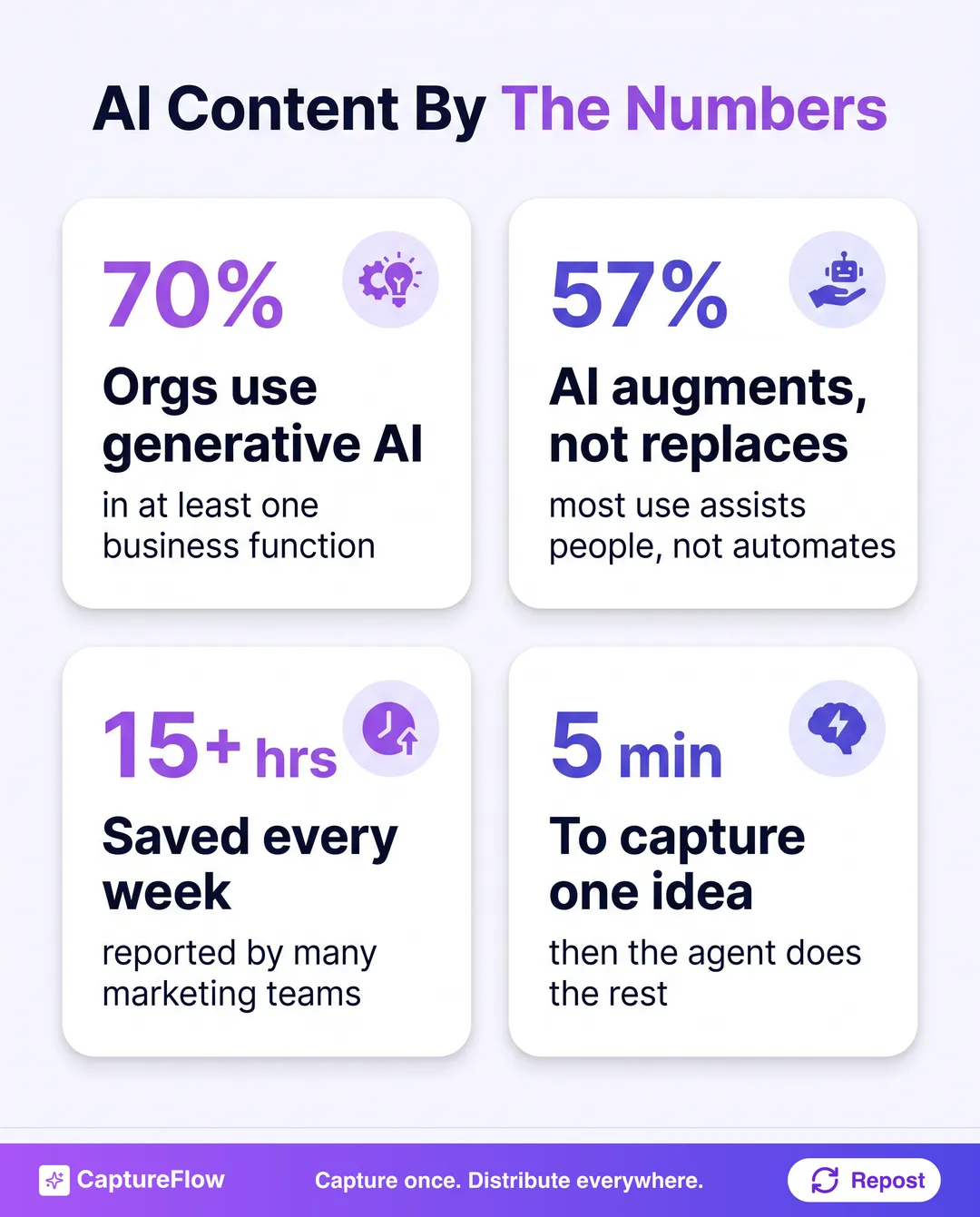 The adoption is settled. The advantage now comes from what you feed the model.
The important nuance is in that second number. The Anthropic Economic Index finds most real-world AI use skews toward augmentation, working alongside a person, rather than full automation. That maps exactly onto how content should work: AI scales your thinking, it does not manufacture opinions you never had.
That is the model behind the product we build. CaptureFlow is an AI content agent that turns your expertise into weeks of on-brand content for every platform. You capture one idea in about 5 minutes, and the agent, trained on your voice and past posts, reshapes it into native content for each channel. The rest of this guide is the general method, whatever tools you use.
Why generic AI content fails founders
A model handed no context defaults to the average of the internet. That average is competent, safe, and completely forgettable. It is the writing equivalent of stock photography.
You know the sound of it: the post that opens with "In today's fast-paced world," hedges every claim, names no one, cites no real number, and closes with a tidy moral nobody asked for. That is not the model failing. It is the model doing exactly what a blank prompt asks, producing the safest possible version of a generic topic.
And it gets worse at scale. A study published in Science Advances found that writers using generative AI produced individually better-rated work, but the work became significantly more similar to each other. Individual quality up, collective diversity down. Now map that onto your feed: every founder in your niche prompting the same models about the same topics gets pulled toward the same center. Fine is invisible.
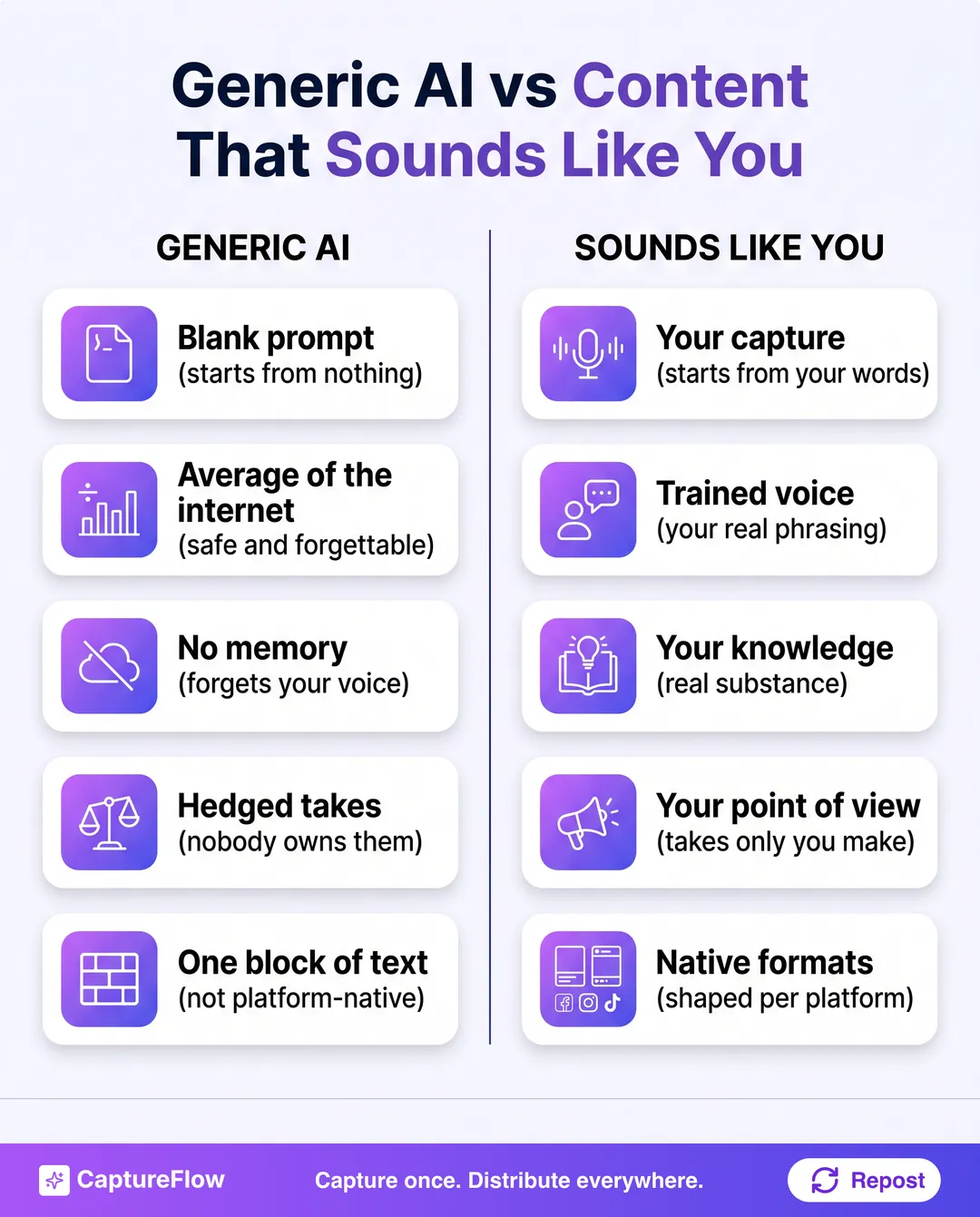
The core reframeA model with no context returns the average of the internet. To get your voice, you have to feed it your signal.
Your only durable advantage in content is sounding unmistakably like yourself, and that is precisely the input the blank prompt lacks. We unpack the full argument in make AI content that sounds like you, but the headline is simple: slop is not a model problem, it is an inputs problem.
The blank-prompt trap, and how capture-first fixes it
The reason so much AI content is bad is structural, not a matter of prompt skill. When you start from an empty box, three things go wrong at once: the model has nothing of yours to work from, you rebuild your context by hand every session, and the output dead-ends as one block of text you still have to reformat and publish yourself.
There is a name for the alternative. Capture-first content means recording a raw idea once, then letting a system reshape it into native posts for every platform. Instead of sitting down to manufacture a post, you capture the thinking you already have, a voice note, a short video, a customer call, a rough paragraph, and the finished content is built from that.
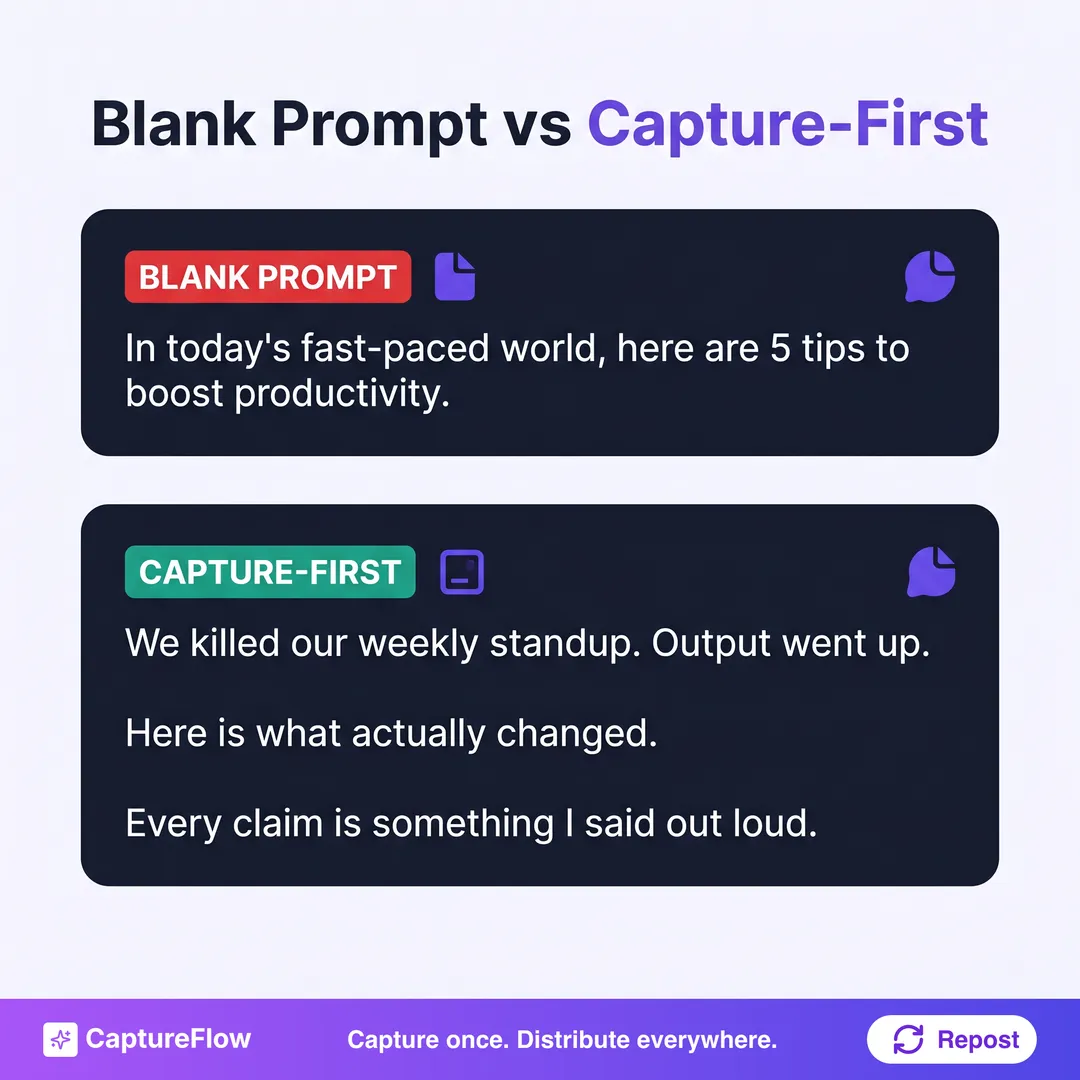 Same topic, different input. The second one can only come from you.
The difference is not magic, it is input quality. When the source is your own words, the model's job shrinks from "invent a founder's opinion" to "reshape this founder's actual opinion." The first produces averages. The second produces you, faster. This is the whole idea behind what is capture-first content, and it is why the founders who win at content are not the most disciplined writers, they are the ones who removed the friction.
The fastest way to give a model your voice is to stop typing and start talking. A 5-minute voice note carries more of your real phrasing than an hour of prompt engineering.
How to create content with AI that sounds like you
If you want to create content with ai that a colleague could identify as yours with the byline removed, you need three inputs. Miss any one and the output drifts back toward the average.
- Voice. Your past posts, so the phrasing, rhythm, and word choice match how you actually write. Start with 10 to 20 of your best ones, not all of them.
- Knowledge. Your docs, talks, and transcripts, so the substance is real instead of invented. This is what makes writing specific, and specific is what makes it believable.
- Point of view. Your positioning and the takes only you would make, so the model argues the way you argue instead of both-sidesing everything into mush.
Getting those inputs into a model is a repeatable process, not a one-time prompt. The short version is a loop: collect a corpus, extract your markers, encode them into a short guide, load it where the AI can always see it, and refresh it as your voice drifts.
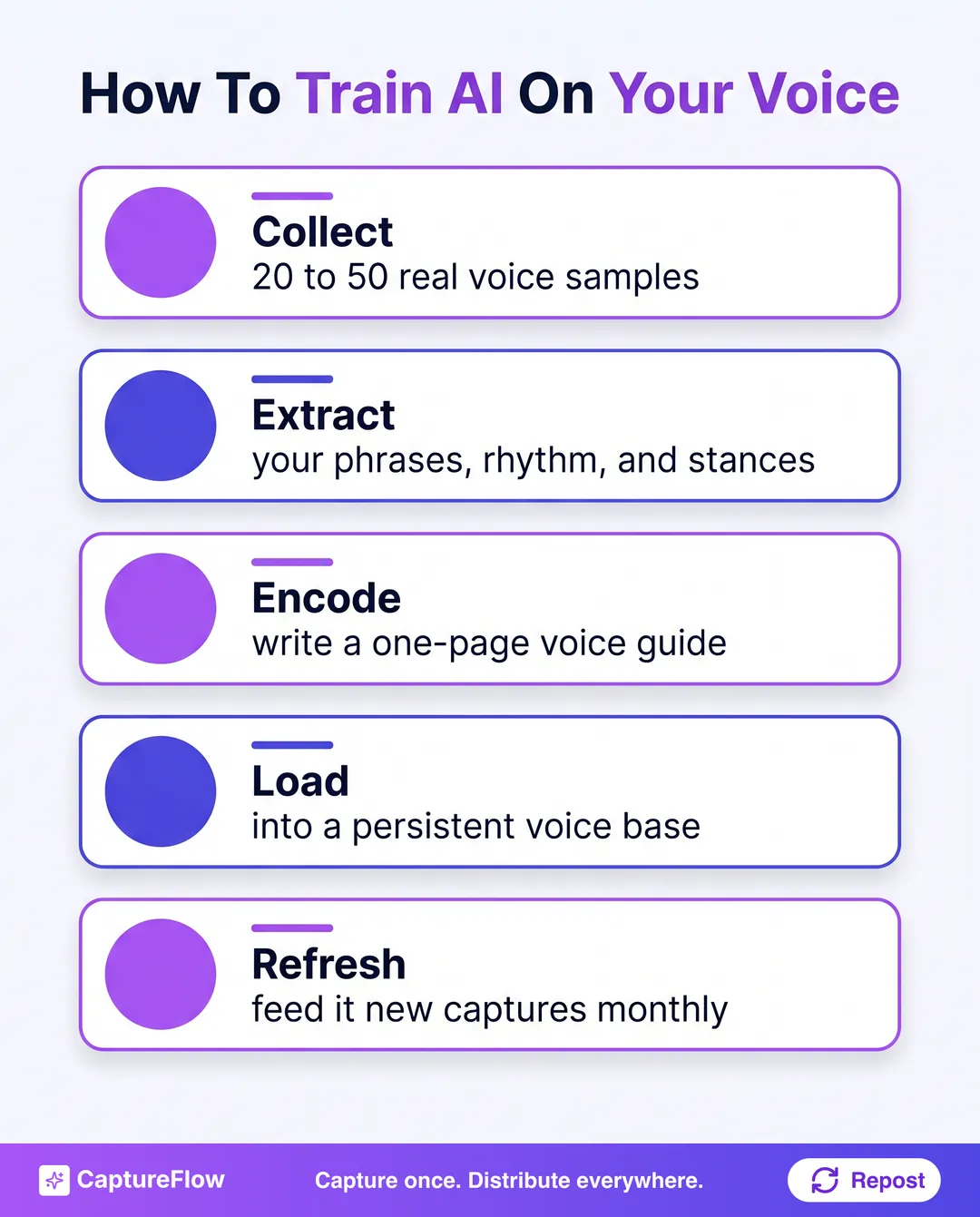 Voice training is a loop, not a setting. The compounding happens in the last step.
The full step-by-step is in how to train AI on your brand voice, and the mistakes that keep AI sounding generic (prompting instead of training, feeding it everything, over-editing into blandness) are broken down in the sounds-like-you guide. The one rule to remember: models imitate patterns, not intentions. "Confident but approachable" trains nothing. Ten example pairs of "we say this, never that" change the output immediately.
In a tool built for this, the training is not something you maintain by hand. A persistent voice and knowledge base stores your corpus, your guide, and everything you approve going forward, and applies it to every draft automatically, so the model keeps learning instead of resetting each session.
Your AI content creation workflow, end to end
Inputs are half the story. The other half is the pipeline that takes one idea and turns it into a full week of native content. The workflow runs on a simple loop: capture, create, distribute.
- Capture. Get the idea out of your head fast. Record a voice note, talk to camera, drop a file, or paste a link. This is multimodal capture, and it is the whole point: the input should take about 5 minutes, not an afternoon.
- Create. A content agent trained on your voice reshapes that capture into finished pieces. Not one format, every format that fits: a long-form post, an X thread, a carousel, a short video, a quote graphic, an infographic.
- Distribute. The finished content gets published natively across platforms and scheduled, so your week fills itself instead of you filling it.
The order is the innovation. Blank-prompt tools optimize the middle step and leave you stuck on the input and the distribution. Capture-first makes the input trivial and automates everything after it. That is the argument behind capture once, distribute everywhere: each platform rewards a different shape, and reshaping one strong idea beats cross-posting identical text to five feeds.
Here is the concrete version. On a Monday, you spend a few minutes talking through the one thing you learned last week. That single capture becomes a LinkedIn post with a real hook, an X thread that earns the next line, a carousel that breaks the idea down, a quote image pulled from your sharpest sentence, and a short video cut from the recording. You did not write five things. You captured one thing and shaped it five ways.
The payoff is not one great post. It is never having to wonder whether the post will happen at all. When capture takes 5 minutes and everything downstream is automated, consistency stops being a discipline problem and becomes a default.
What content can AI create for you?
A useful pillar question, because the honest answer is narrower and more specific than the hype suggests. AI content creation is strongest at the formats that are variations on a core idea, the ones that reward reshaping rather than reinventing.
From a single capture, a capable agent can produce:
- Text posts for every platform. The same idea shaped natively for LinkedIn, X, Threads, Instagram, Facebook, TikTok captions, YouTube descriptions, and Pinterest, each with the rhythm that platform rewards rather than one block cross-posted everywhere.
- Short and long form video. Clips cut from a recording you already made, with the hook up front.
- Carousels. A single argument broken into a swipeable sequence, which is one of the highest-performing formats on most feeds.
- Quote images and branded graphics. Your sharpest line, pulled out and designed so it travels on its own.
- Infographics. A comparison, a set of steps, or a few numbers turned into a designed asset, exactly like the ones in this guide.
The common thread is that every one of these starts from your idea and gets reshaped, which is why the input quality from earlier in this guide matters so much. Garbage in still means garbage out, just in more formats. What AI content creation is not good at is fabricating expertise you do not have, which is why the reader's judgment stays in the loop for every piece.
AI content creation tools: what actually matters
Shopping for ai content creation tools is confusing because most of them solve one slice of the loop and market it like the whole thing. A useful way to evaluate any tool is to ask which of the three jobs it actually does: does it hold your voice, does it produce native formats, and does it distribute.
| Tool type | What it does well | Where it stops |
|---|---|---|
| AI chat (ChatGPT and similar) | Drafting, editing, brainstorming | No persistent voice, no formats, no scheduling |
| Writing assistants | Sharpening a post you are already writing | You still produce every piece from scratch |
| Schedulers | Moving finished content to a calendar | They assume the content already exists |
| Content agent | The whole loop: voice, formats, distribution | Newer category, worth testing against your workflow |
Chat tools are the most common starting point, and they are genuinely capable drafters. The gap is structural, not a matter of quality, and we lay it out in full in ChatGPT vs a content engine: a chat window is a text generator, and founders need a content system.
If you are choosing tools by job to be done, we keep honest, hands-on roundups. For turning your expertise into feed-ready posts, see the best AI LinkedIn content tools. For squeezing a month of content out of assets you already have, see the best AI content repurposing tools. Both concede real strengths before they contrast, because honesty is the only useful way to compare.
Where AI helps, and where it does not
Radical honesty is the whole trust mechanism here, so let me draw the line clearly.
AI helps most where the work is repeatable:
- Turning a rough capture into a clean first draft.
- Reformatting one idea into a post, a thread, a carousel, and a short video.
- Scheduling a week of content so distribution stops eating your evenings.
- Being a tireless second set of eyes on a draft you already have.
AI helps least where the work is not repeatable:
- Having the point of view in the first place. No model can hold an opinion you have not formed.
- The specific story, the real number from your case study, the objection you actually hear on sales calls.
- Judgment about what is worth saying this week, and what is better left unsaid.
The failure mode to avoid is letting the model invent the parts only you can supply. If a stat did not come from your knowledge, cut it. One made-up figure costs you more trust than ten good posts earn. Used well, AI is not a ghostwriter inventing opinions for you. It is an editor who has read everything you have ever published and never gets tired of formatting it.
The bar is not "could a human have written this." It is "would I actually say this, in these words." If the answer is no, do not ship it. Fix the inputs.
Start with what you already have
AI content creation is a bet that your ideas are the scarce resource and everything else is a solvable engineering problem. The founders who benefit are not the ones with the cleverest prompts. They are the ones who stopped starting from a blank page and started from something they already said.
Capture the idea once. Let the system make it native everywhere. Review, approve, and get on with running your company. If you want to run the loop week by week, the deep dives above are the manuals, and training AI on your voice is the best first step.
When you are ready to see the whole thing in one place, here is how CaptureFlow works and what it costs. Either way, stop feeding the blank prompt. It only knows the average, and you did not start a company to sound average. Put your expertise in, and let it become your flow.
Sources
- Stanford HAI: 2026 AI Index Report
- Anthropic: The Anthropic Economic Index
- Science Advances (Doshi and Hauser): Generative AI enhances individual creativity but reduces the collective diversity of novel content
Frequently asked questions
What is AI content creation?+
AI content creation is using AI to turn your own expertise into finished, platform-ready content, rather than generating generic posts from a blank prompt. Done well, the AI handles drafting, formatting, and distribution while you keep the ideas, stories, and point of view.
How do you create content with AI without it sounding generic?+
Stop starting from a blank prompt. Feed the model your own signal: past posts for voice, docs and transcripts for substance, and your real opinions for point of view. Generic output is an inputs problem, not a model problem.
Is AI content creation bad for SEO or reach?+
AI-assisted content is not penalized for being AI-assisted. What gets punished is thin, generic content that says nothing. Content grounded in your real expertise and experience performs because it is specific, and specificity is exactly what a blank prompt loses.
Do I still need to review AI-generated content?+
Always. AI removes the blank page and the formatting grind, not your judgment. The realistic target is drafts you approve with a small edit, not drafts you ship unread.
Chris is the founder and CEO of CaptureFlow, which he builds so founders can turn their expertise into content without hiring a team. After 10+ years building products and growing audiences from scratch, he writes about founder-led content, AI, and distribution from inside the problem he is solving: distributing consistent, on-brand content as a team of one.
Founder & CEO of CaptureFlow · 10+ years building products and audiences
One playbook a week from founders who actually create and distribute lots of content. No spam, unsubscribe anytime.
Keep reading

How to Use AI Content Tools (Without Sounding Like a Bot)
Most people disappointed with AI content tools started with the tool instead of the problem. Here is the workflow that actually works: find the gap, match the tool, train it on your voice, and ship.

How to Scale Content With AI Without Losing Your Brand Voice
The fastest way to make your brand sound like everyone else is to scale content with generic AI. Here is how a team scales output and keeps one voice.
Make AI Content That Sounds Like You
The difference between AI slop and content that sounds like you comes down to three inputs: your voice, your knowledge, and your point of view.