ChatGPT vs a Content Engine: Why the Blank Prompt Fails Founders
ChatGPT is a great drafter and a poor content system. Here is where it genuinely wins, where the blank prompt fails founders, and what a content engine does differently.


Around 900 million people use ChatGPT every week, and at some point most founders among them have typed the same eleven words into it: "write me a LinkedIn post about" followed by their topic. The draft appears in seconds. It is grammatical, structured, confident. And it sounds exactly like the drafts the other founders got, because using ChatGPT for AI content creation this way means starting from the same empty box as everyone else.
I want to make the honest version of this argument, not the strawman. ChatGPT is not bad at writing. It is a remarkable drafter and the most popular writing tool in history. The problem is narrower and more structural: a chat window is a text generator, and founders need a content system. Those are different products.
A content engine is a system that turns your own captured thinking into finished, scheduled, platform-native content. ChatGPT is a text generator that starts from whatever you type into an empty box. This article is about the gap between those two things, and why the blank prompt is where founder content goes to sound like everyone else's.
Is ChatGPT good for content creation? Honestly, partly yes
Credit first, because it is real:
- Drafting speed. Nothing turns an outline into prose faster. Marketers know it: in HubSpot's 2026 State of Marketing survey of 1,500+ marketers, roughly a third say AI saves their team 10 to 14 hours a week, and another third say more than 15.
- Editing. Paste a rough draft and ask it to tighten, and it usually will. As a second pair of eyes, it is superb.
- Thinking. Brainstorming angles, poking holes in an argument, summarizing research. This is where a chat interface genuinely shines, because thinking is conversational.
If your content bottleneck is "I cannot get words on a page," ChatGPT solves it today, for $20 a month. That is the truth, and any comparison that skips it is selling you something.
So here is the equally honest other half.
Why does the blank prompt fail founders?
Three structural failures, none of which better prompting fixes.
1. The blank prompt converges on sameness
When you give a model nothing of yours, it works from its training average. That is not a bug in one product; it is measurable science. A study published in Science Advances found that writers with access to generative AI ideas produced individually better-rated stories, but the stories became significantly more similar to each other. Individual quality up, collective diversity down.
Now map that onto your feed. Every founder in your niche prompting the same model about the same topics gets pulled toward the same center. The output is fine. Fine is invisible. Your only durable advantage in content is sounding unmistakably like yourself, and that is precisely the input the blank prompt lacks.
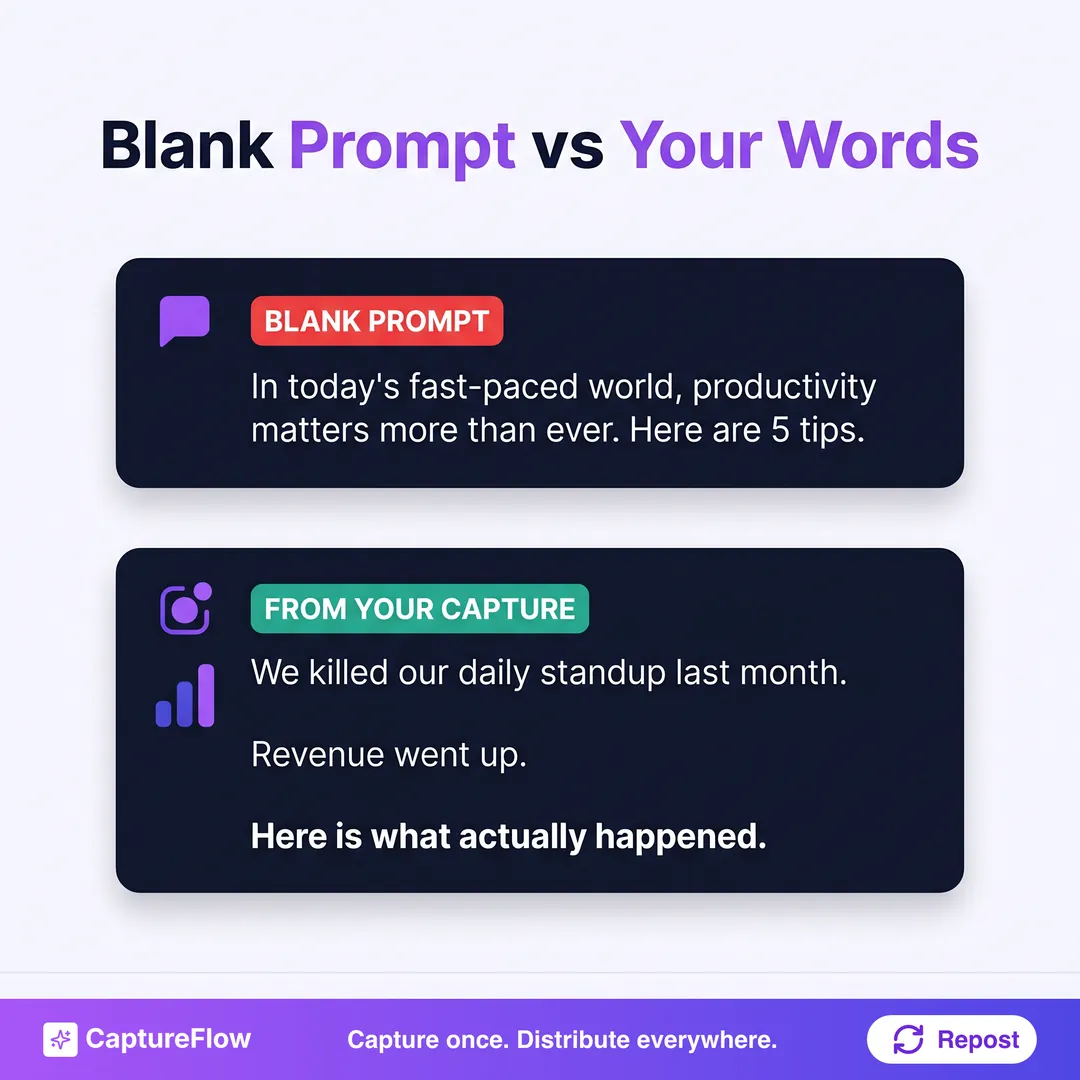 Same topic, different input. The second one can only come from you.
2. It has no memory of your voice
Every ChatGPT session starts near zero. You can paste style guides, maintain custom instructions, build a project with examples, and power users do. But notice what happened: you became the system. You are manually reconstructing, session after session, the context a content tool should own. We wrote about what it actually takes to make AI sound like you, and the short version is: it requires a persistent, structured voice layer, not a pasted prompt. The step-by-step setup is in how to train AI on your brand voice.
3. The output dead-ends in a chat window
Say the draft is good. Now what? You reformat it for LinkedIn's rhythm, rewrite it as a thread for X, resize the idea for a carousel, paste each version into a scheduler, and repeat next session. The generation took 10 seconds; the pipeline around it eats your evening. That hidden workflow is the real price of ChatGPT content, and it is invisible until you count it.
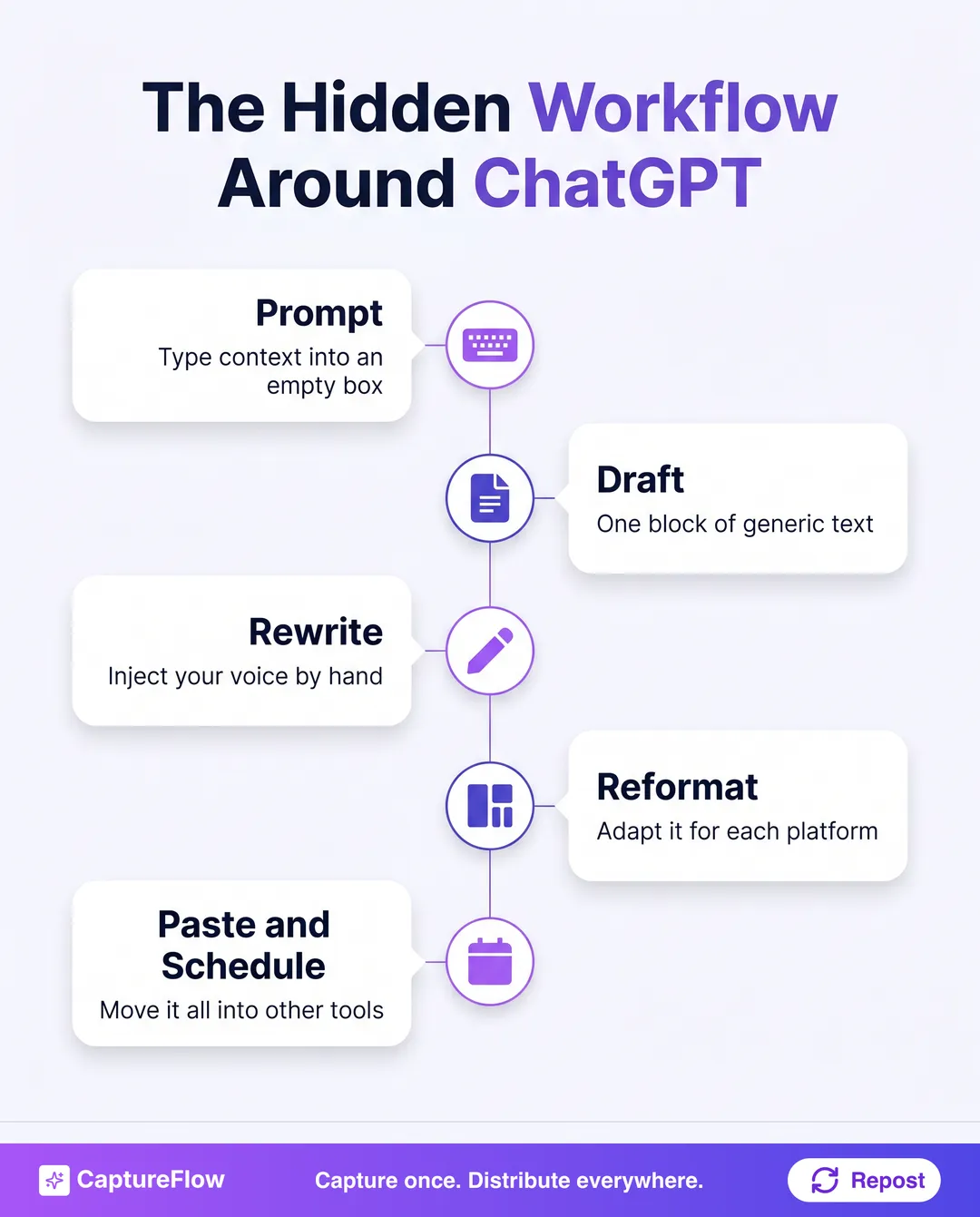 The model writes in seconds. You do everything else, every time.
ChatGPT gives you a draft in 10 seconds and hands you back a job that takes all evening. A content engine takes the evening part.
What does a content engine do differently?
One inversion drives everything: the input is something you said, not something you typed into a box.
A capture-first system starts from a recording of you talking about your work: a 15-minute video, a voice note, a customer call. From that capture, the engine extracts the angles, drafts each one in your trained voice, formats natively per platform, and queues the set. The full weekly system takes about 45 minutes end to end, and 5 minutes of that is the part after capture.
Side by side:
| ChatGPT | Content engine | |
|---|---|---|
| Starting point | Blank prompt you fill each time | A capture of you talking |
| Voice | Session memory, rebuilt by you | Trained on your knowledge base and phrasing |
| Output | One block of text | Native formats per platform |
| Distribution | Copy, paste, schedule elsewhere | Scheduled from the same place |
| Over time | Each session starts over | Library compounds weekly |
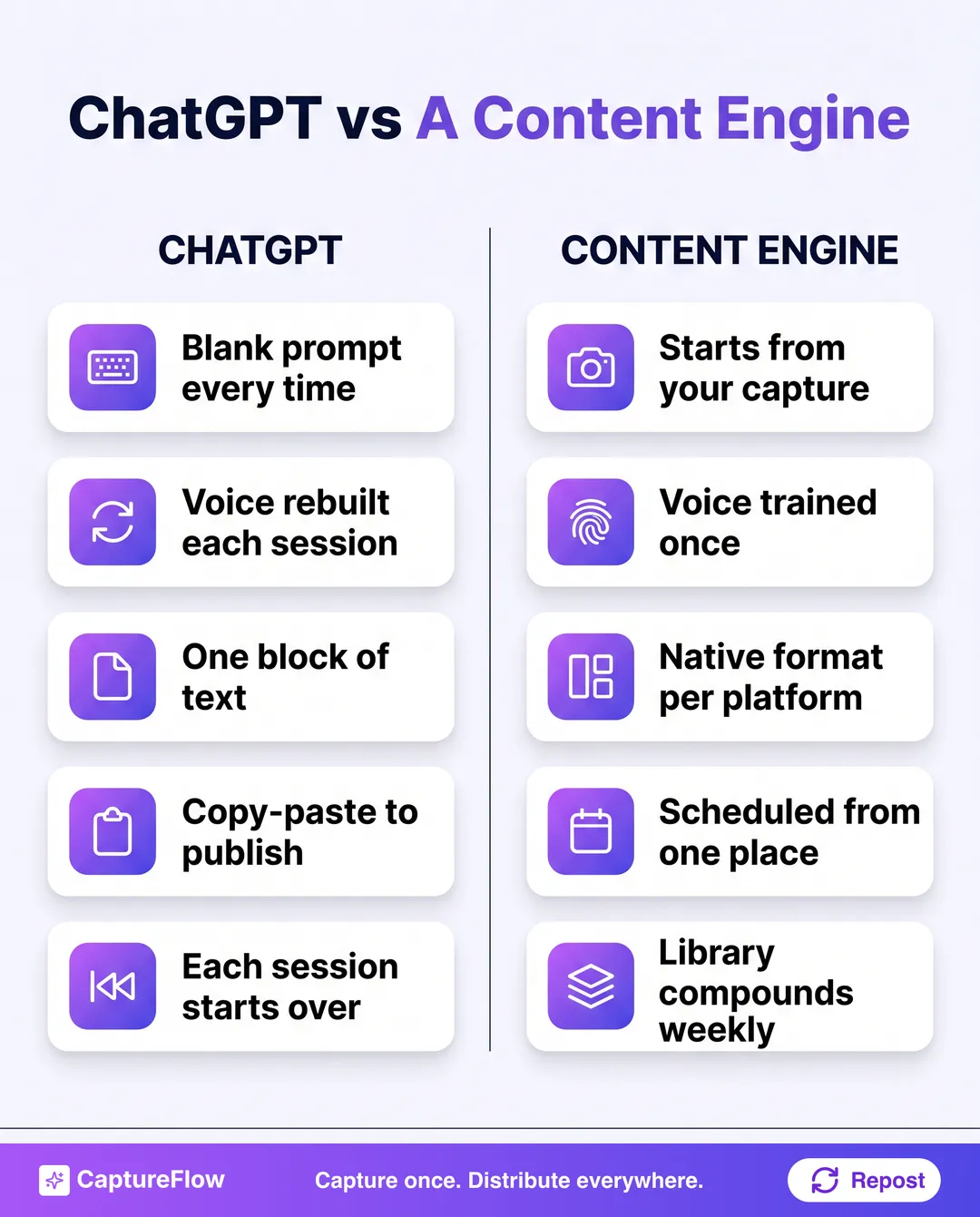 The same five dimensions, two different products. One is a writer, the other is a pipeline.
The voice difference is not magic, it is input quality. When the source material is your own words, the model's job shrinks from "invent a founder's opinion" to "reshape this founder's actual opinion." The first task produces averages. The second produces you, faster.
CaptureFlow is an AI content agent that turns your expertise into weeks of on-brand content for every platform. That is the category difference in one sentence: not a better writer, a different starting point plus the pipeline the chat window never had.
Where does ChatGPT fit in a founder's stack?
Keep it. Seriously. The tools are complementary, not substitutes, and pretending otherwise would break the honesty rule this blog runs on.
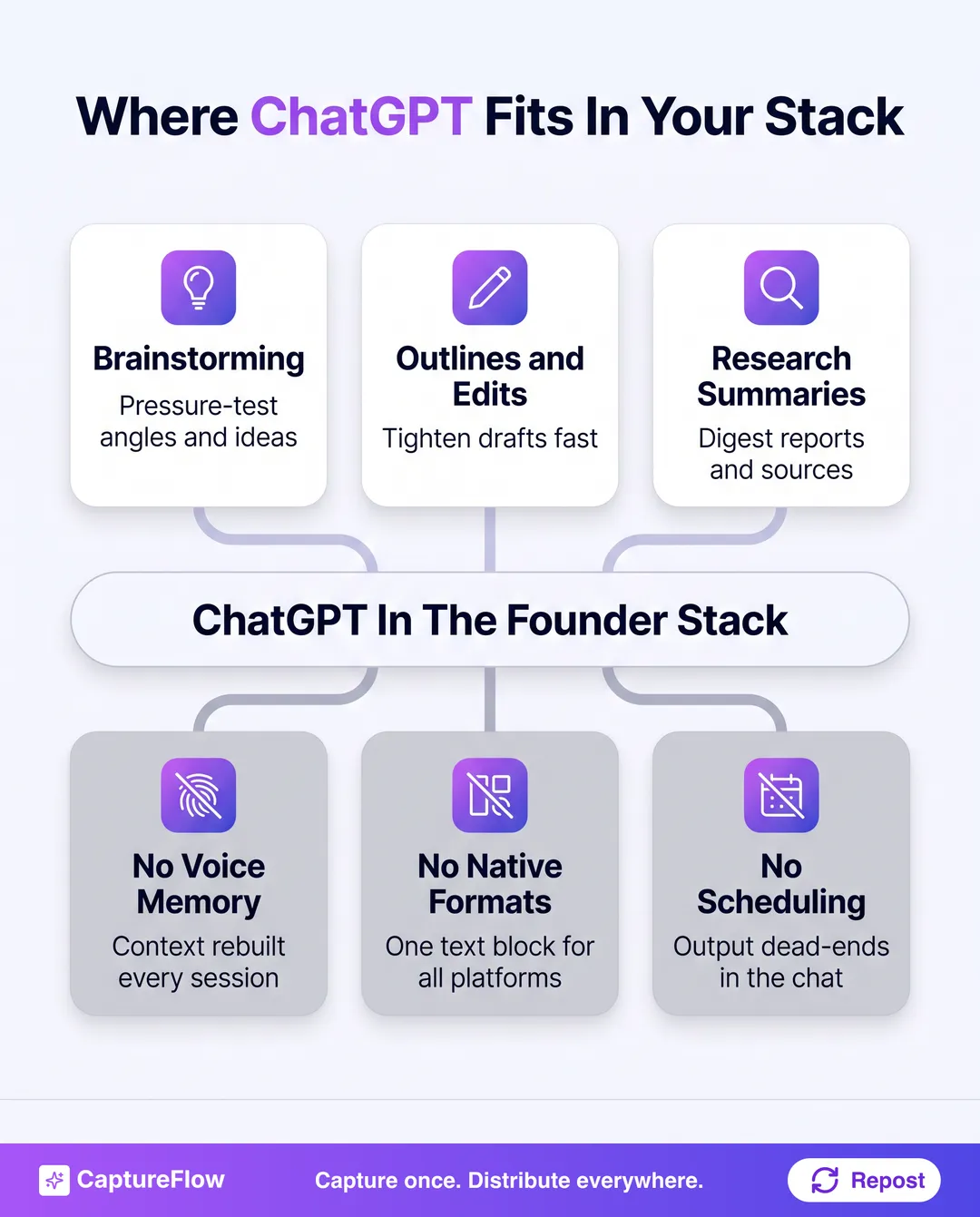 Use the chat window for thinking. Use an engine for the pipeline.
- Use ChatGPT for: pressure-testing an argument before you record, outlining a talk, tightening a sentence, summarizing a report you want to reference.
- Use a content engine for: the repeatable loop from your mouth to your channels, in your voice, on a schedule.
We keep a detailed, honest ChatGPT vs CaptureFlow comparison if you want the feature-level version, and the compare hub covers the rest of the landscape.
A practical split that works: think in ChatGPT in the morning, capture your conclusion on video in the afternoon. The chat sharpens the idea; the capture turns it into a week of content. Each tool does the half it is actually built for.
The two-week test
Do not take a vendor's word for any of this, including ours. Run both workflows for two weeks:
- Week one, blank prompt. Prompt your posts from scratch. Track total time including reformatting and scheduling, and save every draft.
- Week two, capture-first. Record one 15-minute capture, extract and draft from it, queue the set. Track the same numbers.
Then read the two weeks of posts back to back and ask one question: which week sounds like me? That answer, plus the time log, settles the argument better than any comparison table.
Two things founders consistently notice when they run this. First, the blank-prompt week takes longer than they expected once reformatting and scheduling are counted, usually 30 to 45 minutes per post. Second, the capture week produces posts they would actually defend in a comment section, because every claim in them is something they said out loud with conviction. Content you can defend gets replies. Replies are the whole game.
If week two wins, the system behind it is here, and the pricing is here. Either way, stop feeding the blank prompt. It only knows the average, and you did not start a company to sound average.
Sources
- TechCrunch: ChatGPT reaches 900M weekly active users
- Science Advances (Doshi and Hauser): Generative AI enhances individual creativity but reduces the collective diversity of novel content
- HubSpot: 2026 State of Marketing report
Frequently asked questions
Is ChatGPT good for content creation?+
For drafting, editing, outlining, and brainstorming, yes, genuinely. As an end-to-end content system it falls short: it has no persistent memory of your voice, produces one block of text rather than platform-native formats, and cannot schedule or publish anything.
What is the difference between ChatGPT and a content engine?+
ChatGPT generates text from whatever you type into an empty prompt. A content engine runs a pipeline: it starts from your own captured thinking (video, voice, docs), drafts in your trained voice, formats natively per platform, and schedules the output. One is a writer, the other is a system.
Why does ChatGPT content sound generic?+
Two reasons. The model averages across its training data, and the blank prompt gives it nothing of yours to work with, so it fills the gap with that average. Research published in Science Advances found AI assistance makes different writers' output measurably more similar to each other.
Should founders stop using ChatGPT?+
No. Use it where it is excellent: thinking through ideas, tightening drafts, summarizing research. Just do not ask it to be your content system, because the voice, format, and distribution layers do not exist in a chat window.
Chris is the founder and CEO of CaptureFlow, which he builds so founders can turn their expertise into content without hiring a team. After 10+ years building products and growing audiences from scratch, he writes about founder-led content, AI, and distribution from inside the problem he is solving: distributing consistent, on-brand content as a team of one.
Founder & CEO of CaptureFlow · 10+ years building products and audiences
One playbook a week from founders who actually create and distribute lots of content. No spam, unsubscribe anytime.
Keep reading

How to Use AI Content Tools (Without Sounding Like a Bot)
Most people disappointed with AI content tools started with the tool instead of the problem. Here is the workflow that actually works: find the gap, match the tool, train it on your voice, and ship.

How to Scale Content With AI Without Losing Your Brand Voice
The fastest way to make your brand sound like everyone else is to scale content with generic AI. Here is how a team scales output and keeps one voice.

Content Atomization: Turn One Idea Into Many Posts
Most people make one post from one idea, then go hunt for the next idea. Content atomization is the opposite: one idea becomes a week of native posts.