The Capture-First Content System: A Complete Workflow
A complete workflow for the capture-first content system: record what you know once a week, then extract, draft, and schedule everything else from it.

Every founder I know has tried the same content plan: get motivated, post daily for two weeks, miss a day, miss a week, vanish for a quarter. The problem was never commitment. The problem is that the plan starts every single day at the hardest possible place, a blank page.
The fix is a capture-first content system: a weekly loop where you record what you already know once, and everything you publish is extracted from that recording. Capture-first means starting from something you already said, not a blank page. You stop being a writer with a deadline and become an editor with raw material.
This is the complete workflow. We planted the idea in What Is Capture-First Content?; this article is the operating manual: the five steps, the weekly rhythm, the time budget, and where tools fit. If you would rather run the same idea as a daily habit, the founder content operating system is the always-on, 5-minutes-a-day version of this workflow. It assumes nothing but a phone and 15 minutes a week.
What is the capture-first content system?
The system is one loop, run weekly:
- Capture. Record yourself talking about one thing you know, for about 15 minutes.
- Extract. Mine the transcript for post-worthy angles: takes, stories, frameworks, numbers.
- Draft. Turn each angle into a native post for each platform, in your own phrasing.
- Schedule. Queue the set into your proven posting windows for the week.
- Recycle. Once a month, resurface what worked and feed it back into the loop.
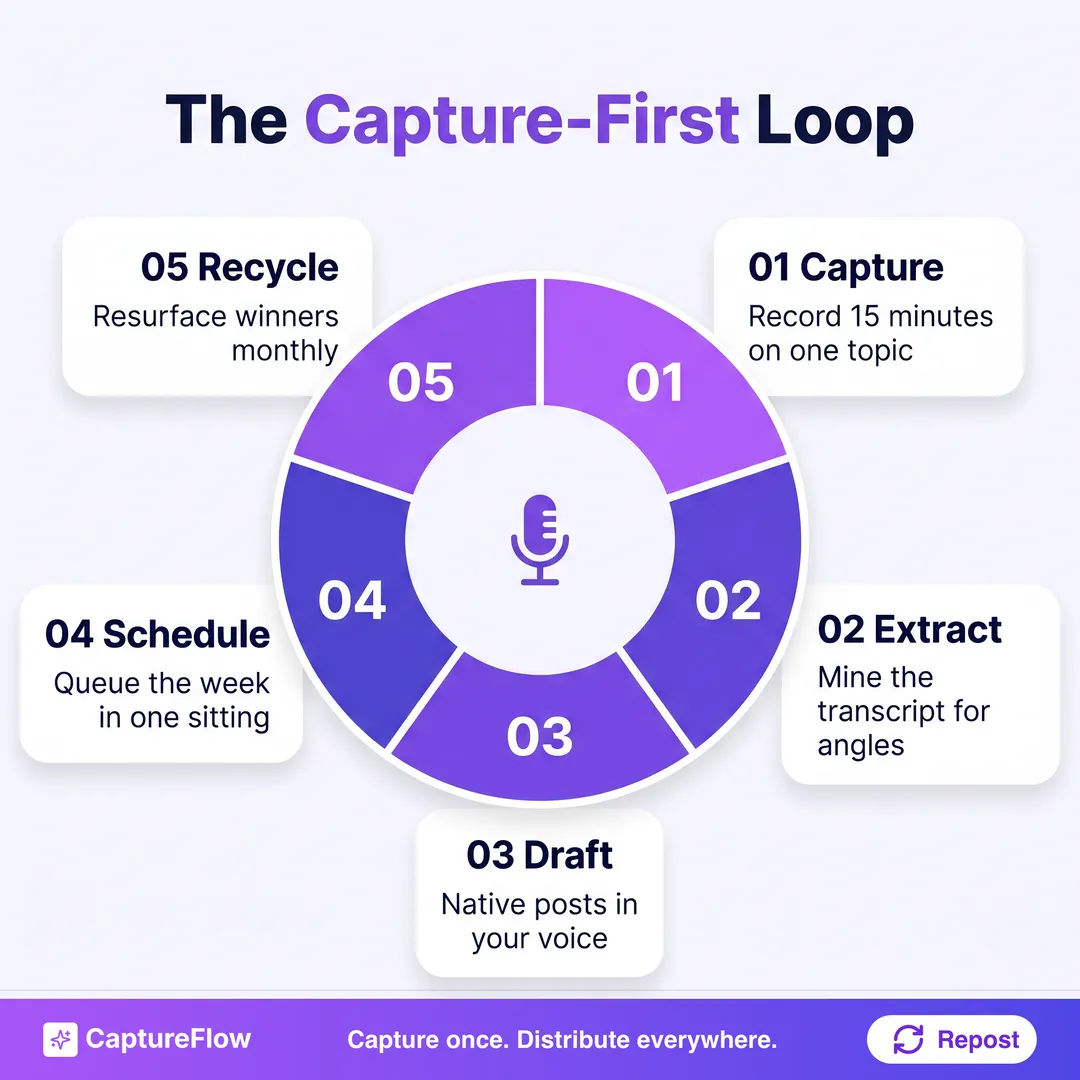 One loop, run once a week. The blank page never appears.
Notice what is missing: an "ideation" step. That is deliberate. Ideation is where content systems die, because it asks you to invent on demand. In a capture-first system, ideas are a byproduct of talking about your work. You do not generate content, you surface it.
You do not have a content problem. You have an extraction problem. The content already exists in what you say every week, it is just not written down yet.
Step 1: Capture once a week (15 minutes)
Pick one topic and talk. To camera, into a voice memo on a walk, or on a quick solo call recording. The format does not matter; the depth does. Fifteen focused minutes on one topic beats an hour of rambling across five, because every extracted post needs enough substance to stand alone.
The best capture prompts come straight from your week:
- A question you answered twice. If two customers asked it, an audience wants it.
- A decision you just made and the reasoning behind it, including what you almost did instead.
- Something you changed your mind about. These make the strongest posts, because tension is built in.
- A mistake that cost you time or money, and the rule you follow now.
- A number that surprised you in your own business, and what explains it.
Schedule the capture like a meeting with yourself, same slot every week. Monday morning works well: the week's questions are fresh and the content ships across the days that follow. Treat it as unmissable, it is the only step the whole system depends on.
If you want a deeper treatment of what makes source material rich, the one capture in, every platform out guide covers what a strong capture looks like.
Step 2: Extract the angles from your transcript
Transcribe the recording, then read it like a prospector, not an author. You are not judging your prose, you are marking veins: every distinct idea, story, framework, stat, or opinion is a separate post with its own hook.
A focused 15-minute capture typically yields around 10 usable angles. We documented the full taxonomy in how to turn one video into 10 LinkedIn posts: the core thesis, the contrarian take, the how-to, the story, the framework, the myth-buster, the stat, the one-liner, the question, and the lesson learned. That article is LinkedIn-flavored, but the angles are platform-agnostic.
The practical move: highlight the transcript in one pass, label each highlight with its angle type, and stop when you have 8 to 10. Do not polish anything yet. Extraction and drafting are different mental modes, and mixing them is what makes content feel slow.
Step 3: Draft native posts in your own voice
Now each angle becomes a post, and one rule governs all of it: keep your own phrasing. The transcript is full of how you actually talk. That phrasing is the moat. Sand it off and you have generic content that happens to be about your topic.
Native matters as much as voice. The same angle becomes:
- a text post on LinkedIn with a hook line and a line break rhythm,
- a thread on X that unrolls the framework step by step,
- an infographic that turns the framework into one shareable image,
- a carousel if the idea has 5 to 7 beats,
- a short clip if the capture was video and the moment was good.
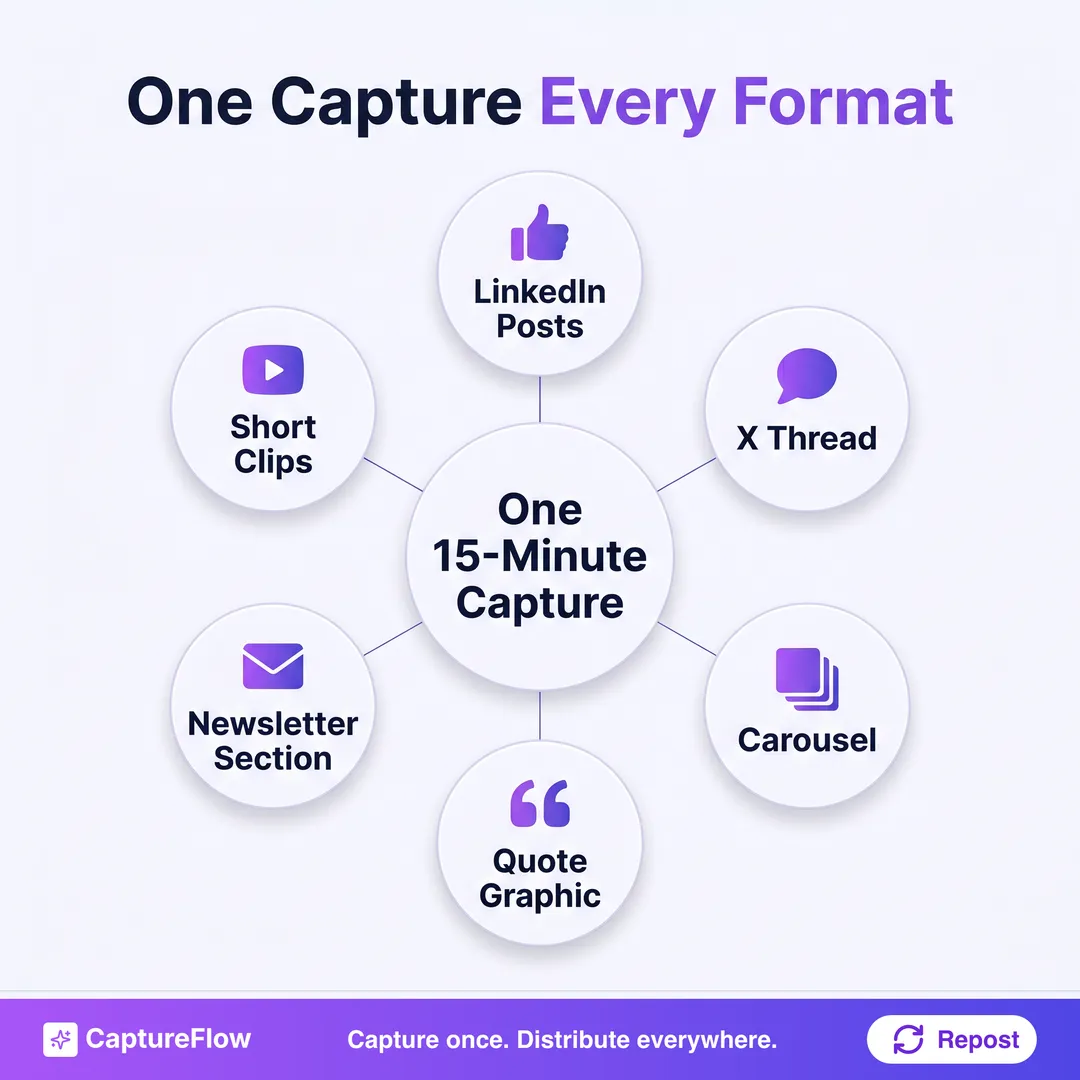 The same capture, rendered native to each format. No idea gets used only once.
This is the step where AI earns its keep, and the data backs the leverage: in HubSpot's 2026 State of Marketing report, a survey of 1,500+ marketers, about a third of teams say AI saves them 10 to 14 hours per week, and another third say it saves more than 15. The catch is that generic AI drafting from a blank prompt produces generic output. Drafting from your transcript, grounded in your voice and phrasing, produces posts that sound like you because the substance already is you.
The quality test for a draft: read it out loud. If you would not say that sentence to a customer, it does not ship. This one filter removes most of what makes AI-assisted content detectable.
Step 4: Schedule the week into proven windows
A drafted set that never gets queued is a diary. Put the week on the calendar in one sitting:
- Spread the set across 5 to 10 days. Lead with the strongest angle (usually the contrarian take or the thesis), and let each post breathe.
- Use data for the slots, then your analytics. Start from the consensus windows in our best time to post on LinkedIn guide, mid-morning on weekdays, and let your own numbers promote or demote slots over time.
- Queue everything at once. The scheduling session is part of the weekly loop, not a daily task. If posting requires a daily decision, the system has a daily failure point.
This is also where a content strategy layer pays off: knowing which pillar each post serves keeps a week from accidentally being five versions of the same idea.
Step 5: Recycle and let the library compound
The loop's real payoff arrives after a few cycles. Every capture, transcript, angle, and post accumulates into a library, and the library changes the economics:
- Winners get re-run. A post that worked in March works again in July, rewritten from the same angle. Audiences turn over; your best ideas deserve more than one at-bat.
- Old captures answer new questions. When a topic comes up, you search your own transcripts before recording anything new.
- Patterns emerge. After 10 weeks you know which angle types your audience actually engages with, so extraction gets sharper.
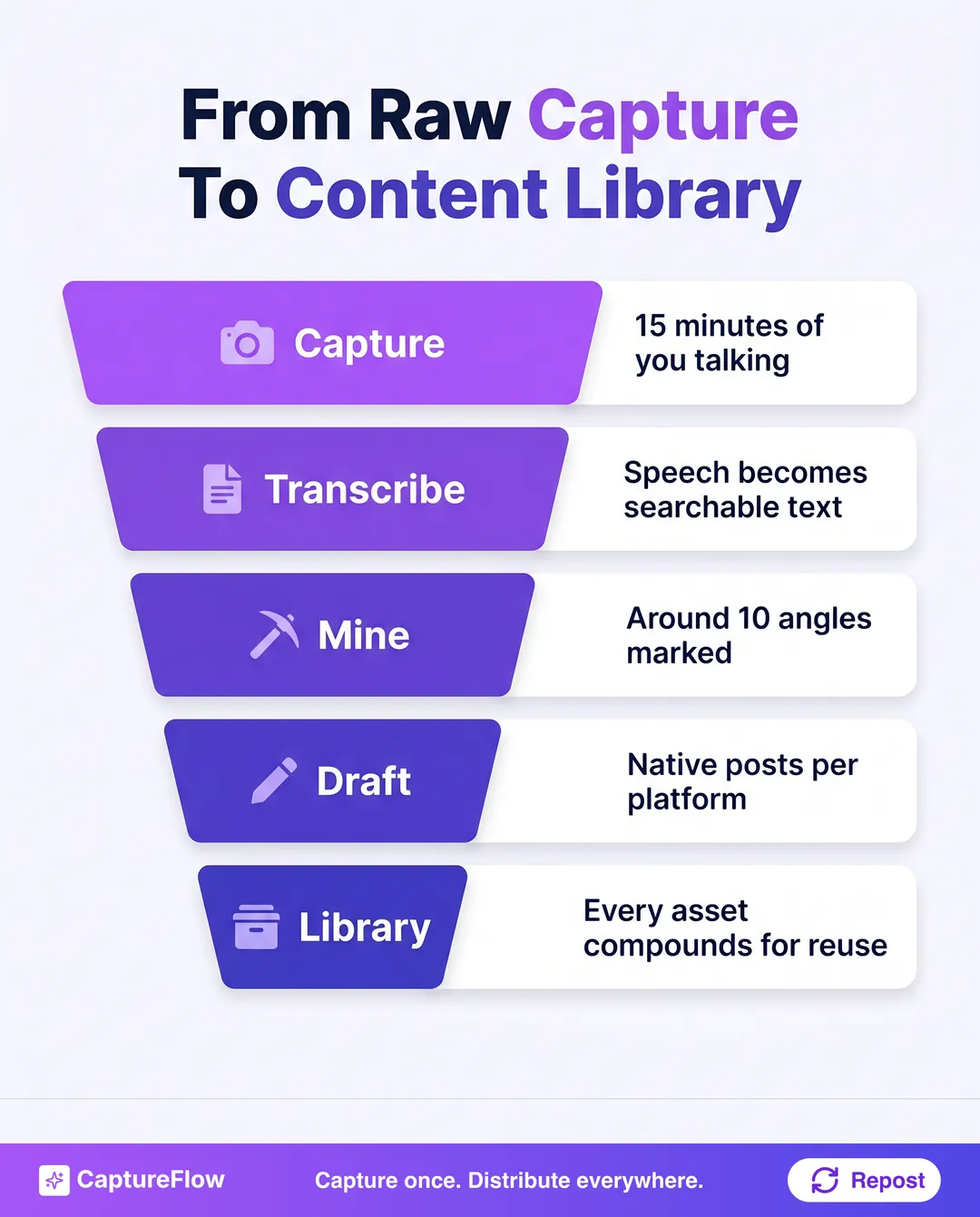 Each week's capture refines down into assets, and the assets accumulate.
Run the recycle pass monthly: 20 minutes, look at the top posts, mark two to re-angle, and note one topic that deserves a fresh capture. That is the whole maintenance burden.
What a real week looks like
Here is the loop laid on a calendar, with honest time costs:
| When | What | Time |
|---|---|---|
| Monday 9:00 | Capture: one topic, to camera or voice | 15 min |
| Monday 9:20 | Extract and draft (AI-assisted from transcript) | 5 minutes with an engine, 2 to 3 hours by hand |
| Monday 9:30 | Review drafts, fix phrasing, approve | 15 min |
| Monday 9:45 | Schedule the set across the week | 5 min |
| Month end | Recycle pass: resurface winners | 20 min |
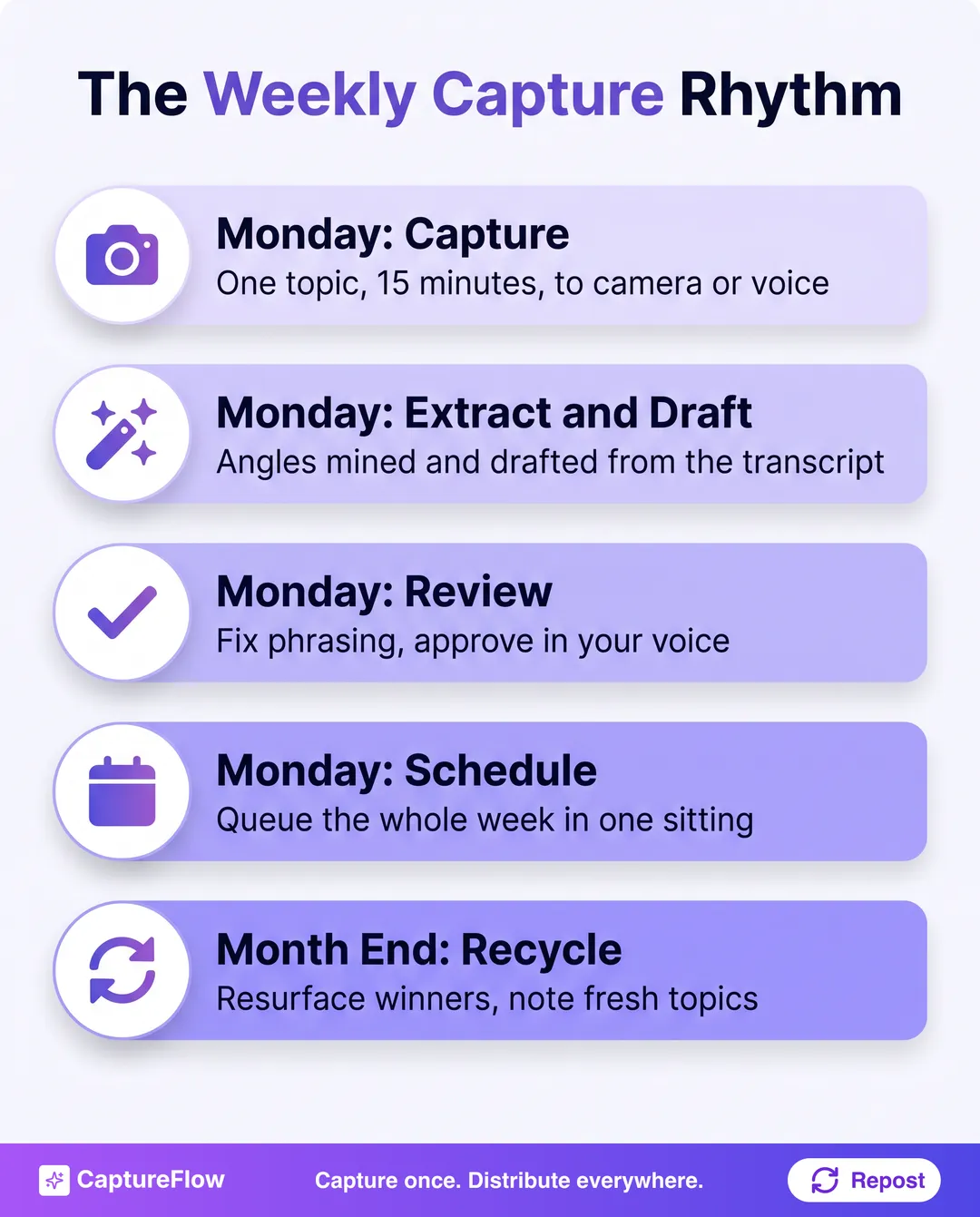 The whole system is one Monday morning block plus a monthly pass.
The by-hand version of this system works and costs a morning. The tooled version costs about 45 minutes end to end. CaptureFlow is an AI content agent that turns your expertise into weeks of on-brand content for every platform: you record the 15 minutes, and 5 minutes later the extracted, voice-matched drafts are waiting for review. The system is the same either way; the tool just removes the labor between capture and calendar.
Where other tools fit (and where they do not)
Honest map of the landscape, because no single tool does this whole loop:
- Schedulers (Buffer, Hootsuite and the rest of the scheduling category) are genuinely good at step 4 and nothing before it. They assume the content exists. If your bottleneck is supply, a scheduler organizes your silence.
- Blank-prompt AI (ChatGPT and peers) drafts fast but starts from nothing, so it fills the voice gap with averages. Useful as a thinking partner in step 2, risky as the author in step 3.
- Clip tools cover one output format from video. Great at what they do, narrow by design.
A capture-first engine is the category that runs the loop end to end. If you want to compare the options side by side, the compare hub has the full set.
Start this Monday
The system asks for one thing you already have: 15 minutes of talking about work you already did. Put the capture slot in your calendar, use the prompt list from step 1, and run the loop three times before judging it. Once the loop feels routine, the same mechanics scale up to batching a whole month in one afternoon. Three weeks builds a small library; the fourth week is when posting stops feeling like a chore and starts feeling like shipping inventory. It is also the engine behind a founder personal brand, if that is where you are headed.
If you want the loop with the labor removed, see how CaptureFlow works or what it costs. Either way, stop creating from zero. You already said the good stuff, capture it.
Frequently asked questions
What is a capture-first content system?+
A weekly workflow where you record yourself talking about what you know (video or voice), then extract post angles from the transcript, draft platform-native content from them, and schedule the set. You create from your own words instead of a blank page.
How much time does the capture-first system take per week?+
About 15 minutes of capture plus a review session. With an AI content agent drafting from your capture, the full loop from recording to a scheduled week is roughly 35 to 45 minutes. By hand, budget 3 to 4 hours.
Do I need special equipment to start?+
No. A phone camera or a voice memo is enough. The system runs on what you say, not how it is shot. Upgrade the recording setup only after the loop is a habit.
What if I run out of things to capture?+
Capture prompts come from your actual week: questions customers asked, decisions you made, things you changed your mind about. If you are doing the work, you have material. The prompt list in step 1 keeps the queue full.
Chris is the founder and CEO of CaptureFlow, which he builds so founders can turn their expertise into content without hiring a team. After 10+ years building products and growing audiences from scratch, he writes about founder-led content, AI, and distribution from inside the problem he is solving: distributing consistent, on-brand content as a team of one.
Founder & CEO of CaptureFlow · 10+ years building products and audiences
One playbook a week from founders who actually create and distribute lots of content. No spam, unsubscribe anytime.
Keep reading

The Founder's Content Operating System (5 Minutes a Day)
You do not have a discipline problem. You have a missing system. Here is the content operating system that runs on 5 minutes a day, from one capture to every platform.
How to Repurpose Podcast Clips, Voice Memos, and Automate Social Content: One System for Founders
Your podcast episode and the voice memo you recorded on the train are the same raw material. Here is one system that turns both into a week of native posts, then distributes them for you.
How to Repurpose One Podcast Episode into 30 Posts
You already recorded an hour of gold. Most of it dies after one listen. Here is the exact system to turn one podcast episode into 30 native posts for every platform.