How to Batch a Month of Content in One Afternoon
A step-by-step batching workflow: four 15-minute captures, one review pass, one scheduling session, and a month of content ships itself.


Posting every day sounds disciplined. In practice it is 30 cold starts a month: 30 context switches, 30 "what should I post today" moments, 30 chances to skip.
Batching deletes the question. Content batching is producing your entire month of content in one focused session, then spending the rest of the month only reviewing and replying. This is the batch content creation workflow we actually use: one afternoon, four hours, roughly a month of posts scheduled by dinner.
It builds directly on the capture-first content system, and it is the production engine behind a full content repurposing strategy. That workflow runs weekly; this one is the same loop scaled to monthly, for founders who would rather go deep once than shallow four times. If you run a lean team rather than a solo founder feed, the same leverage powers scaling content production with a small team.
Why does batching beat daily creation?
Two reasons, one cognitive and one practical.
The cognitive one: switching is expensive. Every daily content session drags your brain out of real work and into publishing mode, and the toll booth charges both ways. Research on interrupted work by Gloria Mark at UC Irvine found that regaining focus after a task switch takes over 20 minutes on average, and that people compensate for fragmentation by working faster at the cost of measurably higher stress. Thirty small content sessions do not cost 30 small units of attention; they cost 30 refocusing cycles on both sides.
The practical one: quality clusters. Your fourth capture of the afternoon is better than your first, because you are warm. Hooks come faster, opinions come sharper. Daily creation never lets you get warm; you spend every session in the first, worst 10 minutes.
Daily content is 30 cold starts. Batching is one warm afternoon and 29 days of just showing up in the comments.
The failure mode of batching is real too, and worth naming honestly: over-batch and you become a robot who ignores the news cycle for three weeks. The fix is built into this workflow: you batch the planned 80 percent and leave 20 percent of slots open for reactive posts. More on that below.
What you need before the afternoon
Thirty minutes of prep, ideally the day before:
- Four capture topics from your lane. Use the prompt list from the capture workflow: questions customers asked twice, a decision you almost got wrong, a number that surprised you, a take that annoys your industry.
- Your voice layer in place. If AI is drafting from your transcripts, it should already be trained on your voice. Setting that up mid-batch burns the afternoon.
- A clear calendar target. Know your cadence (say, 5 posts a week) and your windows (mid-morning Tuesday to Thursday is the data-backed default, per our best time to post guide).
- Four protected hours. Phone in a drawer. The whole point is uninterrupted depth; guard it like a board meeting.
The afternoon, hour by hour
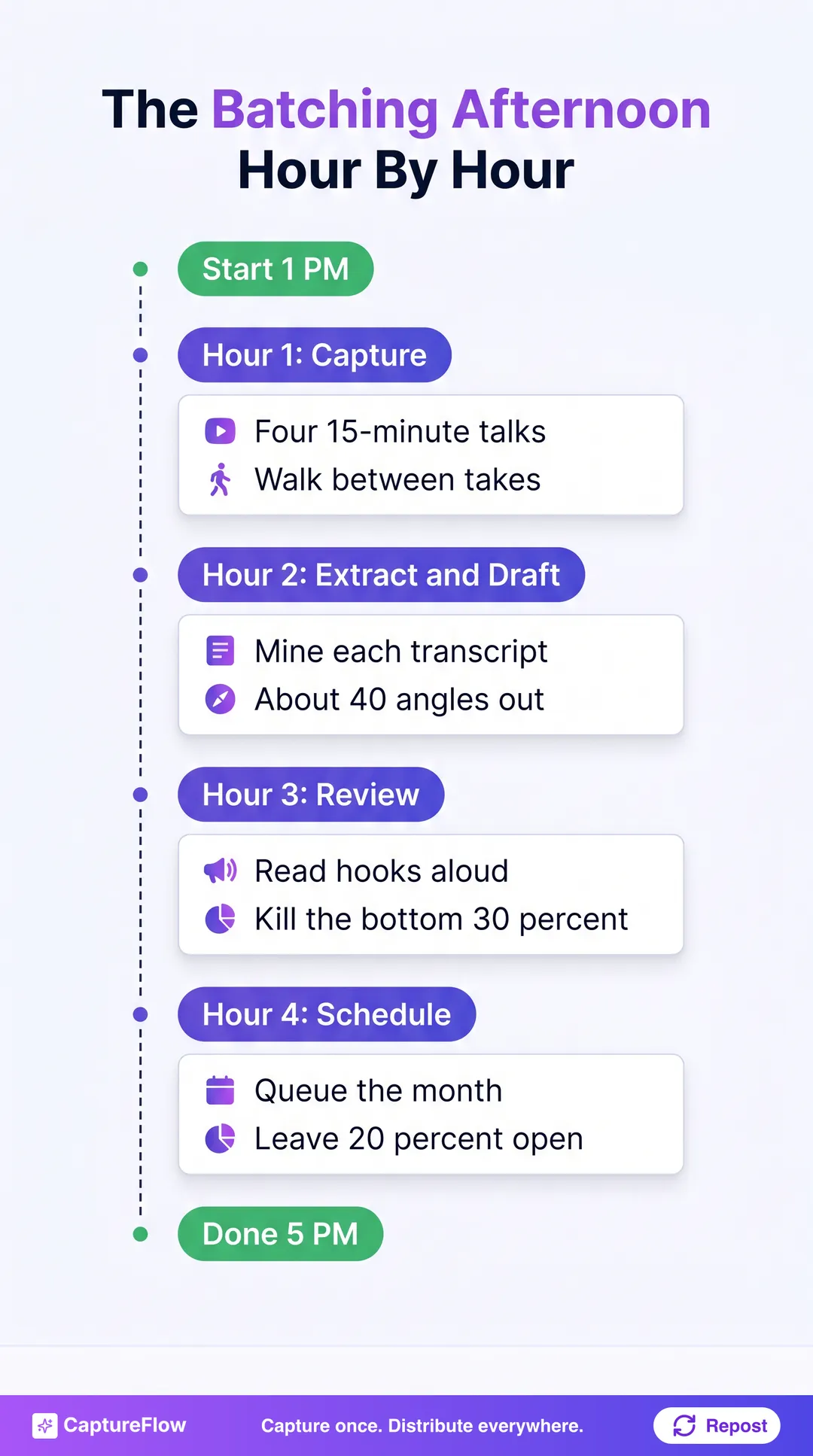 Four hours, four blocks. Protect them like a board meeting.
Hour 1: Capture four topics (4 x 15 minutes)
Record four separate 15-minute captures, one topic each, to camera or voice. Separate beats one rambling hour: each capture needs its own spine so the extracted posts stand alone. Take a two-minute walk between takes; it resets your energy and the next take opens stronger.
Do not review anything yet. Capture mode and edit mode are different brains, and mixing them is the classic batching mistake.
Hour 2: Extract and draft
Transcribe all four captures, then mine each transcript for angles: the thesis, the contrarian take, the story, the framework, the stat, the lesson. The 10-angles method applies to each capture, so four captures yield roughly 40 angles. You will not use all of them; you need 20 to 25 for the month, so you get to throw away the weak half.
By hand this hour is the bottleneck (realistically it spills into two). With an engine drafting from each capture it is nearly idle time: CaptureFlow is an AI content agent that turns your expertise into weeks of on-brand content for every platform, so each 15-minute capture comes back as a drafted set about 5 minutes later, formatted per platform.
Hour 3: Review everything in your voice
Now the judgment pass, the one hour nothing can automate:
- Read every hook aloud. If you would not say it to a customer, rewrite it.
- Kill the bottom 30 percent. Batching gives you surplus; use it to be ruthless. A month of your 25 best beats a month of all 40.
- Vary the formats. Check the mix across opinions, numbers, and stories, so week three is not four how-tos in a row.
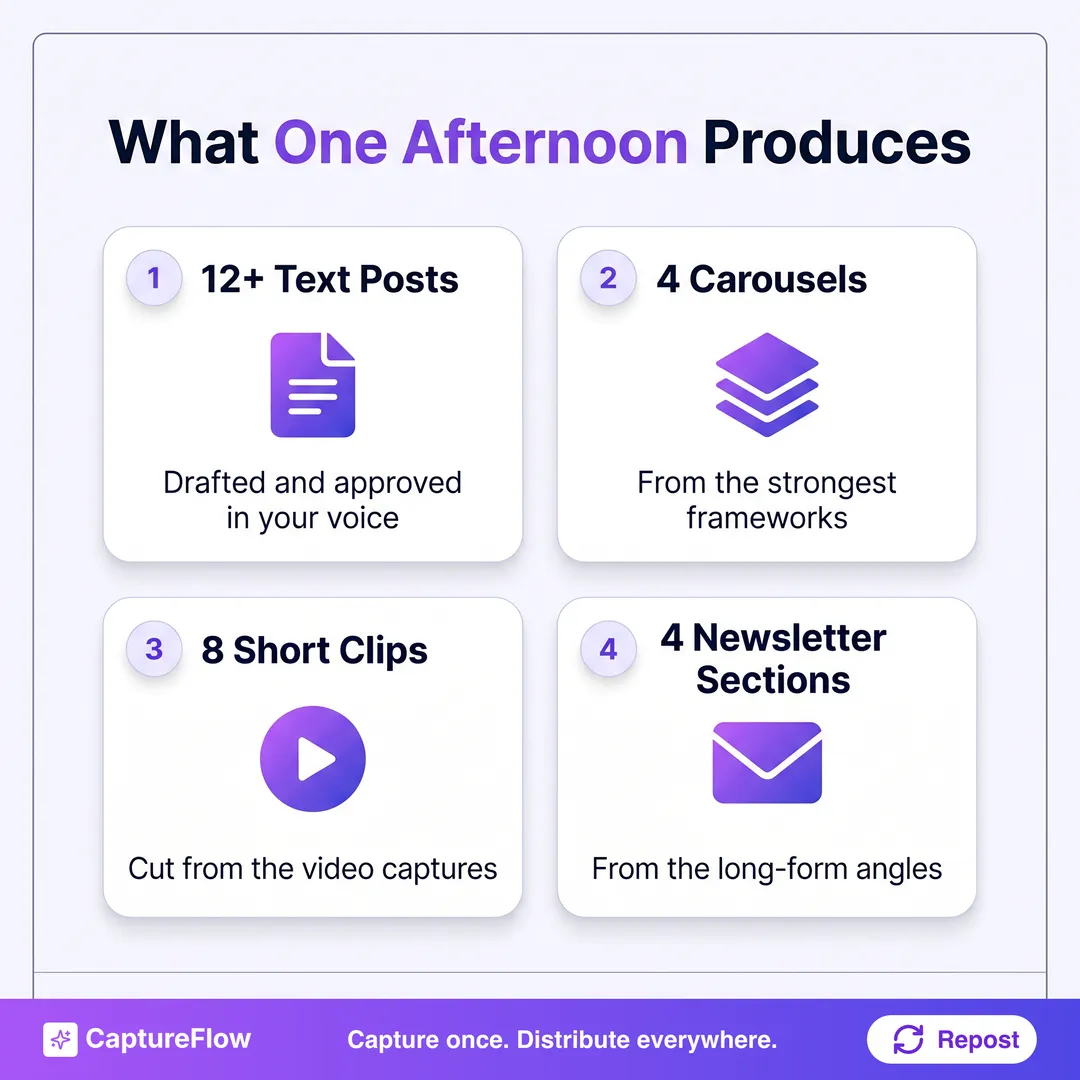 The output of four captures after a ruthless review pass.
Hour 4: Schedule the month
Queue the survivors across the calendar in one sitting:
- Spread each capture's posts across the month rather than clustering them in one week; the angles age fine and the variety reads fresher.
- Lead each week with the strongest hook, usually a contrarian take or a number.
- Fill only 80 percent of slots. The empty 20 percent is your reactive lane for news, replies-turned-posts, and whatever Tuesday brings. This is what keeps a batched calendar from feeling canned.
- Set the windows once in your schedule calendar and reuse them monthly; re-test quarterly.
End the hour by booking next month's batching afternoon. Batching only compounds if it recurs, and the calendar invite is the difference between a system and a stunt.
What a batched month actually looks like
Concrete beats abstract, so here is a realistic month from four captures at a 5-posts-a-week cadence:
| Week | Anchor (from capture) | Supporting posts | Open slots |
|---|---|---|---|
| 1 | Contrarian take from capture A | Story + how-to from A, stat from C | 1 |
| 2 | Framework from capture B | Carousel of B, lesson from A | 1 |
| 3 | Numbers post from capture C | Story from B, how-to from D | 1 |
| 4 | Lesson-learned from capture D | Clip from D, one-liner from C | 1 |
Three details worth copying. Each week anchors on a different capture, so no single topic wears out its welcome, and the strongest angle of each capture leads its week. Angles cross-pollinate across weeks, which is why week one can borrow a stat from capture C; the calendar reads varied even though everything came from one afternoon. And every week keeps an open slot, so the month bends when something happens instead of breaking.
The other thing this table quietly shows: you did not need 20 separate ideas. You needed four topics you know cold, and an extraction pass. That reframe, from "generate 20 ideas" to "mine 4 talks", is the entire psychological difference between batching that sticks and batching you try once.
The sweet spot: focus, material, slack
Batching works when three things are true at once, and it wobbles when any one is missing.
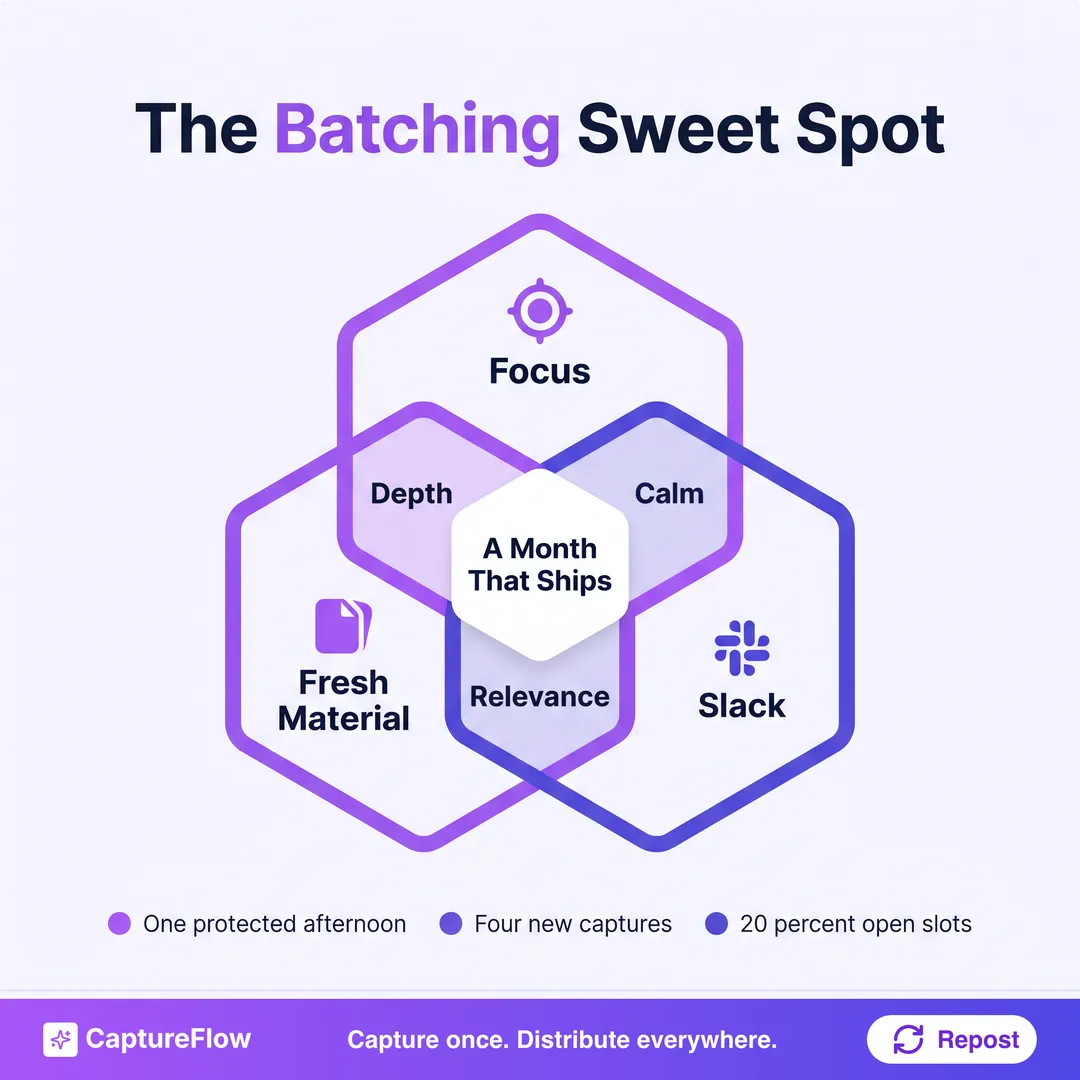 Miss one and you get burnout, staleness, or a canned feed. Hold all three and the month ships itself.
- Focus without material is a productive afternoon spent polishing nothing; capture first.
- Material without slack turns your feed into a pre-recorded broadcast that ignores the room.
- Slack without focus is just daily posting again, with extra steps.
The six batching mistakes (and the fix for each)
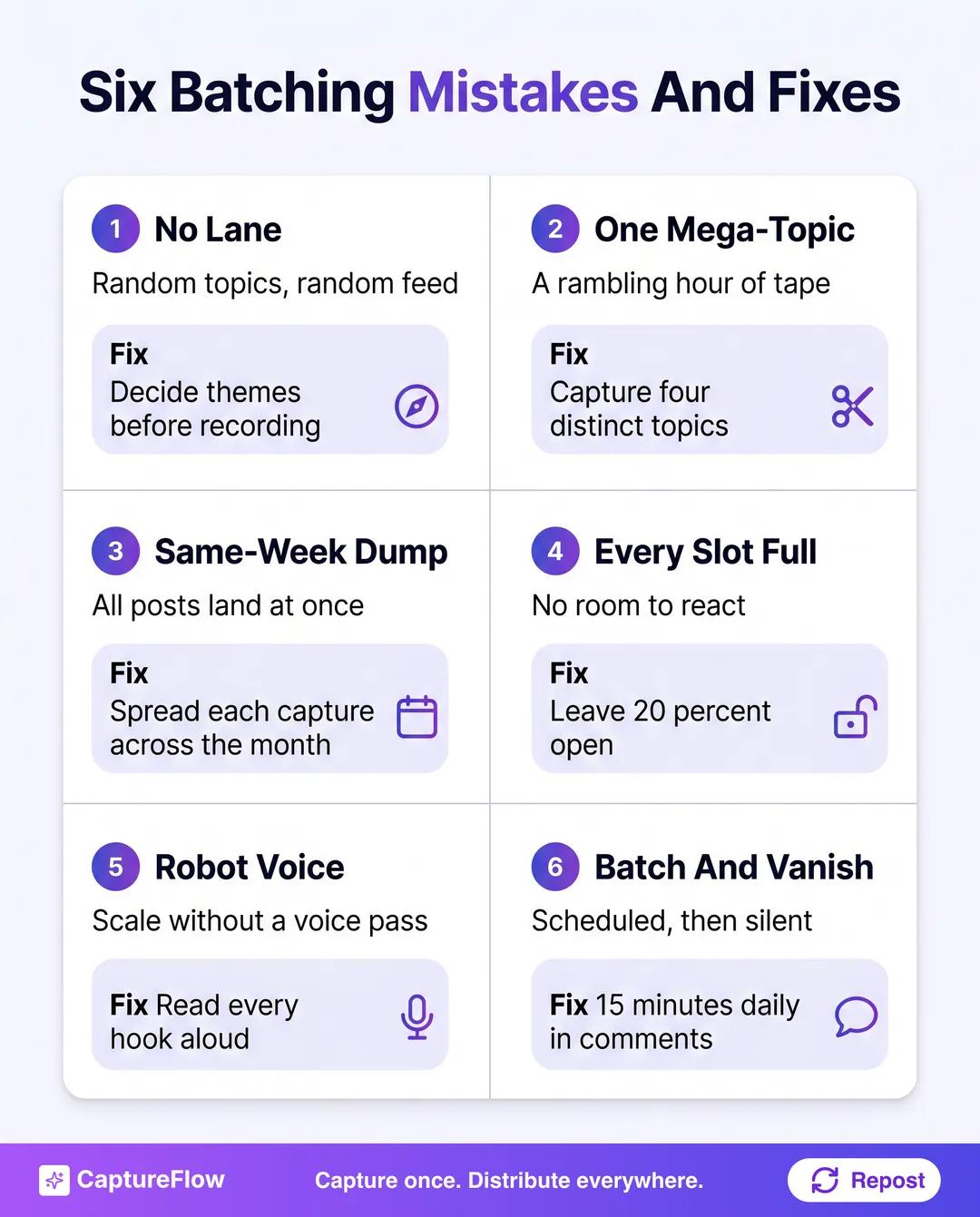 Every one of these is survivable. Number six is the one that quietly kills accounts.
The sixth deserves emphasis: batching creates a dangerous illusion of doneness. The content is scheduled, so it feels like the job is finished, and founders vanish from their own comment sections for weeks. But distribution is a conversation, not a broadcast: 15 minutes of daily replies is still part of the deal, and it is where batched posts turn into pipeline. If the end goal is a durable founder personal brand, the calendar earns attention and the replies convert it.
Weekly loop or monthly batch? An honest comparison
| Weekly capture loop | Monthly batch | |
|---|---|---|
| Session length | ~45 minutes | ~4 hours |
| Freshness | Highest, captures are days old | Good, if you keep the 20% slack |
| Failure risk | Miss a week, lose a week | Miss the afternoon, lose a month |
| Best for | Founders who like rhythm | Founders who like deep work |
There is no wrong answer, and the mechanics are identical either way: capture, extract, review, schedule. Start with the weekly loop if you are new to capture-first; graduate to monthly once the reviewing muscle is built. The one non-negotiable in both: the review pass stays yours.
Your first batching afternoon
Book four hours this week. Prep the four topics the night before, run the hours as written, and judge the result by one number: how many days next month you publish without thinking about publishing. The typical answer after one honest attempt is "all of them except the fun ones", which is exactly the point.
If you want the extract-and-draft hour to take 5 minutes instead of spilling into two, that is the part we automate: see how CaptureFlow works or what it costs. Either way, stop paying the cold-start tax 30 times a month. Pay it once, warm, with coffee.
Sources
- Gloria Mark, UC Irvine: The Cost of Interrupted Work: More Speed and Stress
- HubSpot: The Best Time to Post on LinkedIn
Frequently asked questions
How do you batch a month of content in one day?+
Block four hours. Hour one, record four 15-minute captures on four topics. Hour two, extract angles and draft posts from the transcripts. Hour three, review and edit everything in your voice. Hour four, schedule the set across the month into proven posting windows.
How much content can you realistically batch in one afternoon?+
From four 15-minute captures, expect around 40 usable post angles: enough for 20 to 25 scheduled posts plus carousels and clips, which covers a month at a typical founder cadence with angles to spare.
Does batched content feel stale or robotic?+
Only if you batch 100 percent of the calendar or skip the voice pass. Leave about 20 percent of slots open for reactive posts, review every draft aloud before approving, and the feed cannot tell your Tuesday post was made three weeks ago.
Is it better to batch weekly or monthly?+
Start weekly using the capture-first loop, then graduate to monthly batching once the workflow feels routine. Monthly suits founders who prefer one deep session over four shallow ones; the mechanics are identical, just scaled.
Chris is the founder and CEO of CaptureFlow, which he builds so founders can turn their expertise into content without hiring a team. After 10+ years building products and growing audiences from scratch, he writes about founder-led content, AI, and distribution from inside the problem he is solving: distributing consistent, on-brand content as a team of one.
Founder & CEO of CaptureFlow · 10+ years building products and audiences
One playbook a week from founders who actually create and distribute lots of content. No spam, unsubscribe anytime.
Keep reading
How to Repurpose One Podcast Episode into 30 Posts
You already recorded an hour of gold. Most of it dies after one listen. Here is the exact system to turn one podcast episode into 30 native posts for every platform.

The Founder's Content Operating System (5 Minutes a Day)
You do not have a discipline problem. You have a missing system. Here is the content operating system that runs on 5 minutes a day, from one capture to every platform.
The Capture-First Content System: A Complete Workflow
Consistency does not come from discipline. It comes from a system where the hard part happens once a week. Here is the full capture-first workflow, step by step.