Best Time to Post on LinkedIn in 2026 (Backed by Data)
The best time to post on LinkedIn is Tuesday through Thursday, 9 am to noon in your audience's timezone. Here is the data, and how to find your own peak.

You wrote a genuinely good post. You published it Saturday at 8 pm, because that is when you finally had a minute. It got 4 likes, and one of them was your cofounder being polite.
So here is the direct answer to the question. The best time to post on LinkedIn in 2026, according to platform and industry data, is Tuesday through Thursday between roughly 9 am and noon in your audience's timezone. Mid-morning through lunch on a weekday is the most consistent high-engagement window, and weekends are the most consistent dead zone.
That is the answer worth putting in a calendar. But it is the beginning of the story, not the end, because the same data shows something most "magic hours" charts skip: timing decides how big your post's first audience is, while content decides everything after that. This guide covers both halves, with sources, and ends with a 30-day system to find your own peak instead of borrowing an average. Timing is really the cadence layer of a full LinkedIn content strategy, so treat this as one part of that larger system.
What is the best time to post on LinkedIn?
The best time to post on LinkedIn is mid-morning to early afternoon, Tuesday through Thursday, in the timezone where your audience works.
That one sentence is the consensus of the two most credible non-vendor sources available:
- HubSpot's analysis puts the peak at Tuesday through Thursday, 8 am to 2 pm, and flags weekends and anything outside business hours as the low points.
- LinkedIn's own marketing blog reviewed the major timing studies and landed on weekdays, with mid-morning through lunchtime as the strongest stretch, and Tuesday through Thursday as the strongest days. Their bigger point, which we will get to, is that every audience is different.
The logic is not mysterious. LinkedIn is a workday platform. People check it with their first coffee, between meetings, and over lunch. Engagement rises and falls with the office clock, which is also why "your audience's timezone" matters more than yours. If you are in Berlin and your buyers are on the US East Coast, your 9 am is their 3 am.
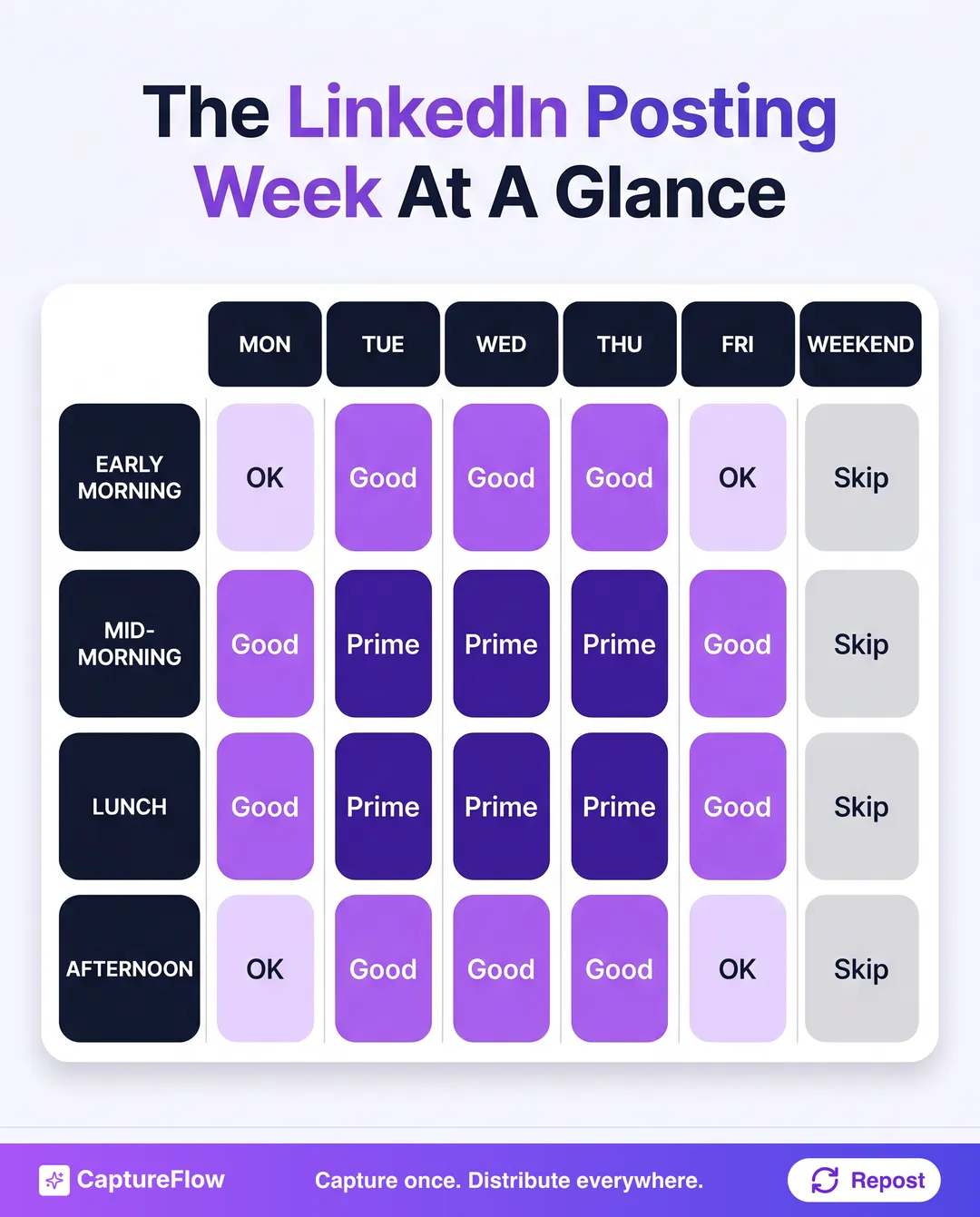 The week at a glance. Prime means post here first. Skip means schedule around it.
HubSpot's day-level ranking, from their 2025 social media timing survey, matches: the best days are Tuesday, Thursday, and Wednesday, and the worst are Sunday, Saturday, and Monday. Monday is the surprise for most people. It is a weekday, but feeds are full of catch-up work and empty of attention.
What does the data say for your specific audience?
The averages above hide real differences by who you are trying to reach. HubSpot's same research breaks the window down by audience, and the spread is worth a table:
| Audience you serve | Best posting window |
|---|---|
| General B2B | Tuesday to Thursday, 8 am to 2 pm |
| B2C audiences | 11 am to 2 pm |
| Healthcare and higher education | 11 am to 1 pm |
| Media and news | 8 am to 10 am |
| Software and tech audiences | Outside the 9-to-5, early morning or evening |
That last row deserves a pause. If you sell to engineers and technical founders, HubSpot's data suggests the classic mid-morning slot is exactly wrong, because that is when your audience is heads-down building. They scroll before standup and after dinner. This is the clearest proof that the generic chart is a starting grid, not a law.
It also helps to remember how big and fast-moving this platform is. Per DataReportal's latest LinkedIn deep-dive, LinkedIn passed 1.2 billion members in early 2025, growing about 17 percent year over year, with roughly 47 percent of its ad audience aged 25 to 34. The feed is not getting quieter, which means the cost of posting into a dead hour keeps rising.
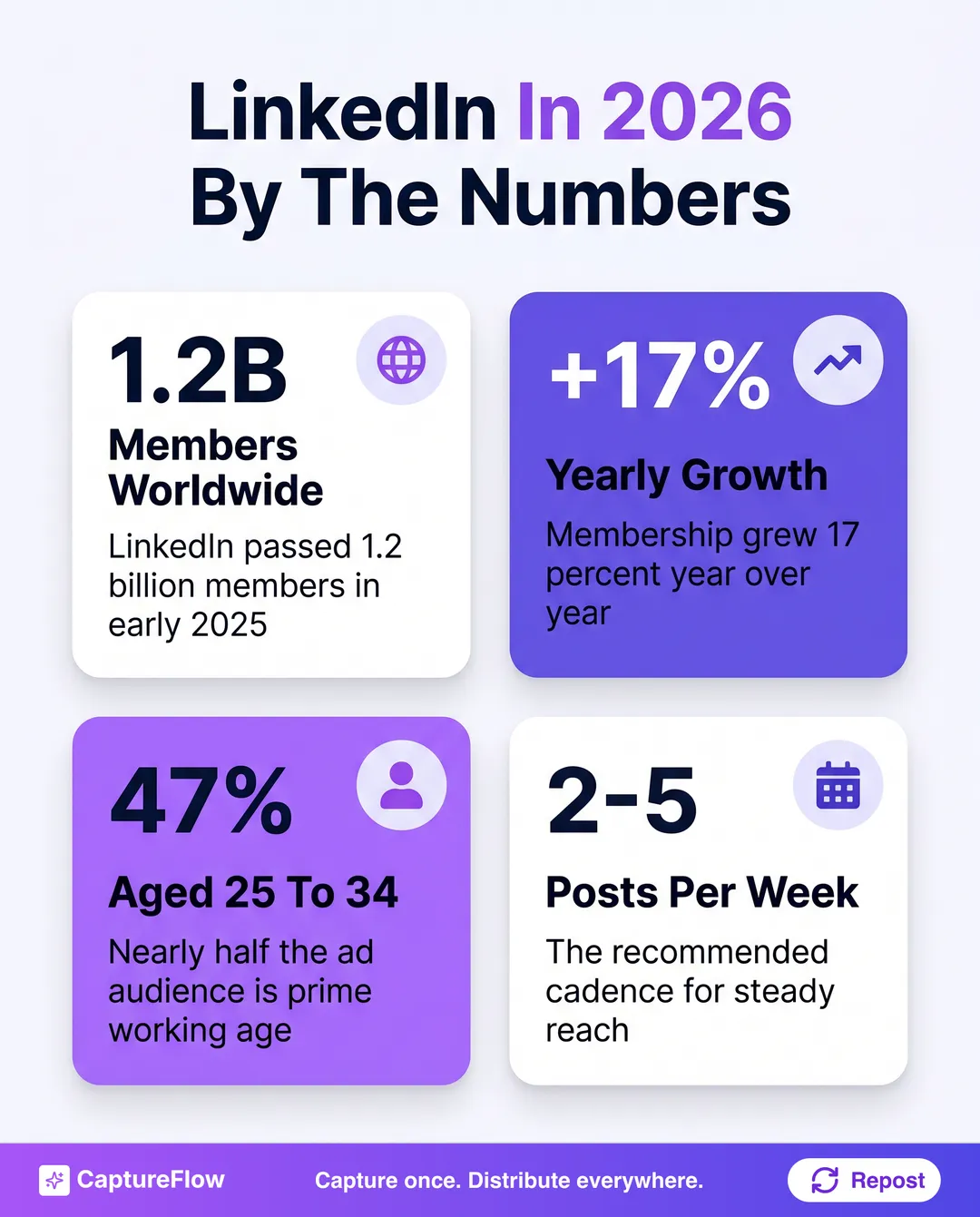 The platform behind the timing debate, per DataReportal and HubSpot.
Why does timing matter less than you think?
Here is the part the magic-hours charts leave out: posting time is not a ranking factor. It is a sampling factor.
When your post goes live, LinkedIn shows it to a slice of your network and watches what happens. The feed's ranking systems then decide how far it travels, and they are judging the post, not the clock. Two pieces of LinkedIn's own engineering work tell you what they judge:
- Dwell time. LinkedIn's feed team added dwell time to feed ranking because likes and clicks alone were easy to game and easy to miss. They measure how long members actually spend on your post in the feed and after clicking it. A post people read to the end outranks a post people skim past, at any hour.
- Relevance at model scale. In 2025, LinkedIn published 360Brew, a 150-billion-parameter foundation model that powers ranking and recommendation across the platform. It reads posts and member context as text and predicts what each person will find relevant, replacing hand-built features. In plain terms: the feed understands what your post is about and who should see it.
Put those together and the role of timing becomes clear. Posting at 10 am on Tuesday does not make the algorithm like you. It makes your first-hour sample bigger, because more of your people are online to generate the dwell time and comments the ranking systems feed on. Timing amplifies a post that earns attention. It does nothing for one that does not.
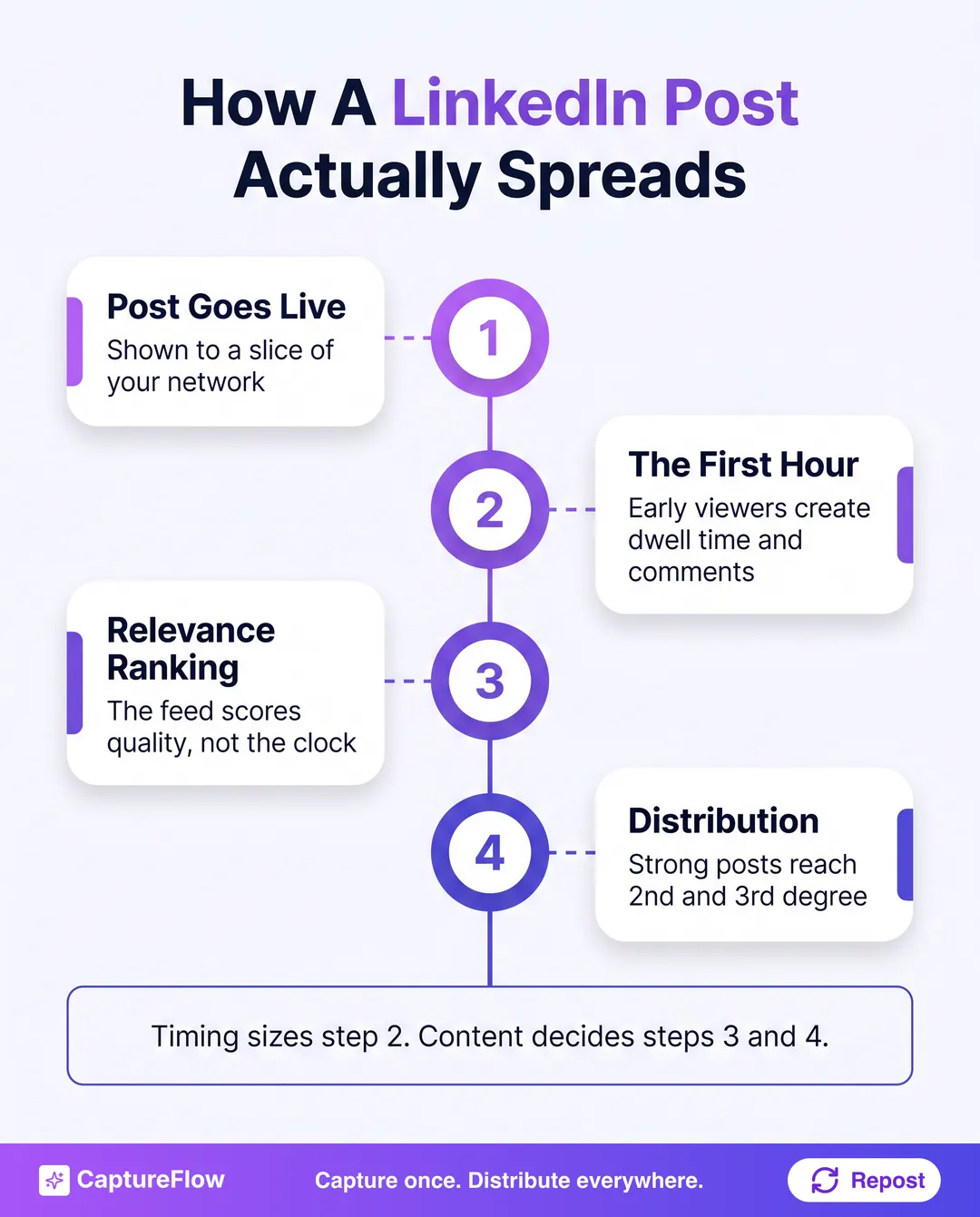 Timing only touches step 2. Content quality decides steps 3 and 4.
A strong post at an average hour beats an average post at the perfect hour. Timing sizes your first audience. Content decides whether there is a second one.
This is also the honest reading of LinkedIn's own advice. Their marketing blog publishes the consensus windows, then immediately tells you that every audience is different and that testing your own schedule beats following anyone's chart. When the platform itself hedges the magic hours, believe the hedge.
How do you find your own best time on LinkedIn?
Industry averages get you to the right neighborhood. Your analytics get you to the right door. Here is the 30-day version, and it costs nothing but consistency.
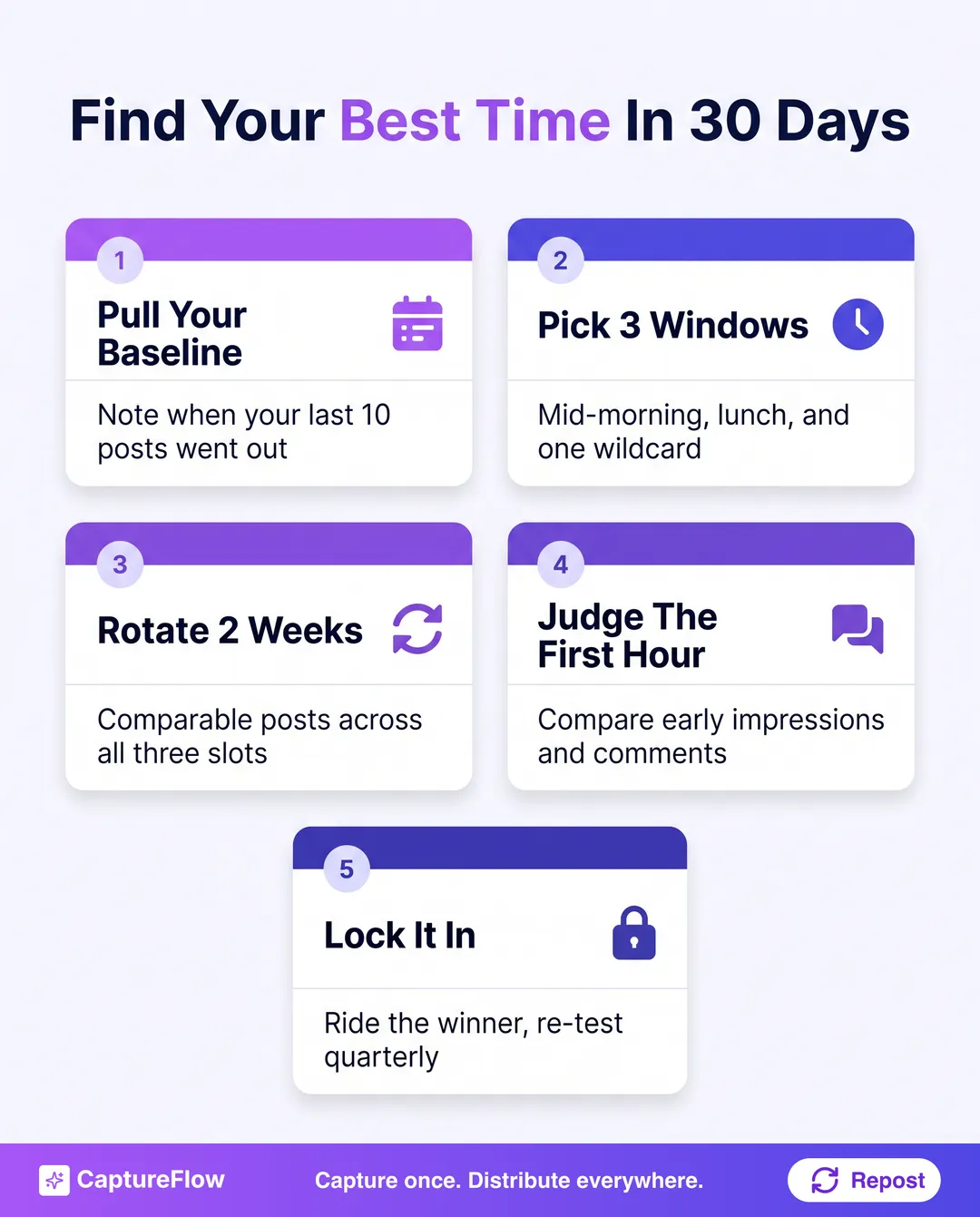 Thirty days, five steps, one answer that is actually yours.
- Pull your baseline. Open your recent post analytics and note when your last 10 posts went out and what each did in impressions and comments. Most people discover their "schedule" was random. That randomness is why generic charts feel true: anything beats chaos.
- Pick three candidate windows. Start from the data above: one mid-morning slot (say Tuesday 9:30 am), one lunch slot (Wednesday noon), and one that fits your specific audience from the table, like Thursday 7 am if you serve technical folks.
- Rotate for two weeks. Post comparable content across the three windows. Do not test a hot take against a housekeeping update and credit the hour for the difference.
- Judge the first hour. Compare impressions and comments in the first 60 minutes per window. That early sample is what the feed uses to decide distribution, so it is the cleanest read on whether the window found your audience awake.
- Lock it in, then re-test quarterly. Pick the winner and ride it. Audiences shift, feeds shift, and a quarterly one-week re-test keeps your window honest.
Test one variable at a time. If you change the posting hour, the format, and the topic in the same week, you learn nothing. Hold the content style steady and let the clock be the only thing that moves.
If you want the fuller system this plugs into, our guide to turning one video into 10 LinkedIn posts pairs well here: it fills the calendar, and this article tells you where on the calendar to put it.
How often should you post on LinkedIn?
HubSpot's guidance is two to five posts per week, and no more than five. Beyond that you start competing with yourself for your own audience's attention.
The trap is not posting too little in a given week. It is posting five times one week and zero times the next three. Every credible take on the feed, including LinkedIn's own, rewards accounts that show up steadily, because steady accounts give the ranking systems a reliable signal of who your content serves. A boring cadence you can sustain beats an impressive cadence you cannot.
That is usually where the real bottleneck reveals itself. Most founders do not have a timing problem. They have a supply problem: they know when to post and have nothing ready to post. A scheduling tool solves the clock. It does not solve the empty queue.
The honest take: timing is the last 10 percent
Nail the timing question in one afternoon: start Tuesday to Thursday mid-morning, run the 30-day test, lock in your window. Done. What remains is the other 90 percent, which is having something worth posting two to five times a week, every week, in your own voice.
That is the problem we built for. CaptureFlow is an AI content agent that turns your expertise into weeks of on-brand content for every platform. You talk about what you know for a few minutes, and 5 minutes later you have a set of posts in your voice, ready to drop into the exact windows you just validated. The capture-first approach means your best posting slot never goes empty because you had no time to write.
So use the data: Tuesday through Thursday, 9 am to noon, your audience's timezone. Then make the data irrelevant by being the account that shows up every week regardless. If the supply side is your gap, look at how CaptureFlow works or see what it costs. And if you are comparing ways to solve it, our rundown of the best AI LinkedIn content tools is a fair place to start.
Sources
- LinkedIn Marketing Solutions: What's the Best Time to Post Content on LinkedIn?
- LinkedIn Engineering: Understanding dwell time to improve LinkedIn feed ranking
- LinkedIn / arXiv: 360Brew: A Decoder-only Foundation Model for Personalized Ranking and Recommendation
- HubSpot: The Best Time to Post on LinkedIn
- HubSpot: The Best Times to Post on Social Media in 2025
- DataReportal: LinkedIn Users, Stats, Data and Trends
Frequently asked questions
What is the best time to post on LinkedIn?+
Tuesday through Thursday between roughly 9 am and noon in your audience's timezone. HubSpot's data points to an 8 am to 2 pm weekday window, and LinkedIn's own marketing blog lands on mid-morning through lunchtime. Treat that as your starting grid, then test against your own analytics.
Is it bad to post on LinkedIn on weekends?+
Weekends are the lowest-engagement days in every credible dataset because LinkedIn usage follows the workday. That said, some audiences (founders, creators, job seekers) do scroll on Sundays, so if that is who you serve, test it before writing weekends off.
Does posting time affect the LinkedIn algorithm?+
Only indirectly. The feed ranks posts on relevance and dwell time, not on the clock. Posting when your audience is active gives the algorithm a bigger early sample to judge your post with, which amplifies a good post. It cannot save a weak one.
How often should you post on LinkedIn?+
Two to five times a week, per HubSpot's guidance. Showing up every week at a sustainable frequency beats bursts of daily posting followed by silence.
Chris is the founder and CEO of CaptureFlow, which he builds so founders can turn their expertise into content without hiring a team. After 10+ years building products and growing audiences from scratch, he writes about founder-led content, AI, and distribution from inside the problem he is solving: distributing consistent, on-brand content as a team of one.
Founder & CEO of CaptureFlow · 10+ years building products and audiences
One playbook a week from founders who actually create and distribute lots of content. No spam, unsubscribe anytime.
Keep reading

How the LinkedIn Algorithm Works in 2026 (Backed by Data)
The LinkedIn algorithm is not a slot machine. It is a relevance system with rules you can read, and most of them trace back to LinkedIn's own engineering.
How to Turn Meeting Recordings Into Content
Your best ideas get said out loud in meetings, then vanish. Here is how to turn a single recording into a week of social posts, in about 5 minutes.

How to Build an Employee Advocacy Program on LinkedIn (2026)
Your company page has 2,000 followers. Your fifteen employees have 30,000 connections nobody is reaching. Here is the 6-step program that fixes that.