How to Build a Personal Brand as a Founder in 2026 (Without a Content Team)
Build a founder personal brand in 6 steps: pick one lane, choose a home platform, capture weekly, ship founder-native formats, hold a 90-day cadence, convert.

Your company page has 400 followers and gets 3 likes per post. Meanwhile some founder in your space with a phone camera and strong opinions is pulling your prospects into their comment section every single day.
That gap is not a content-quality gap. It is a trust gap, and it is structural. So here is the direct answer to how to build a personal brand as a founder in 2026: pick one lane, publish your actual thinking in your own voice on one platform, 2 to 5 times a week, for 90 days, from a weekly capture habit that costs you about 45 minutes. No content team, no ghostwriter, no daily writing session.
A founder personal brand is the compounding public record of what you know, believe, and have done, published consistently in your own voice. It is not a logo, a color palette, or a posting streak. It is receipts, accumulating in public. It is also not the same thing as marketing your company through your face, and it is worth being clear on the difference between founder-led marketing and personal branding before you pick what to post. If you sit in the C-suite rather than the founder's chair, the LinkedIn thought leadership strategy for B2B executives is a tighter, more commercial cut of the same idea.
Why founder brands beat company pages in 2026
The trust data has been moving in one direction for years, and it favors faces over logos.
The 2026 Edelman Trust Barometer shows trust draining out of institutions (national government leaders down 16 points over five years, major news organizations down 11) and pooling in personal circles: neighbors, coworkers, and notably "my CEO", up 9 points. People increasingly trust the humans they can see and verify, not the entities behind them.
Play that forward for marketing: a corporate page is an institution. A founder talking plainly about what they are building is a person. When 1.2 billion people are on LinkedIn and the feed decides what spreads, the person wins the tie every time, and it is usually not a tie.
There is a second, less obvious advantage: a founder brand is un-copyable. Competitors can clone your features, undercut your pricing, and imitate your website. They cannot clone the record of you being right in public for two years.
Your competitors can copy your product page. They cannot copy two years of you being usefully right in public.
Step 1: Pick one lane and stay in it
The founders who break through are narrow. Before you post anything, answer one question: what topic sits at the intersection of what you know deeply and what your buyers actually care about?
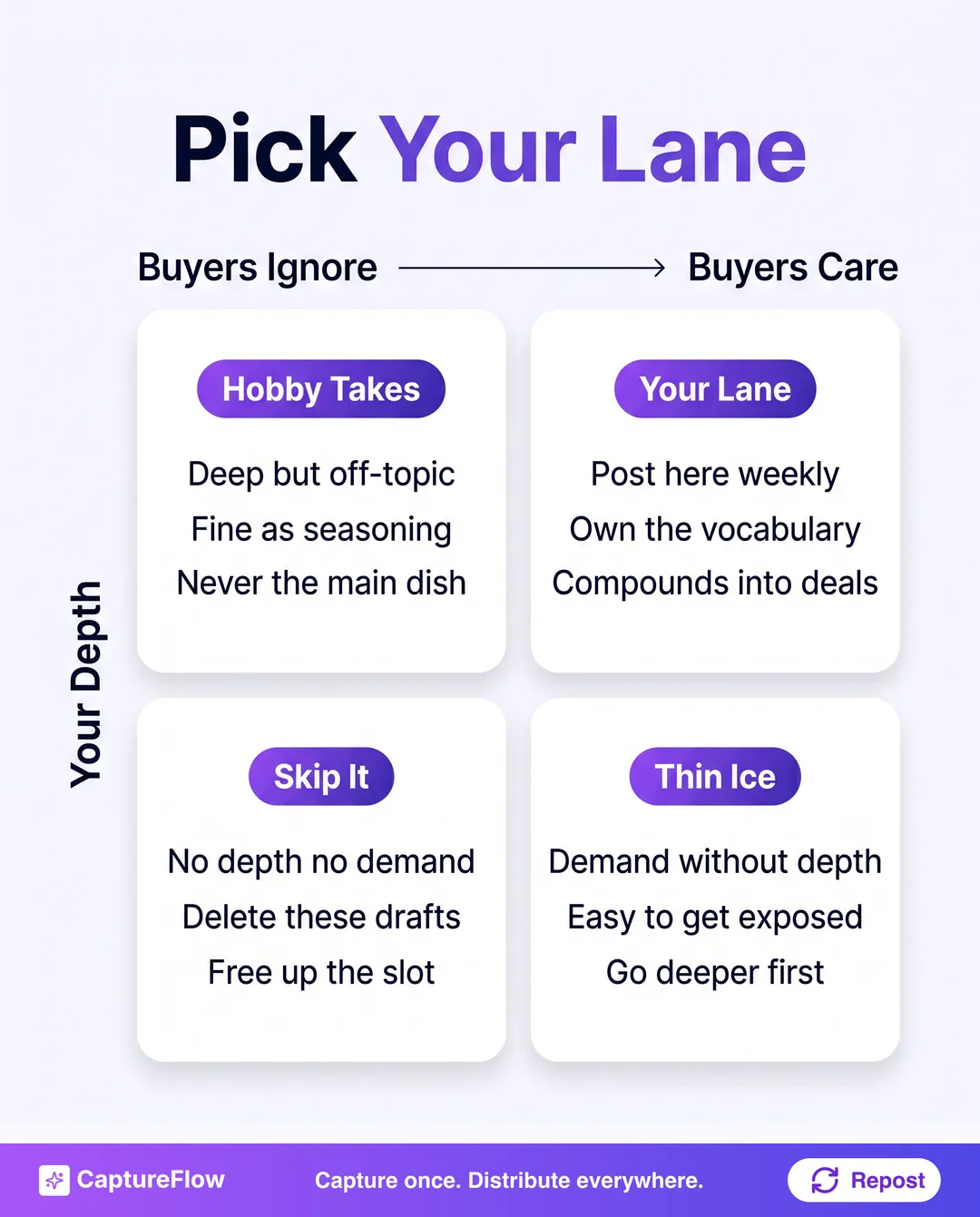 One lane, chosen once. Everything you publish should live in the top-right box.
The test for your lane: you could talk about it for 15 minutes unprepared, your customers bring it up on calls, and you hold at least one opinion about it that annoys your industry. All three matter. Depth without demand is a hobby; demand without depth is thin ice.
Write the lane down as one sentence: "I help [who] [do what], and I publish about [the lane]." That sentence is your filter for every future post, and the seed of your content strategy.
Step 2: Choose a home platform and one satellite
You do not need to be everywhere. You need to be undeniable somewhere.
- Home platform: where your buyers scroll. For most B2B founders that is LinkedIn. Commit to it like a product surface.
- One satellite: X for reach into tech, YouTube for depth, or a newsletter for ownership. The satellite gets repurposed versions, not original effort.
The mechanics of doing this without doubling your workload are covered in capture once, distribute everywhere: one piece of source material, reshaped natively per platform. The point at this step is only to pick, and to resist adding a third channel until the first two run themselves.
Step 3: Build the capture habit (this replaces the content team)
Here is the part that makes "without a content team" honest instead of hype.
A content team's actual job is extraction: getting what is in the founder's head into publishable form. You can replace that function with a weekly 15-minute capture: you talk about one topic from your lane (to camera or into a voice note), and everything you publish that week is mined from the recording. The full mechanics are in the capture-first content system, and the voice training guide covers making AI drafts sound like you rather than like AI.
The weekly budget looks like this:
| Activity | Time |
|---|---|
| Capture one topic (video or voice) | 15 min |
| Review and approve drafts in your voice | 15 min |
| Schedule the week + reply to comments | 15 min |
This is also where the economics quietly changed in your favor: in HubSpot's 2026 State of Marketing survey, roughly two-thirds of marketing teams report AI saving them 10 or more hours a week. The tooling that used to require a hire now fits in a founder's Monday morning. CaptureFlow is an AI content agent that turns your expertise into weeks of on-brand content for every platform, which is this exact workflow productized: you talk for 15 minutes, and 5 minutes later the week's drafts are waiting for review.
Put the capture slot in your calendar before you think about what to say. Material is never the real constraint for a working founder; the slot is. Your week already generated the topics: the question two customers asked, the decision you almost got wrong, the number that surprised you.
Step 4: Ship the three founder-native formats
Do not compete with content marketers at content marketing. Ship the three formats only a founder can produce:
- Opinions with skin in the game. "Most agencies should not exist" hits different when you run one. Your contrarian takes on your lane are the fastest trust builders, because they are falsifiable and you signed them.
- Numbers with context. Revenue, churn, a failed launch, what a feature actually cost. Build-in-public math outperforms polished thought leadership because it cannot be faked by a ghostwriter.
- Lessons with scars. What you got wrong, what it cost, the rule you follow now. Vulnerability plus a takeaway is the most shareable founder format on every platform.
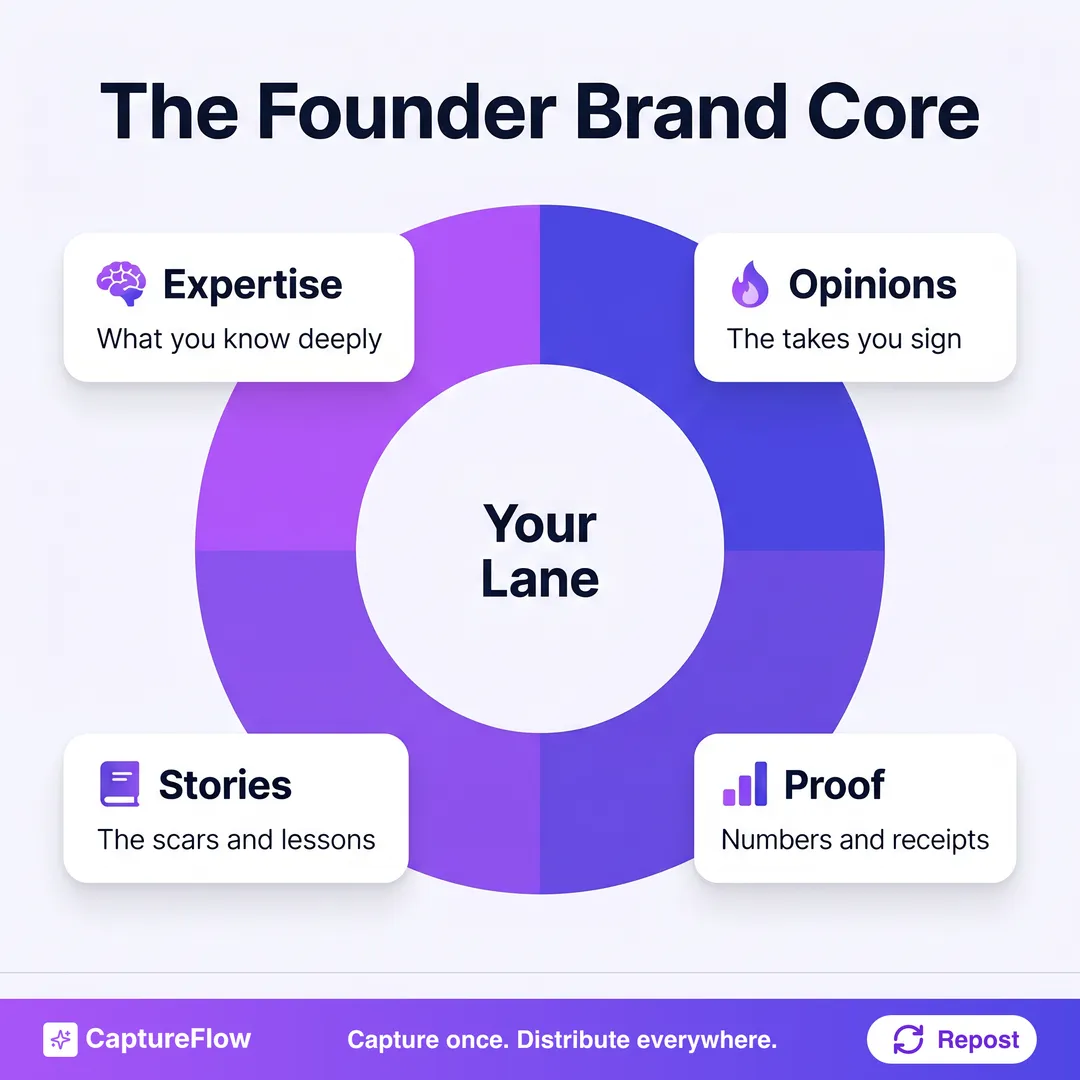 Every post is one of four moves, all inside your lane.
Notice that all three formats come straight out of a talking capture. A 15-minute recording about one hard week contains an opinion, a number, and a lesson; the one-video-into-10-posts method shows exactly how to mine them. If building in public is the lane you pick, the build-in-public content playbook turns these formats into a weekly system.
Step 5: Hold the 90-day cadence
The brutal truth about founder brands: the compounding starts after most people quit.
Commit to 2 to 5 posts a week for 90 days before you judge anything, and write the end date in your calendar so the experiment has a real finish line instead of a vibe. Post into the windows the data supports (mid-morning, Tuesday to Thursday, per our best time to post on LinkedIn breakdown), and expect the first 30 days to feel like talking into a canyon. Days 30 to 60, the algorithm learns who your people are. Days 60 to 90, the replies and DMs start, and they are disproportionately from exactly the buyers, candidates, and investors you wanted.
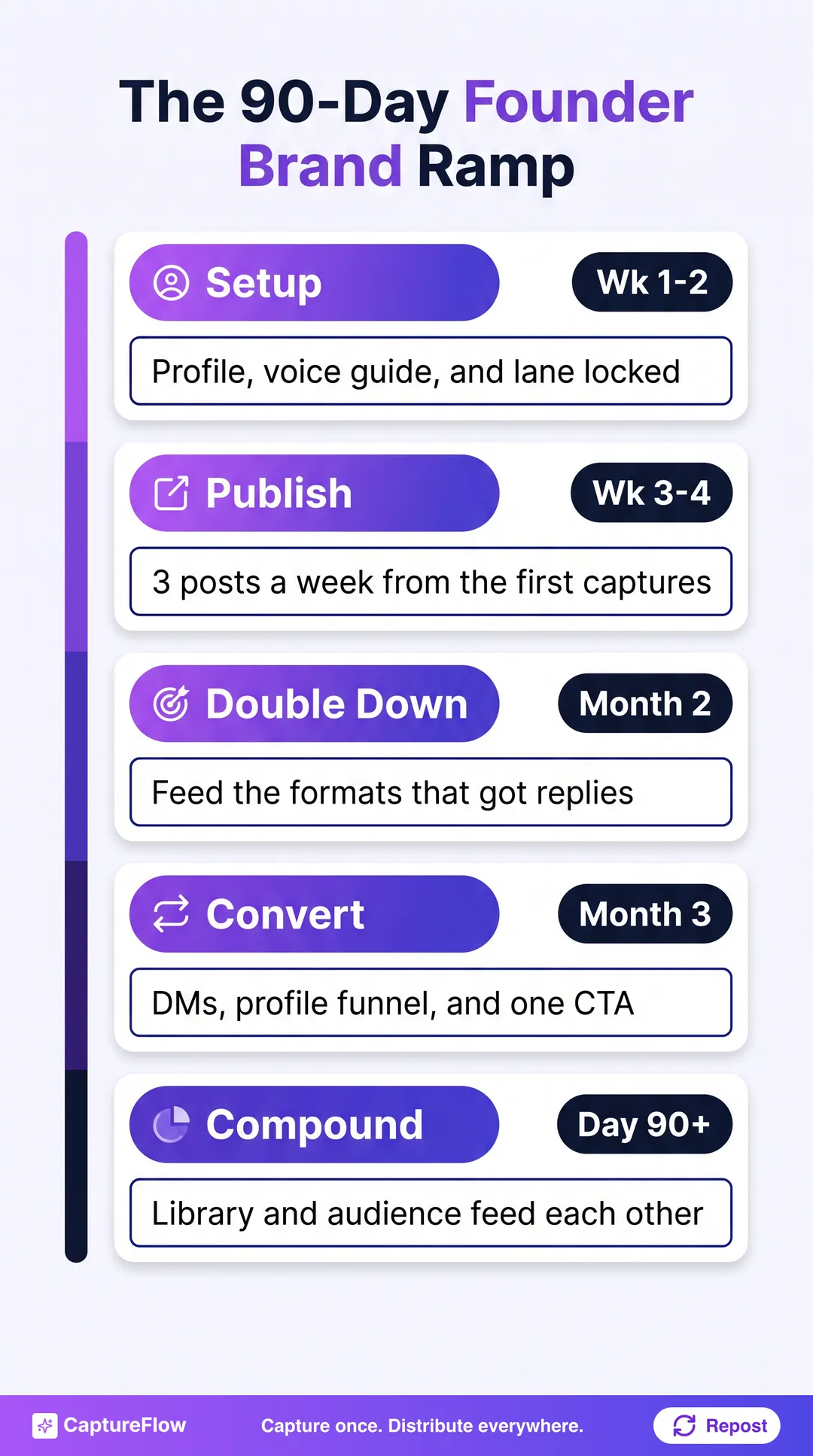 Ninety days, one rung a fortnight. Quitting at day 40 is the most common failure.
The most common failure mode is not bad content, it is a 3-week sprint followed by 6 weeks of silence. The feed forgives mediocre posts; it does not forgive disappearing. Pick the cadence you can sustain on your worst week, then keep it.
Step 6: Convert attention without being cringe
A founder brand that never converts is a diary; one that converts too hard is an infomercial. The middle path:
- Fix the profile funnel. Your headline says who you help and how, your featured section links one product page and one best post, your about section is 5 lines, not a resume. For the tactical version of this and more, see our LinkedIn personal branding tips.
- One CTA per week, max. Nine value posts buy you one ask. When you ask, be direct: "we are onboarding 10 teams this month" beats a coy link drop.
- Reply like a human. The conversion actually happens in comments and DMs. Fifteen minutes of genuine replies per week outperforms any automation, and buyers can smell the difference.
A useful mental model for the ask: your feed presence opens the account, your profile closes the meeting. Most founders obsess over the post and neglect the profile, then wonder why 10,000 impressions produced zero calls. Fix the funnel once and every future post converts a little; fix only the posts and you are renting attention with no landing page.
What does it buy you when it works? More than pipeline.
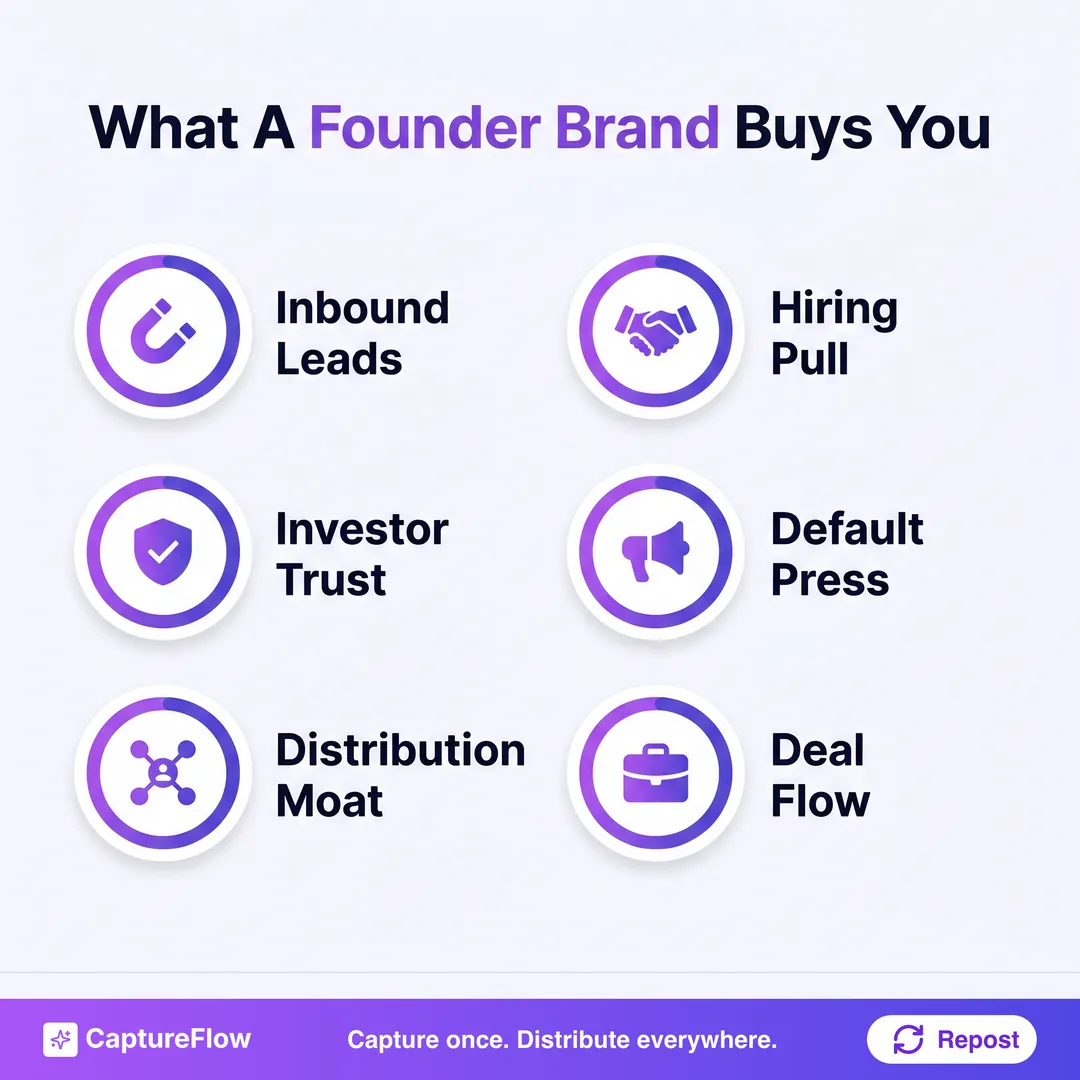 The pipeline shows up first. The hiring and investor effects sneak up on you.
The honest caveats
Radical honesty, as always. A ghostwritten founder brand can work for volume, and some excellent operators run one; the tradeoff is that the trust premium shrinks when the audience senses the voice is rented, and on a long enough timeline they always sense it. Engagement pods and viral templates inflate numbers and quietly poison exactly the credibility you were building. And if your company is pre-product with zero customers, spend the hours on customers first; a brand amplifies a real story, it cannot replace one.
If you want the machine that makes the 45-minute week real, look at how CaptureFlow works or what it costs, and the solo founder use case shows the exact workflow. But the system above works with a phone and a calendar. The only genuinely non-negotiable ingredients are a lane, your real voice, and 90 days of showing up.
Sources
- Edelman: 2026 Edelman Trust Barometer
- DataReportal: LinkedIn Users, Stats, Data and Trends
- HubSpot: 2026 State of Marketing report
Frequently asked questions
How do I build a personal brand as a founder?+
Pick one lane at the intersection of your depth and your buyers' interests, choose a home platform (usually LinkedIn for B2B), capture your thinking once a week, publish 2 to 5 founder-native posts weekly (opinions, numbers, lessons), and hold the cadence for 90 days before judging results.
Do I need a content team or ghostwriter for a founder brand?+
No. A ghostwriter can produce volume, but the trust premium of a founder brand comes from it being verifiably you. With a capture-first workflow and AI trained on your voice, one founder can sustain a real cadence in about 45 minutes a week.
How long does it take to build a founder personal brand?+
Expect the first real signals (replies, DMs, inbound) around 60 to 90 days of consistent posting, and compounding returns after 6 to 12 months. It is a slow asset with a fast payback once it turns.
Which platform should a founder build on?+
Where your buyers already are. For most B2B founders that is LinkedIn, with one satellite channel (X, YouTube, or a newsletter) fed by repurposing. Owning one platform deeply beats being shallow on four.
Chris is the founder and CEO of CaptureFlow, which he builds so founders can turn their expertise into content without hiring a team. After 10+ years building products and growing audiences from scratch, he writes about founder-led content, AI, and distribution from inside the problem he is solving: distributing consistent, on-brand content as a team of one.
Founder & CEO of CaptureFlow · 10+ years building products and audiences
One playbook a week from founders who actually create and distribute lots of content. No spam, unsubscribe anytime.
Keep reading

Build in Public: A Founder's Content Playbook
Building in public is the highest-trust content a founder can make. Here is the full strategy: what to share, where the line is, and a system to turn your week into content.
What Content Grows a LinkedIn Personal Brand Fastest
Not all LinkedIn content grows a personal brand at the same speed. Here are the content types that compound fastest, ranked, and the ones quietly wasting your time.
LinkedIn Personal Branding Tips That Actually Work
Most LinkedIn personal branding advice is fluff. These nine tips are the ones that actually move the needle, from fixing your profile to staying consistent.