What Is Capture-First Content?
Capture-first content means recording a raw idea once, then letting AI shape it into native posts for every platform. Here is what it means and why it wins.


Capture-first content means you record a raw idea once, then a system turns it into finished, native posts for every platform. You start from something you already have, your own thinking, instead of a blank page.
That one shift changes everything about how a founder shows up online.
The blank page is the bottleneck
Most founders do not have an ideas problem. They have a blank-page problem.
You know your space cold. You could talk for an hour about the thing you just shipped, the mistake that cost you six months, the reason your customers actually buy. But the moment you open an editor to write the post, it all goes quiet. The cursor blinks. You reword the first line four times, get interrupted, and the idea dies in a draft.
This is the hidden cost of creation-first tools. Whether it is a doc, a scheduler, or a chat box, they all hand you the same empty canvas and ask you to produce a polished artifact on demand. So consistency ends up depending on willpower, and willpower is the one resource founders never have a surplus of.
You might be stuck in creation-first if:
- You have a graveyard of half-written drafts you will never finish.
- You post in bursts when motivation strikes, then go quiet for three weeks.
- You know exactly what you would say on a call, but freeze when you try to write it.
So what is capture-first content?
Capture-first inverts the order of operations. Instead of sitting down to make a post, you capture the raw idea in whatever form is fastest: a voice note, a quick screen recording, a rough paragraph, a link, a meeting you already had. Then the finished content gets built from that capture.
The blank page never appears, because you never start from nothing.
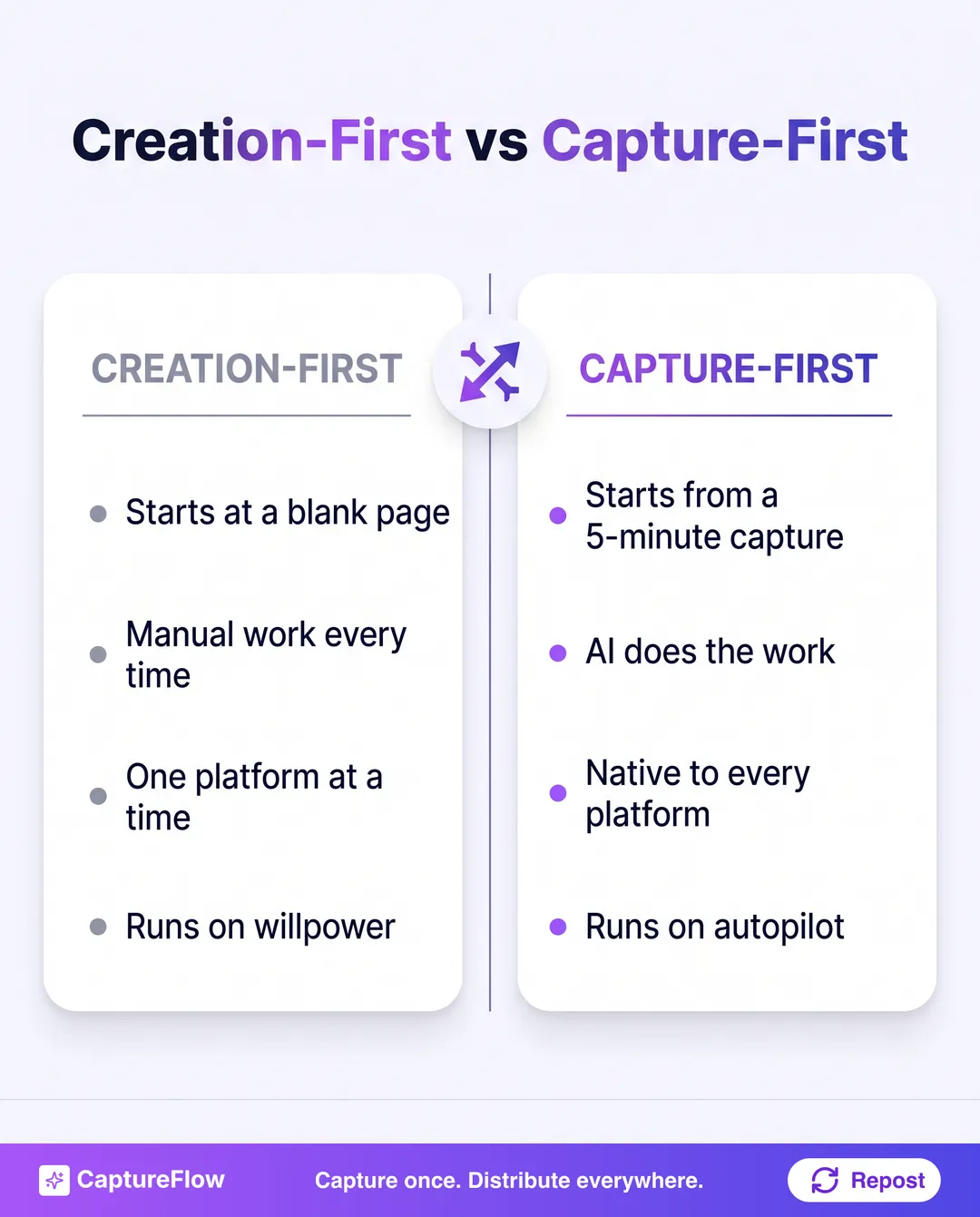
The capture-first premiseYou already have the ideas. The job is to capture them, not to manufacture them on command.
The distinction matters because it moves the hard part off your plate. In a creation-first world, the expensive step is production. In a capture-first world, production is automated, and the only thing left for you is the part no tool can do: having the point of view in the first place.
Why now, and not five years ago
Capture-first is not a new wish. Founders have always wanted to just talk and watch content appear. What changed is that the technology finally caught up on three fronts at once.
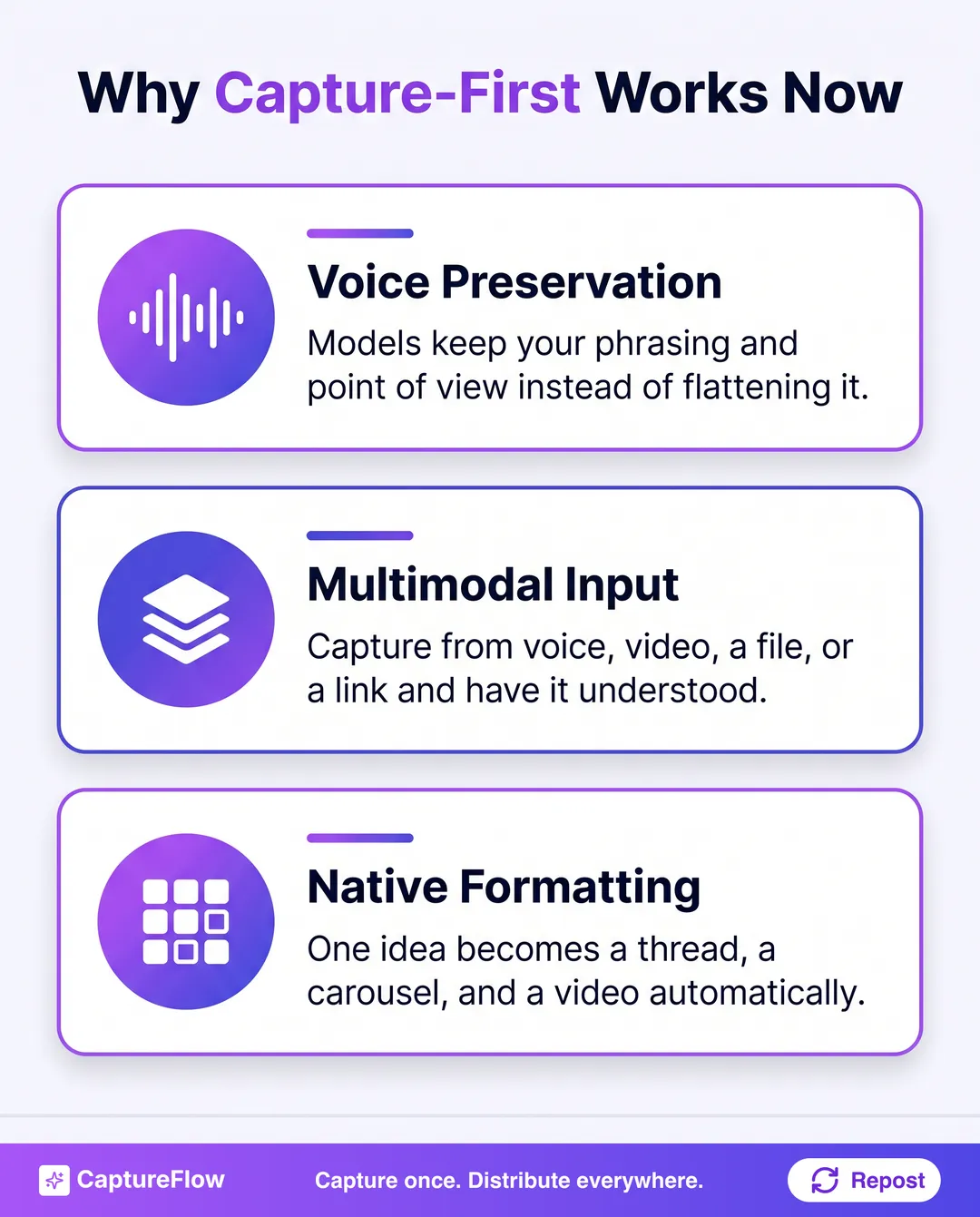
- Voice preservation. Models got good enough to keep your phrasing and your point of view instead of flattening everything into generic copy. That is the whole difference between content that sounds like you and AI slop.
- Multimodal input. You can capture from voice, video, a document, or a link and have it actually understood. The input is no longer limited to what you can type.
- Native formatting. One idea can be reshaped into a thread, a carousel, and a short video automatically, so distribution stops being a manual chore.
Put those together and the two expensive parts of content, production and formatting, drop close to zero. When production is nearly free, rationing your ideas is the wrong move. You capture all of them instead.
The loop: capture, create, distribute
Capture-first content runs on a simple loop.
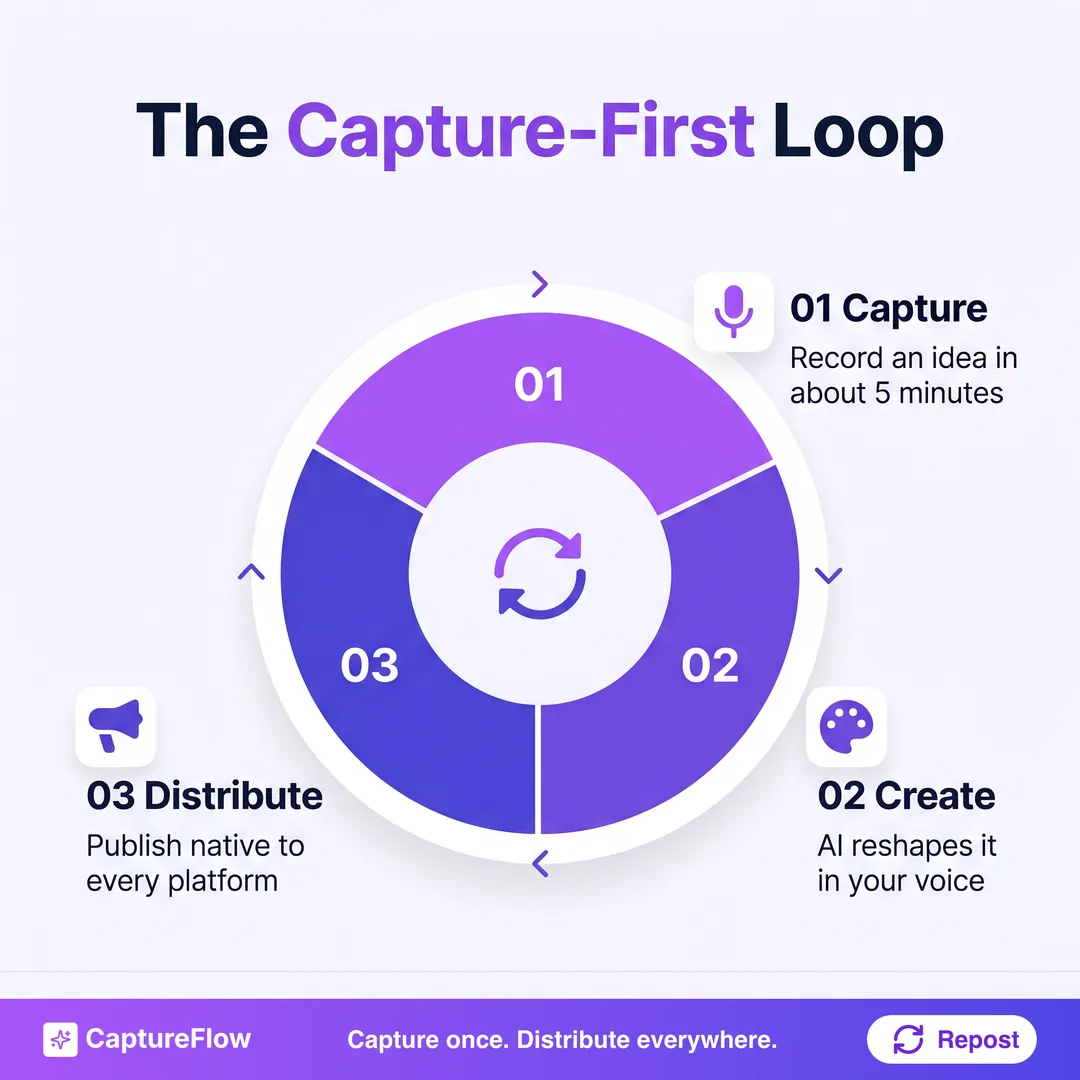 Capture, create, distribute. You own the first step, the system owns the rest.
- Capture. Get the idea out of your head fast. Record a voice note, talk to camera, drop a file, or paste a link. This is multimodal capture, and it is the whole point: the input should take about 5 minutes, not an afternoon.
- Create. A content agent trained on your voice and knowledge base reshapes that capture into finished pieces. Not one format. Every format: a long-form post, a thread, a carousel, a short video, a quote graphic.
- Distribute. The finished content gets published natively across platforms and scheduled so your week fills itself.
The order is the innovation. Creation-first tools optimize the middle step and leave you stuck on the input. Capture-first makes the input trivial and automates everything after it.
You stay in the loop where it counts. You capture, you review, you approve. What disappears is the busywork between having the idea and seeing it live.
What it looks like day to day
Here is the concrete version. On a Monday, you spend a few minutes talking through the one thing you learned last week. That single capture becomes a LinkedIn post with a real hook, an X thread that earns the next line, a carousel that breaks down the idea, and a short video cut from the recording.
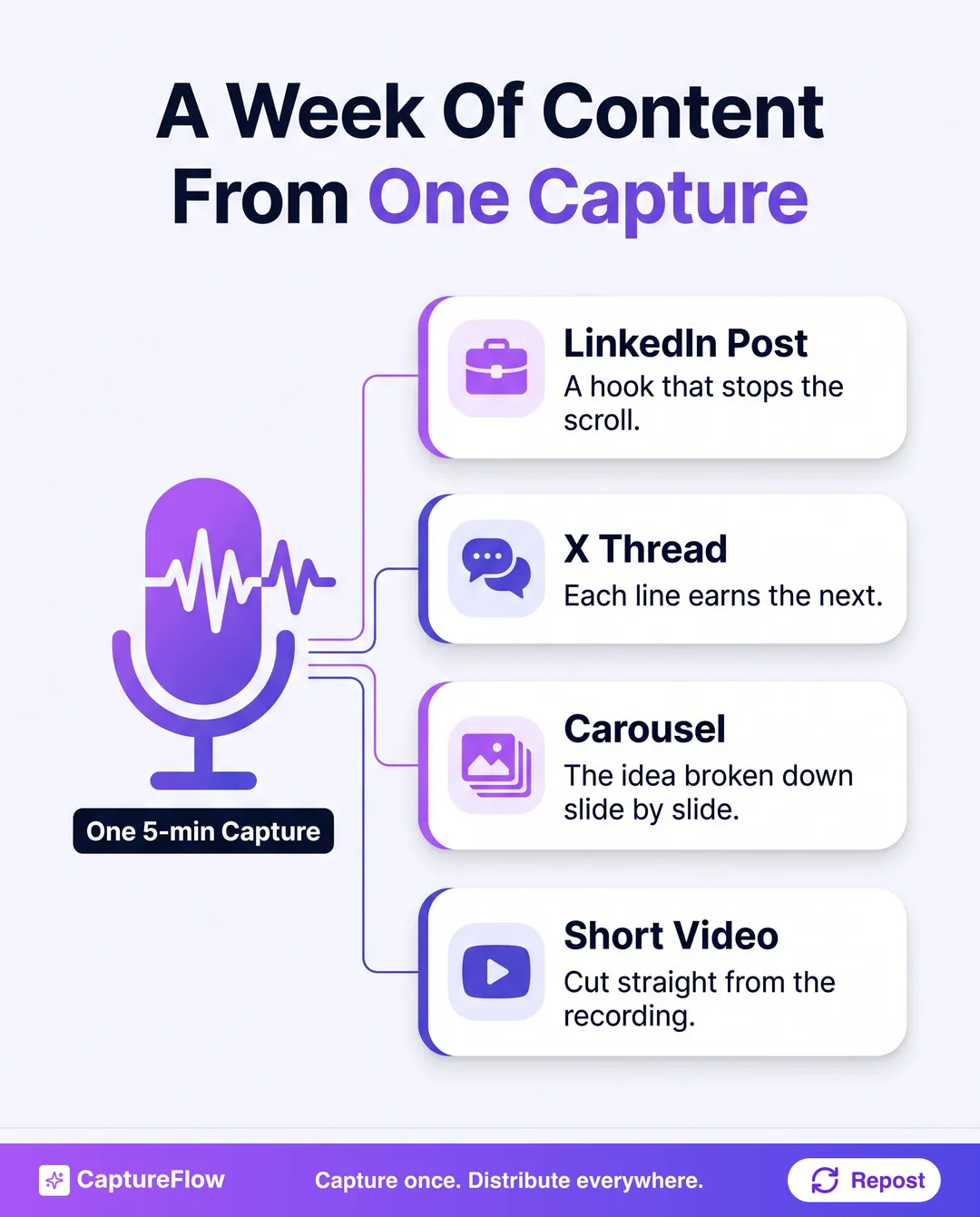 One capture on Monday becomes native content for the whole week.
You did not write four things. You captured one thing and shaped it four ways. That is the same idea we cover in capture once, distribute everywhere, and it is why cross-posting the identical text everywhere leaves reach on the table. Each platform rewards a different shape, and reshaping is exactly what the create step is for.
Because the raw material is your own words, the output still sounds like you. The AI is not inventing opinions. It is scaling the ones you already have.
Autopilot is the point
The payoff is not a single great post. It is never having to think about whether the post will happen at all.
When capture takes 5 minutes and everything downstream is automated, consistency stops being a discipline problem and becomes a default. You show up every day because the system does, not because you summoned the motivation. This is the whole argument behind capture once, distribute everywhere: the founders who win at content are not the most disciplined writers, they are the ones who removed the friction. That is also the honest answer to building a founder personal brand without a content team.
Where the old tools fit
To be fair, the tools built around the creation-first model are good at their slice. They are just solving one piece of the loop.
- AI chat like ChatGPT is a genuinely capable writer, but it starts from a blank prompt with no memory of your voice, and it does not format, schedule, or publish anything. We break this down in CaptureFlow vs ChatGPT.
- Writing assistants sharpen a post you are already writing on one platform. Helpful, but you are still the one producing every piece from scratch.
- Schedulers move finished content to a calendar. Essential for distribution, but they assume the content already exists. They do the last step and none of the first two.
None of that is wrong. It is just partial. If you want to see how the capture-first approach stacks up against the specific tool you are using now, we keep honest, side-by-side comparisons. The short version: capture-first is not one more tool in the stack, it is the loop that replaces the stack.
Start capturing
Capture-first content is a bet that your ideas are the scarce resource, and everything else is a solvable engineering problem. Capture the idea once. Let the system make it native everywhere. Review, approve, move on with your day. When you are ready to run it week by week, the capture-first content system is the full operating manual.
That is the model behind CaptureFlow, an AI content agent that turns your expertise into weeks of on-brand content for every platform. You can see how the whole thing works, or start a free trial and turn this week's ideas into next week's content.
Frequently asked questions
What is the difference between capture-first and creation-first content?+
Creation-first means you sit at a blank editor and produce a finished post from scratch, one platform at a time. Capture-first means you record a raw idea once, in about 5 minutes, and a system reshapes it into native content for every channel. Same expertise, far less friction.
Does capture-first content still sound like me?+
Yes, when the system is trained on your voice. The raw material is your own words, stories, and point of view. AI handles structure and formatting, not the thinking.
Do I still review everything before it publishes?+
Always. Capture-first removes the blank page and the formatting grind, not your judgment. You approve every post before it goes out.
Chris is the founder and CEO of CaptureFlow, which he builds so founders can turn their expertise into content without hiring a team. After 10+ years building products and growing audiences from scratch, he writes about founder-led content, AI, and distribution from inside the problem he is solving: distributing consistent, on-brand content as a team of one.
Founder & CEO of CaptureFlow · 10+ years building products and audiences
One playbook a week from founders who actually create and distribute lots of content. No spam, unsubscribe anytime.
Keep reading

How to Create Content as a Busy Founder Without Hiring a Writer
You do not need a writer or an agency. You need a way to catch one idea in 5 minutes and turn it into a week of posts. Here is the system.

Build in Public: A Founder's Content Playbook
Building in public is the highest-trust content a founder can make. Here is the full strategy: what to share, where the line is, and a system to turn your week into content.

What Content Grows a LinkedIn Personal Brand Fastest
Not all LinkedIn content grows a personal brand at the same speed. Here are the content types that compound fastest, ranked, and the ones quietly wasting your time.