How to Turn a Voice Note Into a Week of Content
Turn voice notes into content: record one 5 minute idea and let an AI content agent reshape it into a week of native posts for every platform.

You already had the idea. You said it on a walk, in a voice memo to yourself, in a reply to a customer. Then it evaporated, because turning a spoken thought into a week of posts felt like more work than the idea was worth.
It isn't. One voice note is enough raw material for a week of content, if you treat the recording as the source and let an AI agent do the reshaping.
To turn voice notes into content, you record one 3 to 5 minute spoken idea, transcribe it, and let an AI content agent reshape that transcript into native posts for each platform: a LinkedIn post, an X thread, a carousel, a quote image, a short video, and more. That is the whole move. The rest of this guide is how to do it well.
Why start from a voice note instead of a blank page?
Because the blank page is the bottleneck, not the ideas. Most founders are not short on things to say. They are short on the uninterrupted hour it takes to sit down and write them.
Speaking removes that hour. A Stanford study found that speech is about 3x faster than typing on a phone, and with a lower error rate. You think out loud faster than you write, and you sound more like yourself when you do.
The best voice notes are not polished. They are you explaining one thing to one smart person who asked a good question. Record that, and the personality is already baked in before any AI touches it.
There is a hidden tax too. Every time you switch into "writing mode," you pay a context-switching cost to get there. Capturing by voice, in the moment the idea is hot, skips the switch entirely. This is the core of capture-first content: start from something you already said, not a blinking cursor.
Step 1: Capture one idea, out loud, in 5 minutes
Pick one idea. Not a topic, an idea, something you actually believe with a reason behind it.
Open your phone's voice memo app and talk for 3 to 5 minutes. If you freeze, answer a question instead: "What did I learn this week that surprised me?" or "What do most people get wrong about this?" A question is easier to answer than a page is to fill.
Do not restart when you stumble. The stumbles get cut later.
Step 2: Transcribe the recording
Run the audio through any transcription tool to get text. This transcript is your source document, the single raw input everything else is built from.
Do not clean it up by hand. The transcript is not the deliverable, it is the clay.
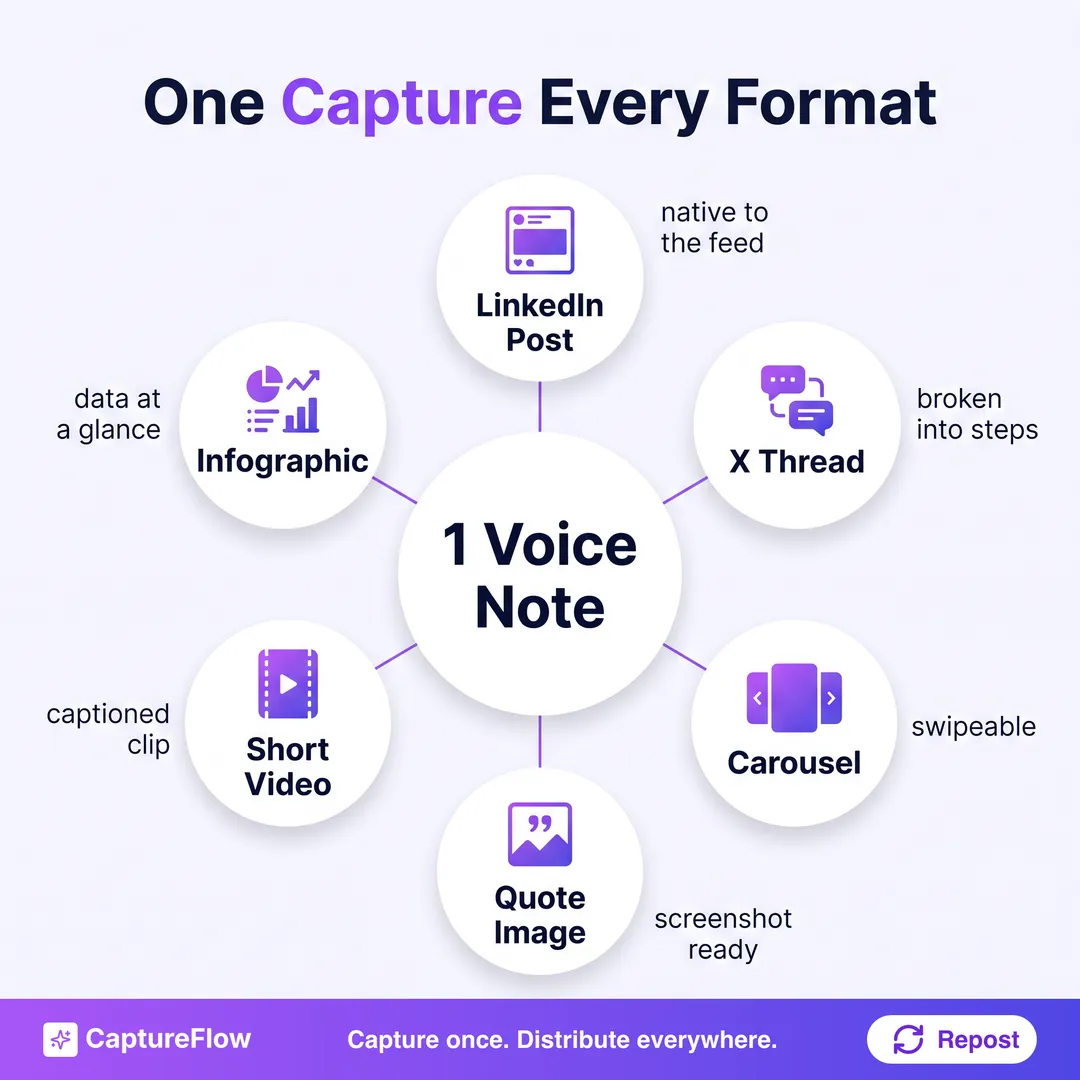 One captured idea reshaped into native content for every channel.
Step 3: Reshape the transcript into every format
This is where the leverage lives. Instead of copying the transcript into each platform and editing by hand, hand it to an agent that reshapes it per channel.
CaptureFlow is an AI content agent that turns your expertise into weeks of on-brand content for every platform. You drop in the voice note, and it, trained on your voice and your past posts, reshapes that one transcript into a LinkedIn post, an X thread, a carousel, a quote image, and a short video, each written natively for its platform rather than copy-pasted across all of them.
That is the difference between repurposing and re-posting. A good repurposing workflow rewrites for the medium; the post repurposer and the rest of the CaptureFlow feature set are built to do exactly that from a single capture.
Step 4: Review in your voice, not the AI's
Read every draft once. You are checking for two things: does it still sound like you, and did it keep the specific detail that made the idea worth sharing?
Cut anything generic. Keep the odd number, the real example, the strong opinion. The AI gives you a fast first draft in every format; your job is to protect the specificity that makes it yours.
The capture-first ruleThe recording carries your voice. Your review keeps it there. Everything in between is just formatting.
Step 5: Schedule the week
Space the pieces across the week so one idea shows up in five places without feeling repetitive. The LinkedIn post Monday, the carousel Wednesday, the short video Friday, the quote image and X thread filling the gaps. If the carousel is the piece you care about most, here's the slide-by-slide way to turn a voice memo into a carousel.
One capture, a week on the calendar. When you see how little time it took, you do it again the next week, and consistency stops being a willpower problem. That is the whole promise of an AI content agent: the hard part is the idea, and you already had it.
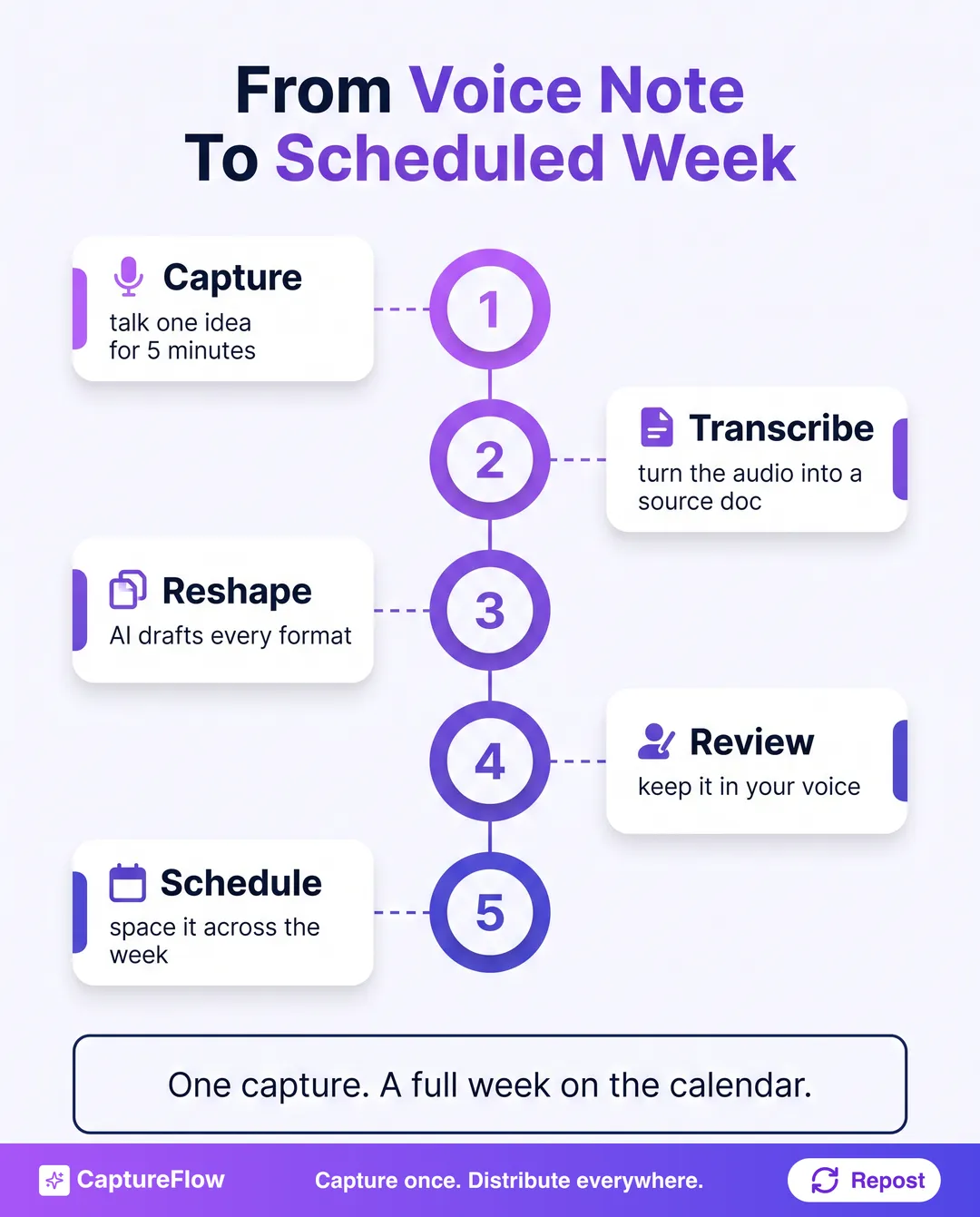 The full workflow, from spoken idea to a scheduled week.
What one voice note actually becomes
A single 5 minute recording about, say, a lesson from a hard customer call can become:
- A LinkedIn post built around your strongest spoken line.
- An X thread that breaks the idea into steps.
- A carousel that visualizes the before and after.
- A quote image of the one sentence people will screenshot.
- A short video cut from the audio, captioned.
None of that started from a blank page. It started from something you already knew, said once, out loud. The same move works for any recording you already make, which is why founders use it to repurpose a podcast episode, turn one video into weeks of posts, or turn meeting recordings into content. Breaking one capture into many native pieces like this is exactly content atomization.
The blank page was never the job. Capturing the idea was. Do that in 5 minutes, and let the agent handle the rest.
Sources
- Ruan et al., Stanford HCI, Speech Is 3x Faster than Typing for English and Mandarin Text Entry on Mobile Devices.
Frequently asked questions
How long should a voice note be to get a week of content?+
Three to five minutes on a single idea is plenty. That is enough to cover a claim, an example, and a takeaway, which is all a week of posts needs. Longer is fine, but one focused idea beats ten shallow ones.
Do I need to write a script before I record?+
No. The whole point is to skip the blank page. Give yourself one prompt or question, hit record, and talk it through the way you would explain it to a peer. The messiness is fixed later in the review step.
What is the best way to turn a voice note into a LinkedIn post?+
Transcribe the recording, then reshape the transcript into the post rather than editing the raw transcript by hand. Keep your strongest spoken line as the hook, and cut everything that was throat-clearing before you got to the point.
Chris is the founder and CEO of CaptureFlow, which he builds so founders can turn their expertise into content without hiring a team. After 10+ years building products and growing audiences from scratch, he writes about founder-led content, AI, and distribution from inside the problem he is solving: distributing consistent, on-brand content as a team of one.
Founder & CEO of CaptureFlow · 10+ years building products and audiences
One playbook a week from founders who actually create and distribute lots of content. No spam, unsubscribe anytime.
Keep reading
Content Atomization: Turn One Idea Into Many Posts
Most people make one post from one idea, then go hunt for the next idea. Content atomization is the opposite: one idea becomes a week of native posts.

7 Best Repurpose.io Alternatives in 2026 (Ranked by Use Case)
Repurpose.io moves your video between platforms, but it does not create anything. Here are 7 alternatives that do, ranked by the job you actually need done.

How to Use AI Content Tools (Without Sounding Like a Bot)
Most people disappointed with AI content tools started with the tool instead of the problem. Here is the workflow that actually works: find the gap, match the tool, train it on your voice, and ship.