How the LinkedIn Algorithm Works in 2026 (Backed by Data)
A data-backed guide to how the LinkedIn algorithm works in 2026: the 4 ranking stages, what it rewards, what it penalizes, and how to work with it.

You have seen it happen. One post lands 40,000 views and a flood of comments. The next one, which you thought was better, sinks at 300. Same author, same audience, same time of day. It feels random, like a slot machine that occasionally pays out. It is not: we analyzed 2,155 posts from 25 top founders to see what actually separates the hits from the flops.
It is not random. The LinkedIn algorithm is closer to a bouncer with a clipboard than a slot machine. It reads every post against a set of rules, decides who gets in, and only lets the crowd grow if the early guests actually stick around. This guide covers how the LinkedIn algorithm works in 2026, stage by stage, using LinkedIn's own engineering and independent data rather than folklore. Understanding it is one piece of a larger LinkedIn content strategy, the layer that decides how far your best work actually travels.
How the LinkedIn algorithm works in 2026
Here is the one-line version, and it is the thing most "hacks" get wrong.
The LinkedIn algorithm is a relevance ranking system: it scores every post by how likely each member is to stop, read, and respond, not by who posted it or when it went up.
LinkedIn describes the goal of the feed plainly. Posts are ranked by predicted relevance, defined as the likelihood a member takes an action like clicking, commenting, or sharing, learned from implicit signals rather than star ratings. In 2025 the platform published 360Brew, a 150-billion-parameter, decoder-only foundation model that solves over 30 predictive tasks across LinkedIn, feed ranking among them. It reads posts and member context as language and predicts relevance directly, replacing the hand-built feature pipelines the old stack relied on.
What that means for you: the LinkedIn algorithm in 2026 understands what your post is about and who should see it. You are not gaming a keyword matcher. You are giving a very good relevance model a clear reason to show your post to the right people.
The 4 stages every LinkedIn post goes through
Think of distribution as a pipeline. Your post does not get broadcast to your whole network at once. It earns each next step.
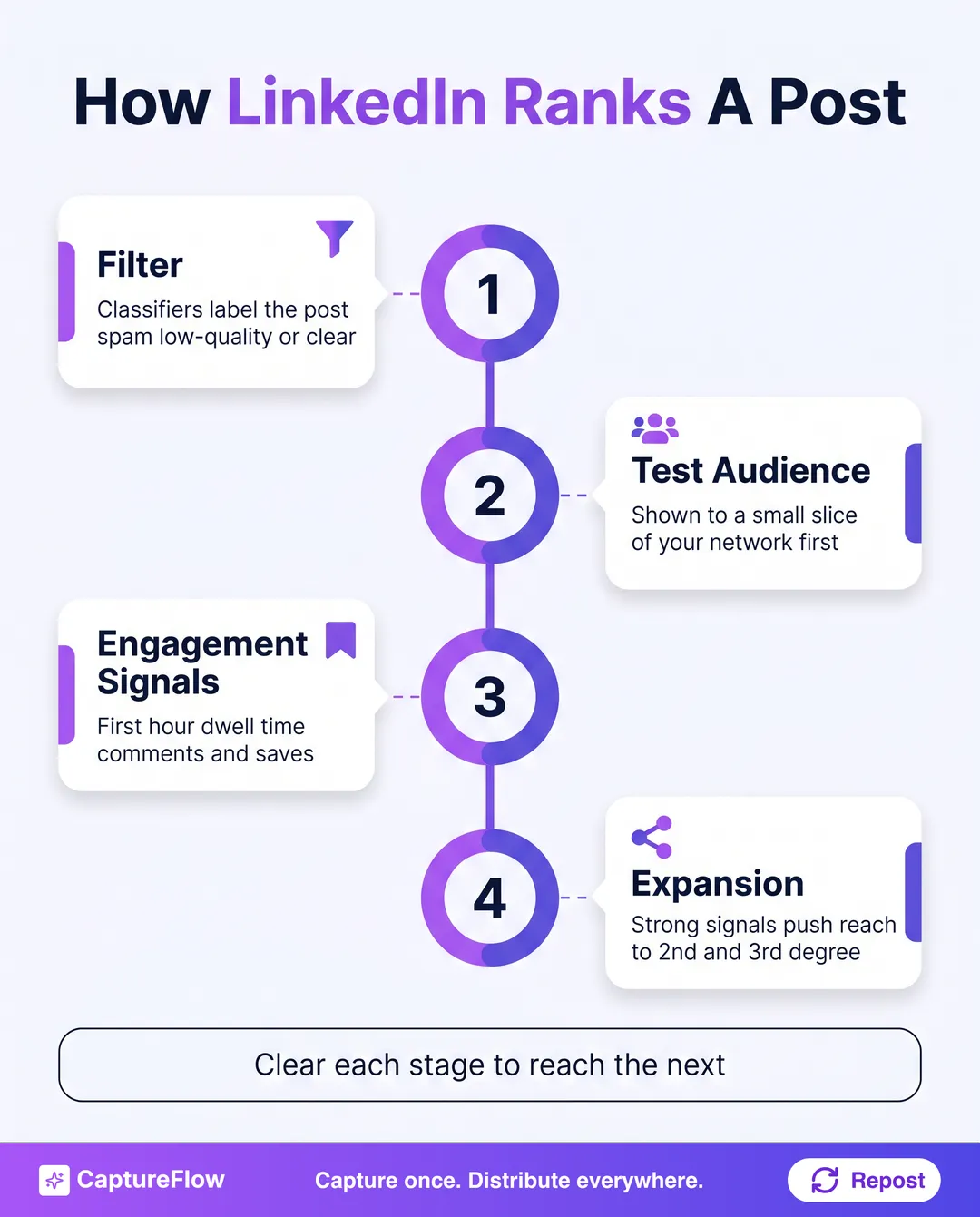 How a LinkedIn post travels from publish to reach. It has to clear each stage to reach the next.
Stage 1: the initial filter. The moment you publish, LinkedIn's classifiers label the post. LinkedIn's feed team says its "online and nearline classifiers label every image, text, or long form post as 'spam,' 'low-quality,' or 'clear' in near real time." Clear the bar and you move on. Trip it and you are throttled before a single stranger sees you. This is a "man plus machine" system: automated classifiers backed by a Trust and Safety team, and LinkedIn reports it cut spam and low-quality content impressions by 48 percent as it tuned this layer.
Stage 2: the small test audience. A clean post is shown to a slice of your network first, not all of it. This is the sample. LinkedIn watches how these early viewers react before committing more reach. Who is online when you post shapes how big that sample is, which is exactly why posting time is a sampling factor, not a ranking factor.
Stage 3: the engagement read. In roughly the first hour, the feed reads the signals your test audience generates. Not just whether they liked it, but whether they stopped, read, expanded the "see more", and commented. This early window, often called the golden hour, is where most posts live or die. It is also why a slow start is so hard to recover from: weak early signals mean the post never gets the sample it would need to prove itself. The clock is not scoring you, but it is deciding how many people are around to react before the feed makes up its mind.
Stage 4: broader distribution. If the signals are strong, the post expands outward to second and third degree connections and into more feeds. If they are weak, distribution quietly tapers. Nothing gets deleted. It just stops traveling.
The feed is judging the post at every stage, not you. A big following gives you a bigger stage-2 sample, but it does not carry a post that people scroll past. This is why small accounts sometimes outreach big ones on a single post.
What the LinkedIn algorithm rewards in 2026
If relevance is the goal, the rewarded behaviors are the ones that prove a real human found your post worth their attention. Here is what the data points to.
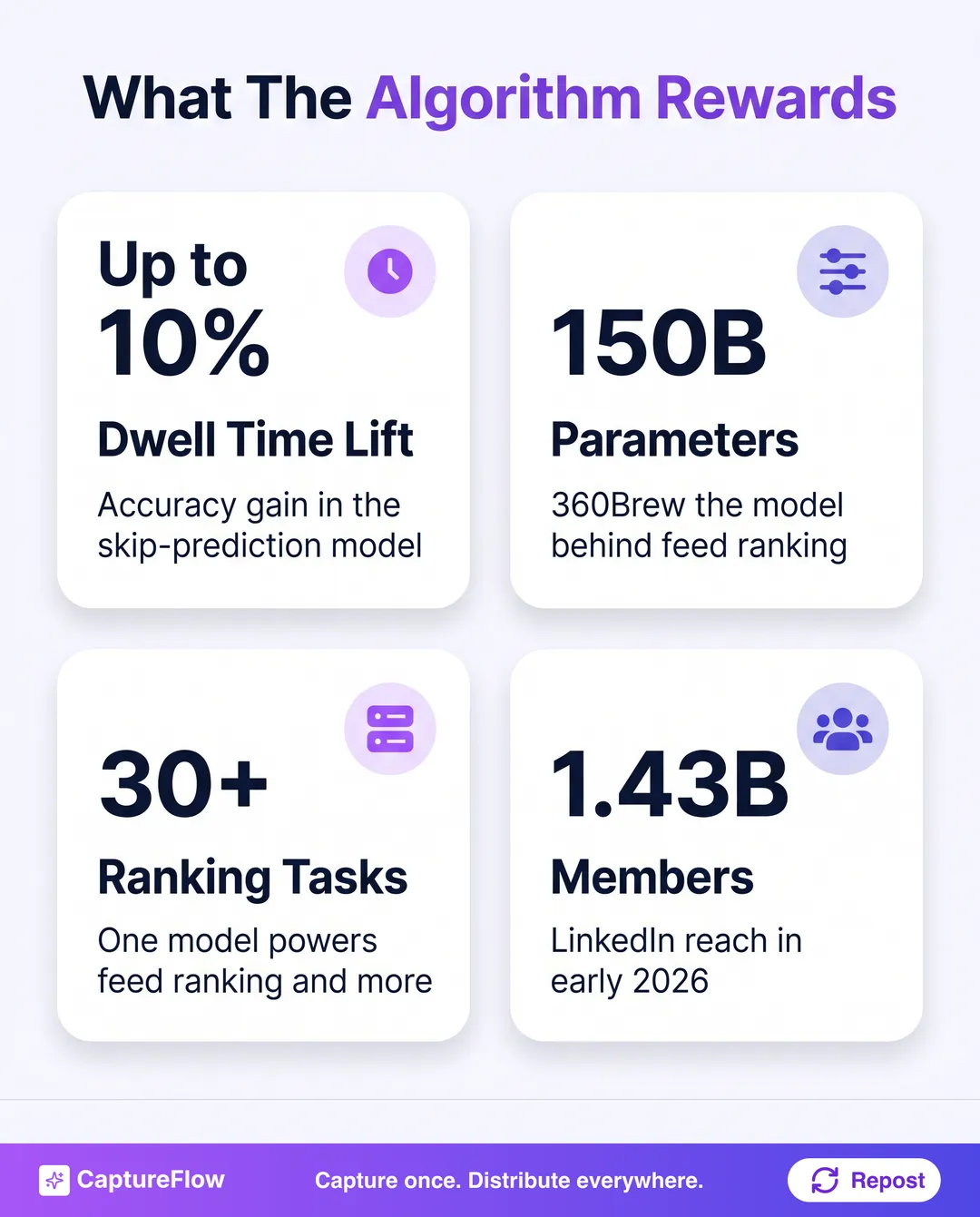 The rewarded signals, drawn from LinkedIn Engineering, the 360Brew paper, and DataReportal.
Dwell time. This is the signal most creators still underrate. LinkedIn's feed team added dwell time to ranking precisely because likes and clicks were easy to game and easy to miss. They measure time "on the feed" (from when at least half your post is visible) and time "after the click." Folding a skip-prediction model into ranking improved that model's accuracy by up to 10 percent and, in live tests, members skipped fewer posts and engaged more. A post people read to the end beats a post people skim past.
Meaningful comments. A thoughtful comment is dwell time plus a signal that someone cared enough to write. It is worth more than a one-tap like because it is harder to fake and it tells the model your post sparked a real response. Replying to those comments extends the conversation and the dwell time with it.
Saves and shares. A save says "I want this later." A share says "my network should see this." Both are strong relevance votes, and both tend to travel further than a like.
Topical relevance and consistency. Because 360Brew reads your post as language, it can match it to members who care about that subject. Posting consistently in a clear lane trains the system, and your audience, on what you are about. This is where a repeatable supply of content matters more than any single trick. If you want the feed to reward you, give it a reason every week, not once a quarter.
The scale of the platform is why this compounds. Per DataReportal, LinkedIn reached about 1.43 billion members in early 2026. That is a vast pool of second and third degree connections your post can reach in stage 4, but only if the earlier stages clear. Relevance is what unlocks that pool. Nothing else does.
The pattern across LinkedIn's own researchEvery signal the feed rewards is a proxy for one thing: a real person spent real attention on your post.
What the LinkedIn algorithm penalizes
The flip side of a relevance system is that anything that fakes relevance gets filtered. These are the reliable ways to lose reach.
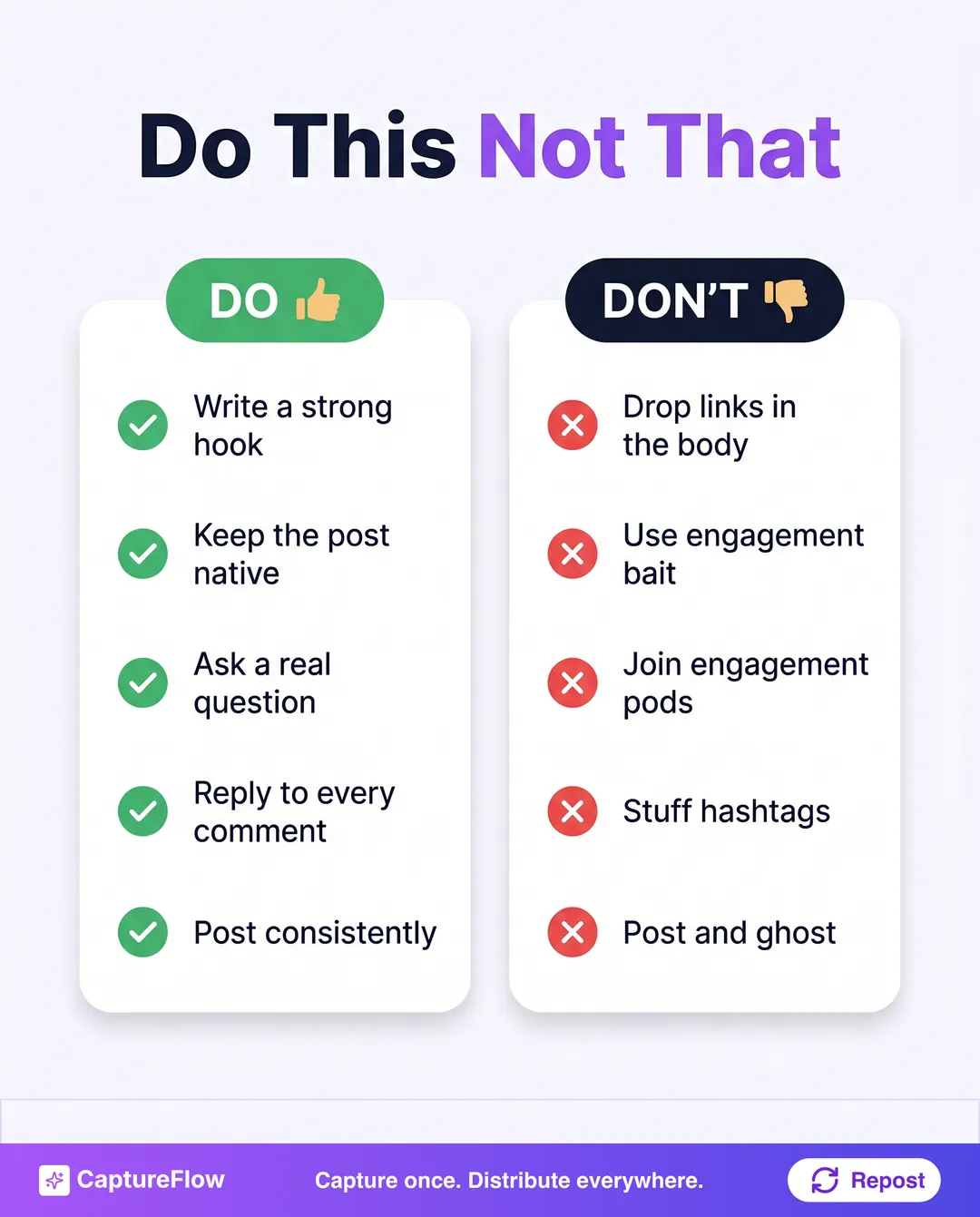 Work with the ranking signals on the left. The right-hand column trips the quality filter.
External links in the post body. LinkedIn wants to keep members reading and engaging on LinkedIn, so posts that send people off-platform tend to get less distribution than native ones. The standard fix is to keep the post itself native and put the link in the first comment.
Engagement bait. "Comment YES below" and "tag someone who needs this" are exactly the shallow-engagement patterns the quality classifiers are built to catch. Bait invites the low-quality label, and that is the last thing you want in stage 1.
Engagement pods. Pods manufacture likes and comments that do not match genuine dwell time or relevance. The signals do not line up, the engagement is shallow, and you carry real account risk for reach that does not last.
Hashtag stuffing and over-tagging. A wall of hashtags or a dozen unrelated tags reads as spam signal, not relevance. A couple of relevant hashtags is plenty, and in truth hashtags barely move reach anymore now that the feed reads your actual words.
Posting and ghosting. If you never reply, you leave dwell time and comment depth on the table in the exact window when they count most.
How to work with the LinkedIn algorithm
None of this requires gaming anything. Working with the LinkedIn algorithm is mostly about feeding the signals it already rewards, consistently.
-
Win the first two lines. The hook decides whether anyone stops long enough to generate dwell time. Spend real effort here. Our guide to writing LinkedIn hooks breaks down the patterns that earn the stop, and you can pressure-test yours with the free hook generator.
-
Keep the post native and readable. Short lines, white space, a real point, no link dump in the body. Give people a reason to expand the "see more".
-
Ask something worth answering. End on a genuine question, then reply to every comment in the first hour. That is dwell time and comment depth compounding.
-
Post consistently in a clear lane. Consistency is the highest-leverage input, because it trains both the model and your audience. The realistic way to sustain it is to stop starting from a blank page. Turn one video into 10 LinkedIn posts is the workflow that keeps the supply going, and a content strategy built on your own material keeps every post on-brand.
-
Check your posts against the signals. Before you hit publish, it helps to see how a post reads through the feed's lens. The free LinkedIn analyzer gives you a read on that.
This is the gap CaptureFlow is built to close. CaptureFlow is an AI content agent that turns your expertise into weeks of on-brand content for every platform. You capture one idea in 5 minutes, a voice note, a video, a file, or a link, and it reshapes that into native posts trained on your voice, so consistency stops depending on willpower. If you are comparing ways to solve the supply problem, our rundown of the best AI LinkedIn content tools is a fair place to start, and you can see what CaptureFlow costs whenever you are ready.
The LinkedIn algorithm in 2026 is not out to get you. It is a relevance system that rewards posts real people find worth their time. Give it those, every week, and it does the distribution for you.
FAQ
See the questions above for quick answers on links, pods, and comments versus likes.
Sources
- LinkedIn Engineering: Understanding dwell time to improve LinkedIn feed ranking
- LinkedIn Engineering: Strategies for keeping the LinkedIn feed relevant
- LinkedIn / arXiv: 360Brew: A Decoder-only Foundation Model for Personalized Ranking and Recommendation
- DataReportal: LinkedIn Users, Stats, Data and Trends
Frequently asked questions
How does the LinkedIn algorithm work in 2026?+
It ranks each post by predicted relevance, the likelihood a given member will stop, read, and respond. A post is filtered for quality, shown to a small slice of your network, judged on early engagement signals like dwell time and comments, then distributed more widely if those signals are strong. LinkedIn now runs much of this through a large foundation model called 360Brew.
Do external links reduce your reach on LinkedIn?+
In practice, yes. Posts that send members off-platform tend to get less distribution than native posts, because the feed favors content that keeps people reading and engaging on LinkedIn. The common workaround is to put the link in the first comment and keep the post itself native.
Are engagement pods or comment bait worth it?+
No. LinkedIn classifies and suppresses low-quality and spammy content, and engagement bait like 'comment YES below' invites exactly that treatment. Pods generate shallow engagement that does not match real dwell time, so they add risk without durable reach.
What matters more, likes or comments?+
Comments, and specifically thoughtful ones. Comments signal a member spent time and attention on your post, which lines up with the dwell-time and relevance signals the feed rewards. A handful of real conversations beats a pile of one-tap likes.
Chris is the founder and CEO of CaptureFlow, which he builds so founders can turn their expertise into content without hiring a team. After 10+ years building products and growing audiences from scratch, he writes about founder-led content, AI, and distribution from inside the problem he is solving: distributing consistent, on-brand content as a team of one.
Founder & CEO of CaptureFlow · 10+ years building products and audiences
One playbook a week from founders who actually create and distribute lots of content. No spam, unsubscribe anytime.
Keep reading
Best Time to Post on LinkedIn in 2026 (Backed by Data)
Everyone has a chart of magic posting hours. Here is what platform-level data actually supports, why timing is an amplifier rather than a ranking factor, and a 30-day system to find your own best time.
How to Turn Meeting Recordings Into Content
Your best ideas get said out loud in meetings, then vanish. Here is how to turn a single recording into a week of social posts, in about 5 minutes.

How to Build an Employee Advocacy Program on LinkedIn (2026)
Your company page has 2,000 followers. Your fifteen employees have 30,000 connections nobody is reaching. Here is the 6-step program that fixes that.