How the X (Twitter) Algorithm Works in 2026 (Backed by Data)
A data-backed guide to how the X algorithm works in 2026: how the For You feed is built, what the heavy ranker rewards, what it penalizes, and how to work with it.


You fire off a post you spent real thought on and it dies at 200 views. The next morning a throwaway reply you barely considered catches fire. Same account, same followers, same time of day. It feels like a slot machine that pays out at random.
It is not random. Understanding how the X algorithm works starts with a reframe: the For You feed is not a lottery, it is an audition pipeline. Every post you publish gets pulled into a pool, scored by a model, filtered, and only then shown, or not shown, to each person. This guide covers how the Twitter algorithm ranks content in 2026, stage by stage, using X's own open-sourced code rather than folklore. The rare good thing about the X algorithm is that X published most of it, so we can read the rules instead of guessing at them.
The one-sentence version
Here is the whole thing compressed, and it is what most "hacks" get wrong.
The X algorithm ranks a post by the probability you will engage with it, scored by a neural network the instant it enters the candidate pool, not by who posted it or when it went up.
In 2023 X open-sourced its recommendation algorithm, and the core has not changed shape since: candidates in, a neural network scores them, filters trim the result, you get a feed. Everything below is detail on that loop. Because the code is public, you are not reverse-engineering a black box. You are reading a scoring function that X itself wrote down.
How the X algorithm works: building the For You timeline
Think of distribution as a funnel with four stages. Your post is not broadcast to your followers and left there. It competes for a slot in every single viewer's feed, one refresh at a time, and it has to earn each step.
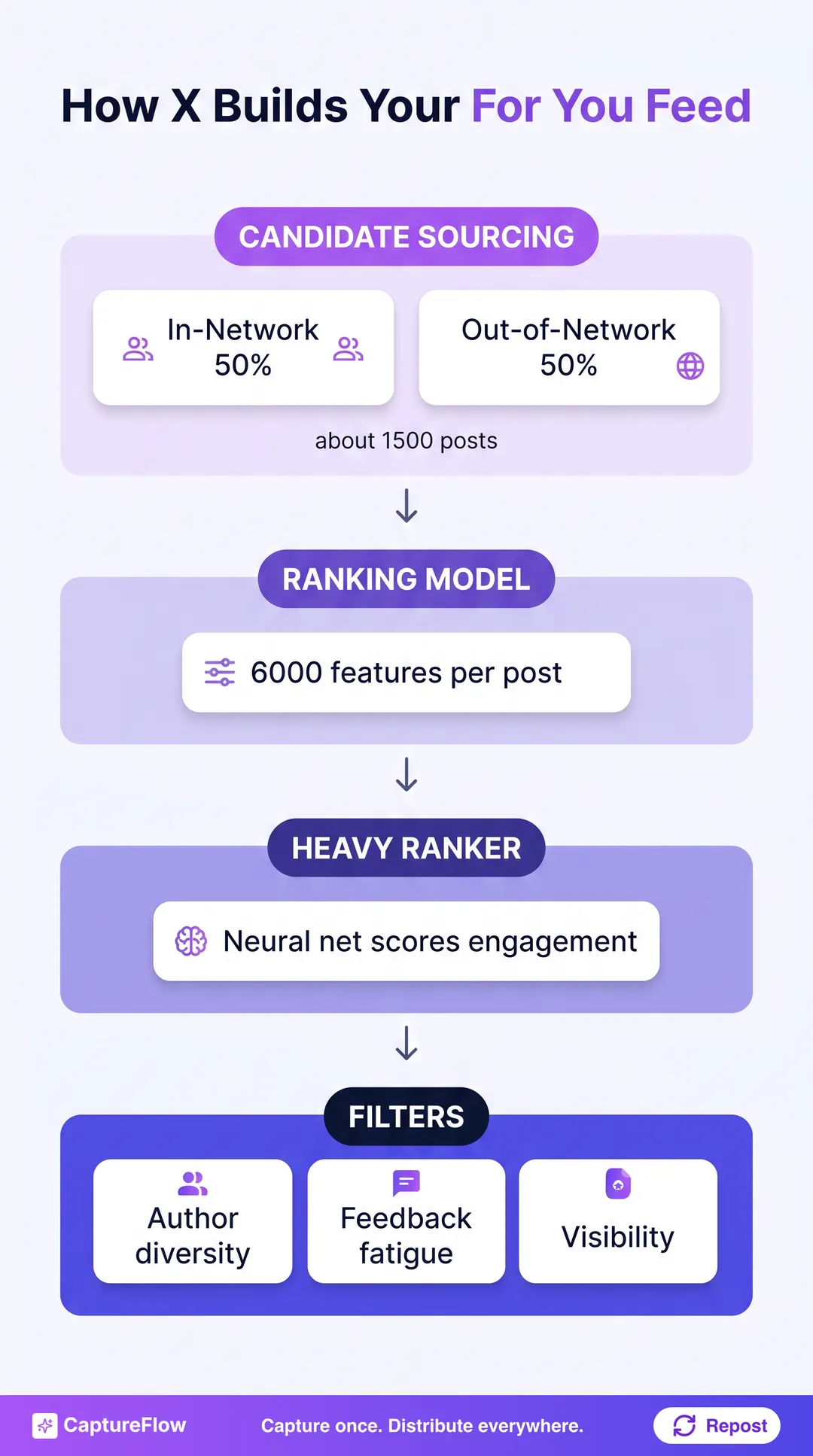 How a post travels from publish to feed. It has to clear each stage to reach the next.
Stage 1: candidate sourcing. For each feed refresh, X assembles a pool of roughly 1,500 candidate posts out of hundreds of millions. Those candidates come from two buckets in a roughly even split: about 50 percent in-network (people you follow) and 50 percent out-of-network (people you do not). In-network posts are pulled from X's Earlybird search index. Out-of-network posts are found by components with names like the User Tweet Entity Graph, a service that walks the follow graph to find posts your connections engaged with, and SimClusters, which groups users and posts into interest communities. The headline fact: half of your potential reach on X comes from people who do not follow you yet. That is exactly why the feed can hand a small account a viral moment, and why chasing follower count alone misses the point.
Stage 2: the ranking model. The pooled candidates then get scored. X's home-mixer service hydrates about 6,000 features for each candidate before ranking. A "feature" is just a fact the model can use: who the author is, what the post contains, how fresh it is, and how you personally have behaved toward similar posts before. Six thousand of them go into every single scoring decision, which is why blanket rules like "post at 9am" explain so little.
Stage 3: the heavy ranker. The model doing the scoring is the heavy ranker, a neural network that reads those features and outputs a set of probabilities, one for each way you might react. Then it blends them into a single score using fixed weights. This weighted sum is the most important thing in the whole system to understand, because the weights were in the open-sourced code. We can see, in plain numbers, exactly what the X algorithm values. The next section is those numbers.
Stage 4: filters and heuristics. A high score still does not guarantee a slot. After ranking, X applies a set of filters: author diversity so one account cannot flood your feed, content balance to keep the in-network and out-of-network mix sane, feedback fatigue that dials down posts you have signalled you dislike, deduplication of posts you already saw, and visibility filtering for blocked or muted authors and your safety settings. Only what survives all of that reaches your screen.
The feed scores the post, not you. A big following gets your post into more candidate pools, but it cannot force a low-scoring post through the heavy ranker or the filters. That asymmetry is why a sharp reply from a tiny account sometimes out-reaches the original poster.
What the X algorithm rewards in 2026
Because the heavy ranker turns your post into a weighted sum of predicted reactions, "what the algorithm rewards" is not a mystery. It is a list of numbers in X's repository. Here are the ones that matter, drawn straight from the open-sourced heavy ranker weights.
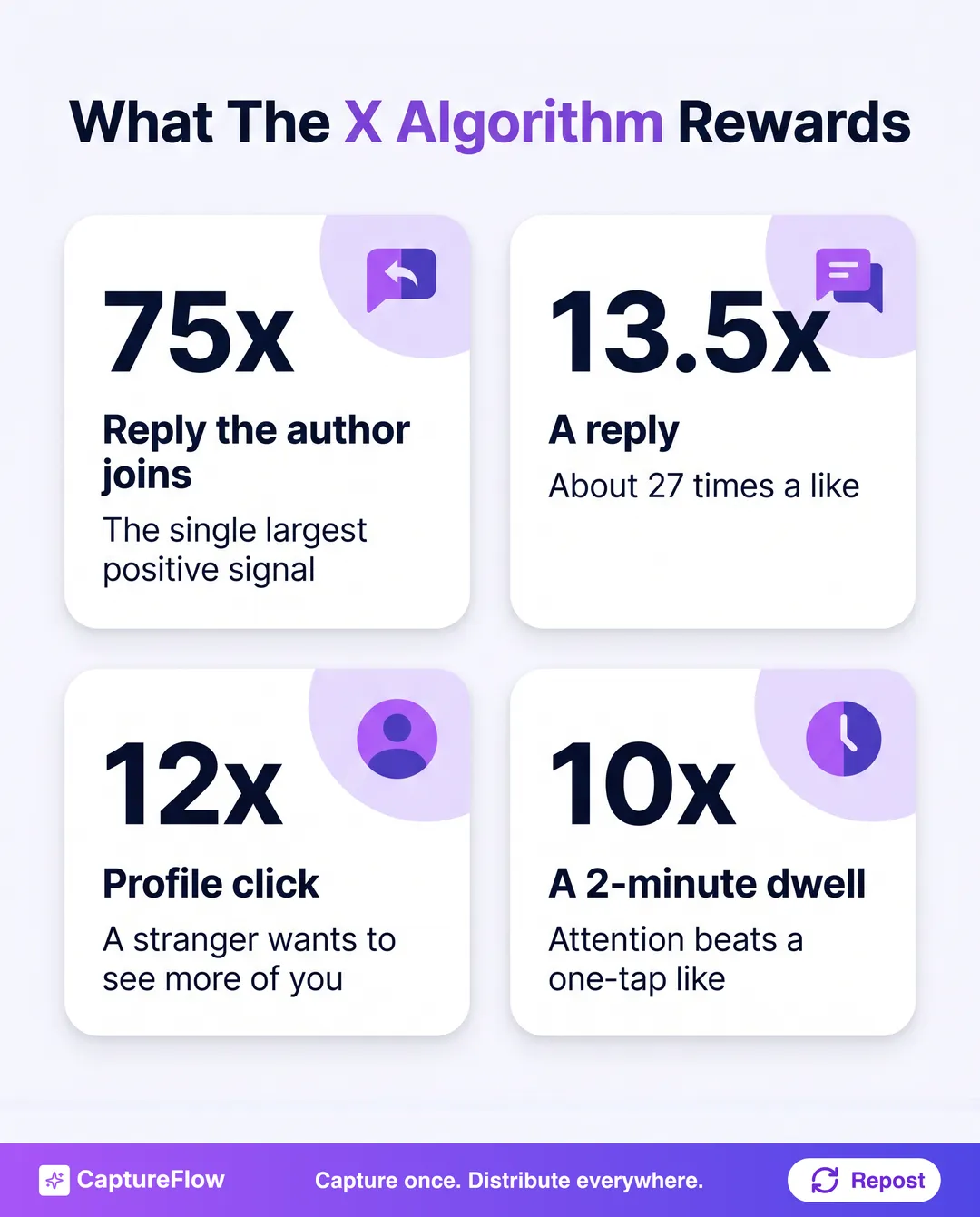 The rewarded signals, taken directly from X's open-sourced heavy ranker weights.
Replies, and conversation most of all. A reply is weighted 13.5, which is 27 times more than a like at 0.5. But the single largest positive signal in the entire model is a reply that the original author then engages with, weighted 75. X is telling you plainly what it wants: not broadcasts, but conversations. A post that starts a back-and-forth you take part in is worth more to the ranker than almost anything else you can do.
Dwell and watch time. Two of the top weights reward attention rather than clicks. Opening a post and staying on it for two minutes or more is weighted 10, and clicking into a post's conversation is weighted 11. Video playback past the halfway mark carries its own weight too. The lesson is the same one that governs every modern feed: content people stop and sit with beats content they scroll past, even when the scroll-past collected a like on the way by.
Profile clicks. When someone taps your post and then clicks through to your profile, that "good profile click" is weighted 12, one of the highest signals in the model. It is a proxy for genuine interest, a stranger deciding the post was good enough to find out who you are. Posts that make people curious about you, not just entertained for a second, score well and convert reach into followers.
Verified reach. X Premium and Premium+ subscribers get a documented reply boost: their replies rank higher in conversations and are more likely to be seen. It is the one place in the system where paying, rather than posting well, changes your distribution, and X states it openly rather than hiding it.
Scale is why all of this compounds. Per DataReportal, X's ads reached about 586 million users in early 2025, close to 10 percent of every adult on Earth, even as that audience shrank about 5 percent year over year. That out-of-network pool is what the heavy ranker can push a strong post into. The reach exists. The score is what unlocks it.
The pattern in X's own weightsEvery signal the heavy ranker prizes is a proxy for one thing: a real person paused, replied, or wanted to know more.
What the X algorithm penalizes
The mirror image of a scoring system is that a few actions carry large negative weights, and one of them can erase a pile of positive engagement in a single tap.
External links in the post. X wants people reading and replying on X, not leaving for another tab. Posts that push people off-platform tend to under-perform native ones. The fix is the same one that works on other feeds: keep the post itself native and self-contained, and put the link in a reply.
Engagement bait. "Reply YES and I will DM you the guide" farms shallow reactions that do not match real dwell time or conversation. Worse, it nudges annoyed readers toward the negative signals below. The heavy ranker is trained on genuine attention, and bait is the opposite of it.
Rapid unfollows, mutes, and blocks. These are the actions that hurt most. In the open-sourced weights, negative feedback, a mute, a block, or "show less often," is weighted -74, and reporting a post is weighted -369. Set that against a like at 0.5 and the math is brutal: a single report can wipe out the scoring value of hundreds of likes. Content that provokes people into muting or blocking you is not merely neutral, it actively drags down how the model treats your next post, because the model learns from every one of those signals.
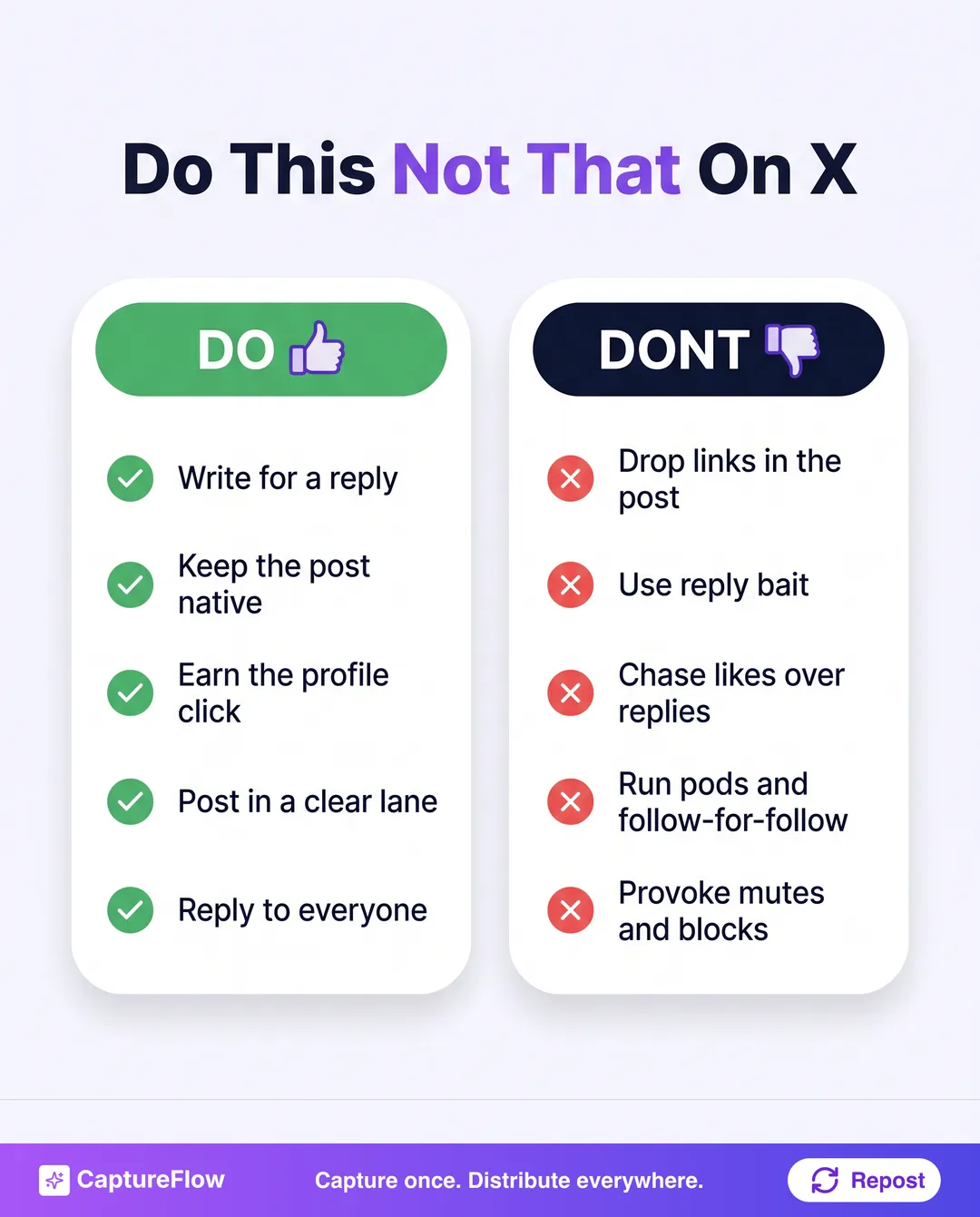 Feed the signals on the left. The right-hand column trips the filters or the negative weights.
How to work with the X algorithm
None of this requires a trick. Working with the Twitter algorithm in 2026 is mostly about feeding the signals it already pays for, on purpose.
-
Write for a reply, not a like. The single highest-value outcome is a conversation you take part in. End with a real question or a take worth arguing with, then reply to the people who show up in the first hour. A strong first line is what earns the stop in the first place. Our guide to writing hooks applies just as well to X, and you can pressure-test yours with the free hook generator.
-
Keep the post native. Say the whole thing in the post. Put any link in a reply so the post itself keeps people on X and reading, which protects your dwell-time signal.
-
Earn the profile click. Post with a consistent point of view so a single good post makes a stranger want to see the rest of your work. That is the 12-weight signal, and it is the mechanism that turns out-of-network reach into actual followers.
-
Post consistently in a clear lane. Consistency is the highest-leverage input, because it gives the feed more chances to sample you and trains your audience on what you are about. The realistic way to sustain it is to stop starting from a blank page. If you want a system for volume, the best X growth tools cover the field honestly, and how often to post on social media sets a sane cadence you can actually keep.
-
Do not fake it. Pods, reply bait, and follow-for-follow generate exactly the shallow engagement the model is built to discount, and they raise your odds of the mute-and-block signals that carry the biggest penalties in the whole system.
The early window matters, but not the way "post at 9am" implies. Timing decides how many people are around to reply and dwell in the first hour, which is when the strongest signals land. It is a sampling factor, not a ranking factor, the same mechanic that governs the best time to post on LinkedIn and the best time to post on X.
This is the gap CaptureFlow is built to close. CaptureFlow is an AI content agent that turns your expertise into weeks of on-brand content for every platform. You capture one idea in 5 minutes, a voice note, a video, a file, or a link, and it reshapes that into native posts trained on your voice, so showing up on X consistently stops depending on willpower. A content strategy built on your own material keeps every post in a clear lane, and you can see what CaptureFlow costs whenever you are ready.
If X is one of several places you show up, the same logic governs the rest of your feeds. How the LinkedIn algorithm works is the sister guide, built the same way from that platform's own engineering. The X algorithm in 2026 is not out to bury you. It is a scoring system that rewards posts real people stop on, reply to, and remember. Give it those, and it does the distribution for you.
FAQ
See the questions above for quick answers on replies versus likes, external links, and whether X Premium boosts your reach.
Sources
- X Engineering: Twitter's Recommendation Algorithm
- X / GitHub: the-algorithm (home-mixer and candidate sources)
- X / GitHub: the-algorithm-ml (heavy ranker engagement weights)
- X Help Center: About X Premium
- DataReportal: X Users, Stats, Data and Trends
Frequently asked questions
How does the X (Twitter) algorithm work in 2026?+
For each feed refresh, X gathers about 1,500 candidate posts split roughly evenly between accounts you follow and accounts you do not, scores each one with a neural network called the heavy ranker that predicts how likely you are to engage, then applies filters for author diversity, freshness, and safety. The highest-scoring posts that survive the filters reach your feed. Most of this is visible in X's open-sourced code.
What does the X algorithm reward most?+
Conversation. In X's open-sourced heavy ranker, a reply is weighted 13.5 and a reply the author then engages with is weighted 75, the single largest positive signal. A profile click is weighted 12 and a 2-minute dwell is weighted 10, both well above a like at 0.5. Posts that spark replies and hold attention win.
Do external links reduce your reach on X?+
In practice they tend to. X favors posts that keep people reading and replying on X rather than leaving the app, so native posts usually out-distribute posts that send people off-platform. The common workaround is to keep the post self-contained and put the link in a reply.
Does X Premium boost your reach?+
Yes, in one specific way X states openly. Premium and Premium+ subscribers get a reply boost, so their replies rank higher in conversations and are more likely to be seen. It is the one place where paying, rather than posting well, changes your distribution.
Chris is the founder and CEO of CaptureFlow, which he builds so founders can turn their expertise into content without hiring a team. After 10+ years building products and growing audiences from scratch, he writes about founder-led content, AI, and distribution from inside the problem he is solving: distributing consistent, on-brand content as a team of one.
Founder & CEO of CaptureFlow · 10+ years building products and audiences
One playbook a week from founders who actually create and distribute lots of content. No spam, unsubscribe anytime.
Keep reading

Best Time to Post on X (Twitter) in 2026 (Data-Backed)
Most X timing charts you'll find online are scheduling-tool studies dressed up as research. Here is what the clean, non-vendor data actually supports, and a system to find your own window.

How the LinkedIn Algorithm Works in 2026 (Backed by Data)
The LinkedIn algorithm is not a slot machine. It is a relevance system with rules you can read, and most of them trace back to LinkedIn's own engineering.

LinkedIn Marketing for B2B Companies
For B2B, LinkedIn is not one channel among many. It is the channel. Here is how B2B companies actually win on it: the stack, the pillars, and the cadence.