What Is Employee Advocacy? The Complete Guide
What employee advocacy is, how it works, why it out-trusts brand content, the two types, the benefits, and how to start a program that actually produces posts.


Your company page has a few thousand followers and a reach chart that flatlines on a good day. Your employees, collectively, have networks many times larger, full of exactly the people you are trying to reach, sitting completely unused.
Closing that gap is the entire idea behind employee advocacy, and it is one of the highest-leverage, lowest-cost channels most companies have.
Employee advocacy is the practice of a company's employees promoting the brand through their own social networks, by sharing company content or creating their own posts, in their own voice. This is the complete guide: what it is, how it works, why it beats brand content, the two types, the benefits, and how to start.
How employee advocacy works
The mechanism is simple. The company produces content and ideas, employees share or create posts from them, those posts reach the employees' personal networks, and buyers encounter the brand through a person they already follow rather than a logo they would scroll past. The one input this mechanism needs is posts, and the most common reason it stalls is people not knowing what to write, so here are employee advocacy content ideas your team can pull from any week.
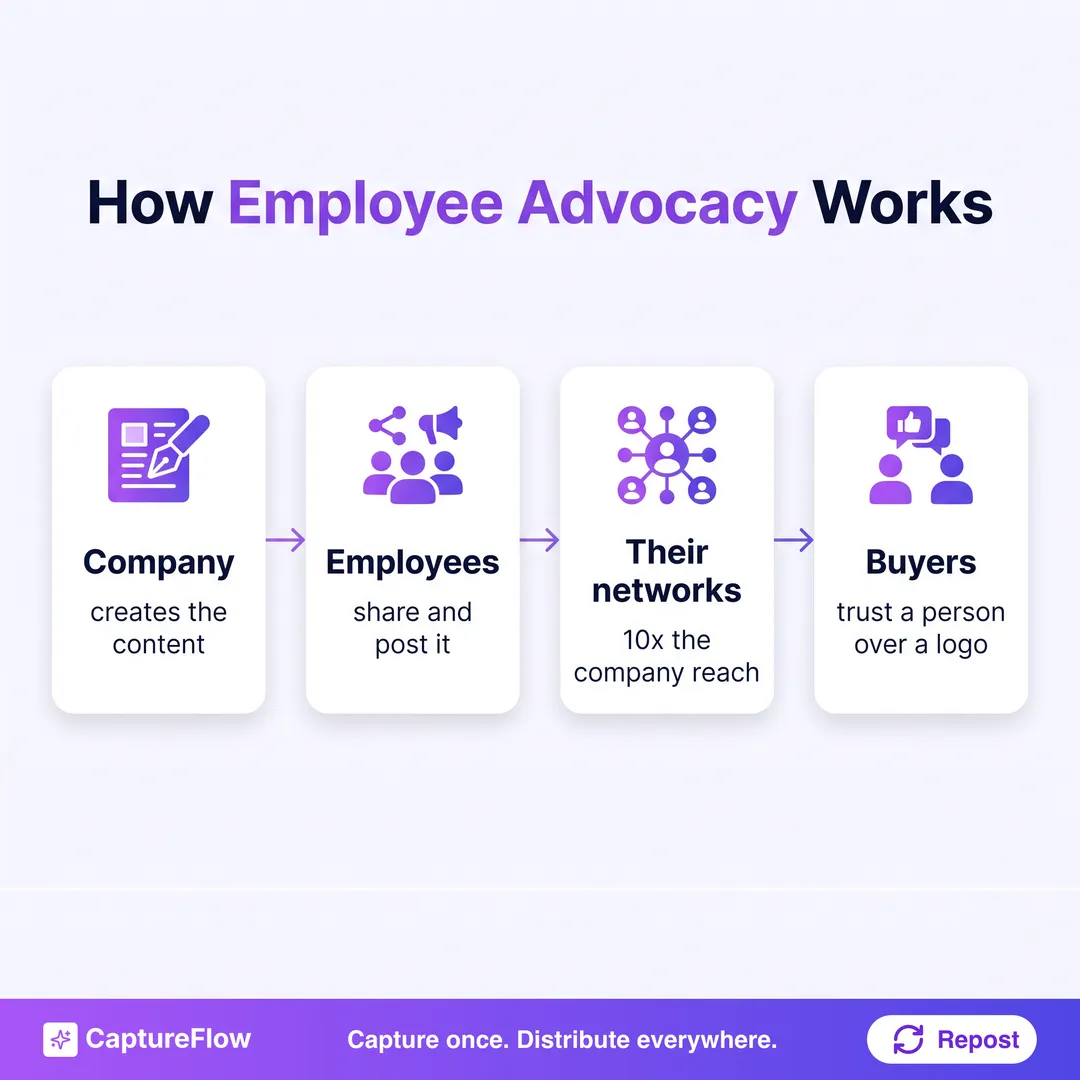 The chain that makes advocacy work: company to employee to network to buyer.
The key move is that the message travels through the person. That single change, from a brand account to a human someone already follows, is what unlocks both the reach and the trust that a company page cannot manufacture on its own.
The two types of employee advocacy
"Employee advocacy" covers two different behaviors, and knowing the difference is what separates a program that works from one that reads as spam.
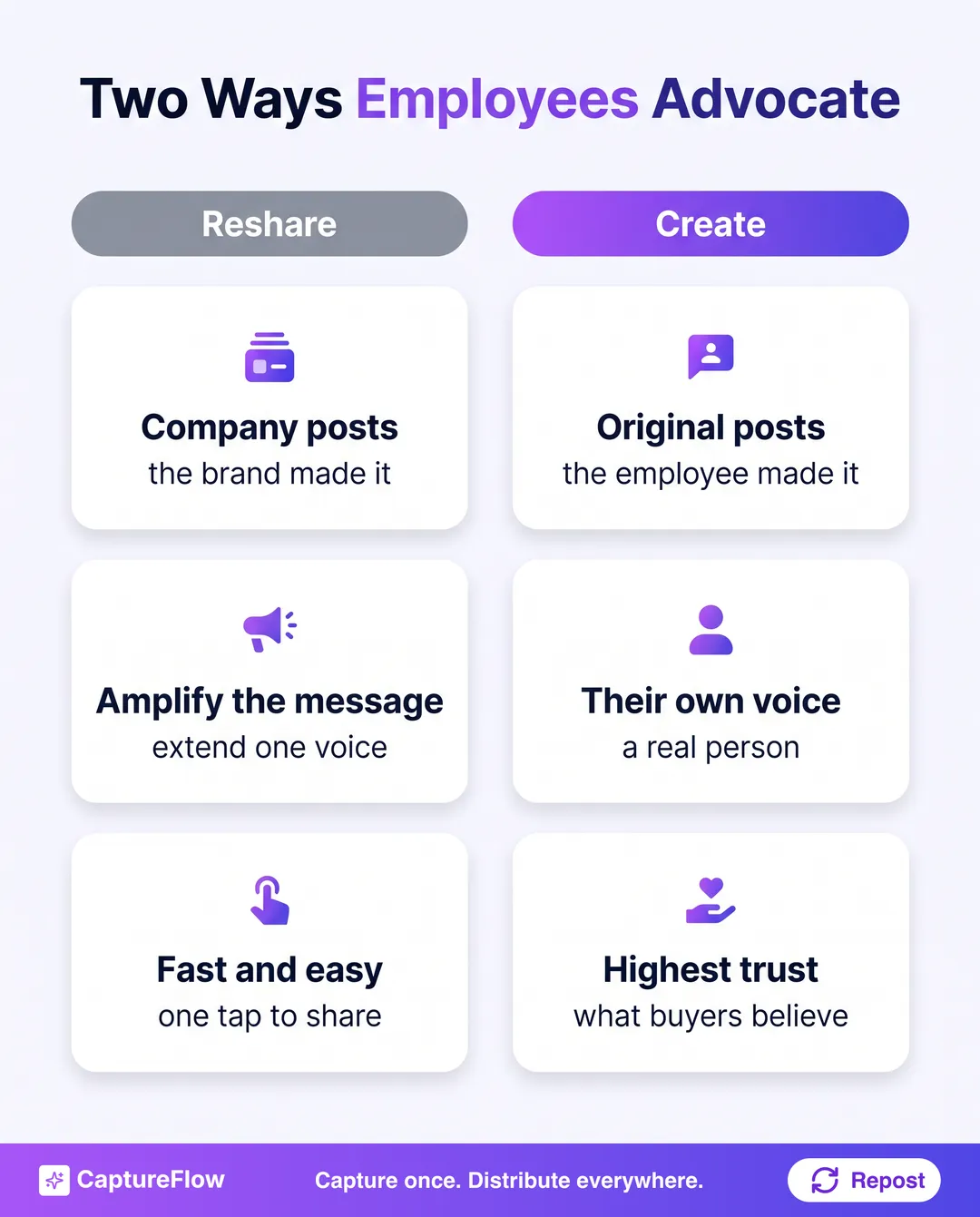 Resharing amplifies the brand. Creating earns the trust. The best programs do both.
Resharing is the classic version: the company publishes a post, and employees share it. It is fast, easy, and useful for spreading an announcement, but it still arrives as the company's voice, one step removed.
Creating is the higher-trust version, known as employee-generated content: employees write their own original posts about their work and expertise. It takes more effort, but it reads as a real person thinking out loud, which is exactly why it earns the most trust. The strongest programs use both, leaning on original creation for the content that actually moves buyers.
Why employee advocacy works
Two forces make this the highest-leverage organic channel most companies have, and both are backed by data.
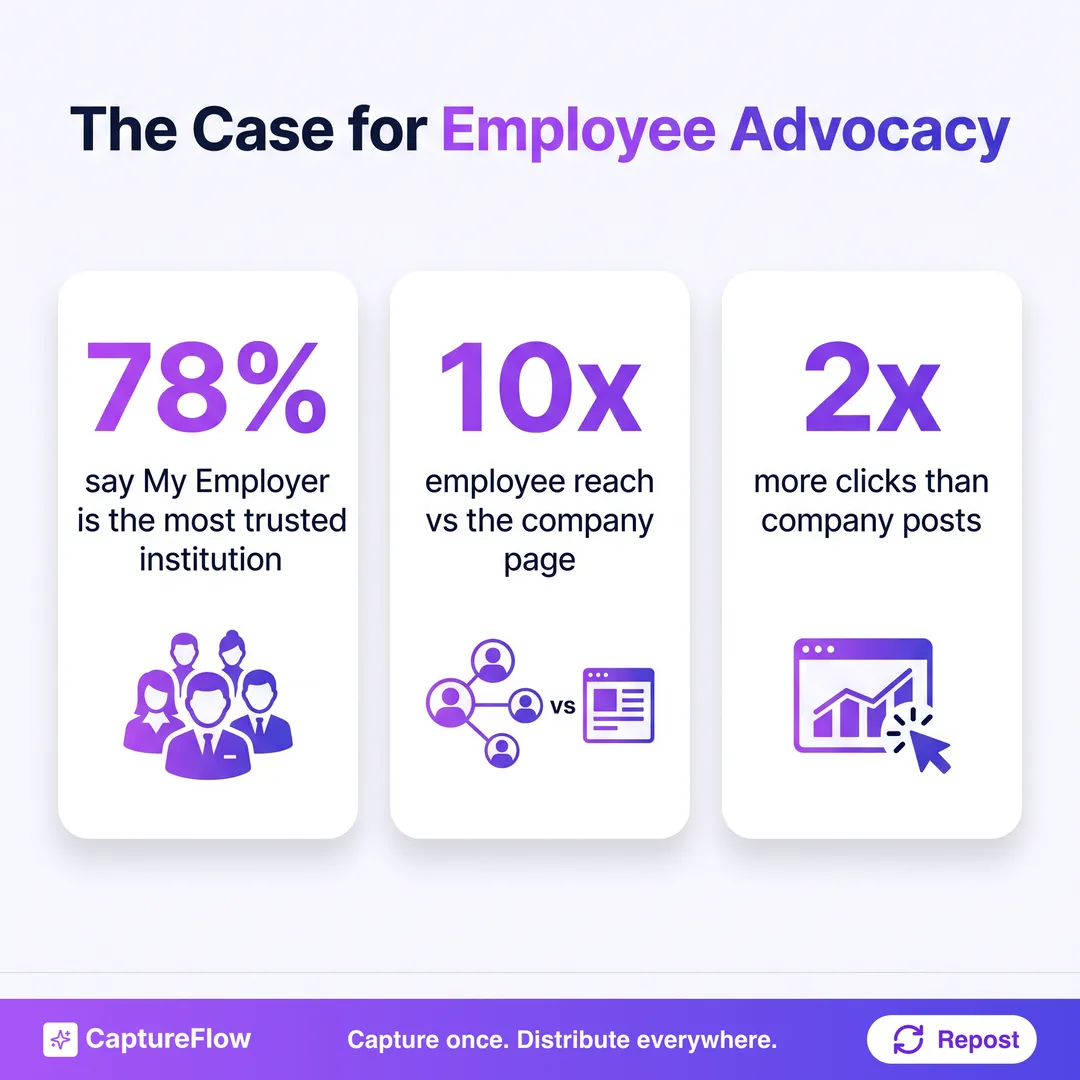 The case in three numbers: more trust, more reach, more clicks.
Trust has moved to the person. The 2026 Edelman Trust Barometer found that "My Employer" is now the most trusted institution at 78 percent, ahead of business in general and far ahead of government and media. People believe those close to them over distant institutions, and an employee is exactly that trusted, local voice.
The reach and engagement math is lopsided. According to LinkedIn's own data, employees' combined networks are on average about ten times the size of a company's follower base, and their shares are roughly twice as likely to be clicked as the same content from the company page. And in the 2024 Edelman-LinkedIn B2B Thought Leadership Report, 73 percent of decision-makers said thought leadership is a more trustworthy basis for judging a company than its marketing. Advocacy is how you produce that trust at the scale of your whole team.
The benefits of employee advocacy
Put the mechanism and the data together and the benefits are concrete:
- Reach you did not pay for. Your team's networks are an audience larger than your ad budget can buy, at close to zero media cost.
- Trust you cannot buy. Content from a named person carries credibility a brand account structurally cannot earn.
- Pipeline and demand. More trusted reach among the right people is, in B2B, the top of the funnel. It supports the whole LinkedIn marketing motion for B2B companies.
- Recruiting and employer brand. Candidates check what employees say before they apply, so an active team doubles as your best hiring signal.
Why an employee advocacy strategy compounds
A one-off campaign spikes and dies. A real employee advocacy strategy feeds itself, and every turn makes the next one easier.
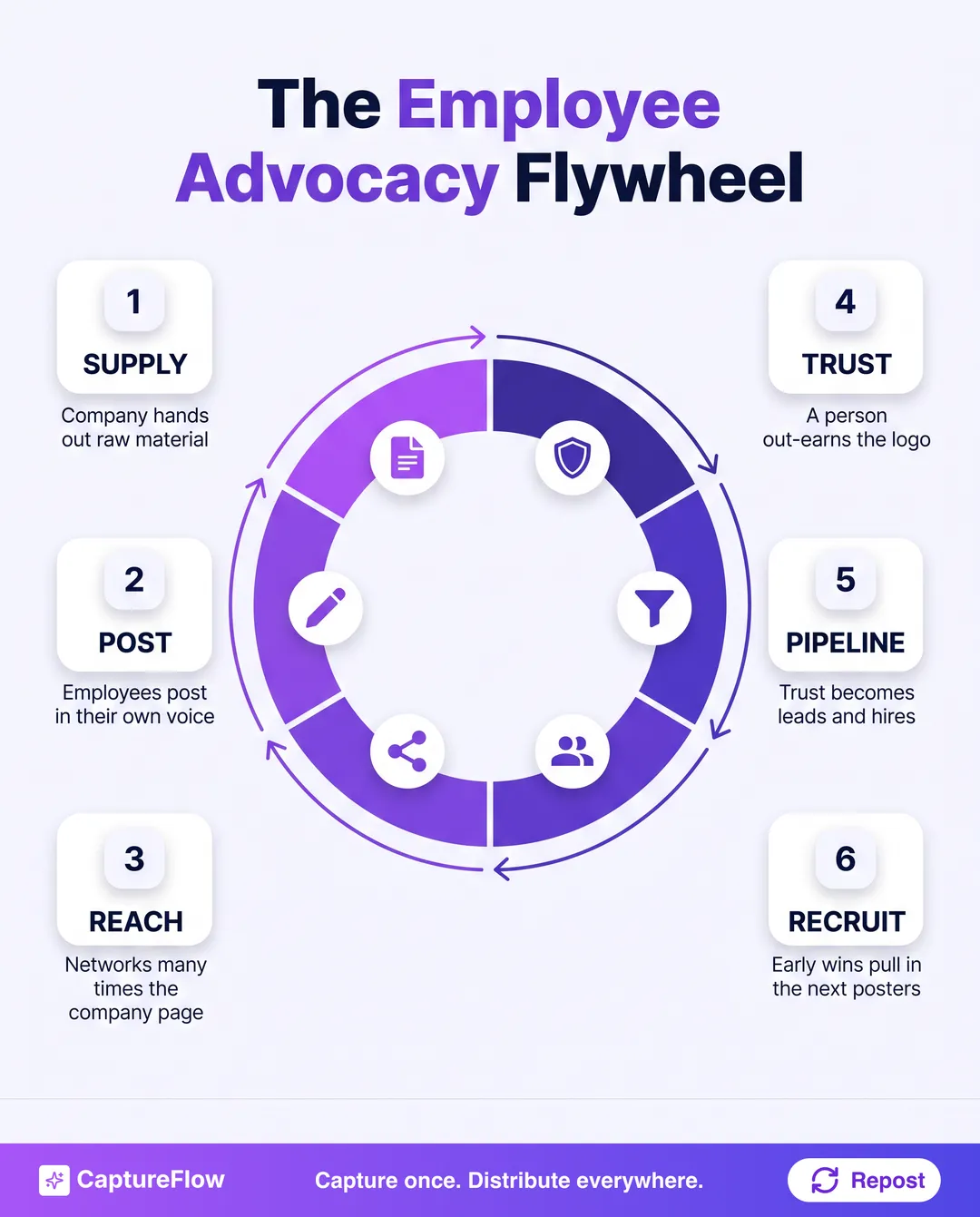 Each stage powers the next, so the program gets easier the longer you run it.
Here is the loop. The company hands out raw material. A few employees post it in their own voice. Those posts land in networks many times larger than the company page, where a named person out-earns the logo on trust. That trust turns into pipeline, and the occasional inbound hire. Then the early wins do the recruiting for you, the next group sees it working and asks in.
The hardest turn is the first one: getting a few reluctant people posting every week. That is its own discipline, and the activation playbook is the step-by-step for it.
How to start an employee advocacy program
You do not launch this company-wide on day one. The programs that last start small and voluntary, then scale from proof. The short version:
- Set one goal with a number attached (reach, pipeline, or recruiting).
- Recruit a small pilot of willing employees. Never mandate it.
- Give them content and their own voice, raw material to make their own, not a script to paste.
- Remove all friction so posting takes minutes, not a blank-page evening.
- Measure reach and clicks, not vanity followers, and celebrate what works.
The full step-by-step is in our employee advocacy program playbook, which walks through each stage in depth.
Never mandate participation. Forced advocacy is obvious, and the posts show it. Start with the handful of employees who already enjoy being on LinkedIn, prove it works with them, and let their results recruit the next group. A program people ask to join outlasts one they are assigned to.
Employee advocacy best practices
A few employee advocacy tips separate the programs that compound from the ones that stall:
- Protect each person's voice. Ten identical pasted captions read as spam and waste the entire trust advantage. Give ideas, not scripts.
- Make it genuinely easy. Consistency is a friction problem, not a willpower one. If posting takes thirty minutes, people quit; if it takes five, they keep going.
- Fuel it with a content supply. The most common failure is an empty feed. A program needs a steady stream of things worth sharing, which is a content problem upstream of the tool.
- Measure outcomes, not activity. Reach, clicks, conversations, and pipeline are the numbers that matter. Company-page followers is vanity.
When you are ready to buy software for the distribution side, our roundup of the best employee advocacy tools ranks the platforms honestly, including the one thing every one of them assumes you already have. Whether to buy a platform at all or run the program in-house is its own call, which we weigh in employee advocacy software vs building in-house.
Common employee advocacy mistakes
Most programs fail for the same handful of reasons, and none of them is a lack of good intentions:
- Mandating it. The fastest way to kill the trust advantage is to require posts. Forced advocacy is obvious and erodes the exact credibility the program depends on.
- Handing out copy to paste. When ten people post the identical caption, you have rebuilt the company account with extra steps, and readers pattern-match it as spam.
- Treating it as a one-off campaign. Advocacy compounds over months. A big launch week followed by silence resets you to zero. The steady drip wins.
- Buying software before solving supply. A platform gives employees a place to share, not something worth sharing. If the feed is thin, distribution just spreads your silence faster.
- Measuring the wrong thing. Company-page follower count is a vanity number here. Employee reach, clicks, and pipeline are the real ones.
Avoid those five and almost any program will grow. Get them wrong and the best strategy on paper will still produce a quiet, abandoned feed.
Who should own employee advocacy?
In most companies it sits with marketing or communications, because they own the content supply and the measurement. But the best programs treat it as a shared effort: leadership models it by posting themselves, marketing fuels it with raw material, and the employees provide the voices. It is closely related to founder-led marketing, which runs the same trust mechanic through the founder specifically. The common thread is that advocacy is powered by people, so whoever owns it has to make participating genuinely easy rather than one more thing on a to-do list.
The advocacy ruleEmployee advocacy is not your team amplifying the company's voice. It is the company handing its best ideas to the people your buyers already trust, then getting out of the way.
The move
Employee advocacy turns your team's networks and credibility into your largest, most trusted, and cheapest distribution channel. It works because trust has moved to the person, the reach math favors people over pages, and buyers believe an employee over a logo.
Start small, protect each voice, and above all keep it easy, because the whole program rests on consistency. If the bottleneck is giving every employee on-brand content they can make their own in five minutes, that is exactly what CaptureFlow is built to do, and you can see how it works or begin with the step-by-step program playbook.
Sources
- Edelman, 2026 Edelman Trust Barometer ("My Employer" the most trusted institution at 78 percent).
- LinkedIn Marketing Blog, How to Increase Employee Social Sharing for More Organic Reach (employee networks ~10x the company audience; shares ~2x more likely to be clicked).
- Edelman and LinkedIn, 2024 B2B Thought Leadership Impact Report (73 percent trust thought leadership over marketing).
Frequently asked questions
What is employee advocacy?+
Employee advocacy is the practice of a company's employees promoting the brand through their own social profiles, either by sharing the company's content or by creating their own posts about their work, in their own voice. It turns the collective networks and personal credibility of a team into a distribution channel that is larger and more trusted than the company page.
What is the difference between employee advocacy and employee-generated content?+
Employee advocacy is the broad practice, and it has two modes. Resharing is amplifying the company's existing posts. Employee-generated content (EGC) is the higher-trust mode where employees create their own original posts in their own voice. EGC is a type of employee advocacy, and it is the version that earns the most trust because it reads as a person, not a reshared brand message.
What are the benefits of employee advocacy?+
Reach, trust, and pipeline at near-zero media cost. Employee networks are on average about ten times the size of the company's follower base, their posts earn more engagement and clicks than company posts, and buyers trust a named person over a brand account. It also supports recruiting and employer brand, since candidates check what employees say before they apply.
How do you start an employee advocacy program?+
Start small and voluntary: pick one clear goal, recruit a handful of willing employees, give them content and let them use their own voice, remove every bit of friction so posting takes minutes, and measure reach and clicks rather than vanity metrics. Never mandate it, because forced advocacy reads as forced and erodes the trust the program depends on.
Chris is the founder and CEO of CaptureFlow, which he builds so founders can turn their expertise into content without hiring a team. After 10+ years building products and growing audiences from scratch, he writes about founder-led content, AI, and distribution from inside the problem he is solving: distributing consistent, on-brand content as a team of one.
Founder & CEO of CaptureFlow · 10+ years building products and audiences
One playbook a week from founders who actually create and distribute lots of content. No spam, unsubscribe anytime.
Keep reading

Employee Advocacy Content Ideas: What Your Team Should Post on LinkedIn
Your team is willing to post, they just do not know what to say. Here is the content employees should share on LinkedIn, and how to make it take 5 minutes.
How to Get Your Team Posting on LinkedIn: An Activation Playbook
The strategy was fine. The recruiting was fine. Six weeks in, two people post and the rest have gone quiet. Activation is the missing step, and this is the playbook for it.

Employee Generated Content: The B2B Playbook
Your buyers trust your employees more than your brand. Employee-generated content is how you put that trust to work. Here is the B2B playbook.