Employee Generated Content: The B2B Playbook
What employee-generated content (EGC) is, why it out-trusts brand content in B2B, and the 5-step playbook to build an EGC program that actually produces posts.


Look at your last ten company-page posts, then look at the last thing a respected person in your industry wrote on their own profile. One of those got scrolled past. The other got read, saved, and replied to.
That gap is not about your content team's talent. It is about who is talking.
Employee-generated content (EGC) is original content that a company's employees create and publish on their own channels, in their own voice, about their work and expertise. It is the most trusted, highest-reach, lowest-cost channel most B2B companies are sitting on and not using. This is the practical playbook: what EGC is, why it works, and how to build a program that actually produces posts instead of a policy nobody follows.
What is employee-generated content (and how it differs from advocacy)
The terms get blurred, and the difference is the whole point.
Employee advocacy is usually resharing: the company publishes a post, and employees hit "share." Useful, but it still arrives as the company's voice, one step removed. It is the broader practice, explained in full in what employee advocacy is, and we cover the how in the employee advocacy program playbook.
Employee-generated content is creation: an employee writes their own post, records their own short video, shares their own lesson from the week. It is theirs. That is exactly why it lands, because it reads as a person thinking out loud, not a brand pushing a message. The hard part is knowing what that post should be about, which is why we keep a running list of employee advocacy content ideas your team can pull from.
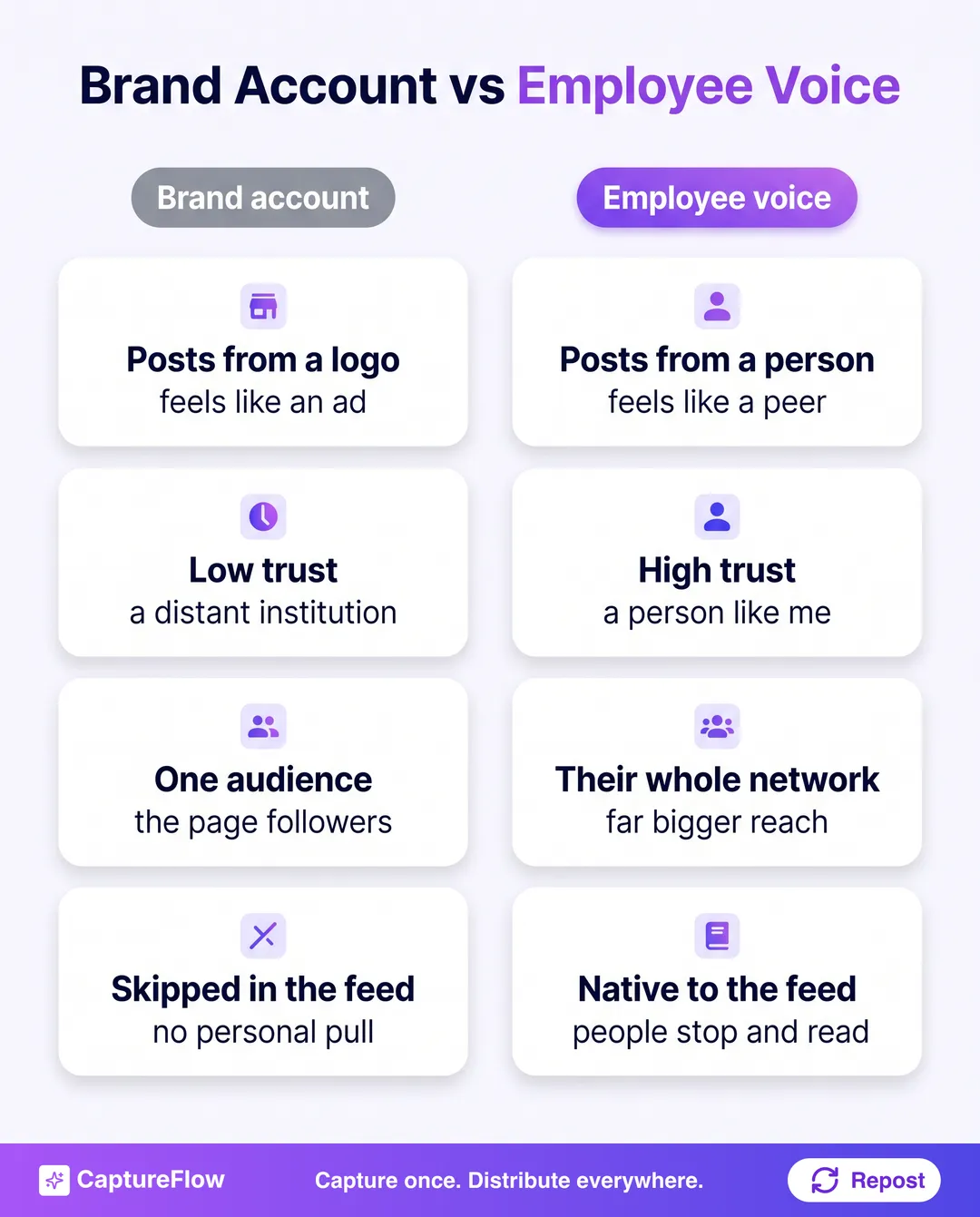 Same message, two senders. The employee wins on every axis that moves a B2B buyer.
Why employee-generated content wins in B2B
Two forces make EGC the highest-leverage organic channel most B2B companies have.
Trust has moved to the person. The 2026 Edelman Trust Barometer found that "My Employer" is now the most trusted institution at 78 percent, well ahead of business in general and far ahead of government and media. In the same research, technical experts like scientists and teachers are the most trusted voices while CEOs sit in the low 50s. Trust has become local and personal. An employee sharing what they know is exactly that trusted, near-you voice. A brand account is the distant institution people have learned to tune out.
The reach and credibility math is lopsided. According to LinkedIn's own marketing data, employees' combined networks are on average about ten times the size of a company's follower base, and their content earns meaningfully more engagement than the same message from the page. And in the 2024 Edelman-LinkedIn B2B Thought Leadership Report, 73 percent of decision-makers said thought-leadership content is a more trustworthy basis for judging an organization than its marketing, and 90 percent are more receptive to companies that publish it consistently. EGC is how you produce that thought leadership at the scale of your whole team, not just the founder.
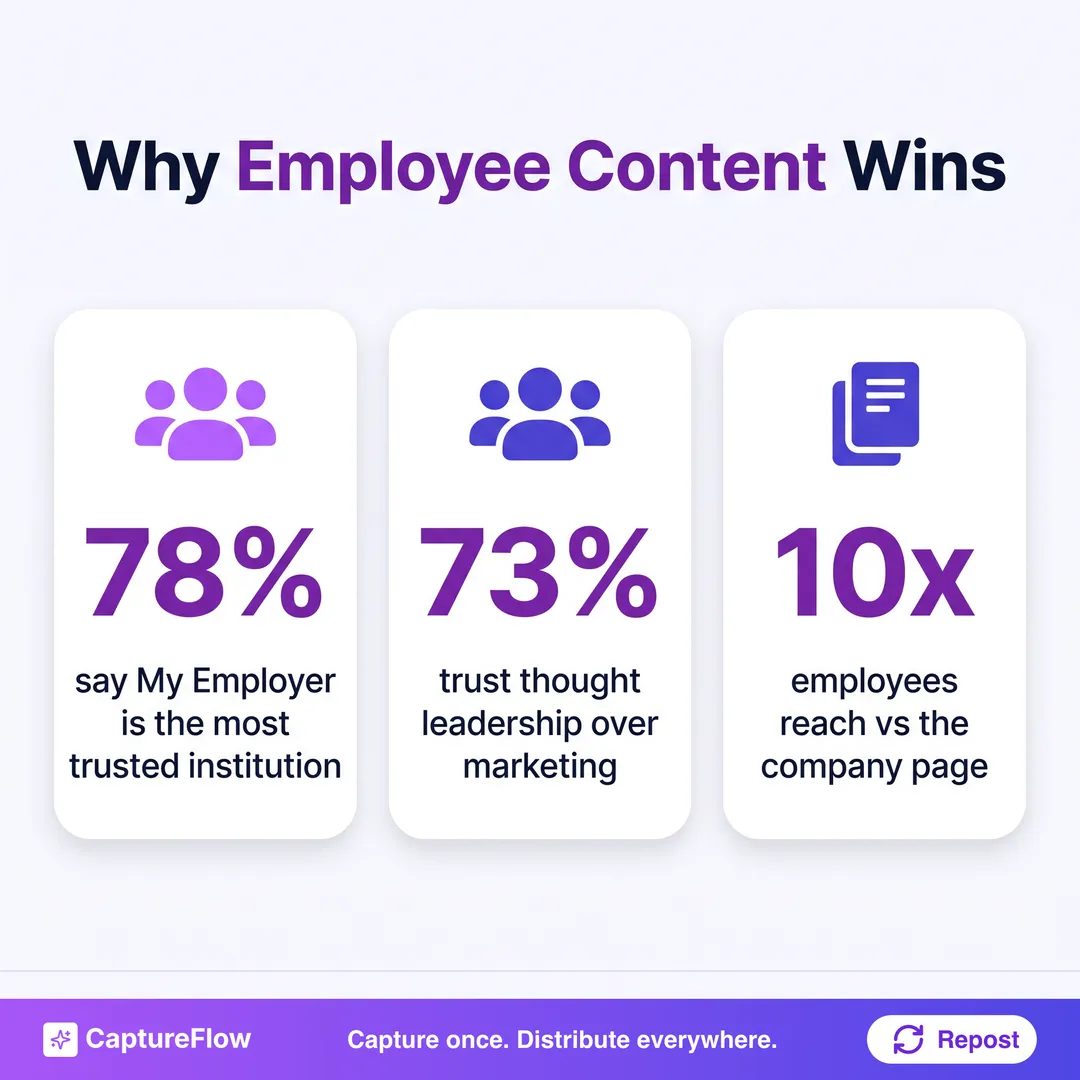 More trust, more reach, more credibility, at close to zero media cost.
Put those together and the case is hard to argue with: your team can reach a bigger audience than your ad budget, with more trust than your brand account, for free. And it compounds. A brand account resets to zero interest with every post, while an employee who shows up weekly builds a following that carries every future post further. The reach you earn this quarter becomes the floor for next quarter.
The only reason it is not already happening is that creating the content feels hard. That is a solvable problem, and the rest of this playbook solves it.
The 5-step employee-generated content playbook
Here is the whole system before we go deep on each step.
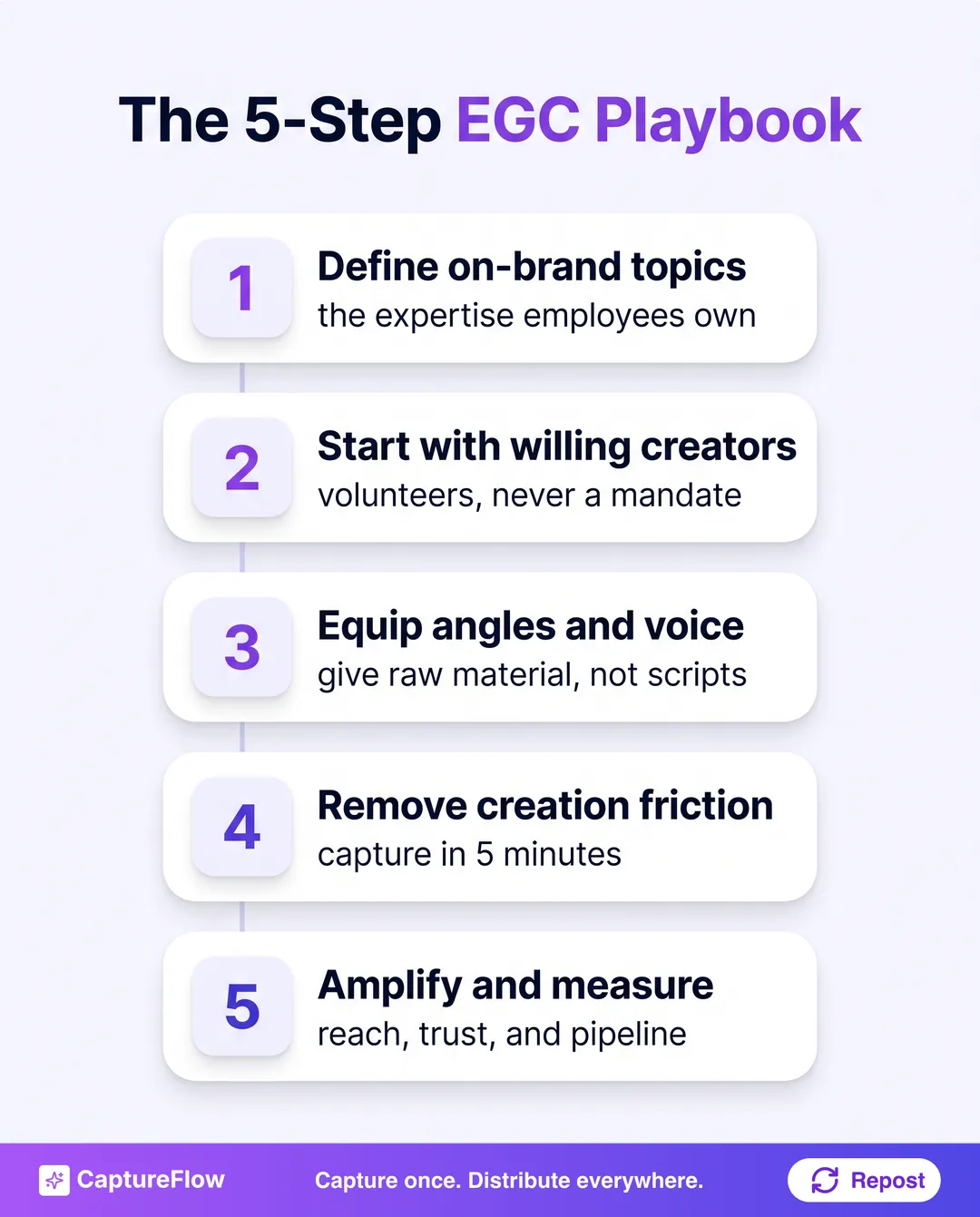 The whole program on one page. Each step exists to keep creating easy enough that people keep doing it.
Step 1: Define the topics employees own
EGC fails when it is a vague ask to "post more." It works when each person knows the two or three subjects they are genuinely expert in and expected to talk about.
Map your team to topics: your head of product owns the "why we built it this way" stories, your sales lead owns the objections buyers actually raise, your engineers own the hard technical trade-offs. Give people a lane, not a quota.
Write each person a one-line "you own this" brief. "You are the voice on onboarding and activation" beats "please be active on LinkedIn." A defined lane removes the blank-page paralysis that kills most programs in week one.
Step 2: Start with willing creators
Do not launch company-wide and do not mandate it. Forced content reads as forced, and the posts show it.
Start with five to ten people who already enjoy being on LinkedIn or want to be. Enthusiasm is the only prerequisite that matters. A small group of willing creators beats the whole company checking a box, and their early wins become the proof you recruit the next group with. Turning that willingness into consistent posting is the hard part, and the employee activation playbook is the step-by-step for it.
Look for the employees who already comment on industry posts or share the occasional win. They are telling you they want to do this. Your job is to make it easier, not to convince the unwilling.
Step 3: Equip them with angles and their own voice
This is where most programs quietly die. They hand employees a block of approved copy to paste, everyone posts the identical paragraph, and the feed looks like a hostage situation. That is not EGC, it is the brand account wearing ten name tags.
Give people raw material, not a script. A strong angle, a customer story, a stat, a contrarian take, then let each person say it their way. The content idea can be the company's. The voice has to be theirs, or you lose the exact trust advantage you just read about. This is the same principle behind training an AI on your brand voice: the output has to sound like the human, not the template.
Never send a caption to copy-paste. Send the idea and one example, and explicitly tell people to rewrite it in their own words. Ten identical posts across ten profiles get pattern-matched as spam by readers and the feed alike.
Step 4: Remove the creation friction
Consistency is a friction problem, not a willpower problem. Every step between "I have a thought" and "it is posted" is where the program leaks people.
The target is five minutes, start to posted. If contributing takes an employee thirty minutes and a blank document, they will do it twice and quit. If it takes five minutes and the hard part is handled, they keep going. This is the exact gap an AI content agent is built to close. CaptureFlow is an AI content agent that turns your expertise into weeks of on-brand content for every platform. A team member captures one idea, a lesson, a customer story, a strong opinion, and it drafts on-brand posts, carousels, and short video that person can review and make their own in minutes, in their own voice, trained on how they actually write. The friction that kills EGC is exactly what it removes.
Measure the real cost of a post in minutes, not intentions. If your most willing contributor needs more than five minutes and three tools to post once, fix that before you recruit anyone else. The tooling is the program.
Step 5: Amplify and measure what matters
When a team member posts, help it travel: a few colleagues engaging early gives the post its first push, and the company page can reshare the best ones (now the logo is amplifying the person, the right way round).
Then measure the two things EGC is actually for: reach and trust that convert, not vanity. Track employee-driven impressions and the clicks and conversations that follow, and watch the trend over weeks, not the spike from any single post. If you want the honest read on which engagement signals matter, our guide to a good LinkedIn engagement rate makes the case for depth over raw reach.
Report results back to the group monthly, by name and with real numbers. People keep doing what they can see is working, and nothing kills a program faster than posting into a void with no feedback.
Common mistakes that sink EGC programs
A few failure modes show up again and again:
- Mandating it. Forced content is obvious and erodes the trust the whole program depends on.
- Handing out copy to paste. Identical posts read as spam and waste the personal-voice advantage entirely.
- Making creation a second job. If it is not fast, consistency dies, and consistency is the entire game.
- Measuring the wrong thing. Company-page followers is a vanity number here. Employee reach, clicks, and pipeline are the real ones.
The EGC ruleEmployee-generated content is not your team repeating the company line. It is the company handing its best ideas to the people your buyers already trust, then getting out of the way.
The move
Employee-generated content is the rare growth lever that is both high-leverage and nearly free: your team's networks already dwarf your page, and their voices already carry trust yours cannot. The only thing standing between you and that reach is the friction of creating.
Remove the friction, protect each person's voice, and start with the handful of people who already want to post. If the bottleneck is giving each employee on-brand content they can make their own in five minutes, that is exactly what CaptureFlow is built to do, and you can see how it works or how it fits a wider content operations system. EGC sits on top of that: the raw material in, a week of trusted, human content out. For the distribution mechanics that pair with it, the employee advocacy program playbook is the natural next read, the best employee advocacy tools covers the software side, and B2B leaders will find the B2B execs use case maps it to their goals. It all sits inside a wider LinkedIn marketing strategy for B2B companies.
Sources
- Edelman, 2026 Edelman Trust Barometer ("My Employer" the most trusted institution at 78 percent; technical experts the most trusted voices).
- LinkedIn Marketing Blog, How to Increase Employee Social Sharing for More Organic Reach (employee networks ~10x the company audience).
- Edelman and LinkedIn, 2024 B2B Thought Leadership Impact Report (73 percent trust thought leadership over marketing; 90 percent more receptive to consistent publishers).
Frequently asked questions
What is employee-generated content?+
Employee-generated content (EGC) is original content that a company's employees create and publish on their own social profiles, in their own voice, about their work and expertise. It is different from employee advocacy, which usually means resharing the company's existing posts. EGC is employees making something new, which is what earns the trust a brand account cannot.
How does employee-generated content help a B2B brand?+
It converts your team's personal credibility and networks into reach and trust the company page cannot buy. Buyers trust a person far more than a logo, employee networks are many times larger than the brand's follower base, and content from a named expert reads as thought leadership rather than an ad. The cost is close to zero in media spend.
How do you get employees to actually create content?+
Make it genuinely easy and never mandatory. Give people the raw material and let them use their own voice, then remove every step between having an idea and posting it. Consistency dies the moment creating a post feels like unpaid homework, so the whole design goal is to get it under five minutes.
Chris is the founder and CEO of CaptureFlow, which he builds so founders can turn their expertise into content without hiring a team. After 10+ years building products and growing audiences from scratch, he writes about founder-led content, AI, and distribution from inside the problem he is solving: distributing consistent, on-brand content as a team of one.
Founder & CEO of CaptureFlow · 10+ years building products and audiences
One playbook a week from founders who actually create and distribute lots of content. No spam, unsubscribe anytime.
Keep reading

What Is Employee Advocacy? The Complete Guide
Your employees' networks are bigger and more trusted than your company page. Employee advocacy is how you put that to work. Here is the complete guide.

Employee Advocacy Content Ideas: What Your Team Should Post on LinkedIn
Your team is willing to post, they just do not know what to say. Here is the content employees should share on LinkedIn, and how to make it take 5 minutes.
How to Get Your Team Posting on LinkedIn: An Activation Playbook
The strategy was fine. The recruiting was fine. Six weeks in, two people post and the rest have gone quiet. Activation is the missing step, and this is the playbook for it.