How to Turn Meeting Recordings Into Content
How to turn meeting recordings into social media posts: transcribe, pull the sharpest moments, and reshape each into native content for LinkedIn and beyond.

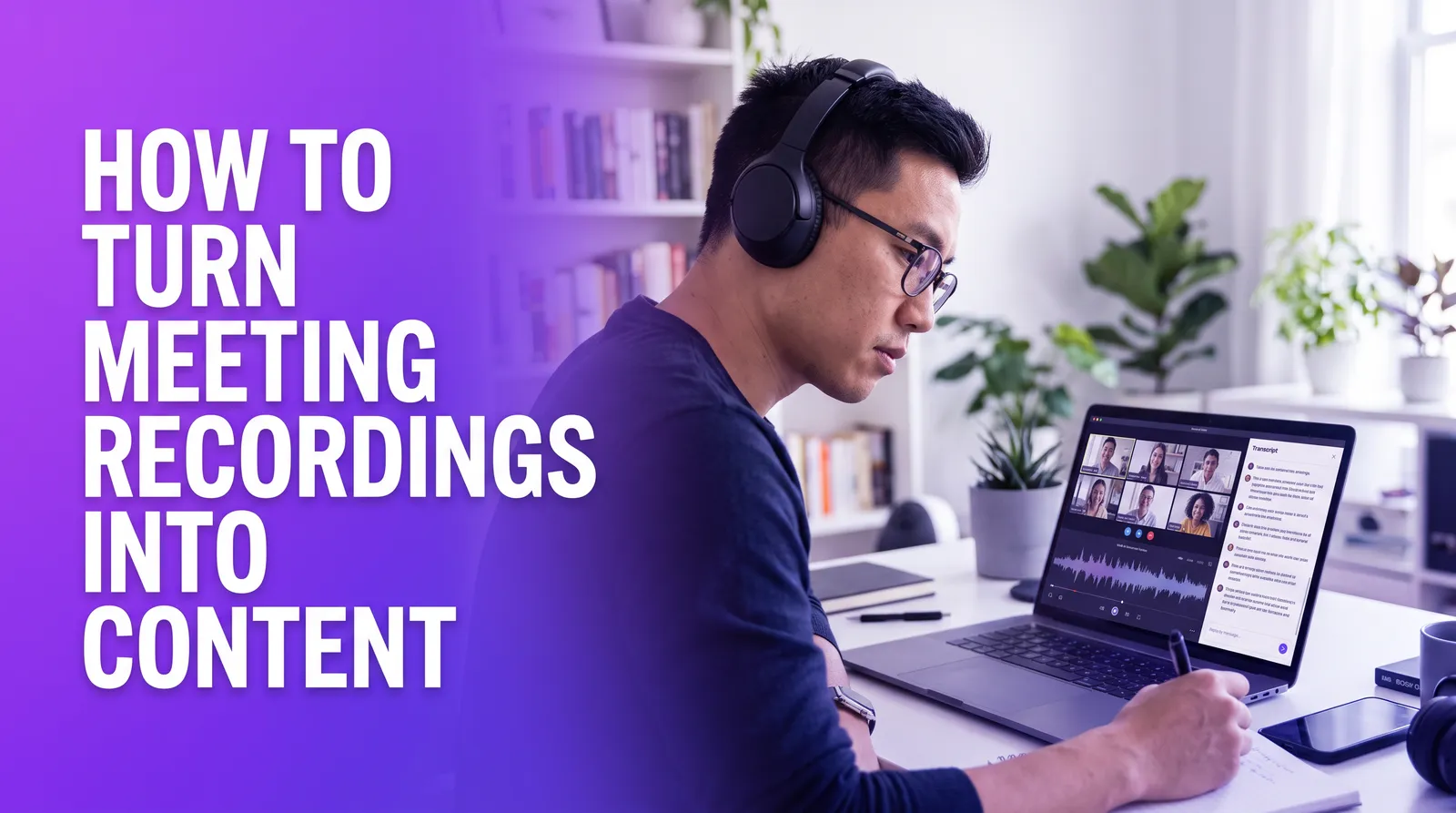
You just spent an hour in a meeting saying genuinely smart things. A sharp take on where your market is heading. A story about why a customer churned. A framework you explained off the cuff that landed perfectly.
Then the call ended, and all of it evaporated.
That is the most expensive habit in B2B: your best expertise gets said out loud, once, to five people, and then it is gone. To turn meeting recordings into content, you record the meeting, transcribe it, pull the sharpest moments, and reshape each one into a native social post in your own voice. The thinking is already done. What is missing is the shaping and the distributing.
Why meeting recordings are your richest content source
A blank page is hard because you are inventing from nothing. A meeting recording is the opposite: it is an hour of your real expertise, in your real voice, already spoken.
Every recurring meeting is a content vein. A sales call surfaces the exact objections your buyers have. A strategy session contains your sharpest opinions. A customer QBR holds the stories that make the best posts. You are already generating the raw material daily, you are just letting it disappear when the recording stops.
The meetings that produce the best content are the ones you already have on the calendar:
- Sales and discovery calls: the exact objections, questions, and language your buyers use.
- Strategy sessions: your sharpest opinions and predictions, said with conviction.
- Customer calls and QBRs: the stories and results that make proof-driven posts.
- Team standups and retros: the lessons and build-in-public moments.
This is the same logic behind turning a voice note into content, scaled up: capture something you already said, rather than starting cold.
The meeting ruleYou are not short on content ideas. You are letting a week of them evaporate every time a call ends.
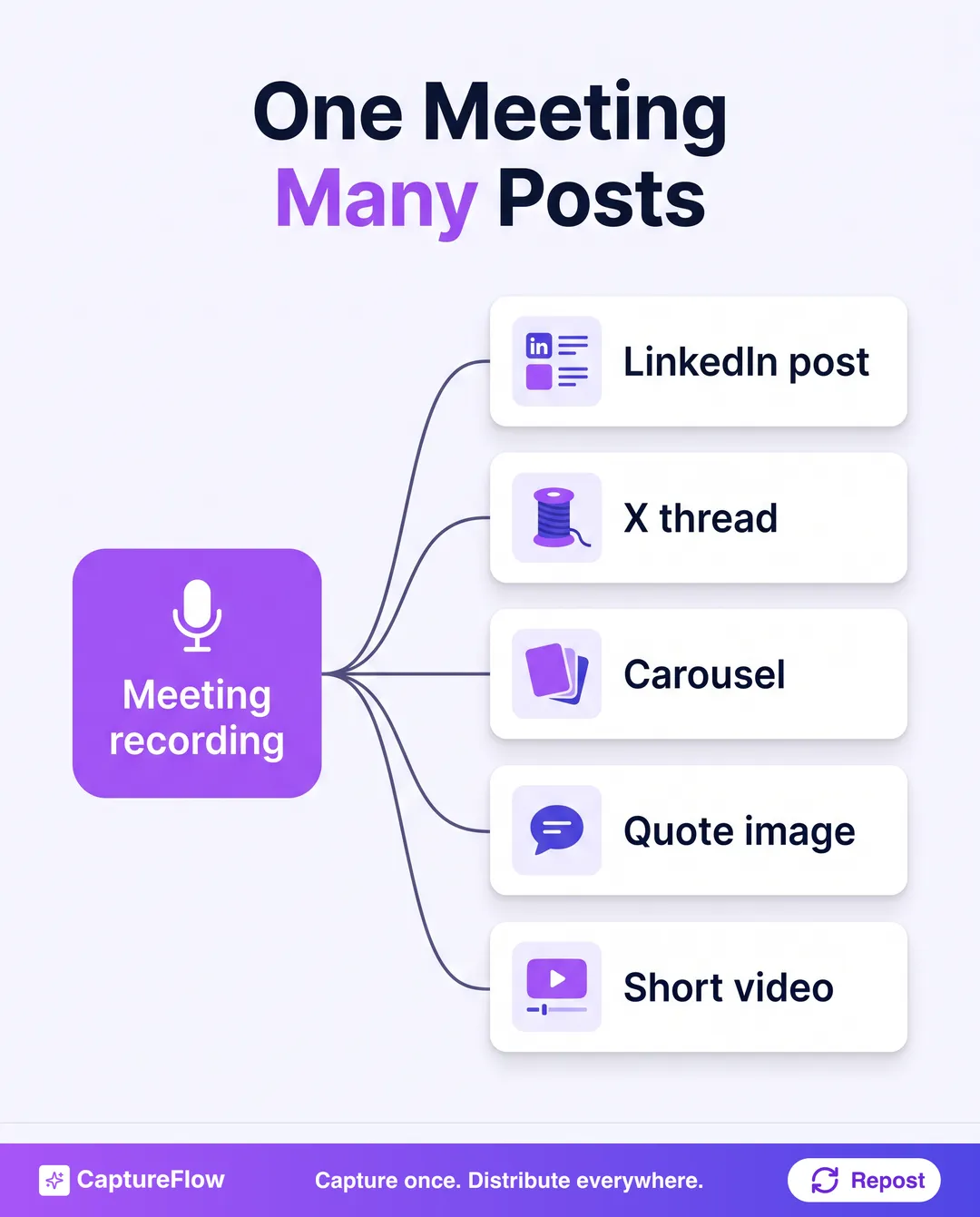 One recording is not one post. It is a week of them, waiting to be shaped.
How to turn a meeting recording into content
The workflow is four steps, and after the recording it takes about 5 minutes.
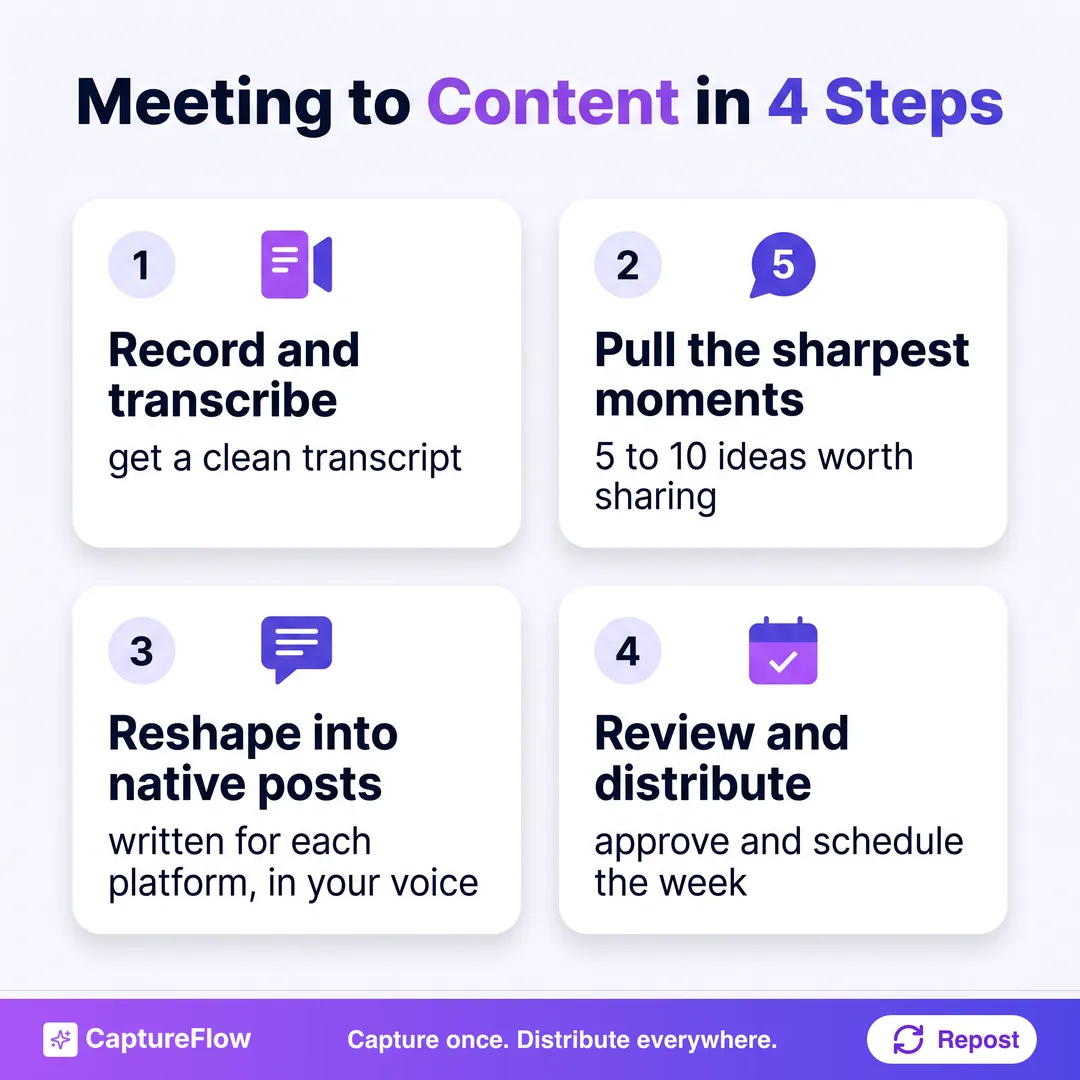 Record, pull, reshape, distribute. The hard part, the thinking, already happened.
Step 1: Record and transcribe
Record the meeting (with everyone's consent) and get a clean transcript. The transcript is your raw material, the searchable, reusable version of what was said. Most meeting tools can produce one, or an AI content agent can import and transcribe the recording directly.
Step 2: Pull the sharpest moments
Read the transcript and mark the 5 to 10 moments worth sharing: a strong opinion, a specific number, a customer story, a lesson, a contrarian take. Not the logistics, not the small talk, the ideas that would make someone stop scrolling.
Step 3: Reshape each into a native post
This is where most people stall, and where the tool matters. Each moment becomes a post shaped for its channel: a LinkedIn post, an X thread, a carousel, a quote image, or a short video clip. The key word is native, written for the platform and in your voice, not a transcript pasted into a status box.
Step 4: Review and distribute
Review the drafts, fix anything off, and schedule them across your channels. One strong meeting can fill a week of your content calendar, which means the next busy week does not go dark.
Never publish the transcript itself. A meeting transcript is a record, not content. The value is in extracting the ideas and reshaping them, so a listener who was not in the room gets the insight without the filler.
How to repurpose Zoom calls into posts
Most of the meetings worth mining now happen on Zoom, Google Meet, or Teams, and most are already recorded and transcribed by default. That makes remote calls the easiest capture path you have: the file exists the moment the call ends, with no extra step to remember.
A meeting to content workflow is a repeatable path from a recorded call to a set of native, on-brand posts, run the same way every week. The recording type just changes what you pull from it:
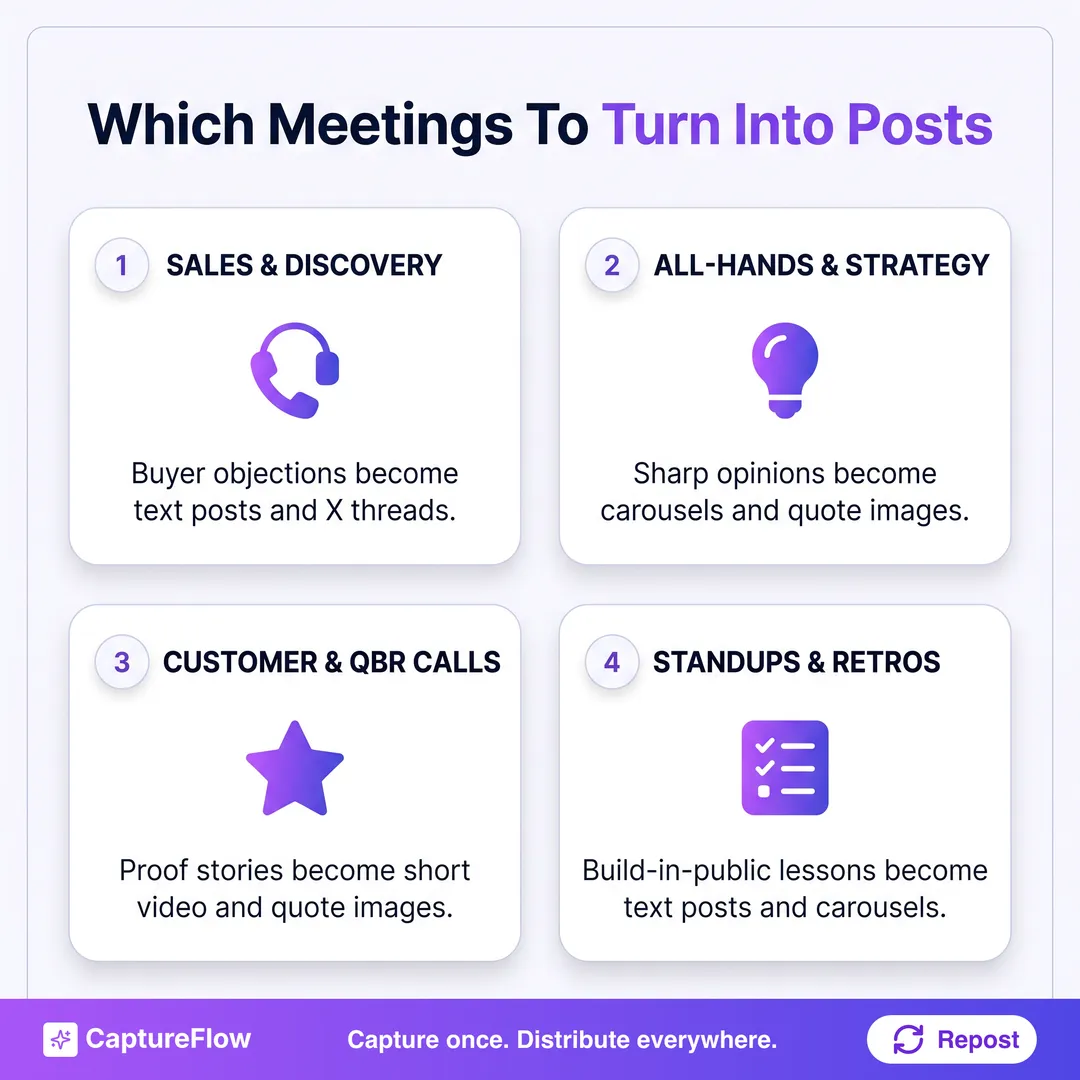 Every recurring call is a different content vein. The workflow is the same, the raw material changes.
- Webinars and all-hands carry your sharpest opinions and predictions, which become carousels and quote images.
- Sales and discovery calls hold the exact objections your buyers raise, which become text posts and short X threads.
- Customer calls and QBRs contain proof stories and results, which become short video and quote images.
- Standups and retros surface the build-in-public lessons, which become text posts and carousels.
For a distributed team, this is the highest-leverage habit there is: the calls are already on the calendar, so repurposing them adds reach without adding a single new meeting. It pairs directly with scaling content production with a small team, where the whole point is more output from inputs you already have. And the same path works for any recorded conversation, which is why turning one podcast into carousels and short videos runs on the exact same four steps.
What tools can convert meeting recordings into social posts?
If you have searched for AI tools that convert meeting transcripts into social media content, here is the honest buyer's test: a raw transcription tool is not enough. It hands you a wall of text and leaves every hard step, finding the moments, writing the posts, matching your voice, still to do. Transcript-first tools like Castmagic sit at one end of the spectrum; what you actually want is the reshaping. For a ranked comparison of the options, see the 5 best AI tools to turn meeting recordings into content.
The tool worth using does the reshaping. CaptureFlow is an AI content agent that turns your expertise into weeks of on-brand content for every platform. You import a meeting recording, and it transcribes it, finds the sharpest moments, and drafts native posts, carousels, and short video in your voice, ready for you to review. The recording is the capture. Everything after is handled.
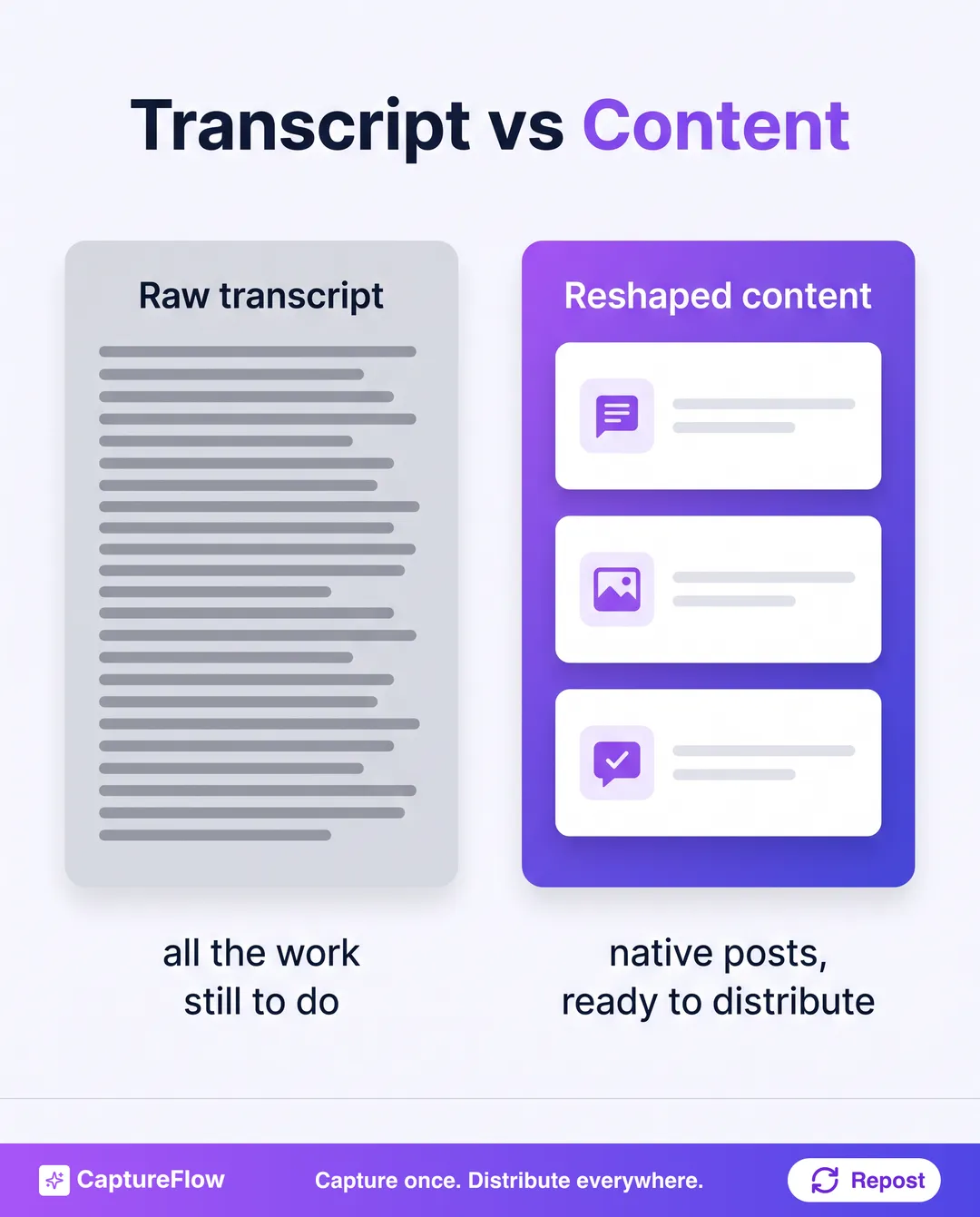 A transcript is a record. Content is what people actually read. The gap between them is the whole job.
That is the difference between a transcript and content: one is a chore you still have to do, the other is a week of posts you just have to approve. If you are comparing options, the best AI content repurposing tools breaks down where each one fits, and the best Repurpose.io alternatives covers the format-conversion category specifically.
The move
Stop letting your best thinking die when the call ends. Record the meetings you are already in, pull the moments worth sharing, and reshape them into native posts, in about 5 minutes once the recording exists.
Your expertise is already being spoken out loud every single day. The only question is whether it becomes content or vanishes. If you want the shaping and distributing handled for you, that is exactly what CaptureFlow is built to do.
Frequently asked questions
What tools can convert meeting recordings into social media posts?+
You want a tool that does more than transcribe. The right one takes the recording, finds the sharpest points, and reshapes them into native posts, carousels, and short video in your voice, ready to review. A raw transcription tool leaves you with a wall of text and all the actual work still to do.
How do I turn a meeting into LinkedIn content?+
Record the meeting, transcribe it, pull the five to ten sharpest moments (a strong opinion, a customer insight, a lesson), then reshape each into a native LinkedIn post in your own voice. One good strategy call can easily produce a week of posts, because the thinking is already done.
Is it okay to turn internal meetings into public content?+
Only the ideas, never anything confidential. Share the insight, the framework, or the lesson, not names, numbers, or anything private. The goal is to reuse the thinking that happened out loud, not to leak the meeting.
Chris is the founder and CEO of CaptureFlow, which he builds so founders can turn their expertise into content without hiring a team. After 10+ years building products and growing audiences from scratch, he writes about founder-led content, AI, and distribution from inside the problem he is solving: distributing consistent, on-brand content as a team of one.
Founder & CEO of CaptureFlow · 10+ years building products and audiences
One playbook a week from founders who actually create and distribute lots of content. No spam, unsubscribe anytime.
Keep reading

How to Build an Employee Advocacy Program on LinkedIn (2026)
Your company page has 2,000 followers. Your fifteen employees have 30,000 connections nobody is reaching. Here is the 6-step program that fixes that.
Content Repurposing: The Complete Strategy Guide
You are not short on ideas. You are short on a system to turn the ones you already had into content. This is the complete guide to content repurposing.

How the LinkedIn Algorithm Works in 2026 (Backed by Data)
The LinkedIn algorithm is not a slot machine. It is a relevance system with rules you can read, and most of them trace back to LinkedIn's own engineering.