LinkedIn Content Strategy: The Complete 2026 Guide
A LinkedIn content strategy is a repeatable system for turning your expertise into posts that build authority. Here is the complete 2026 guide.


Most founders treat LinkedIn like a slot machine.
You pull the lever, post something, and hope this is the one that hits. Some weeks you post five times, some weeks you go dark for a month, and the results feel just as random as the effort. The problem is not your writing. It is that there is no system underneath it. A good LinkedIn content strategy is the difference between posting and building. One is a lottery ticket. The other is compound interest.
This is the complete guide to that system. It is the hub for our whole LinkedIn library, so wherever you want to go deeper, positioning, hooks, carousels, the algorithm, timing, or tooling, there is a link to the full deep dive. Read this end to end and you will have the shape of a strategy you can run for a year, not a weekend.
A LinkedIn content strategy is a repeatable system for turning your expertise into posts that build authority, instead of posting at random and hoping. That is the whole idea. Not a viral hack. A system you can run on your worst week and still show up.
I run CaptureFlow, so this is my daily work. CaptureFlow is an AI content agent that turns your expertise into weeks of on-brand content for every platform. But you do not need any tool to start. You need the six layers below, in order.
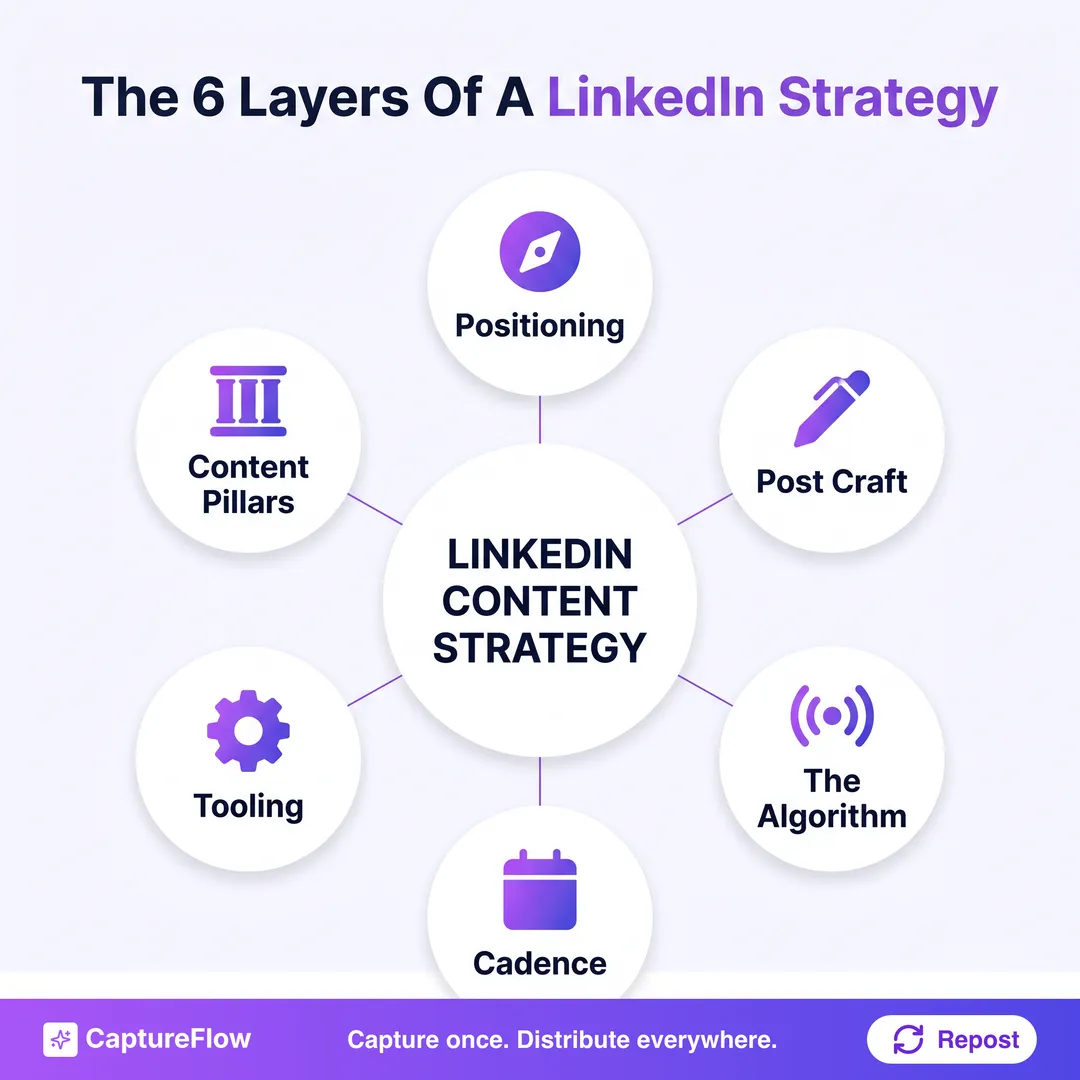 Six layers, one system. Skip any and the whole thing wobbles.
Why LinkedIn deserves a real strategy in 2026
Before the how, the why. LinkedIn is not just another feed to feel guilty about.
It is the largest professional network on earth, and it is still growing fast. According to DataReportal's LinkedIn stats, the platform's advertising reach passed 1.20 billion members in early 2025, up more than 17 percent year over year, with roughly 250 million of those in the United States alone. That is not a niche. That is most of the professional world logging in with intent to learn, hire, buy, and be seen.
More important than the size is what happens when your buyers read your content. The 2025 Edelman-LinkedIn B2B Thought Leadership Impact Report, which surveyed nearly 2,000 professionals, found that 71 percent of decision-makers say a piece of thought leadership is more effective than traditional marketing at demonstrating a vendor's potential value. In the same research, 79 percent said they are more likely to champion a vendor during an RFP when that company consistently publishes quality content, and 63 percent of the hidden buyers who quietly shape deals spend more than an hour a week consuming it. If you are applying this at the company level, our guide to LinkedIn marketing for B2B companies lays out the full three-layer system, and if you are a C-suite leader specifically, the LinkedIn thought leadership strategy for B2B executives is the tighter, more commercial cut.
Read those numbers again. The people who decide whether you win the deal are already reading. The only question is whether they find you or a competitor.
2025 Edelman-LinkedIn B2B Thought Leadership Impact Report71 percent of B2B decision-makers say strong thought leadership is more effective than traditional marketing at showing a vendor's value.
That is the case for a real strategy instead of random posting. Now the six layers.
Layer 1: Positioning, or the one topic you own
The biggest strategic mistake on LinkedIn is trying to be interesting about everything.
Positioning is the opposite move. Pick one specific topic and make it yours, so that when someone in your world thinks of that problem, your name is the one that surfaces. Not "business" or "marketing" or "startups". Something a real person would say out loud: "the founder who explains B2B pricing", "the designer who demystifies AI tools for non-designers", "the ops person who fixes messy Notion setups".
The narrower the topic, the faster you become the obvious person for it. A wide account has to fight the entire feed for attention. A focused account only has to be the best on one small hill, and that is a fight you can actually win.
Your positioning answers three questions before you write a single post:
- Who is this for? The specific person you are trying to reach, described so tightly they would recognise themselves.
- What do you help them do or understand? The transformation, not the topic. "Ship content without a team" beats "content marketing".
- Why should they believe you? Your unfair angle, the scar tissue, the results, the years you spent learning this the hard way.
Get this right and every other layer gets easier, because you are no longer asking "what should I post?" You are asking "what do I know about my one topic that my one person needs today?"
Layer 2: Content pillars, the themes you rotate
Once you know your topic, you break it into content pillars. Content pillars are the three to five recurring themes you post about, over and over, in different shapes. They are how you stay on-topic without saying the same thing every day, and they are the backbone of any real LinkedIn content plan.
Pillars solve two problems at once. They kill the blank page, because you are never starting from nothing, you are picking a lane. And they train the algorithm, because a feed that keeps seeing you post about one cluster of topics learns exactly who to show you to.
Here are six pillar types that work for almost any founder. Pick three to five, not all six.
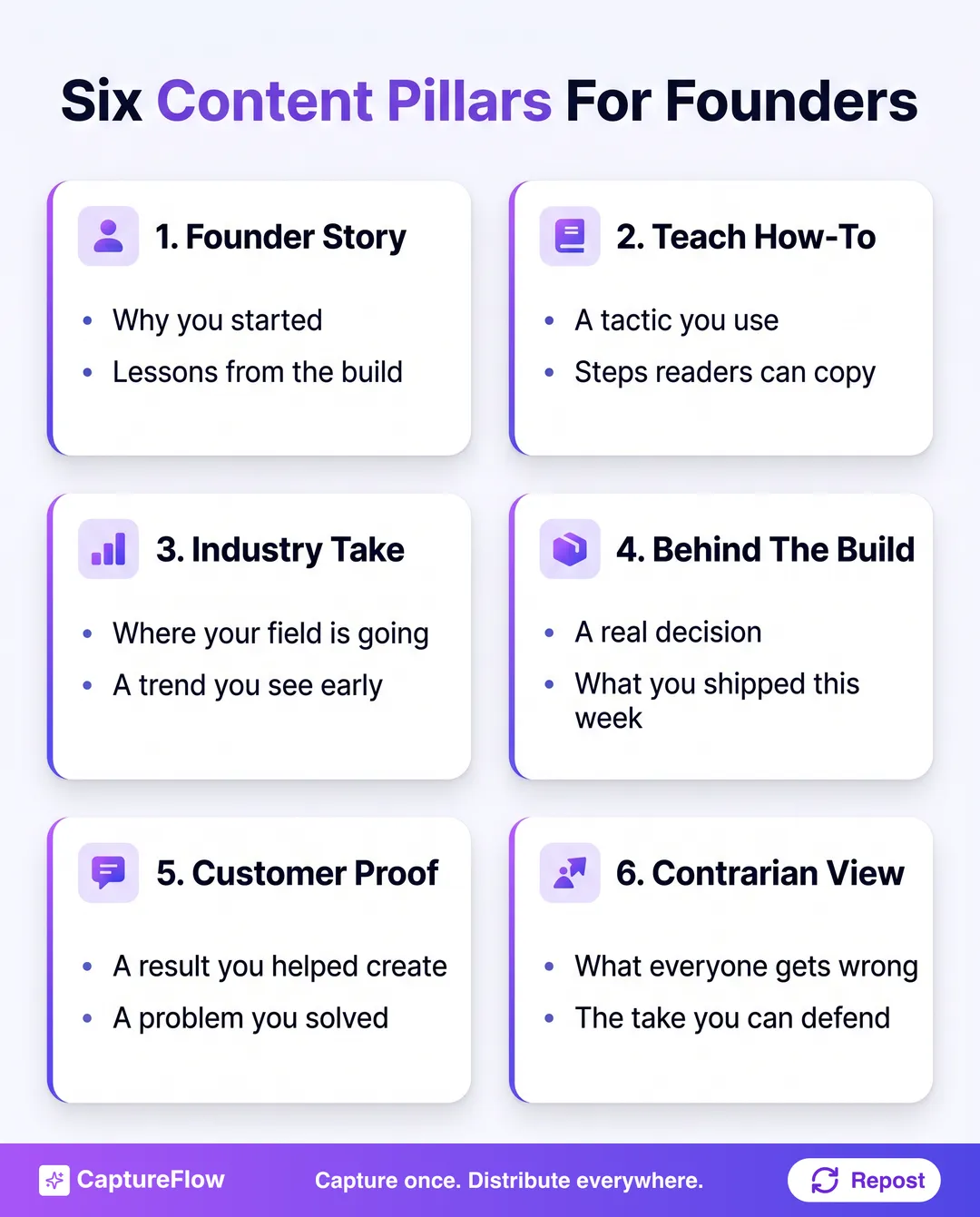 Pick three to five and rotate them. The mix is what keeps you sounding human, not like a brochure.
- Founder story. Why you started, the lessons the build taught you, the moments that changed how you think. This is the pillar people follow you for.
- Teach how-to. A tactic you actually use, broken into steps a reader can copy today. The most reliably useful pillar there is.
- Industry take. Where your field is heading, a trend you saw early, a shift others are missing. This is how you look like a leader, not a follower.
- Behind the build. A real decision, what you shipped this week, the unglamorous middle of the work. Transparency is magnetic on LinkedIn.
- Customer proof. A result you helped create, a problem you solved, without turning it into a sales pitch. Show, do not sell.
- Contrarian view. What everyone in your space gets wrong, and the take you can defend. Handled honestly, this is the pillar that gets shared.
Rotating pillars is also what makes repurposing sane. One deep idea can become a founder-story post, a how-to, and a carousel, three pillars from a single capture.
Layer 3: Post craft, where strategy meets the page
Strategy gets you to the right idea. Craft is what makes people stop scrolling and read it. This is the layer with the most surface area, so it has the most dedicated guides.
Every post lives or dies on its first line. On mobile, LinkedIn hides everything after a line or two behind "see more", so your opening sentence is not an introduction, it is a tripwire. This is worth real practice, and we wrote a full drill on how to write LinkedIn hooks that walks through the patterns that earn the tap.
Past the hook, the shape of the post matters more than the word count. The strongest posts make one point, use short one-thought-per-line sentences that are easy to scan on a phone, land a single takeaway, and end with a soft question instead of a hard sell. Our guide to how to write a LinkedIn post that gets engagement breaks down that anatomy and hands you five fill-in-the-blank templates so you never start cold.
Text is not your only format. Document carousels consistently earn some of the highest engagement on the platform, because they slow the scroll and reward a tap. If you want to build one that people actually swipe through, how to make a LinkedIn carousel covers the structure, the design, and the tools. A single idea can become a text post one day and a carousel the next, which is exactly the kind of leverage a pillar system is built for.
The fastest craft upgrade for most people is line breaks, not better words. Take any draft, put every sentence on its own line, delete the three that do not serve your one point, and read it again. Nine times out of ten it improves instantly.
Layer 4: The algorithm, and what it actually rewards
You do not need to game the algorithm. You need to understand what it is optimising for so you stop fighting it.
LinkedIn is refreshingly open about its intent. As the platform's own editor-in-chief Dan Roth has put it, the feed is not designed for virality but for "sharing useful knowledge and insights". Everything about the 2026 feed follows from that sentence. It is not trying to make you famous. It is trying to match useful content with the people who will find it useful.
In practice, that means topic relevance now matters more than follower count. The feed reads your profile and your posting history, decides what you are an expert in, and shows your posts to people interested in that subject, often well beyond your immediate network. This is the algorithmic reward for having positioning and pillars: a focused account is legible to the machine, a scattered one is noise.
It also means not all engagement is equal. A thoughtful comment and a save tell the algorithm far more than a passing like, and dwell time, the seconds someone actually spends on your post, is a quiet but powerful signal. This is why conversational, scannable writing wins twice: it is better for humans and better for reach.
The full mechanics, how distribution happens in waves, how the golden-hour window works, and what actually suppresses reach, are worth understanding in depth. We break it all down in how the LinkedIn algorithm works. The short version: post about your topic, write to be read, invite real conversation, and reply when it comes.
Layer 5: Cadence, the rhythm that compounds
Here is the truth nobody selling a viral hack wants to admit: consistency beats intensity, every time. A viral post you never repeat is a spike. A useful post every week is a slope, and slopes compound.
So how often should you post? For most founders, two to five times a week is the range where authority builds without burnout. The exact number matters far less than whether you can actually sustain it. We dug into the trade-offs across every platform in how often to post on social media, and the pattern is consistent: pick a rhythm you can hold on your busiest week, then hold it.
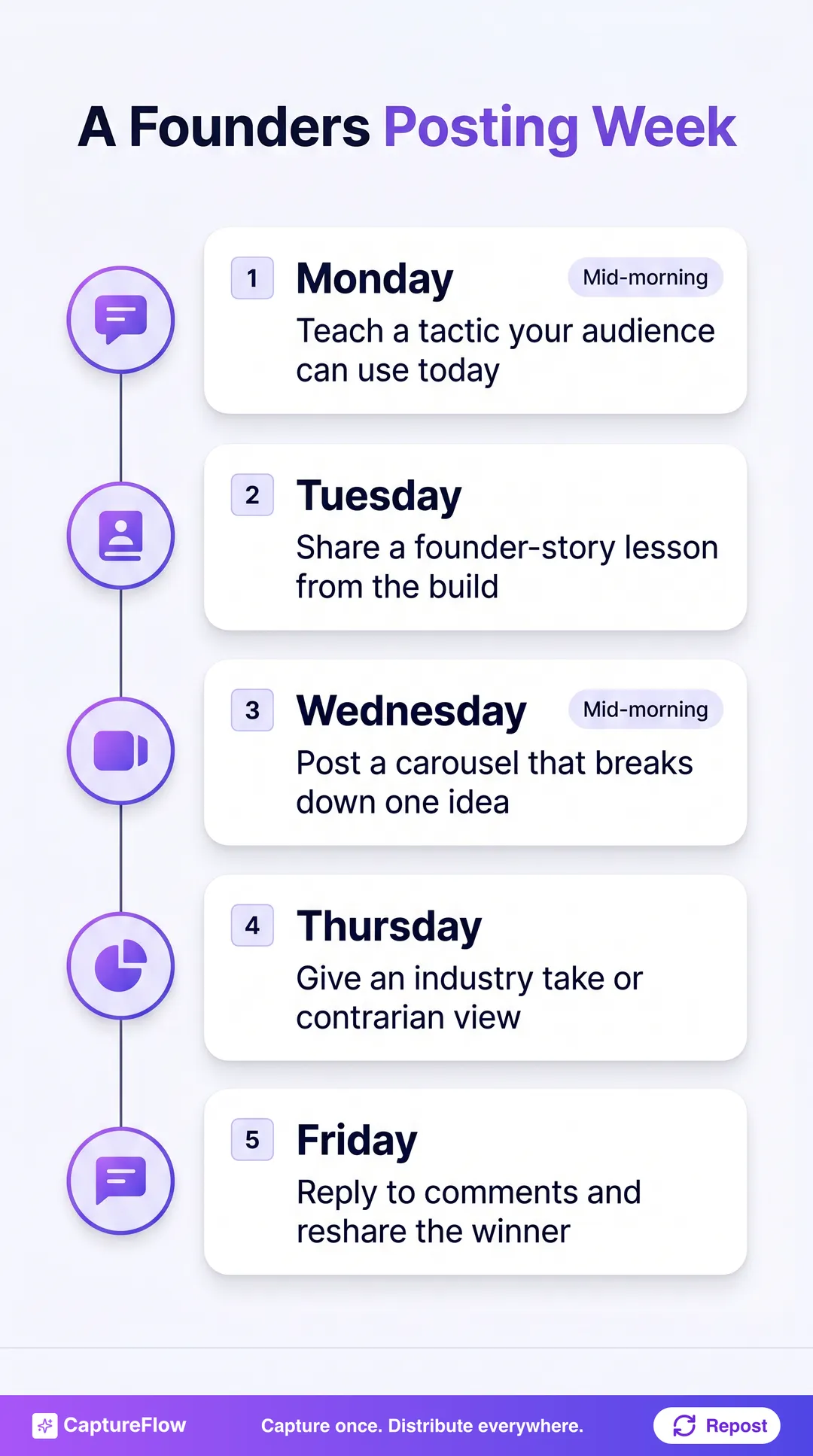 One workable week. Rotate your pillars across the days and leave Friday to nurture the conversation.
Timing within the day matters too, though less than people obsess over. Mid-morning on weekdays tends to catch professionals between meetings, when they are actually scrolling with attention. Rather than chase a mythical perfect minute, test a couple of windows and watch your own analytics. We collected what the data actually says in the best time to post on LinkedIn, but the honest headline is that a good post at an average time beats a weak post at the perfect time.
The real unlock is the calendar, not the clock. When you plan a week of posts against your pillars in advance, you remove the daily "what do I post?" decision that kills most content habits. A rhythm you decide once is a rhythm you can keep.
Layer 6: Tooling, so the system survives a busy week
Every layer above is sound. The reason most founders still fall off is layer six. Strategy that depends on you having a free, inspired hour every morning is not a strategy, it is a hobby that dies the first busy week.
Tooling is what makes the system durable. And the biggest shift in the last two years is that you no longer need a content team or a full-time ghostwriter to stay consistent. The same durability logic scales to a whole company: content operations for B2B teams turns this into a repeatable system, and if you want your team posting too, how to build an employee advocacy program applies it across many voices. AI has genuinely changed the math here, though not all of it is good. There is a flood of generic AI slop on LinkedIn right now, the beige, voiceless posts everyone can smell. The tools worth using are the ones trained on your voice, not the ones that flatten it.
If you are comparing options, we did the honest legwork in the best AI LinkedIn content tools, and if you are specifically weighing the popular incumbents, the best Taplio alternatives lays out where each one genuinely fits and where it does not. Both are fair to the competition, because the goal is the right tool for you, not a coronation.
The approach we build CaptureFlow around is what we call capture-first. Instead of sitting at a blank page, you capture one idea when it is fresh, a voice note, a short video, a file, or a link, and reshape that single input into a week of native posts. It is a genuinely different starting point, and we made the full case for it in capture once, distribute everywhere.
In practice that means one capture becomes many native outputs across your channels: text posts for LinkedIn and X, short and long video, carousels, quote images, infographics, and branded graphics, all shaped to fit each platform instead of one message pasted everywhere.
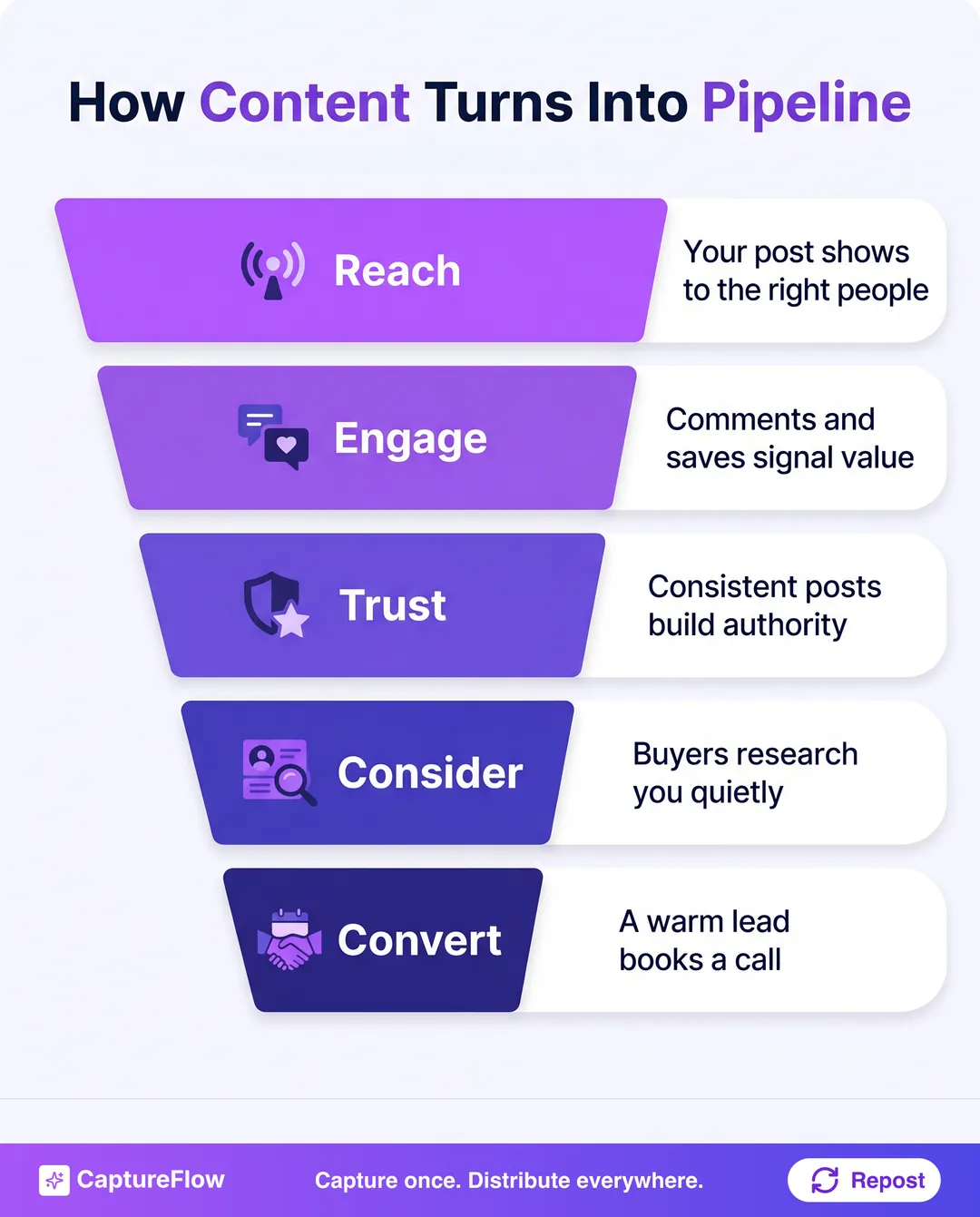 The point of the whole system. Consistent, on-topic posts move strangers down this funnel while you sleep.
If you are running this at the company level and the goal is pipeline, our playbook on a LinkedIn content strategy that generates B2B leads covers the mix of voices and how to measure leads instead of likes.
The math that makes this sustainable: you capture one idea in about 5 minutes, and your agent, trained on your voice and past posts, turns it into a full week of on-brand content. The blank page, the thing that actually kills most LinkedIn habits, disappears.
Your 30-day LinkedIn content plan
Put the six layers together and you have a plan you can start this week. Here is the simplest version of a LinkedIn content plan that actually holds.
- Week 1: Positioning. Write your one-line positioning: who it is for, what you help them do, why you. Update your headline and About section to match. Pick your three to five pillars.
- Week 2: Craft. Write three posts, one hook drill, one template post, one carousel. Do not aim for viral. Aim for useful and finished.
- Week 3: Cadence. Batch a full week of posts against your pillars in one sitting. Schedule them at mid-morning windows. Post, then reply to every comment you get.
- Week 4: Review and systematise. Look at what got saved and commented on, not just liked. Do more of that. Then decide how you will capture ideas going forward so week five never starts from zero.
Notice what is not in that plan: going viral, gaming the feed, or posting ten times a day. The whole thing is boring on purpose, because boring is what compounds. If you want to see the machinery that makes the capturing and reshaping part effortless, our features page walks through it, and pricing is straightforward when you are ready to run the system without a team.
The honest final take
A LinkedIn content strategy is not a growth hack. It is six unglamorous layers, positioning, pillars, craft, the algorithm, cadence, and tooling, stacked so that showing up stops depending on motivation.
Most people never build the system. They post when inspired, go quiet when busy, and conclude LinkedIn "does not work for them". It worked fine. The strategy was missing. Build the six layers, pick a rhythm you can keep, and let one captured idea become your week. That is how expertise turns into authority, and how your flow turns into pipeline while you get back to building.
Sources
Frequently asked questions
What is a LinkedIn content strategy?+
A LinkedIn content strategy is a repeatable system for turning your expertise into posts that build authority and pipeline, instead of posting at random. It has six parts: your positioning (the one topic you own), your content pillars (the three to five themes you rotate), your post craft (hooks and structure), an understanding of the algorithm, a realistic cadence, and the tooling to keep it going without a team.
How often should I post on LinkedIn?+
For most founders, two to five times a week is the sweet spot. What matters far more than the exact number is that it is sustainable and consistent. Three strong posts every week for a year will build far more authority than a daily sprint that burns out in a month.
How do I create content on LinkedIn without spending hours a day?+
Capture one idea when it is fresh, a voice note, a short video, or a few messy sentences, then reshape that single input into a week of posts instead of starting from a blank page each time. This capture-first approach, especially paired with an AI content agent trained on your voice, is how one idea becomes multiple native posts in minutes.
Does follower count still matter on LinkedIn in 2026?+
Less than most people think. The 2026 feed leans on topic relevance and engagement quality rather than raw follower numbers, so a smaller, focused account that consistently posts about one subject can out-reach a larger, scattered one. Owning a topic beats chasing followers.
Chris is the founder and CEO of CaptureFlow, which he builds so founders can turn their expertise into content without hiring a team. After 10+ years building products and growing audiences from scratch, he writes about founder-led content, AI, and distribution from inside the problem he is solving: distributing consistent, on-brand content as a team of one.
Founder & CEO of CaptureFlow · 10+ years building products and audiences
One playbook a week from founders who actually create and distribute lots of content. No spam, unsubscribe anytime.
Keep reading

What Drives LinkedIn Engagement: 2,500 Posts Analyzed
We pulled the public LinkedIn history of 25 founders, 2,500 posts in total, to build our playbook teardowns. The engagement pattern hiding in that data surprised us.

LinkedIn Content Ideas: 50 Posts to Steal When You're Not an Influencer
You are not out of things to say, you are out of shapes to say them in. Here are 50 specific LinkedIn content ideas, organized into 6 buckets, that you can post starting today.
How to Make a Scroll-Stopping LinkedIn Carousel in 2026
A LinkedIn carousel is the highest-dwell format in the feed. Here is how to make one that earns the swipe, from one idea to a finished PDF.