How to Build an Employee Advocacy Program on LinkedIn (2026)
How to build an employee advocacy program on LinkedIn in 6 steps: set a goal, recruit a pilot, give employees their own voice, make posting frictionless, measure, scale.


Your company page has 2,000 followers and a reach chart that looks like a heartbeat monitor on a good day. Meanwhile, the fifteen people who work for you have somewhere north of 30,000 connections between them, exactly the audience you are trying to buy ads to reach, sitting completely idle.
That gap is the whole opportunity. And closing it is not a campaign, it is a program.
An employee advocacy program is a structured system where a company's employees share and create content on their own social profiles to grow the brand's reach and trust through people, not the logo. This guide is the practical version: how to build an employee advocacy program from a standing start, in six steps, without it collapsing into a spreadsheet nobody updates. If you want the concept first, start with what employee advocacy is and why it works. And if you are still deciding whether to run this yourself or buy a platform, weigh employee advocacy software vs building in-house before you commit.
What is an employee advocacy program?
It is not "please repost the company announcement." That is the version that fails.
A real program is a repeatable system: a clear goal, a group of willing employees, a steady supply of content they can make their own, and a light measurement loop. It sits on top of a working content operations system, which is what reliably produces the raw material in the first place. The company provides that material and removes the friction. The employees provide the reach, the voice, and the trust that a logo can never earn on its own.
The distinction that matters: advocacy runs through the person. A post from your head of product, in her voice, about a problem she solved, does something a company post physically cannot. It arrives from a human someone already follows. When employees create their own original posts rather than reshare the company's, you cross into employee-generated content, the highest-trust version of this whole idea.
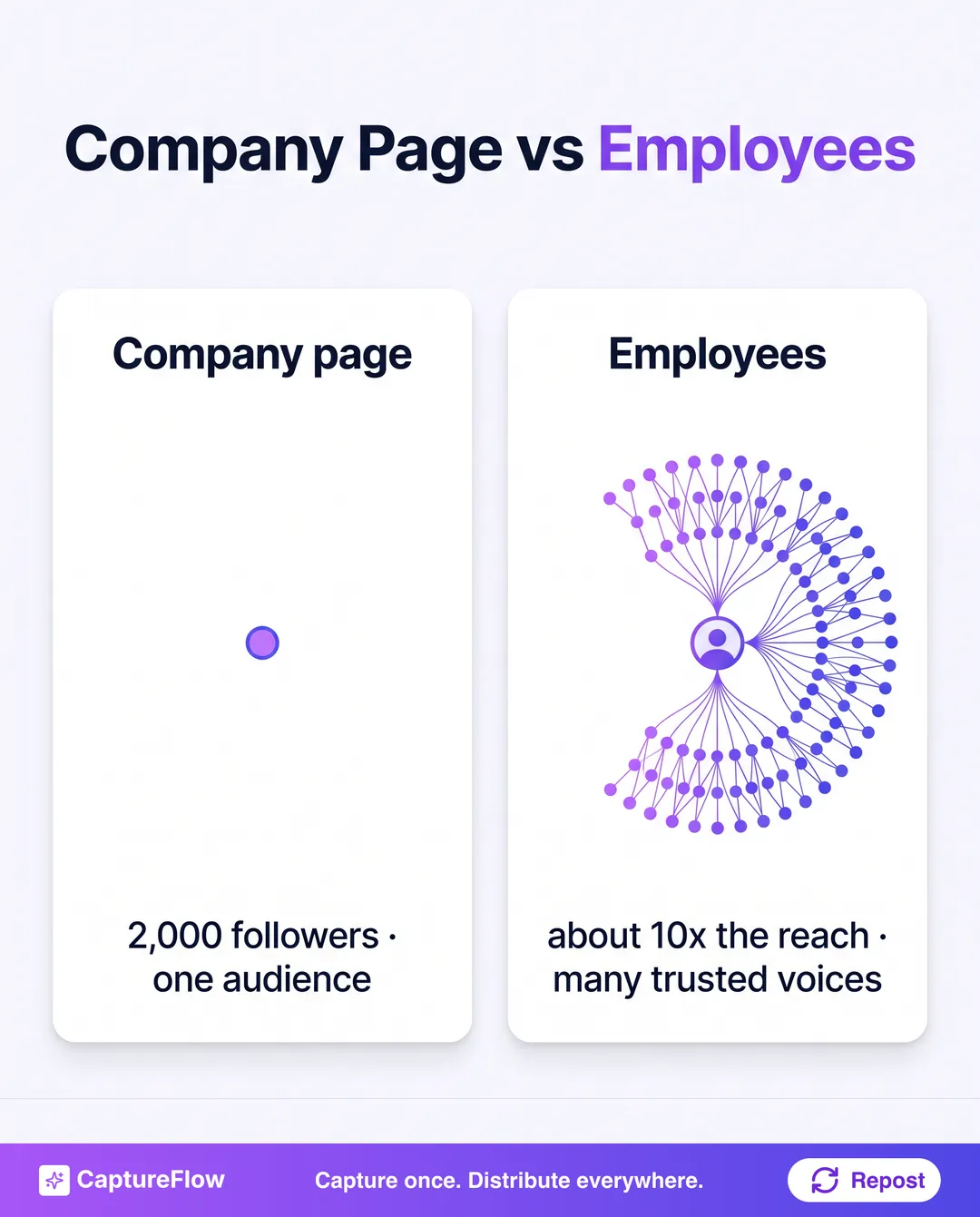 One logo, one audience. Fifteen people, roughly ten times the reach.
Why employee advocacy works on LinkedIn in 2026
Two forces make this the highest-leverage organic channel most B2B companies have.
The reach math is lopsided. According to LinkedIn's own marketing data, employees' combined networks are on average ten times the size of a company's follower audience, and their shares are twice as likely to be clicked as the same content from the company page. You are not adding a channel, you are unlocking one that is already an order of magnitude bigger than the one you have been feeding.
Trust has moved to people. The 2026 Edelman Trust Barometer found that "My Employer" is now the most trusted institution at 78 percent, ahead of business in general and far ahead of government and media. Trust has become local: people believe their employer, their CEO, and their own circle over distant institutions. An employee posting is exactly that trusted, local voice. A brand account is the distant institution.
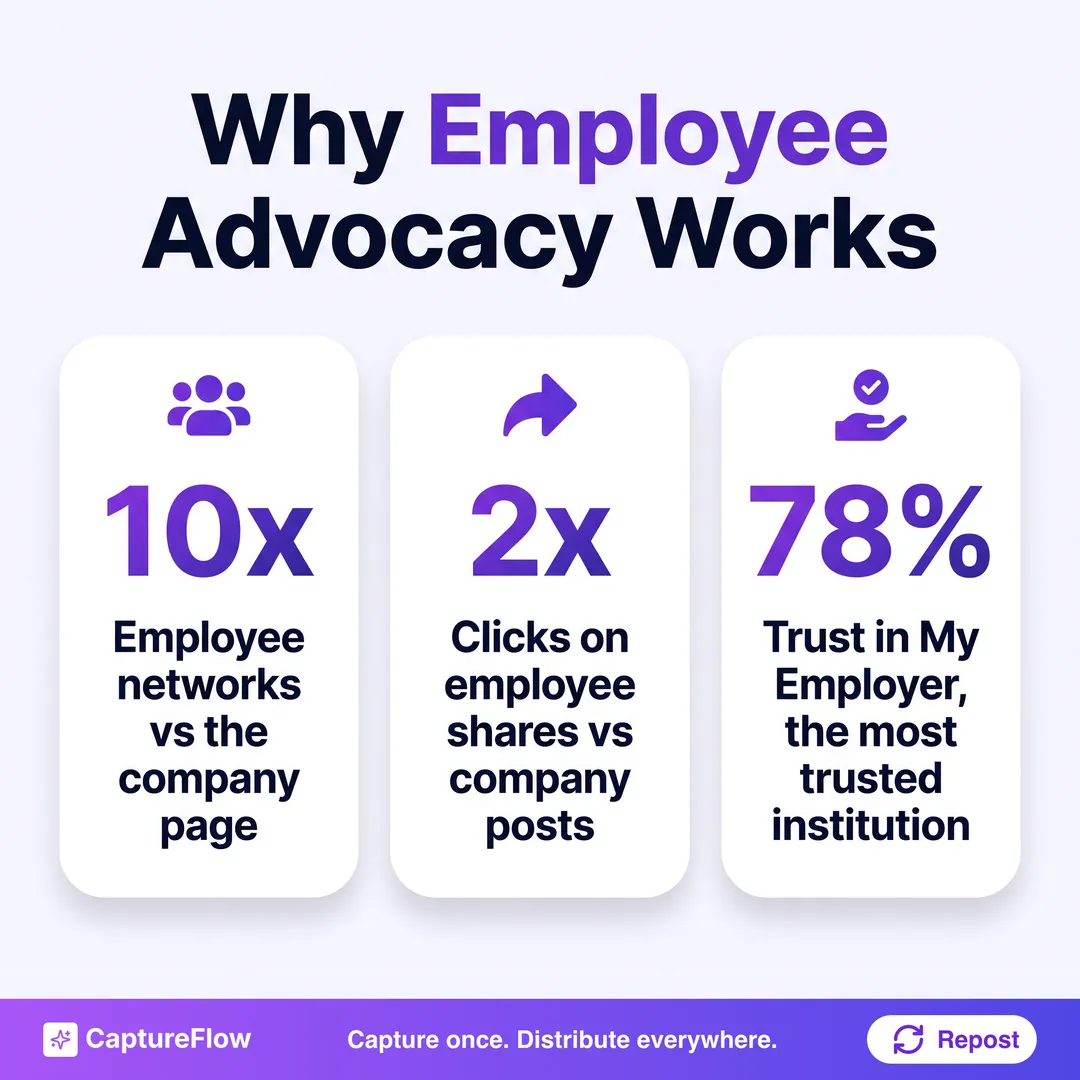 Bigger reach, more clicks, more trust. The case for advocacy in three numbers.
This is also just how the LinkedIn algorithm works: it rewards content that people dwell on and engage with, and posts from individuals in a real network consistently clear that bar better than posts from a faceless page.
What is the ROI of employee advocacy?
The return is reach you did not pay for, attached to trust you cannot buy.
Put it next to the cost, which is close to zero in media spend, and the math is hard to argue with. The same logic shows up in the 2024 Edelman-LinkedIn B2B Thought Leadership Report: 73 percent of decision-makers said an organization's thought-leadership content is a more trustworthy basis for judging it than its marketing, and 90 percent are more receptive to outreach from companies that publish it consistently. Employee advocacy is how you produce that thought leadership at the scale of your whole team instead of just the founder.
The catch: none of this pays off from one good week. It compounds, or it does nothing. Which is why the program design below is built entirely around surviving past month one.
The 6-step employee advocacy playbook
Here is the whole system before we go deep on each step:
- Set one goal and the metric that proves it.
- Recruit a small pilot of willing volunteers.
- Give them content and their own voice.
- Make posting genuinely frictionless.
- Measure reach and clicks, not vanity.
- Celebrate, then scale from the pilot.
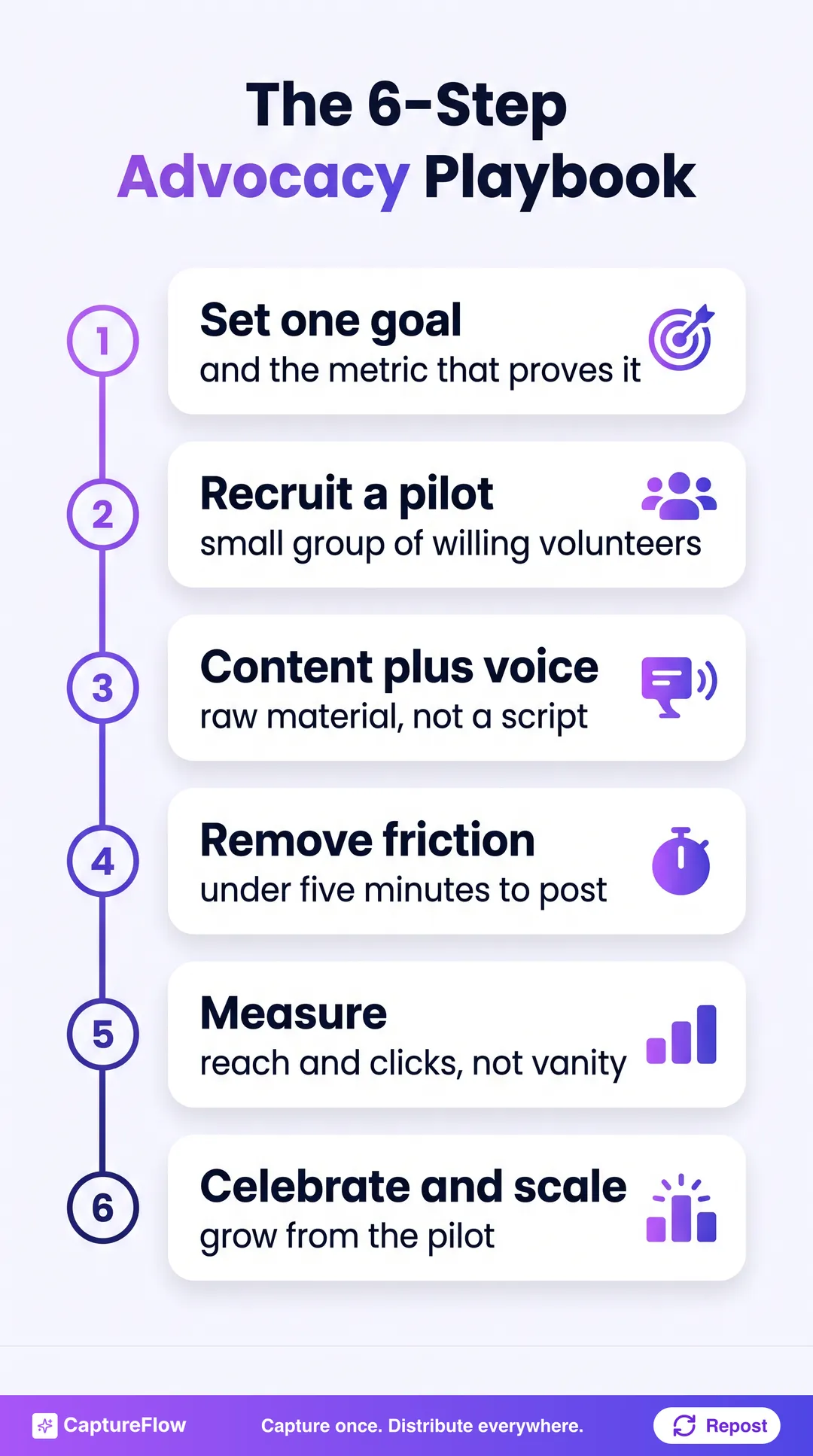 The whole program on one page. Each step exists to protect consistency.
Step 1: Set one goal and the metric that proves it
Pick a single outcome the program is for: brand reach, inbound pipeline, or recruiting. Not all three. The goal decides who you recruit and what "working" looks like.
If the goal is reach, your metric is total employee-driven impressions. If it is pipeline, it is clicks to the site and the demos that follow. If it is hiring, it is applications that mention a team member's post.
Write the goal as one sentence with one number in it before you invite a single person. "Drive 500,000 employee-network impressions a quarter" is a program. "Get everyone posting more" is a wish.
Step 2: Recruit a small pilot of willing volunteers
Do not launch company-wide. Do not mandate it. A forced advocacy program reads as forced, and the posts show it.
Start with five to ten people who already like being on LinkedIn or want to be. Enthusiasm is the only prerequisite that matters. A small group of willing posters beats the entire company checking a box.
Look for the employees who already comment on industry posts or share the occasional win. They are telling you they want to do this. Your job is to make it easier, not to convince the unwilling.
Step 3: Give them content and their own voice
This is where most programs quietly die. They hand employees a block of corporate copy to paste, everyone posts the identical paragraph, and the feed looks like a hostage situation.
Activate employees on LinkedIn by giving them raw material, not a script. A strong angle, a stat, a customer story, then let each person say it their way. The content is the company's. The voice has to be theirs, or the trust advantage you just read about evaporates.
Never send a caption to copy-paste. Send the idea and one example, and explicitly tell people to rewrite it in their own words. Identical posts across ten profiles get pattern-matched as spam by readers and the feed alike.
Step 4: Make posting genuinely frictionless
Consistency is a friction problem, not a willpower problem. Every extra step between "I have a thought" and "it is posted" is where the program leaks people.
The target is five minutes, start to posted. If contributing to advocacy takes an employee thirty minutes and a blank page, they will do it twice and quit. If it takes five minutes and the hard part is already done, they will keep going. Getting reluctant people over that line is its own discipline, which the employee activation playbook covers step by step.
This is the exact gap an AI content agent is built to close. CaptureFlow is an AI content agent that turns your expertise into weeks of on-brand content for every platform. A team member captures one idea, a lesson, a customer story, a strong opinion, and it drafts on-brand posts, carousels, and short video that person can review and make their own in minutes, in their own voice, rather than facing an empty box after a full day of actual work.
Measure the real cost of a post in minutes and clicks, not intentions. If your best-case contributor needs more than five minutes and three tools to post once, fix that before you recruit anyone else.
Step 5: Measure reach and clicks, not vanity
Track the two numbers that map to the goal from Step 1: employee-network reach and click-through, the two places LinkedIn's data says advocacy actually beats the company page. Watch the trend over weeks, not the spike from any single post.
Resist the pull of vanity metrics. Total follower count on the company page is not what this program moves. If you want the honest version of what to watch, our guide to a good LinkedIn engagement rate explains why depth beats raw reach.
Report results back to the pilot group monthly, by name and with real numbers. People keep doing what they can see is working, and nothing kills a program faster than posting into a void with no feedback.
Step 6: Celebrate, then scale from the pilot
Make the wins visible. When a team member's post drives a demo or a great hire, say so publicly inside the company. Advocacy spreads by social proof, the same way it spreads on the feed.
Only once the pilot is running smoothly do you widen it. Bring in the next group with the first group's results as the invitation, not a policy memo. A program people ask to join outlasts one they are assigned to.
Your best recruiting tool for round two is a screenshot of a round-one member's post that clearly worked. Show the outcome, not the obligation.
Common mistakes that sink advocacy programs
A few failure modes show up again and again:
- Mandating participation. Forced posts are obvious and they erode the trust the program depends on.
- Handing out copy to paste. Identical posts across profiles read as spam and waste the personal-voice advantage entirely.
- Making it a second job. If posting is not fast, consistency dies, and consistency is the entire game.
- Measuring the wrong thing. Company-page followers is a vanity number here. Employee reach and clicks are the real ones.
The advocacy ruleEmployee advocacy is not your team amplifying the company's voice. It is the company handing its best ideas to the people your buyers already trust, then getting out of the way.
The move
An employee advocacy program is the rare growth lever that is both high-leverage and nearly free: your team's networks already dwarf your company page, and their voices already carry trust yours cannot. The only thing standing between you and that reach is friction and consistency.
Remove the friction, protect the consistency, and start with the handful of people who already want to post. If the bottleneck is giving each person on-brand content they can make their own in five minutes, that is exactly what CaptureFlow is built to do, and you can see how it works or read how it fits your team's wider LinkedIn content strategy. The founder version of this same idea lives in founder-led marketing vs personal branding, and if you are evaluating software to run the program, the best employee advocacy tools breaks down the platforms honestly.
Sources
- Edelman, 2026 Edelman Trust Barometer ("My Employer" the most trusted institution at 78 percent).
- LinkedIn Marketing Blog, How to Increase Employee Social Sharing for More Organic Reach (employee networks ~10x the company audience; shares 2x more likely to be clicked).
- Edelman and LinkedIn, 2024 B2B Thought Leadership Impact Report.
Frequently asked questions
What is an employee advocacy program?+
It is a structured system where a company's employees share and create content on their own social profiles to grow the brand's reach and trust through people rather than the company logo. Done well, it turns the collective networks of your team into a distribution channel far larger than your company page.
What is the ROI of employee advocacy on LinkedIn?+
The return shows up as reach, trust, and pipeline. Employee networks are roughly ten times the size of a company's follower base, their posts earn about twice the click-through of company posts, and buyers trust content from a person more than from a brand. Measured against the near-zero media cost, that reach is the highest-leverage organic channel most B2B companies have.
How do I get employees to post consistently for the company?+
Make it genuinely easy and never mandatory. Give people ready, on-brand material they can make their own in a few minutes, let them post in their own voice, and celebrate the ones who show up. Consistency dies the moment posting feels like unpaid homework, so the whole design goal is to keep it under five minutes.
Chris is the founder and CEO of CaptureFlow, which he builds so founders can turn their expertise into content without hiring a team. After 10+ years building products and growing audiences from scratch, he writes about founder-led content, AI, and distribution from inside the problem he is solving: distributing consistent, on-brand content as a team of one.
Founder & CEO of CaptureFlow · 10+ years building products and audiences
One playbook a week from founders who actually create and distribute lots of content. No spam, unsubscribe anytime.
Keep reading

What Is Employee Advocacy? The Complete Guide
Your employees' networks are bigger and more trusted than your company page. Employee advocacy is how you put that to work. Here is the complete guide.
Employee Advocacy Tools vs Letting Employees Post on Their Own
Do you need an employee advocacy platform, or is letting employees post on their own better? The honest answer depends on your size, and mostly on adoption.

Employee Advocacy Content Ideas: What Your Team Should Post on LinkedIn
Your team is willing to post, they just do not know what to say. Here is the content employees should share on LinkedIn, and how to make it take 5 minutes.