Content Operations for B2B Teams: Build a Scalable System
How B2B teams build a scalable content operations system in 2026: centralize inputs, define the pipeline, protect brand voice, cut tool sprawl, and measure throughput.


Every B2B marketing team eventually hits the same wall. Leadership wants more content on more channels, and the team is already at capacity. So the work fragments: a transcription tool here, an AI writer there, a design app, a scheduler, an analytics dashboard, five tabs and no system. Quality slips, voice drifts, and everyone is busy.
That wall is not a talent problem or an effort problem. It is an operations problem.
Content operations is the system of people, process, and tools a team uses to plan, produce, and distribute content at scale, without quality or brand voice slipping as volume grows. This is the practical guide to how B2B companies build a scalable content operations system in 2026, one that adds output without adding chaos.
What is content operations?
Think of it as the difference between the recipe and the kitchen.
A content strategy is the recipe: what to publish, for whom, on which channels. Content operations is the kitchen: the stations, the workflow, and the tools that turn that plan into published work, reliably, every week, no matter who is on shift.
Strategy without operations is a great plan nobody can execute. Operations without strategy is a fast machine pointed nowhere. Scaling B2B content needs both, but the part that breaks first, and quietly, is almost always operations.
One quick disambiguation, because the terms blur. A content strategy is the plan. Content operations is the engine room that makes the plan run at volume. When a team says "we know what to post, we just cannot keep up," that is not a strategy problem. It is an operations problem, and no new strategy deck will fix it. Content marketing sits above both, and the difference trips up more B2B teams than it should, so here it is.
Content operations vs content marketing for B2B companies
Short version: content marketing is the goal, content operations is the machine that hits it. Content marketing is the discipline of using content to attract and convert B2B buyers; content operations is the system of people, process, and tools that actually produces and distributes that content, week after week, without quality slipping. One is why you publish. The other is how you keep publishing when demand outruns the two people you have.
The confusion is expensive. A B2B team that keeps buying content marketing advice (more topics, better SEO, a fresh channel) when the real problem is operations just adds pressure to a pipe that is already clogged. The decks pile up. The content does not.
Here is the clean split.
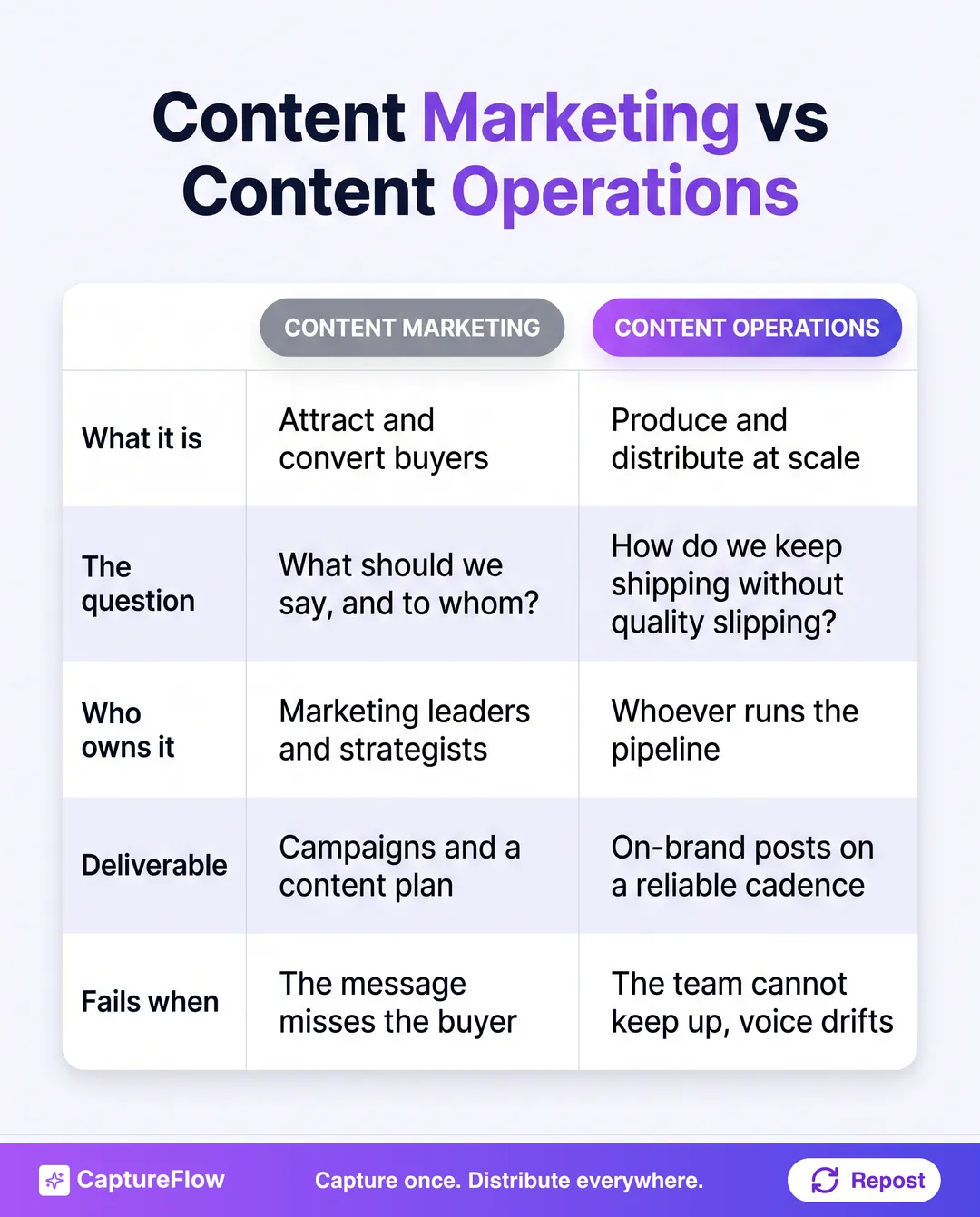 Content marketing is the strategy and the goal. Content operations is the engine that delivers it at volume.
| Dimension | Content marketing | Content operations |
|---|---|---|
| What it is | The discipline of attracting and converting buyers with content | The system that produces and distributes that content at scale |
| The question | What should we say, and to whom? | How do we keep distributing it without quality slipping? |
| Who owns it | Marketing leadership, strategists | Whoever runs the pipeline, capture to distribute |
| The deliverable | Campaigns, messaging, a content plan | On-brand posts distributed on a reliable cadence |
| Fails when | The message misses the buyer | The team cannot keep up and voice drifts |
A useful gut-check: if your content plan is solid but the calendar keeps slipping, you have a content operations b2b problem, not a marketing one. That is the gap this guide closes. Content marketing tells you what a good week of content looks like; content operations is what makes this week actually be that.
Why content operations breaks for B2B teams
The root cause is boring and universal: demand for content exceeds the team's capacity to produce it, and the overflow gets handled badly. This bites hardest on lean teams, which is why the sister guide to this one covers how to scale content production with a small team specifically.
Content Marketing Institute traces most content bottlenecks to the same handful of causes: requests exceeding available resources, content silos that make collaboration hard, and a pile of disconnected tools used to manage the process. Every one of those is an operations failure, not a creativity failure.
AI was supposed to fix this, and partly it has. In HubSpot's 2026 State of Marketing report, 86 percent of marketers now use AI, and 67 percent of teams report saving 10 or more hours a week with it. But the same research carries a warning: more content is now generated by AI than by humans, and most of it is average. Buyers can smell it and tune it out.
That is the real 2026 problem. Producing more is solved. Producing more without sounding like everyone else is the actual job, and it is an operations design choice.
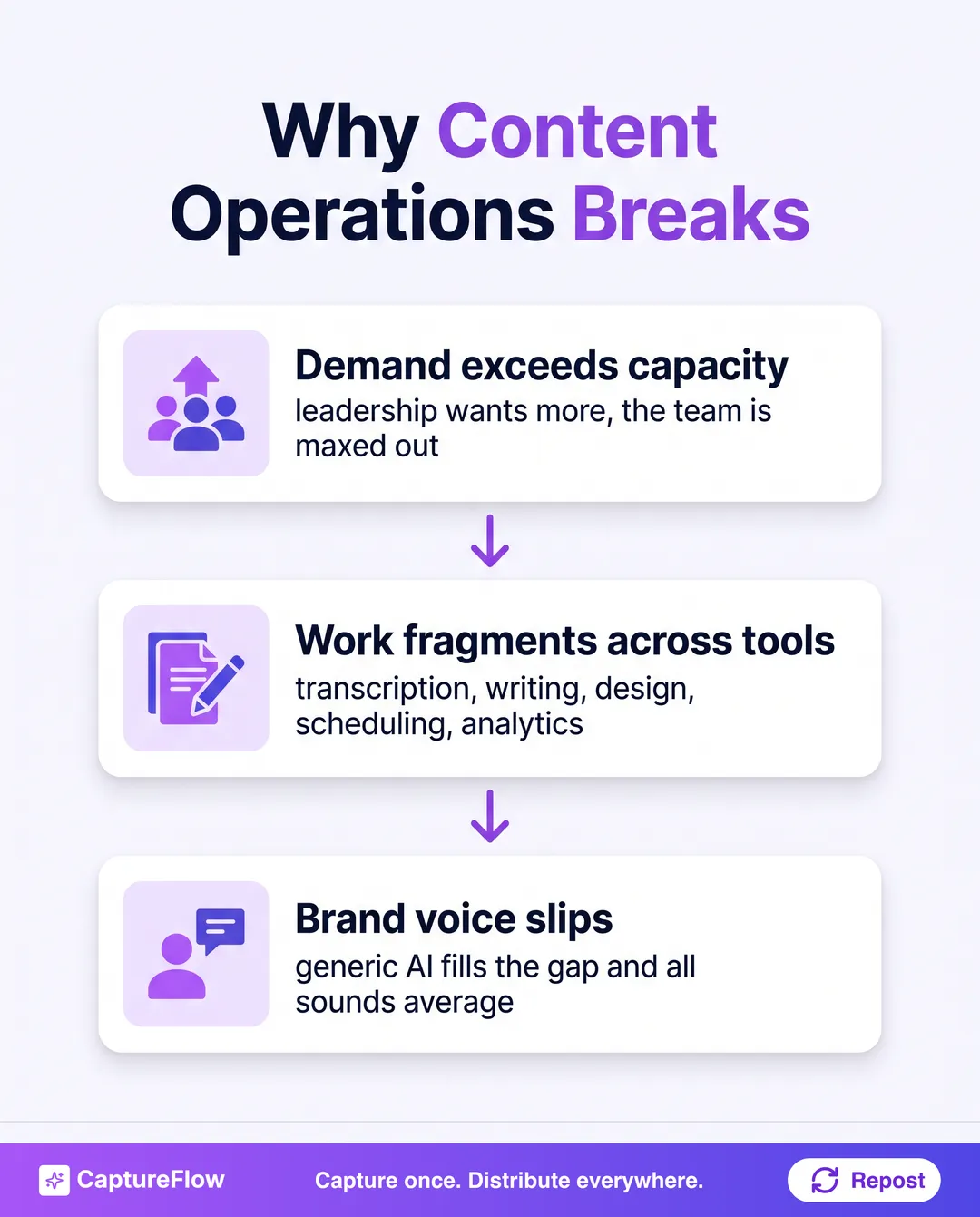 The jam is structural: demand over capacity, scattered across too many tools.
How AI moved the bottleneck (and what it did not fix)
Content operations looks different in 2026 than it did in 2021 because the production step got cheap. HubSpot's data shows 74 percent of marketers now use AI to repurpose a single asset, one video, into many formats at once. Making the content used to be the constraint. That constraint is largely gone.
The bottleneck simply moved, and it moved to two places AI did not fix, both of them operational:
- Voice. A model that drafts fast also drafts generic. Speed without a trained voice just produces average content more quickly, which is worse than less content.
- Coordination. AI made each step faster while multiplying the tools and handoffs between steps. A team can now generate a week of drafts in an hour and still fail to publish them, because the review-and-distribute pipeline was never built.
So the modern content ops job is not "produce more." It is orchestration: the tightest possible path from a raw idea to an on-brand, published post. The teams winning in 2026 are not the ones generating the most drafts, they are the ones with the shortest, most reliable pipeline.
The scalable content operations system
Here is the whole system before the detail. Five stages, one goal each: remove a bottleneck, never add a step.
- Centralize your inputs into one source of truth.
- Define the pipeline: capture, draft, review, distribute, measure.
- Protect brand voice as volume grows.
- Cut the tool sprawl down to one workflow.
- Measure throughput and consistency, not vanity.
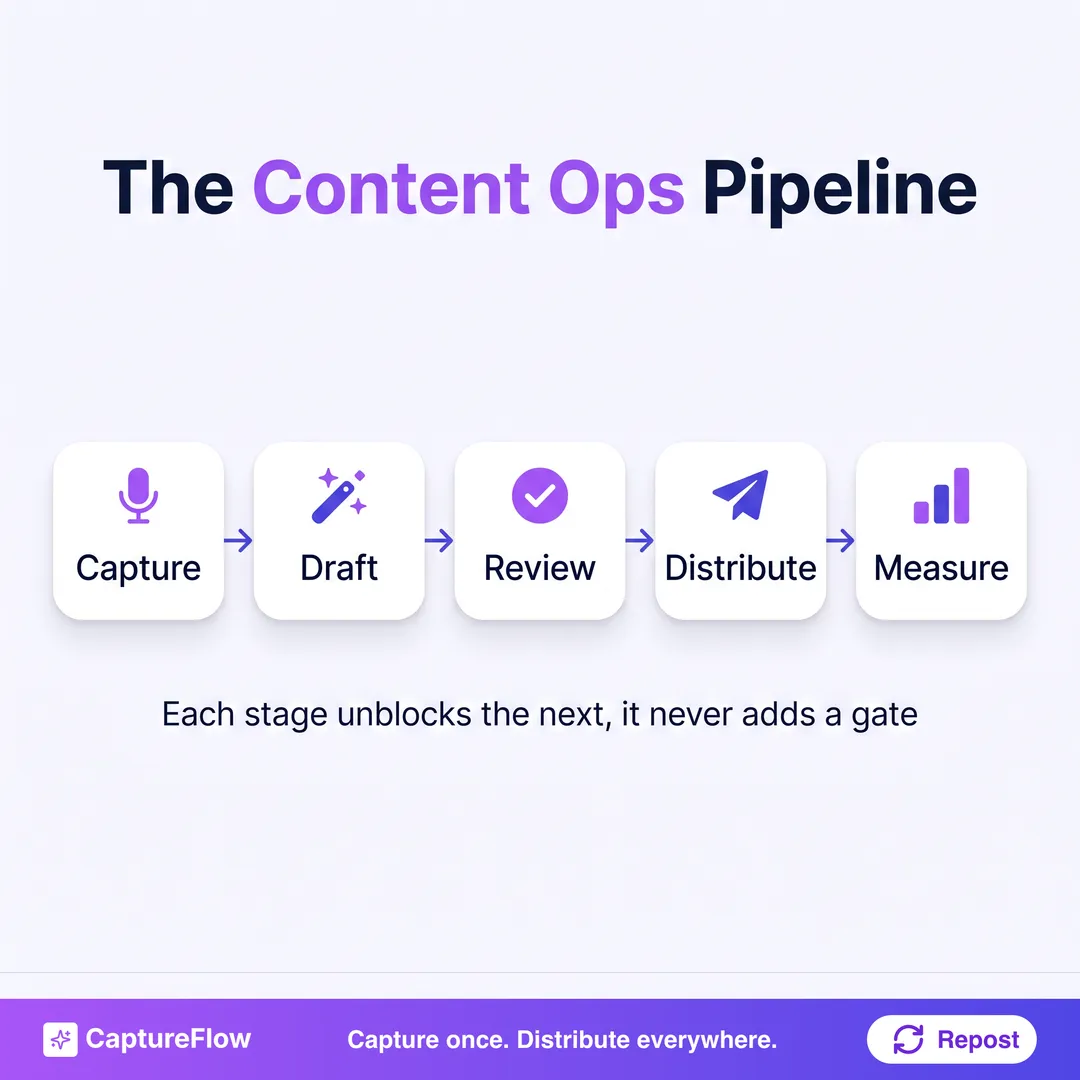 The pipeline. Each stage is designed to unblock the next, not to add a gate.
Step 1: Centralize your inputs
Most teams have no shortage of raw material. They have calls, meetings, product updates, customer questions, and expert opinions, all scattered across heads and inboxes. The content never gets made because the inputs are never in one place.
Fix that first. Create one source of truth where every reusable idea, recording, and note lands. You cannot operate a pipeline on raw material you have to hunt for.
Before you optimize production, audit inputs. Most teams discover they are sitting on months of content raw material (recorded calls, webinar transcripts, internal docs) that never became anything. That backlog is your first month of output.
Step 2: Define the pipeline
Name the five stages explicitly and assign each an owner: capture the idea, draft it into formats, review for accuracy and voice, distribute across channels, measure the result. When every piece follows the same path, work stops stalling in someone's drafts folder.
The point of naming the pipeline is visibility. You cannot see a bottleneck you have not defined, and you cannot fix one you cannot see.
Map your current pipeline honestly and time each stage. The bottleneck is almost never "writing", it is the wait between stages: a draft sitting three days for review, an approval lost in a thread. Attack the waits, not the work.
Step 3: Protect brand voice as you scale
This is the stage that separates a content operation from a content factory. Volume is easy now. Volume that still sounds like you is the hard, valuable part.
Generic AI drafting is what makes scaled content average. The fix is a system trained on your team's actual voice and past work, not a blank-prompt generator. CaptureFlow is an AI content agent that turns your expertise into weeks of on-brand content for every platform. A team member captures one idea and it drafts on-brand posts, carousels, and short video in that person's voice, ready to review, so scaling output does not mean scaling sameness.
Set a voice bar and enforce it at review, not after publishing. One off-brand post that goes out is worth ten caught in review. If your drafting tool cannot hold voice consistently, that is a tooling problem to solve before you scale volume.
Step 4: Cut the tool sprawl
The five-tab problem is the silent killer. When capture lives in one tool, drafting in another, design in a third, scheduling in a fourth, and analytics in a fifth, the handoffs between them are where time and quality leak.
Every handoff is a chance for context to drop and a piece to stall. Consolidating the pipeline into one workflow removes those seams. This is the same logic behind the best AI content repurposing tools: one input, every format, without the stitching. If you are auditing what to keep, our roundup of the best AI content tools for marketing teams sorts them by the job each one does, and agencies running this across many clients will want content workflow automation for agencies.
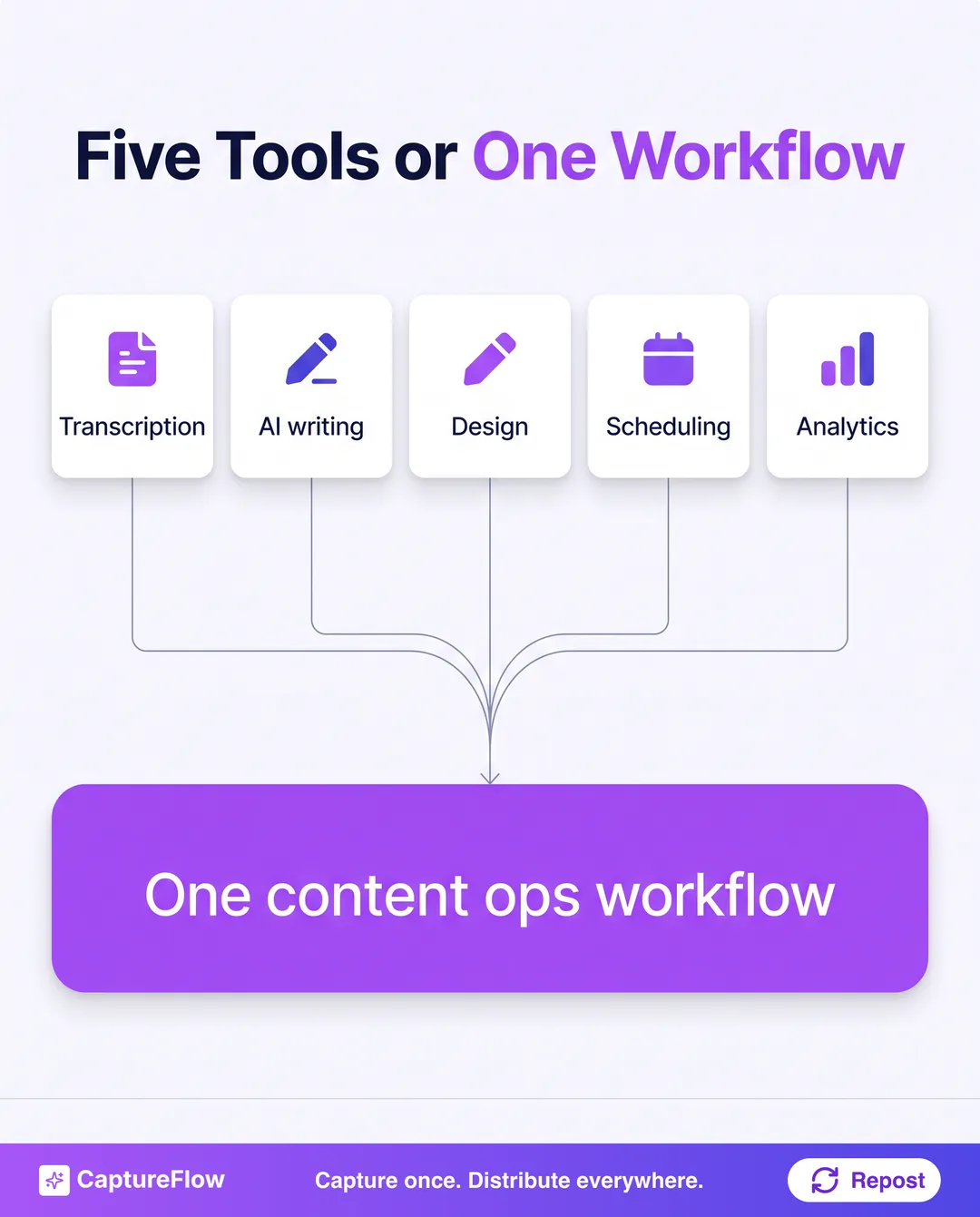 Five disconnected tools become one workflow. The handoffs are where scale breaks.
Step 5: Measure throughput and consistency
Finally, measure the two things a content operation is actually for: throughput (how much on-brand content the team distributes per week) and consistency (whether it keeps distributing without a hero scrambling at the deadline).
Vanity metrics like total impressions describe the output, not the machine. If you want the honest read on which engagement signals matter, a good LinkedIn engagement rate makes the case for depth over raw reach.
Track your streak: the number of consecutive weeks the team hit its publishing cadence. A content operation that runs 20 weeks straight beats one that spikes and stalls, every time. Consistency compounds; spikes do not.
The B2B content operations framework: roles, workflow, cadence, tooling
The five steps above are the what. The framework below is the how it sits on your org chart, which is the part most "content operations b2b" searches are really asking about: not another list of tasks, but who owns what and on what rhythm. For that rhythm as a literal Monday-to-Friday plan, see the weekly content workflow for a small marketing team.
A B2B content operations framework is the arrangement of four things, roles, workflow, cadence, and tooling, that turns a content strategy into published work every week without a hero scrambling at the deadline. Get those four aligned and the pipeline runs itself; leave one undefined and that is where the jam forms.
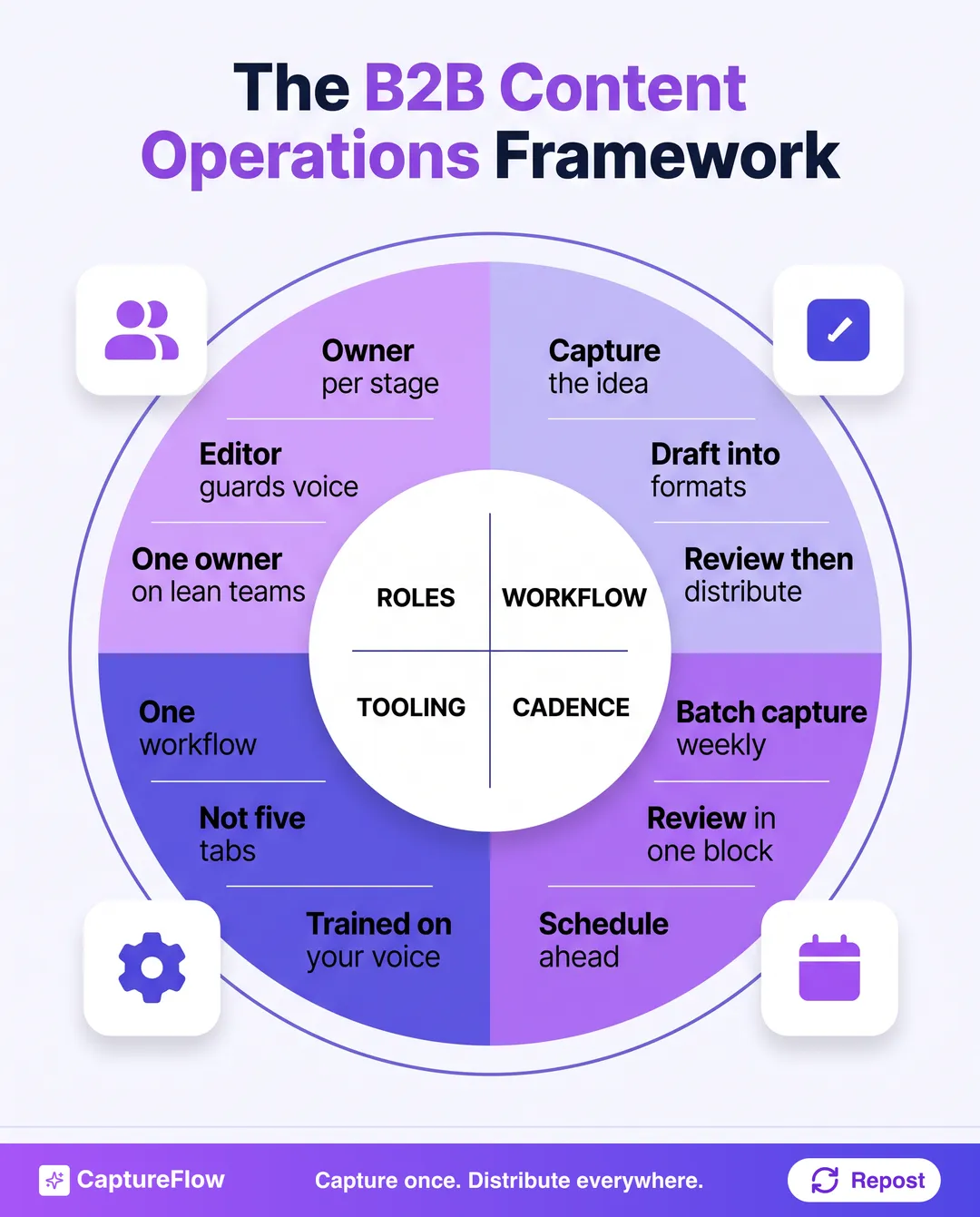 The framework as a wheel. Four quadrants, one system: define all four or the pipeline stalls.
- Roles. Give every pipeline stage an owner, even if that owner is the same person wearing four hats. On a lean marketing team one person may capture, draft, and distribute while a single editor guards voice at review. The point is not headcount, it is that no stage is nobody's job.
- Workflow. The five-stage pipeline (capture, draft, review, distribute, measure) is the workflow. Written down, it becomes a checklist anyone can run, which is what a content ops strategy for teams actually is: a shared path, not tribal knowledge in one person's head.
- Cadence. Batch the work into a weekly rhythm: capture in one block, review in one block, schedule ahead. A predictable cadence is what lets a team distribute content consistently instead of in panicked bursts. This is where a real content strategy turns into a repeatable operation rather than a good intention.
- Tooling. Consolidate the five-tab stack into one workflow trained on your voice, so the framework does not leak time at every handoff. Tooling is the last quadrant on purpose: pick it to serve the roles, workflow, and cadence you already defined, never the other way around.
That is the whole b2b content operations framework. It scales from a solo founder to a distributed team without changing shape, because the four quadrants stay the same, only the number of people filling the roles grows.
How to scale content production without losing quality
The reason "scale content production" makes teams nervous is the fear that more output means worse output. It does not have to, as long as you scale the right things.
To scale content production across a team without losing quality, scale the inputs and the review, not the manual drafting. Centralize the raw material so everyone pulls from one source of truth, use a voice-trained agent to produce the drafts so more volume does not dilute the brand, and put a single, fast review gate in front of everything that publishes.
The failure mode is the opposite: scaling production by adding more people writing from blank pages, each in a slightly different voice, with no consistent check. That is how output goes up and quality goes down at the same time.
The fix is a system where one captured idea becomes many on-brand drafts that a human approves. A distributed marketing team can then lift output several times over while quality holds, because the voice lives in the system and a person still owns the final read. You scale the machine, not the number of blank pages.
Common mistakes that stall content ops
- Adding process instead of removing bottlenecks. Every new step needs to unblock something, or it is just friction with a Kanban board.
- Buying another tool. More tools usually means more handoffs. Consolidate before you add.
- Scaling volume before voice. Fast average content is still average. Fix voice first, then turn up the dial.
- Measuring reach instead of throughput. Impressions flatter you. On-brand pieces distributed per week tells the truth.
The content ops ruleScaling content is not about producing faster. It is about removing the waits, the handoffs, and the sameness between an idea and a published, on-brand post.
The move
A scalable content operation is not a bigger team or a longer tool stack. It is a centralized input, a named pipeline, a defended brand voice, one workflow instead of five, and honest throughput metrics. Build that, and more content stops meaning more chaos.
If the bottleneck is turning scattered raw material into on-brand content without the five-tab scramble, that is exactly what CaptureFlow is built to remove, and you can see how it works. When you are ready to put your team's own voices to work as a channel, an employee advocacy program and employee-generated content are the natural next layer on top of a working content operation.
Sources
- HubSpot, 2026 State of Marketing report (86 percent of marketers use AI; 67 percent of teams save 10+ hours a week).
- Content Marketing Institute, Build a Content Operation Workflow (causes of content bottlenecks).
Frequently asked questions
What is content operations?+
Content operations is the system of people, process, and tools a team uses to plan, produce, and distribute content at scale, without quality or brand voice slipping as volume grows. It is the how behind a content strategy: the strategy says what to publish, content operations makes it repeatable.
How do B2B companies build a scalable content operations system?+
Centralize the raw material into one source of truth, define a clear pipeline from capture to distribution, protect brand voice with a trained system rather than ad-hoc AI, replace the sprawl of single-purpose tools with one workflow, and measure throughput and consistency rather than vanity metrics. The goal at every step is to remove a bottleneck, not add a process.
Why does content production break down as a team grows?+
Because demand for content outpaces capacity, and the work fragments across silos and disconnected tools. Content Marketing Institute traces most content bottlenecks to exactly this: requests exceeding resources, silos that block collaboration, and multiple tools stitched together. Centralizing operations is what removes the jam.
What is a B2B content operations framework and how should a team structure it?+
A B2B content operations framework aligns four things: roles (an owner for every pipeline stage), workflow (capture, draft, review, distribute, measure), cadence (a weekly batch rhythm), and tooling (one voice-trained workflow instead of five tabs). Structure it by defining the roles and workflow first, then the cadence, and choose tooling last to serve them. The framework holds its shape from a solo founder to a distributed team, only the number of people filling the roles changes.
Chris is the founder and CEO of CaptureFlow, which he builds so founders can turn their expertise into content without hiring a team. After 10+ years building products and growing audiences from scratch, he writes about founder-led content, AI, and distribution from inside the problem he is solving: distributing consistent, on-brand content as a team of one.
Founder & CEO of CaptureFlow · 10+ years building products and audiences
One playbook a week from founders who actually create and distribute lots of content. No spam, unsubscribe anytime.
Keep reading

LinkedIn Marketing for B2B Companies
For B2B, LinkedIn is not one channel among many. It is the channel. Here is how B2B companies actually win on it: the stack, the pillars, and the cadence.

How to Build an Employee Advocacy Program on LinkedIn (2026)
Your company page has 2,000 followers. Your fifteen employees have 30,000 connections nobody is reaching. Here is the 6-step program that fixes that.

Content Repurposing: The Complete Strategy Guide
You are not short on ideas. You are short on a system to turn the ones you already had into content. This is the complete guide to content repurposing.