7 Best AI Content Tools for Marketing Teams (2026)
The 7 best AI content tools that help marketing teams produce more content with fewer people in 2026, ranked honestly by the job each one does best.


Every growing marketing team hits the same ceiling. Leadership wants more content on more channels, the board wants it "backed by AI," and the headcount to make it all is exactly the same as last quarter. So the team does what teams do: they buy tools. A writer here, a clipper there, a scheduler, a transcription app, an analytics dashboard. Five tabs, no system, and somehow still behind.
The tools are not the problem. The wrong tools, stitched together badly, are.
An AI content tool for marketing teams is software that uses AI to help a team produce, reshape, or distribute more content without adding people, ideally while protecting the brand voice as volume grows. This guide ranks the seven that actually earn a place in a 2026 stack, honest about what each one does best and where it stops. The real question running through all of it: what AI tools help marketing teams produce more content with fewer people, without the output turning to generic mush.
What makes an AI content tool worth it for a team
A tool earns its seat when it removes a bottleneck a person was stuck on, not when it adds a new step to babysit. For a marketing team specifically, three things separate the keepers from the shelfware:
- Leverage per input. The best tools turn one thing you already have (a recording, a doc, an idea) into many finished pieces. That is how a small team produces like a big one.
- Brand voice at scale. AI drafting is easy now. AI drafting that still sounds like your company, across ten contributors, is the hard and valuable part, and it is a discipline of its own.
- Fewer handoffs. Every tool you add is another seam where context drops and work stalls. Consolidation is usually worth more than the next point solution.
This is the same logic behind building a real content operations system: the win is a shorter, more reliable path from idea to published post, not a longer tool list.
And the pressure to get this right is not hype. In HubSpot's 2026 State of Marketing report, 86 percent of marketers now use AI, and 67 percent of teams report saving 10 or more hours a week with it. The same research shows 74 percent of marketers use AI to repurpose a single asset into many formats. AI is table stakes; the edge is in which tools and how they fit together.
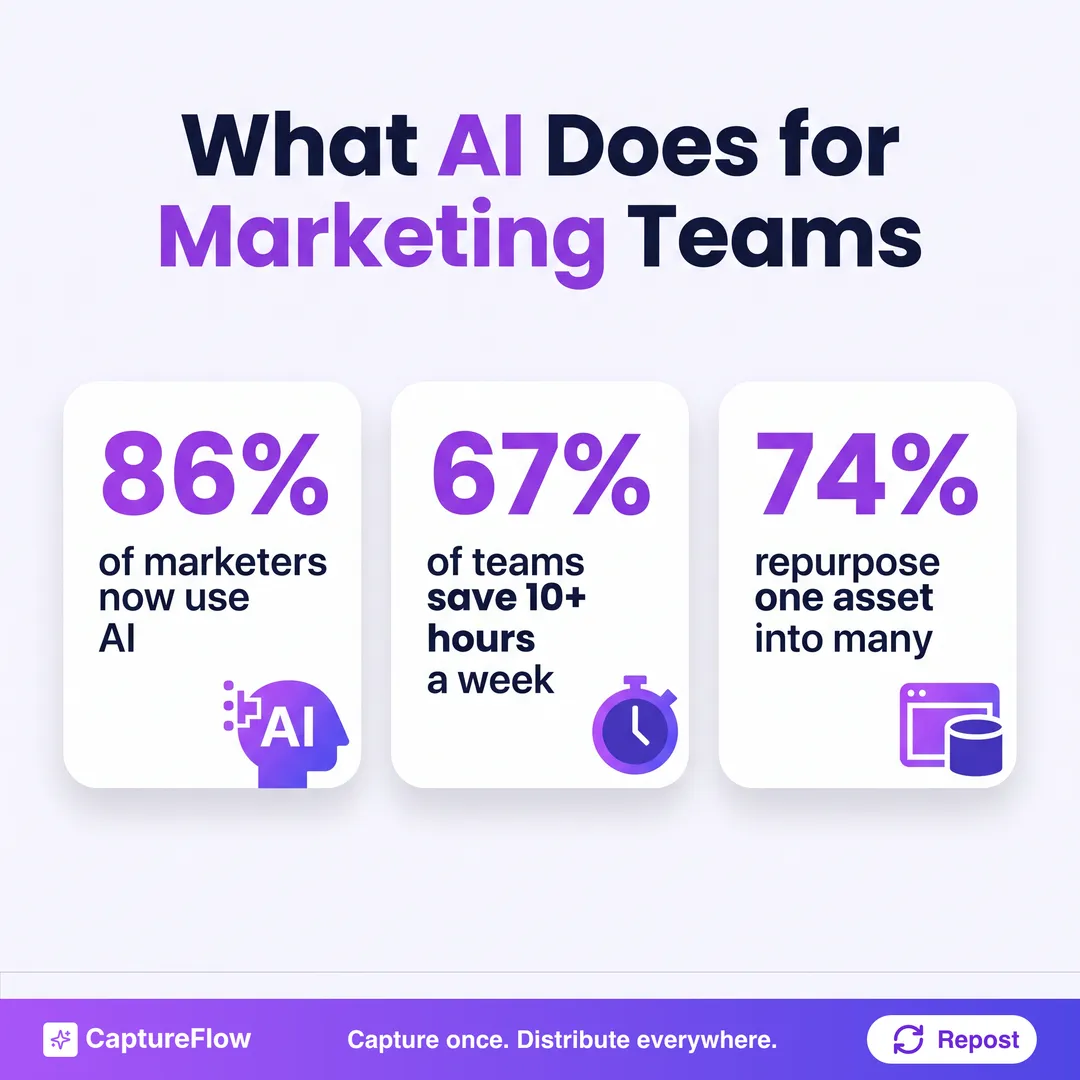 The pressure is real, and so is the payoff. The question is which tools capture it.
The 7 best AI content tools for marketing teams at a glance
Ranked by how much leverage each gives a small team, not by marketing budget.
| # | Tool | Best for | Team fit | Price |
|---|---|---|---|---|
| 1 | CaptureFlow | One capture into content for every platform | Small teams punching above their size | Free trial, then paid |
| 2 | Jasper | High-volume marketing copy | Larger teams and brand governance | From ~$39/mo |
| 3 | ChatGPT | Flexible general-purpose drafting | Anyone, as a Swiss-army assistant | Free, Plus ~$20/mo |
| 4 | OpusClip | Long video into short clips | Teams with a video or webinar engine | Free tier, then ~$15/mo |
| 5 | Castmagic | Calls and podcasts into text assets | Audio-heavy teams | From ~$21/mo |
| 6 | Buffer | Simple, clean team scheduling | Teams that already have the content | Free to ~$6/channel |
| 7 | Blotato | One topic to every platform, then posted | Lean teams that want draft-plus-distribute | ~$29/mo |
Here is how the seven sort by the job they do, which is the useful way to think about a stack.
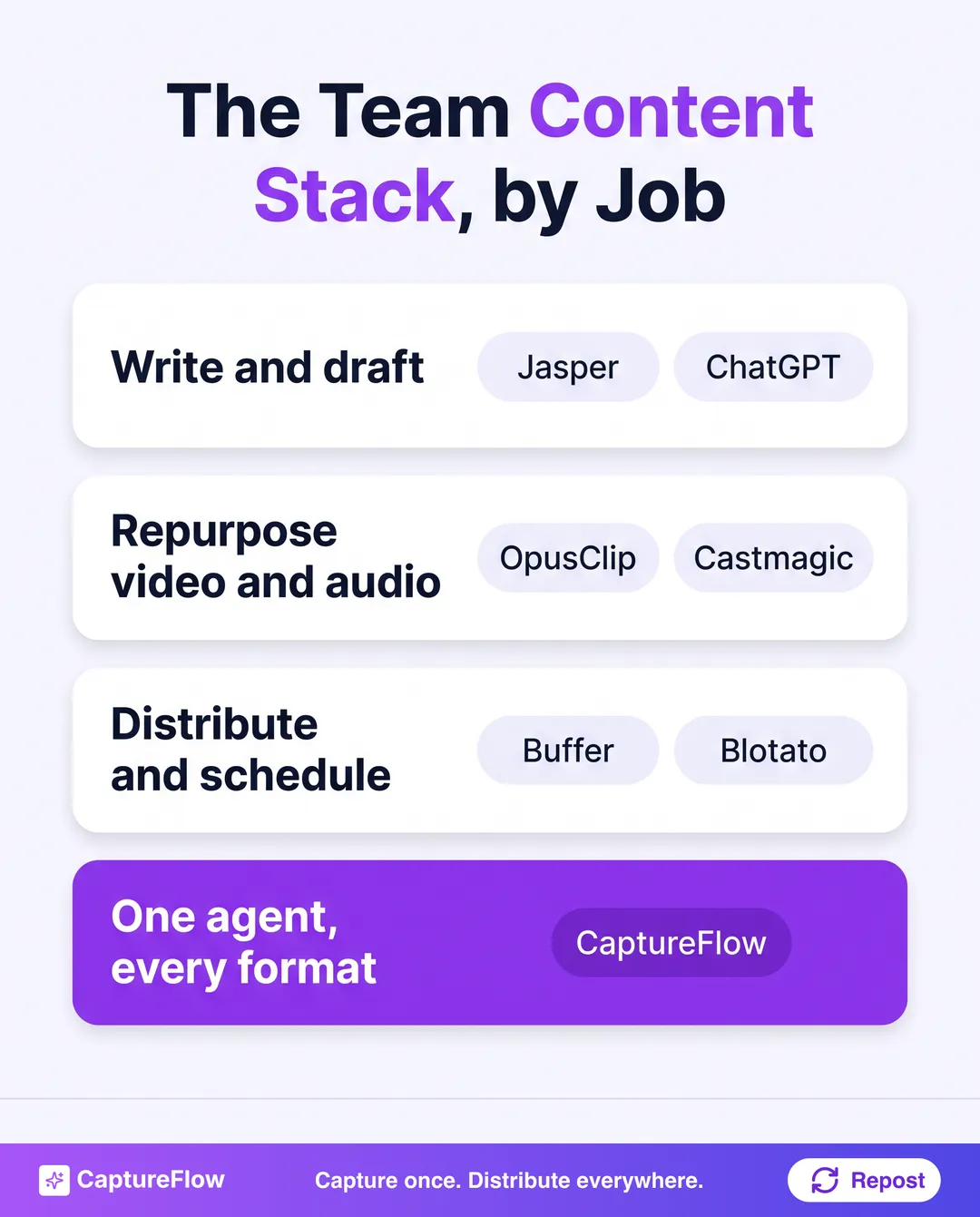 Most teams buy one tool per band. The leverage is collapsing the bands into one workflow.
1. CaptureFlow: best for turning one capture into content for every platform
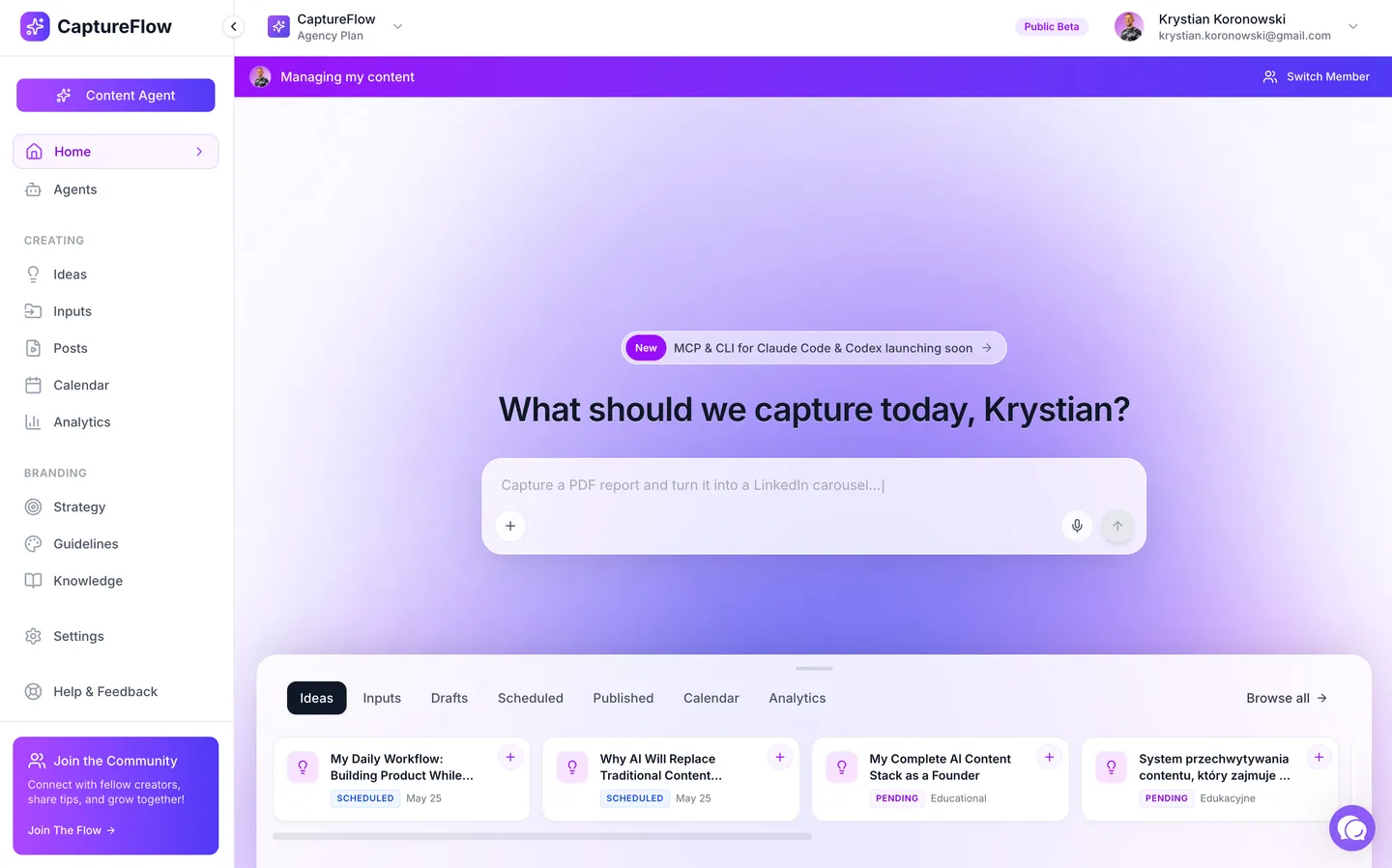 CaptureFlow. Source: captureflow.ai
Most tools on this list do one stage of the content job well. CaptureFlow is built to do the whole span from a single input, which is exactly the leverage a small team needs.
CaptureFlow is an AI content agent that turns your expertise into weeks of on-brand content for every platform. A team member captures one idea (a voice note, a video, a meeting recording, a PDF, or a link), and CaptureFlow, trained on your brand voice and past posts, reshapes it into native content for each channel: a LinkedIn post, an X thread, a carousel, a quote image, an infographic, a short video, and more. You review it, or leave it to the agent, and it schedules the week.
For a marketing team, the point is compression. Instead of a writer, a clipper, a designer, and a scheduler each touching a piece, one capture fans out into the whole set, in your voice, ready to approve. That is how you produce more content with fewer people without the output going generic, and it starts with using these tools the right way.
- Best for: teams that have plenty of raw material (calls, ideas, expertise) and not enough hands to turn it into finished, on-brand content everywhere.
- Team fit: genuinely strong for small-to-mid teams; multi-input and trained on your voice, so contributors sound like themselves.
- Pricing: free to start, then paid plans. See how CaptureFlow compares to any single-purpose tool here.
- The honest caveat: if your only need is queuing posts you have already written, a dedicated scheduler is simpler. CaptureFlow earns its place when the bottleneck is making the content, not just sending it.
2. Jasper: best for high-volume marketing copy at team scale
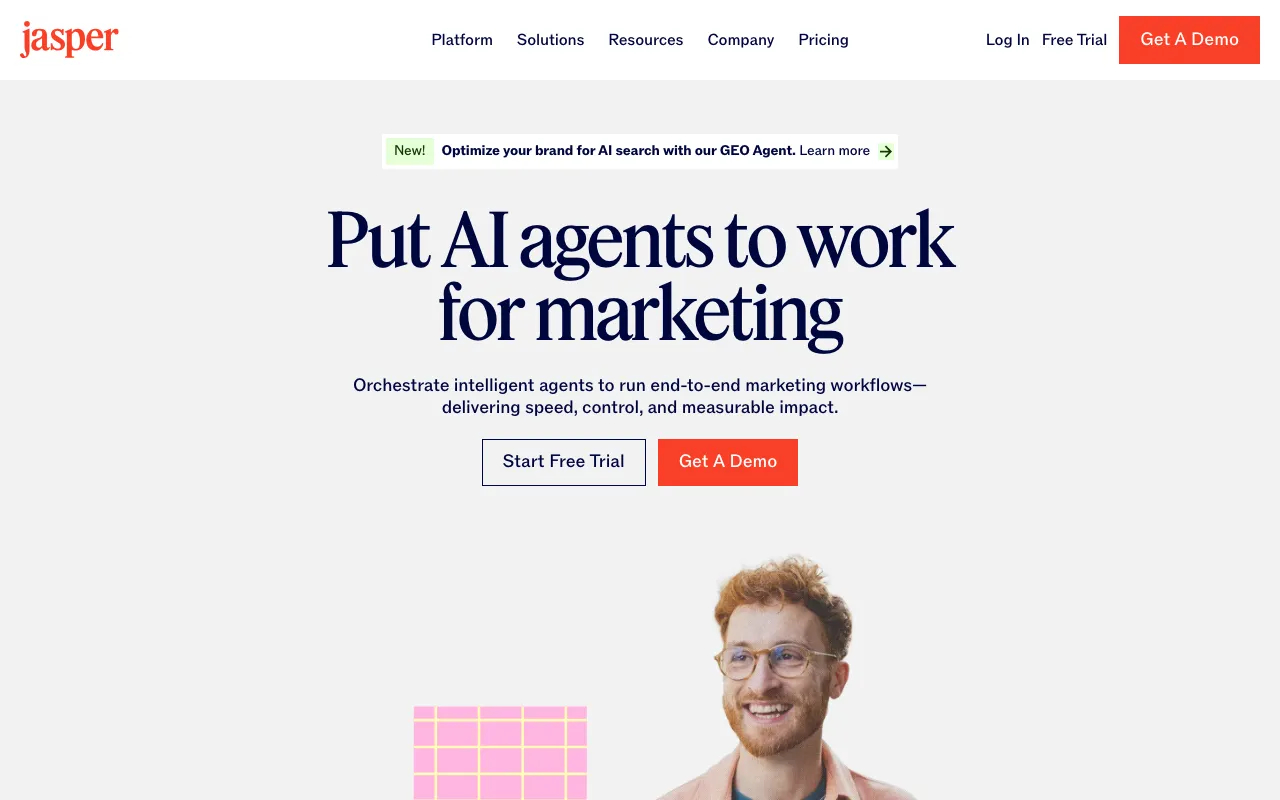 Jasper. Source: jasper.ai
Credit where it is due. For a larger marketing team that needs governed, high-volume copy across campaigns, Jasper is the most complete AI writing platform here. It has brand voice controls, templates, team seats, and workflow features built for organizations, not solo creators.
Where Jasper fits is the copy-heavy team: landing pages, ad variations, email campaigns, product descriptions at volume, with brand and role controls so ten marketers stay on-message. That governance layer is real and hard to replicate with a raw chat window.
Its limit is scope and sameness. Jasper is a writing platform, so video, audio, carousels, and cross-platform scheduling live in other tools. And like any generic AI writer, it produces fluent copy that can drift toward the mean unless a person keeps sharpening it. See the full CaptureFlow vs Jasper breakdown for where an all-in-one agent picks up what a writing platform leaves on the table.
- Best for: large teams producing a high volume of marketing copy with brand governance.
- Team fit: strong; built for seats, roles, and campaigns.
- Pricing: Creator plans from around $39/mo, Pro tiers higher.
3. ChatGPT: best flexible, general-purpose assistant
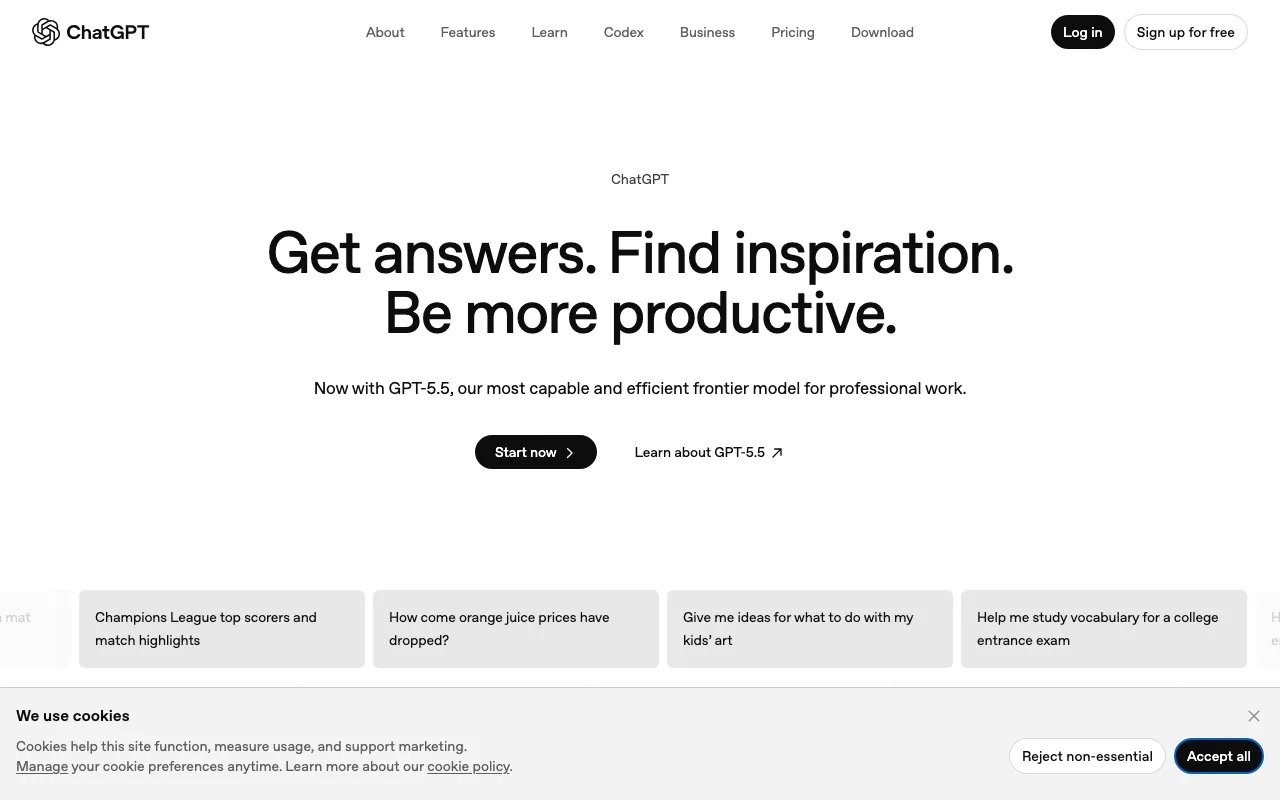 ChatGPT. Source: chatgpt.com
Almost every marketer already has this one open in a tab, and for good reason. ChatGPT is the most flexible drafting and brainstorming tool on this list. Outline a campaign, rewrite a paragraph, summarize a call, generate ten subject lines, it does all of it capably and cheaply.
The gap is structural, not quality. A chat window has no persistent memory of how your brand actually sounds from one session to the next, no native formats, and no scheduling. Every marketer prompts it slightly differently, so voice scatters across the team. It is a brilliant assistant and a poor system, which we unpack in full in ChatGPT vs a content engine.
- Best for: flexible, ad-hoc drafting, editing, and ideation across a team.
- Team fit: universal, but inconsistent voice without a layer on top.
- Pricing: free tier, Plus around $20/mo.
4. OpusClip: best for turning long video into short clips
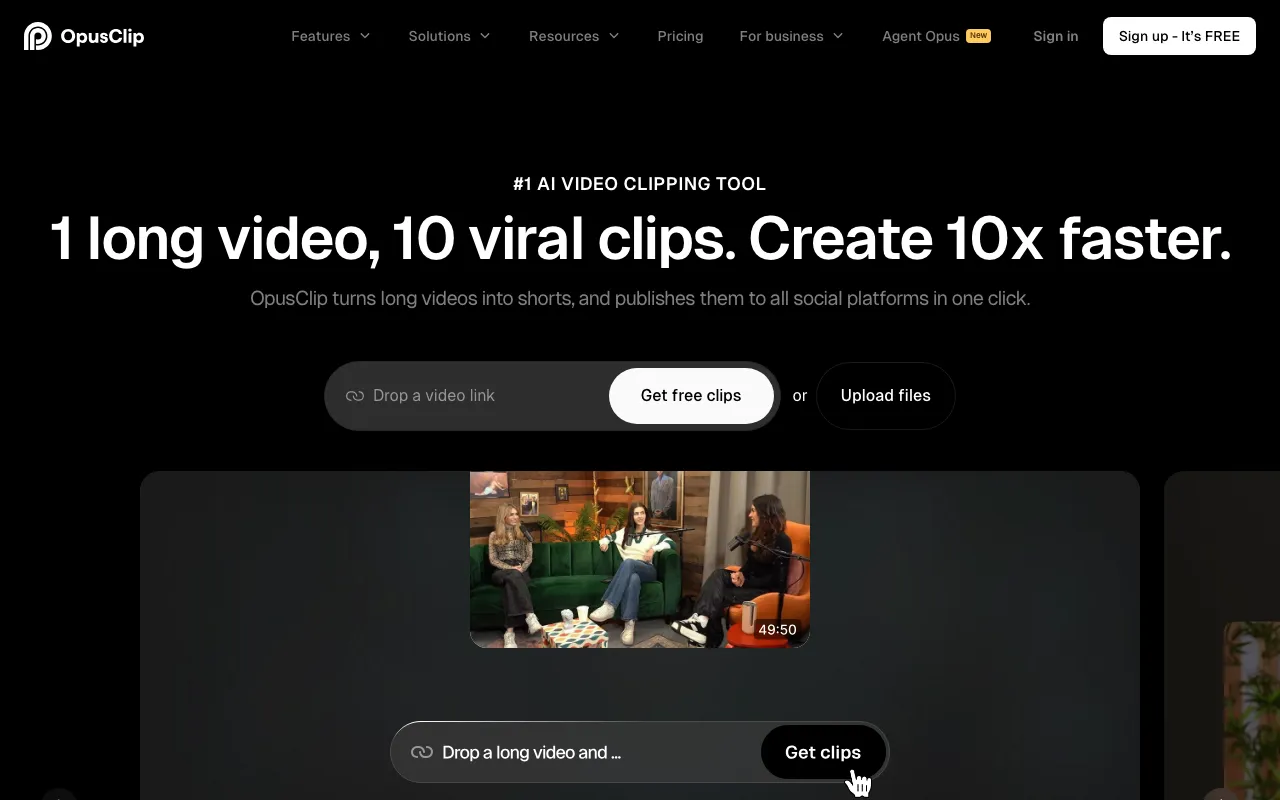 OpusClip. Source: opus.pro
If your team runs on video, this is a genuine workhorse. OpusClip turns one long video, a webinar, a podcast, or a talk, into a stack of captioned vertical clips, and it does that one job about as well as anything. For a team sitting on hours of recorded video, it is fast leverage.
Its limitation is exactly its focus. OpusClip is a clip generator: no text posts, no carousels, no long-form drafting, no cross-platform strategy. You still need something to write around the clips and somewhere to send them. See the full OpusClip comparison for how a single-purpose clipper stacks against an all-in-one agent, or the best OpusClip alternatives if clipping is your whole focus.
- Best for: teams with a video or webinar engine that need clips at volume.
- Team fit: good as one node in a wider stack.
- Pricing: free tier with a watermark, then around $15/mo.
5. Castmagic: best for turning calls and podcasts into text
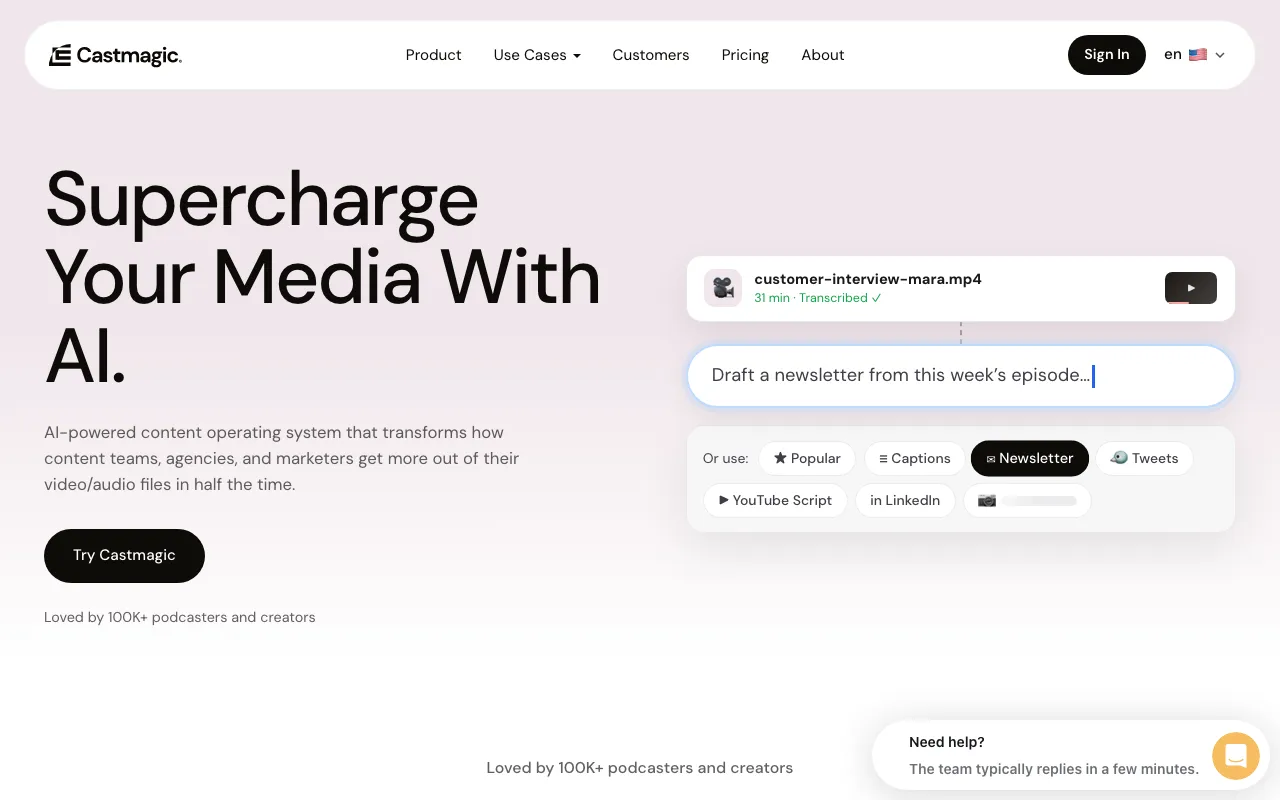 Castmagic. Source: castmagic.io
For teams that live in audio (podcasts, sales calls, webinars), Castmagic squeezes a surprising amount of text out of one recording. Drop in an episode and it produces transcripts, show notes, and social posts, all from the audio you already captured. It is purpose-built and focused.
Where it stops is breadth: it is weak at finished video clips, and heavy users hit the monthly transcription-hour caps. If you want the same episode turned into short video and native posts for every platform, that is a wider fan-out than Castmagic aims for, which is the Castmagic vs CaptureFlow tradeoff. Either way, our guide on how to turn meeting recordings into content covers the workflow.
- Best for: audio-heavy teams turning recordings into text assets.
- Team fit: solid for podcast and call-driven teams.
- Pricing: from around $21/mo.
6. Buffer: best for simple, clean team scheduling
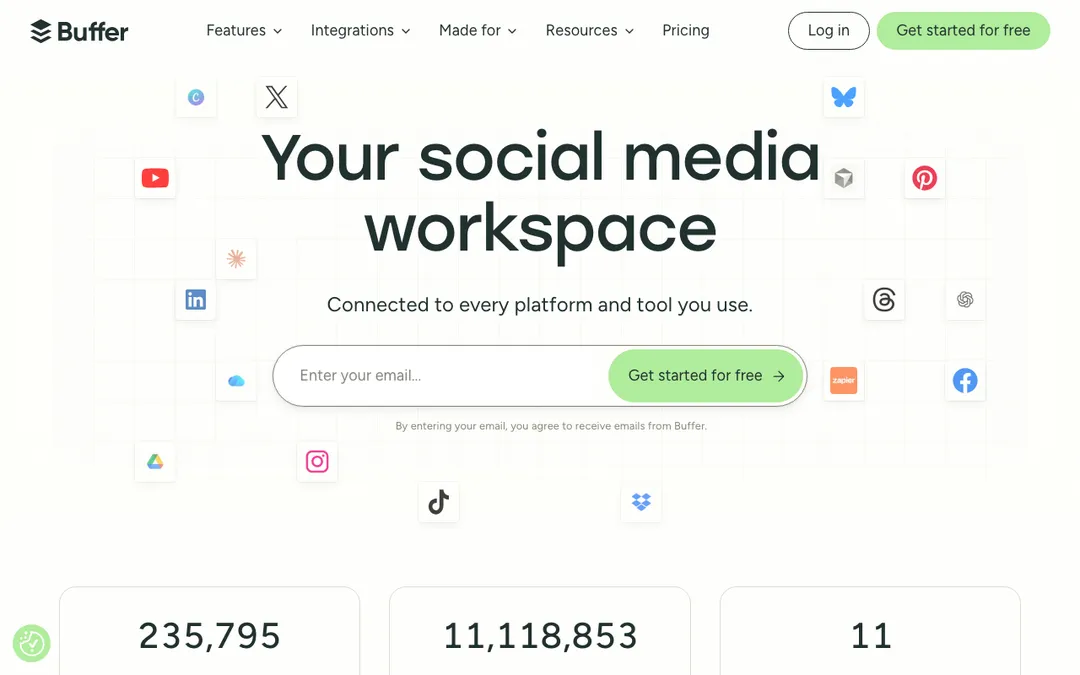 Buffer. Source: buffer.com
Once the content exists, it has to go out reliably, and Buffer is the calmest way to do that. Buffer is the cleanest, most beginner-friendly scheduler here, with a genuinely useful free tier and simple team collaboration. For a team that already writes its content elsewhere and just wants a tidy, shared queue, it is hard to beat on simplicity.
The honest framing: Buffer is a distribution tool, not a creation one. It assumes the content already exists. If your bottleneck is supply, a scheduler just organizes your silence. For the full picture of the category, our best social media scheduling tools guide ranks the alternatives, or see the CaptureFlow vs Buffer breakdown.
- Best for: teams that have the content and need clean, collaborative scheduling.
- Team fit: good; simple approvals and a shared calendar.
- Pricing: free tier, then around $6 per channel per month.
7. Blotato: best for one topic to every platform, then posted
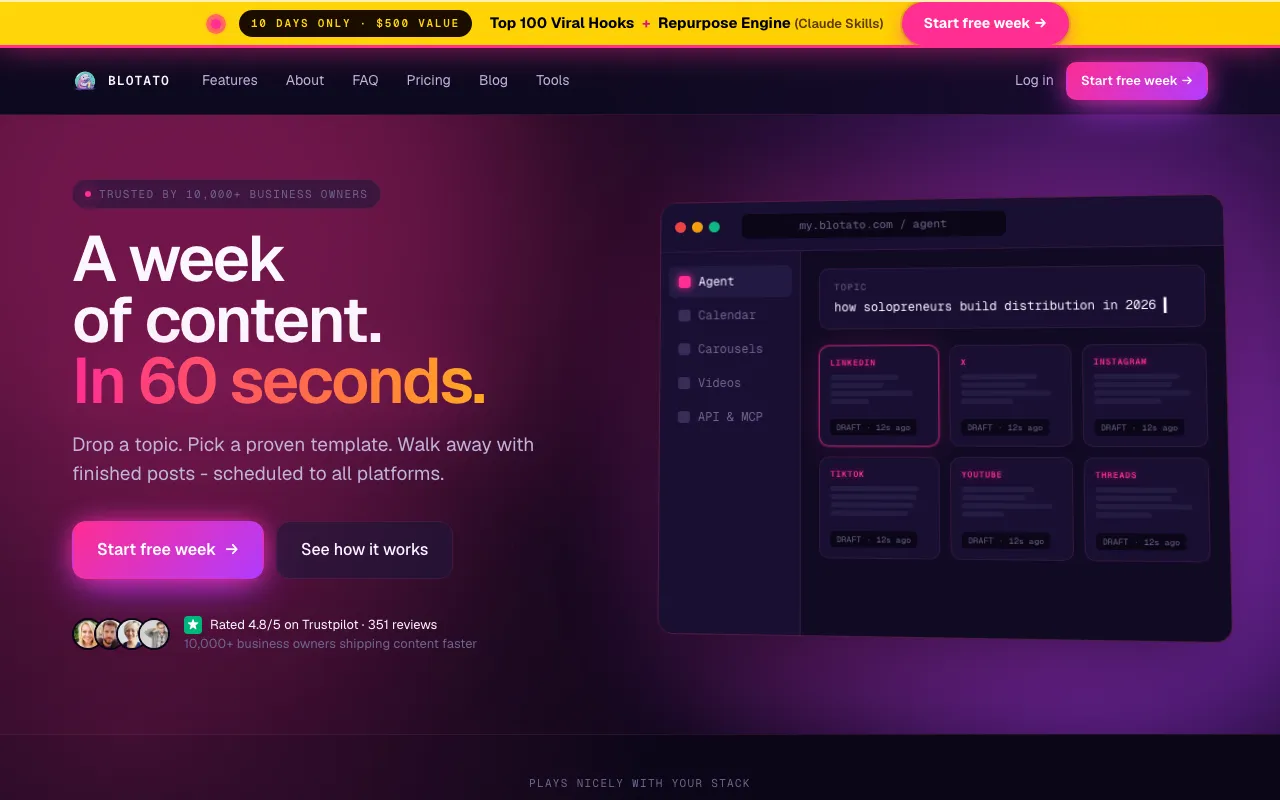 Blotato. Source: blotato.com
Blotato sits in the useful middle: it drafts a topic into posts for multiple platforms and then distributes them, closing the gap between "write" and "schedule" that most tools leave open. For a lean team that wants AI drafting plus multi-platform posting in one place, it is a tidy fit.
Its ceiling is depth of voice and format range. It leans toward text-and-link posts and lighter personalization, so it is closer to a fast distributor than a voice-trained content engine. If breadth of format and a trained brand voice matter more than raw posting speed, weigh it against an all-in-one agent in the CaptureFlow vs Blotato comparison, or read the wider best AI content repurposing tools roundup.
- Best for: lean teams wanting draft-and-distribute in one tool.
- Team fit: good for small teams; lighter on governance.
- Pricing: around $29/mo.
How to choose the right AI content tool for your team
Do not start from the tool. Start from the stage of the content job that is actually jamming, then buy for that.
Ask what breaks first in your team's pipeline:
- Producing enough on-brand content across channels? That is a supply-and-voice problem, which is exactly what an all-in-one agent like CaptureFlow is built for.
- High volume of marketing copy with brand controls? A writing platform like Jasper.
- Turning existing video or audio into assets? OpusClip for clips, Castmagic for text.
- Getting written content out reliably? A scheduler like Buffer, or Blotato if you want drafting bundled in.
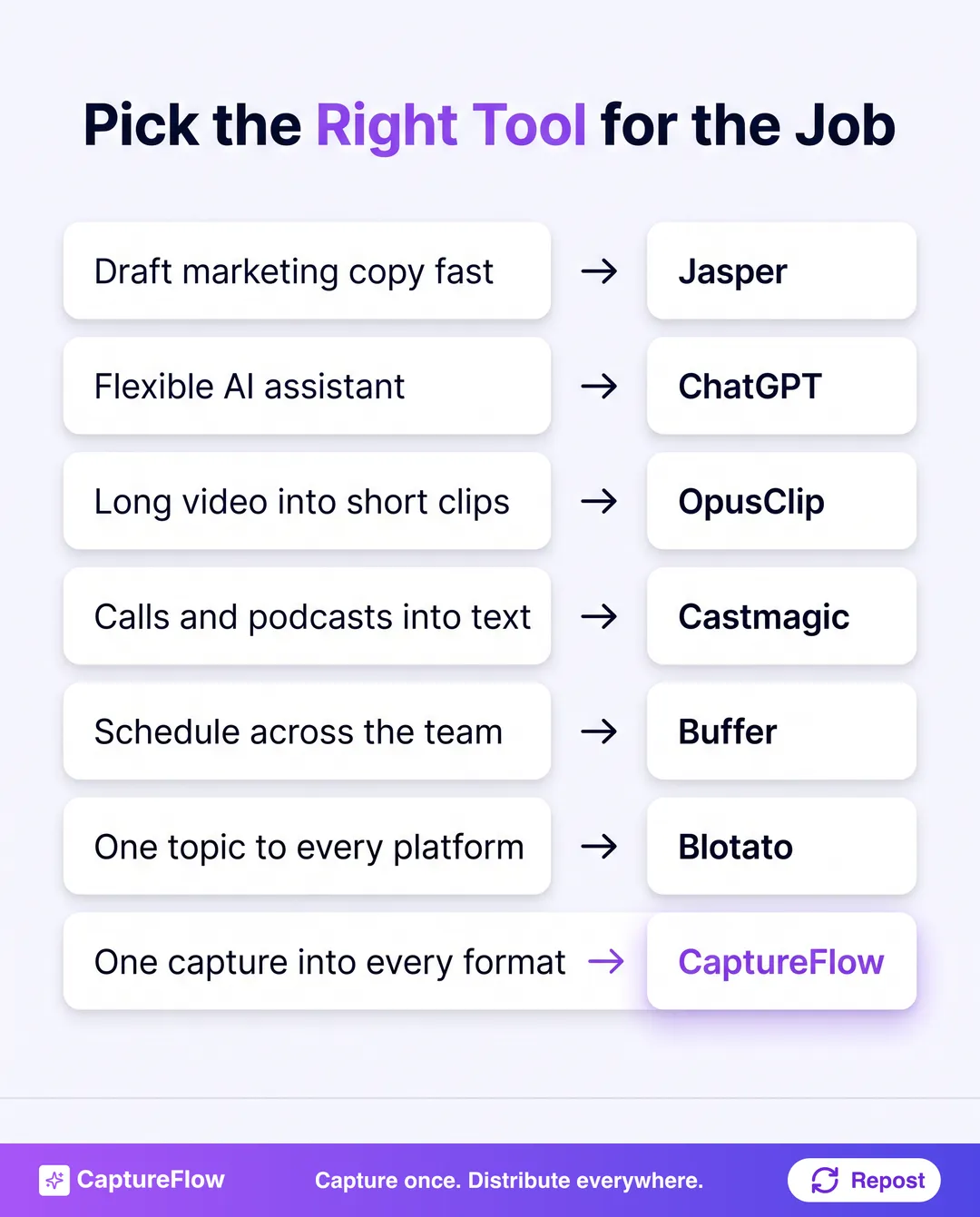 Buy for the stage that is jamming. Then ask how many of these one tool could replace.
The trap most teams fall into is buying one tool per row and ending up with five subscriptions, five logins, and five places for a piece to stall. Before you add the next tool, ask the more valuable question: how much of this stack could one workflow absorb? Consolidation is usually the higher-leverage move, and it is the whole idea behind a real content operations system. If you run an agency serving many brands, the same logic scales further in content workflow automation for agencies.
Count your team's content stack in logins, not features. If a piece of content passes through four tools and three people before it publishes, your bottleneck is the handoffs, not any single tool. Collapsing that path beats upgrading any one seat.
The honest final take
There is no single "best" AI content tool for a marketing team, because the seven here do genuinely different jobs. Jasper is the strongest writing platform. OpusClip is the best clipper. Buffer is the simplest scheduler. If your bottleneck is precisely one of those, buy the specialist and move on. That is the fair verdict, and I would rather you pick the right one than the loudest.
But most teams do not have one bottleneck. They have a supply problem across every channel and a headcount that will not grow, and they solve it by stacking four point tools that do not talk to each other. That is where an all-in-one agent changes the math: one capture, reshaped into on-brand content for every platform, in your team's voice, ready to review and schedule.
The team content ruleMore tools rarely means more content. The teams that produce the most in 2026 are the ones with the shortest path from an idea to an on-brand post, not the longest tool list.
If the thing standing between your team and consistent output is turning scattered raw material into finished content without the five-tab scramble, that is exactly what CaptureFlow is built to remove. You can see how it works or browse how it compares to every single-purpose tool on this list.
Sources
- HubSpot, 2026 State of Marketing report (86 percent of marketers use AI; 67 percent of teams save 10+ hours a week; 74 percent repurpose one asset into many).
- Jasper, Plans and Pricing (Creator and Pro tiers).
- OpusClip, Pricing (free tier and Starter plan).
Frequently asked questions
What AI tools help marketing teams produce more content with fewer people?+
The highest-leverage ones turn a single input into many finished pieces so a small team produces like a big one. CaptureFlow reshapes one capture into native content for every platform, Jasper and ChatGPT draft copy fast, OpusClip and Castmagic turn video and audio into assets, and Buffer and Blotato handle distribution. The biggest gain comes from consolidating the stack, not adding tools.
What is the best AI content tool for a marketing team in 2026?+
It depends on your bottleneck. If the problem is producing enough on-brand content across channels from what you already have, CaptureFlow is built for that. If it is high-volume marketing copy inside a large team, Jasper. If it is turning long video into clips, OpusClip. Match the tool to the job that is actually jamming your pipeline.
Can AI content tools replace a marketing team?+
No, and the ones that promise it produce the average content buyers already tune out. AI moves the bottleneck from production to judgment: a person still decides what is worth saying, protects the brand voice, and approves what goes out. The best tools make a small team faster, they do not remove the humans from the loop.
Chris is the founder and CEO of CaptureFlow, which he builds so founders can turn their expertise into content without hiring a team. After 10+ years building products and growing audiences from scratch, he writes about founder-led content, AI, and distribution from inside the problem he is solving: distributing consistent, on-brand content as a team of one.
Founder & CEO of CaptureFlow · 10+ years building products and audiences
One playbook a week from founders who actually create and distribute lots of content. No spam, unsubscribe anytime.
Keep reading

How to Use AI Content Tools (Without Sounding Like a Bot)
Most people disappointed with AI content tools started with the tool instead of the problem. Here is the workflow that actually works: find the gap, match the tool, train it on your voice, and ship.

9 Best AI Content Tools for Founders in 2026: Honestly Ranked
You do not have a marketing team. You have a company to run and a feed to fill. Here are the 9 best AI content tools for founders in 2026, ranked honestly by the job.

How to Scale Content With AI Without Losing Your Brand Voice
The fastest way to make your brand sound like everyone else is to scale content with generic AI. Here is how a team scales output and keeps one voice.