Founder-Led Marketing vs Personal Branding: The Difference
Founder-led marketing grows the company. Personal branding grows you. They overlap, but confusing them costs founders reach. Here is the difference.

From the outside, they look identical: a founder posting on LinkedIn, showing up on podcasts, sharing what they have learned. Same person, same platforms, same content. So most founders treat "building a personal brand" and "doing founder-led marketing" as the same project.
They are not, and the gap between them is where a lot of founder content quietly underperforms.
Founder-led marketing is using the founder's voice and presence as a channel to grow the company. Personal branding is building the founder's own reputation and audience as an individual. Same activity, different owner. One serves the business; the other serves the person. Knowing which you are actually doing changes what you post, how you measure it, and what you are left with at the end.
What is founder-led marketing?
Founder-led marketing is a go-to-market strategy where the company's growth runs through the founder as its primary voice. The founder becomes the most trusted channel the business has, and their content drives awareness, trust, and demand for the product.
The hero of founder-led marketing is the business. The founder is the medium, not the message. When a founder shares a hard lesson from building the product, the payoff is measured in pipeline: people who now trust the company, remember it, and reach out. This is the logic behind a founder content operating system, content built deliberately to compound into company outcomes.
What is personal branding?
Personal branding is the ongoing work of shaping how the world perceives you as an individual professional. The asset you are building is your own name: your reputation, your audience, your credibility in a field.
The hero of a personal brand is you. Its value is portable, it follows you between companies, into your next raise, your next role, your next venture. A founder with a strong personal brand carries that audience with them no matter what happens to any single company.
That portability is the whole distinction in one word. A personal brand goes with you. Founder-led marketing stays with the company.
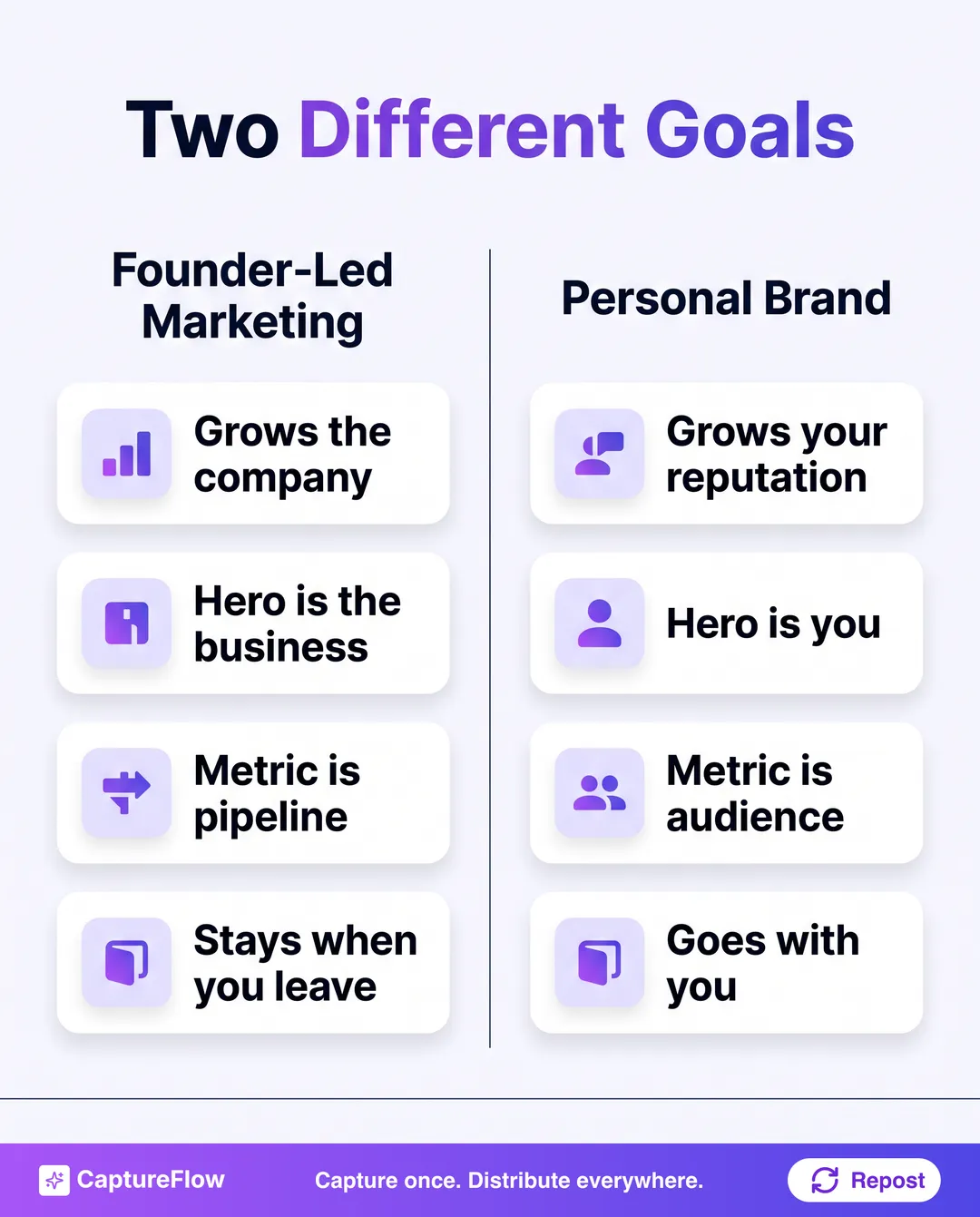 Same posts, different owners. The goal is what separates them.
The real difference, dimension by dimension
Line them up and the split is clean:
| Dimension | Founder-led marketing | Personal branding |
|---|---|---|
| Goal | Grow the company | Grow your reputation |
| Hero | The business | You |
| Success metric | Pipeline, trust, demand | Audience, authority, opportunities |
| Who owns the value | The company | The individual |
| What happens if you leave | It stays behind | It goes with you |
Neither is better. They are just different jobs, and the content that serves one is not automatically optimized for the other. A viral post about your morning routine grows your personal brand and does almost nothing for your company. A sharp breakdown of a problem your product solves does both, but only if you built it to.
Why founders confuse them, and what it costs
The confusion is natural, because the activity is genuinely the same. You open LinkedIn and write. The difference is invisible until you look at what you are optimizing for.
The cost shows up in two ways. Founders chasing a personal brand often optimize for reach and applause, and end up with a big audience that never converts into anything the business can use. Founders doing founder-led marketing without any personal brand have the opposite problem: they post company updates in a founder's name with none of the credibility or voice that makes a founder worth following.
The fix is not to pick one. It is to know which lever you are pulling on any given post, and to make sure the two point in the same direction.
Do you need both? Almost certainly
Here is the good news: done well, they reinforce each other. Your personal brand is what earns founder-led marketing its reach and trust. Founder-led marketing is what gives your personal brand a reason to exist beyond vanity.
And the business case for pointing your credibility at the company is strong. In the 2024 Edelman-LinkedIn B2B Thought Leadership Impact Report, 73 percent of decision-makers said an organization's thought-leadership content is a more trustworthy basis for judging its capabilities than its marketing materials. In the same study, 75 percent said strong thought leadership prompted them to research a product they were not previously considering, and 90 percent said they are more receptive to outreach from companies that publish it consistently.
That is founder-led marketing working: the founder's credible voice, pointed at the company, moving buyers. A personal brand is the fuel; the company is where you aim it. One of the most trusted ways to point it is building in public, sharing the real journey rather than only the polished result. And it does not have to stop at the founder: the same trust mechanic scales to the whole team through an employee advocacy program.
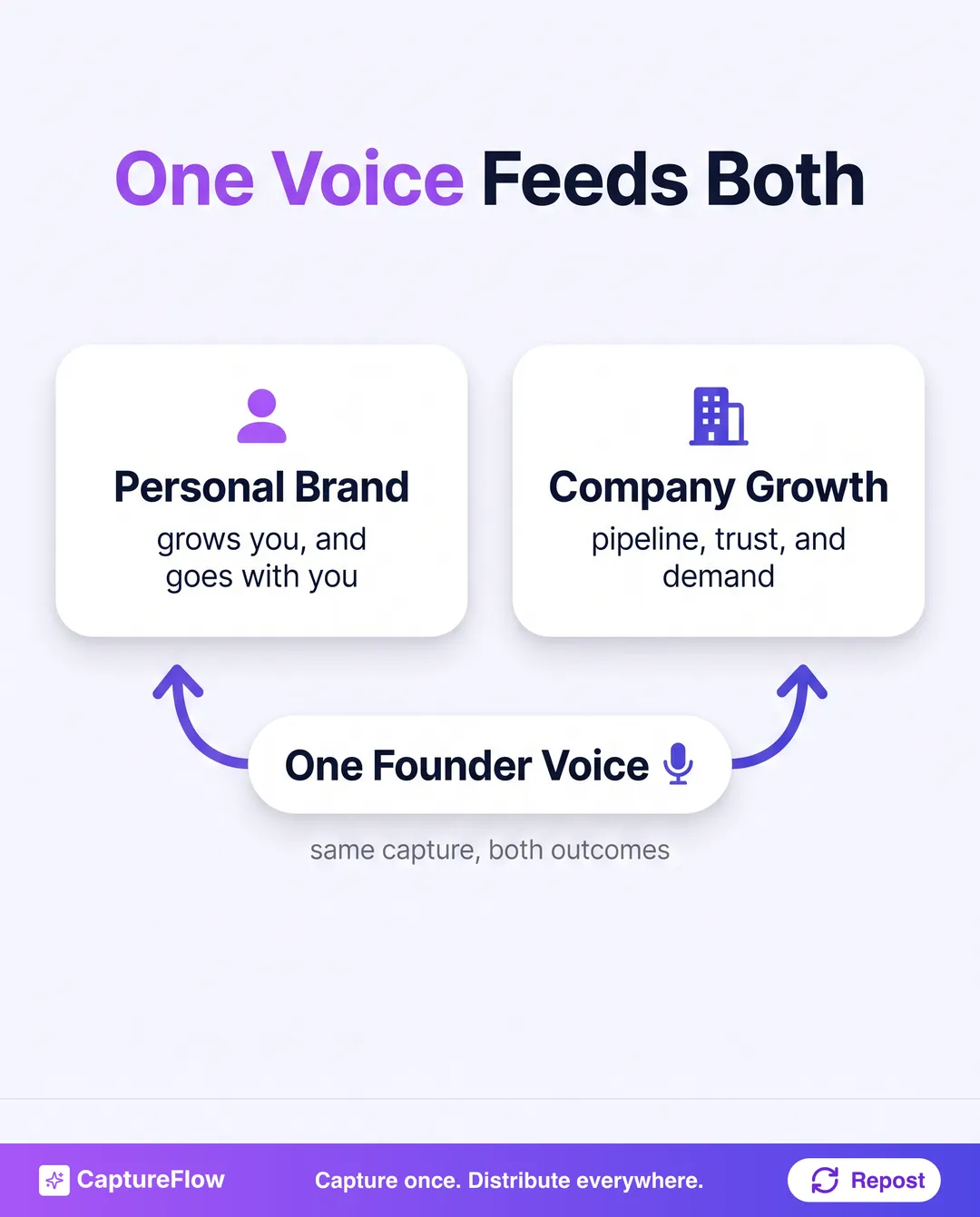 One voice, pointed deliberately, grows both the person and the business.
Before you post, ask one question: is this for me or for the company? Both are valid answers. The mistake is not knowing, and letting the wrong one run on autopilot.
How to run both from one capture
The reason founders drop one or the other is time. Building a personal brand and marketing the company both demand consistent output, and doing both by hand is a second full-time job.
It does not have to be. CaptureFlow is an AI content agent that turns your expertise into weeks of on-brand content for every platform. You capture one idea, a lesson, a customer story, a strong opinion, and it reshapes that single input into native content for each channel. The personal, credibility-building posts and the company-pointed ones come from the same capture, in your voice, so the two reinforce each other instead of competing for the hour you do not have.
The founder content ruleYour personal brand earns the attention. Founder-led marketing decides where you spend it. Run both from one voice, or you will run neither for long.
That is the sustainable version: not choosing between growing yourself and growing the company, but building a content strategy where one capture does both. If consistency is the thing standing between you and that, it is exactly what CaptureFlow is built to fix, and you can see how it works or browse how it compares to the single-purpose tools.
Sources
- Edelman and LinkedIn, 2024 B2B Thought Leadership Impact Report.
Frequently asked questions
What is the difference between founder-led marketing and personal branding?+
Founder-led marketing uses the founder as a channel to grow the company: the goal is pipeline, trust, and demand for the business. Personal branding builds the individual's own reputation and audience, which is portable and follows them between companies. The visible activity looks the same; the owner and the goal differ.
Do founders need a personal brand or founder-led marketing?+
Most founders benefit from both, because they reinforce each other. A strong personal brand gives founder-led marketing its reach and credibility, and founder-led marketing gives the personal brand a business reason to exist. The mistake is running one while thinking you are running the other.
Can you do founder-led marketing without building a personal brand?+
Not really. Founder-led marketing depends on the founder being a credible, recognizable voice, which is a personal brand by another name. What you can do is point that brand deliberately at company outcomes rather than treating audience growth as the end in itself.
Chris is the founder and CEO of CaptureFlow, which he builds so founders can turn their expertise into content without hiring a team. After 10+ years building products and growing audiences from scratch, he writes about founder-led content, AI, and distribution from inside the problem he is solving: distributing consistent, on-brand content as a team of one.
Founder & CEO of CaptureFlow · 10+ years building products and audiences
One playbook a week from founders who actually create and distribute lots of content. No spam, unsubscribe anytime.
Keep reading
The Best AI Tool for Founders to Create LinkedIn Content
You know you should be posting on LinkedIn. You do not have an hour a day to do it. Here is what the best AI tool for a busy founder actually looks like.
LinkedIn Thought Leadership Strategy for B2B Executives
Most executive LinkedIn reads like a press release nobody asked for. Here is the strategy that turns a leader's real point of view into B2B pipeline.
How to Create Content as a Busy Founder Without Hiring a Writer
You do not need a writer or an agency. You need a way to catch one idea in 5 minutes and turn it into a week of posts. Here is the system.