How to Get Your Team Posting on LinkedIn: An Activation Playbook
You recruited the pilot and bought the tool, and still nobody posts. Here is the activation playbook that gets reluctant employees posting on LinkedIn for real.

You did the hard part. You set a goal, recruited a willing pilot, maybe even bought a tool. Six weeks in, two people are posting and everyone else has gone quiet.
The program did not fail at strategy. It failed at activation.
There is a real gap between an employee saying "yes, I'll post" in a kickoff meeting and that same person actually publishing something on a Tuesday afternoon with a full inbox. Activation is the moment an employee goes from "I should post" to actually posting, on their own, without being chased. Everything in this playbook exists to close that gap. If you have not built the program itself yet, start with the employee advocacy program playbook and come back here for the part where you get people to actually show up.
Why your employees aren't posting (the five real blockers)
The instinct when a program stalls is to push harder: another reminder, a leaderboard, a gentle "hey, haven't seen you post lately." That almost never works, because it treats a friction problem like a motivation problem.
People are not staying silent because they do not care. They are staying silent because of five specific, fixable blockers.
- No time. Posting competes with their actual job, and their actual job wins every time. A task that needs 30 focused minutes will lose to the next Slack ping.
- The blank page. "Post something on LinkedIn" is a terrifyingly open brief. Staring at an empty box after a full day is where most good intentions die.
- Fear of judgment. Publishing under your own name, to colleagues and your industry, feels exposed. "What if it's cringe" is a real, rational worry.
- Not knowing what to say. People assume their day-to-day work is boring. They do not realize the objection they answer ten times a week is a great post.
- No feedback. They post once, hear nothing, and quietly conclude it did not matter. Silence reads as failure.
Notice that not one of these is "unwilling." Willingness got them to say yes. Activation is about removing the five things standing between yes and posted.
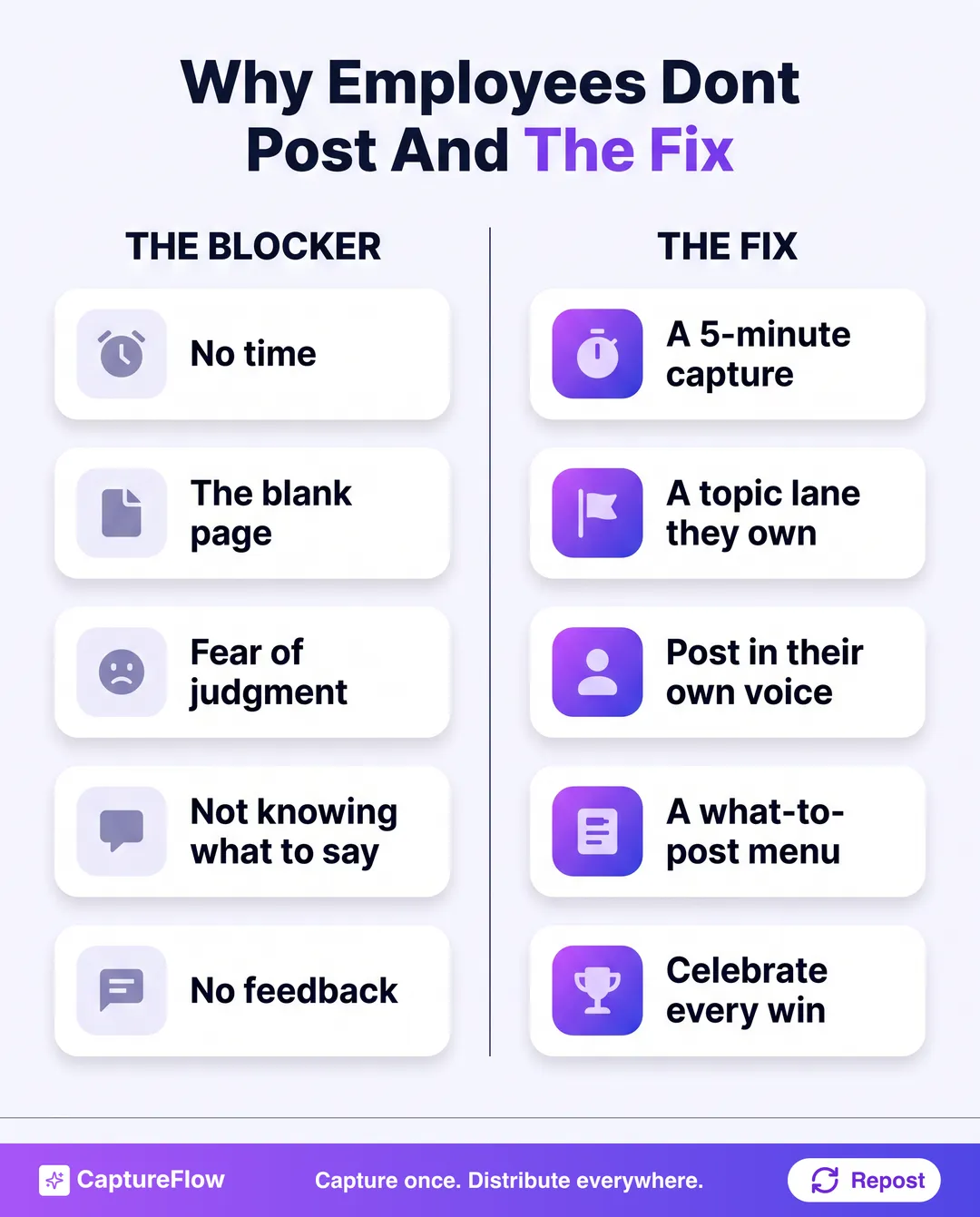 Five blockers, five fixes. None of them is a willingness problem.
Why solving this is worth the effort
Before the how, the why, because activation takes real work and you should know the payoff is large.
Your employees' networks are, on average, about ten times the size of your company page's audience, and their shares are roughly twice as likely to be clicked, according to LinkedIn's own marketing data. You are not adding a small channel. You are unlocking one an order of magnitude bigger than the one you already feed.
And that reach arrives wrapped in trust a brand account cannot buy. The 2026 Edelman Trust Barometer found that "My Employer" is now the most trusted institution at 78 percent, while distant institutions keep losing ground. A person your buyer already follows saying something useful is the most trusted, most native thing in the feed. That is what sits idle every week an activated program does not exist. For the full case, see what employee advocacy is and why it works.
How to activate employees on LinkedIn: the system
You activate employees on LinkedIn by attacking the five blockers directly, in order, and never by turning up the pressure. Here is the whole system before we go step by step.
- Diagnose the blocker, don't push harder.
- Kill the blank page with a defined lane.
- Get the first post out in 5 minutes.
- Hand them a what-to-post menu.
- Turn it into a rhythm, not a chore.
- Celebrate participation, and measure it.
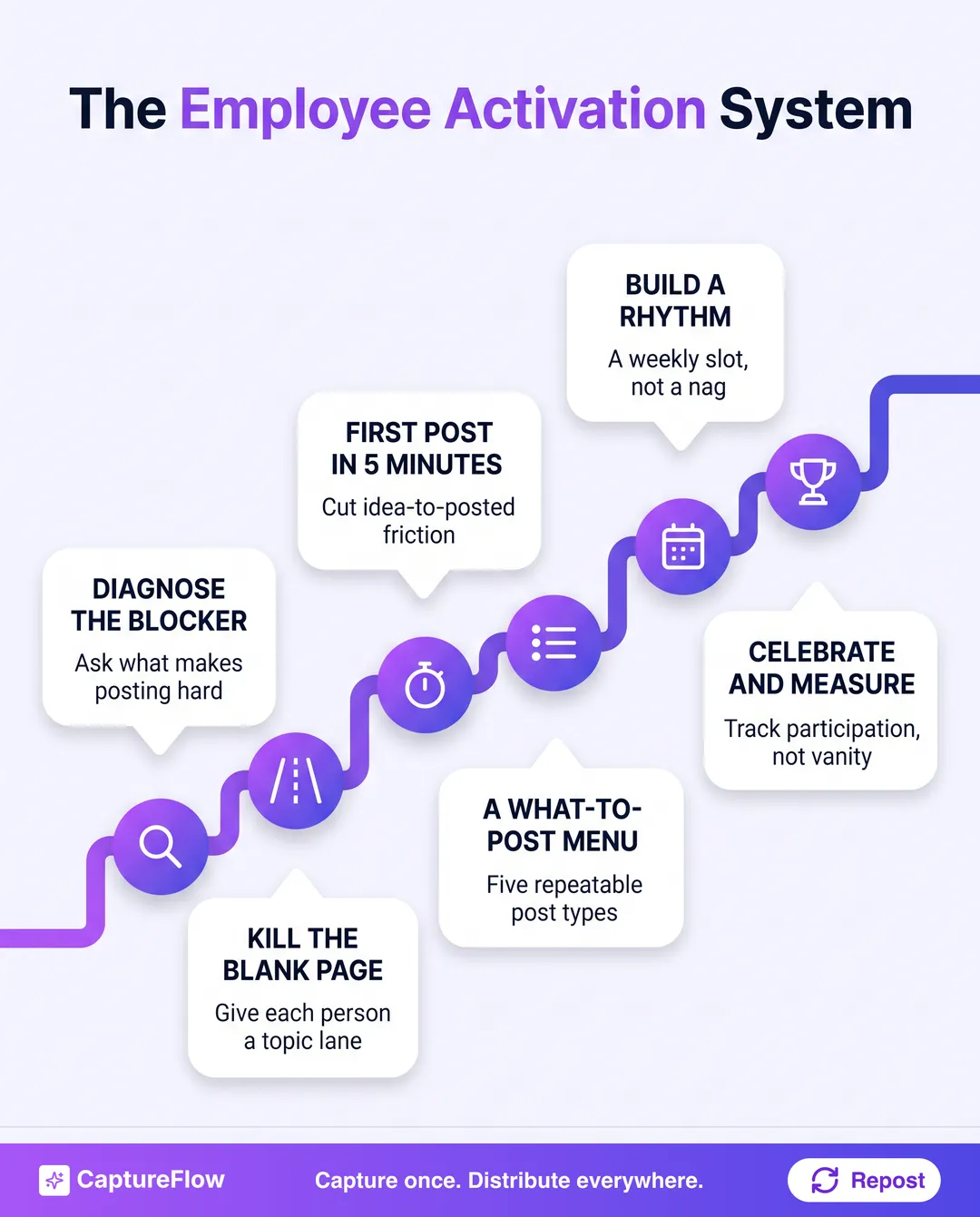 Each step removes one of the five blockers. Work them in order.
Step 1: Diagnose the blocker, don't push harder
Before you send another nudge, find out which of the five blockers is actually stopping each person. Ask them directly: "What is the thing that makes posting hard for you?"
You will get honest answers, and they will differ. The engineer is scared of judgment. The sales lead has no time. The new hire genuinely does not know what would be worth saying. One reminder cannot fix three different problems.
A leaderboard is not activation. Ranking people by post count punishes the exact ones who are blocked and rewards the one who was already going to post. It makes the quiet people quieter.
Step 2: Kill the blank page with a defined lane
The blank page is the single biggest killer, so give everyone a lane. Each person should own two or three topics they are genuinely expert in and expected to talk about.
Your head of product owns the "why we built it this way" stories. Your sales lead owns the objections buyers actually raise. Your engineers own the hard technical trade-offs. When someone knows their lane, "post something" becomes "share a thought about the thing I already think about all day," which is a completely different ask.
Write each person a one-line brief: "You are our voice on onboarding and activation." A defined lane removes the paralysis that kills most people in week one. Vague permission to post about anything is the same as no permission at all.
This is also the boundary between resharing and real employee-generated content: a lane turns employees into creators with a beat, not amplifiers pasting the company line.
Step 3: Get the first post out in 5 minutes
Consistency is a friction problem, not a willpower problem. Every step between "I have a thought" and "it is posted" is a place the program leaks people.
The target is five minutes, start to posted. If contributing takes an employee 30 minutes and a blank document, they will do it twice and quit. If it takes 5 minutes and the hard part is already handled, they keep going.
This is the exact gap an AI content agent is built to close. CaptureFlow is an AI content agent that turns your expertise into weeks of on-brand content for every platform. A team member captures one idea in minutes, a lesson, a customer story, a strong opinion spoken into their phone, and it drafts on-brand posts, carousels, and short video they review and make their own in their own voice, rather than facing an empty box after a full day of real work. You can see how that works, and it is why the tool, not the pep talk, is usually what actually distributes the first post.
Time your most willing contributor from idea to posted, in minutes, with a stopwatch. If your best case is more than five minutes and three tools, fix that before you recruit a single additional person. The friction you tolerate for the eager one will stop the reluctant one cold.
Step 4: Hand them a what-to-post menu
"I don't know what to say" dissolves the moment you show people what a good post actually looks like for them. Give the team a short, standing menu of post types they can pull from any day.
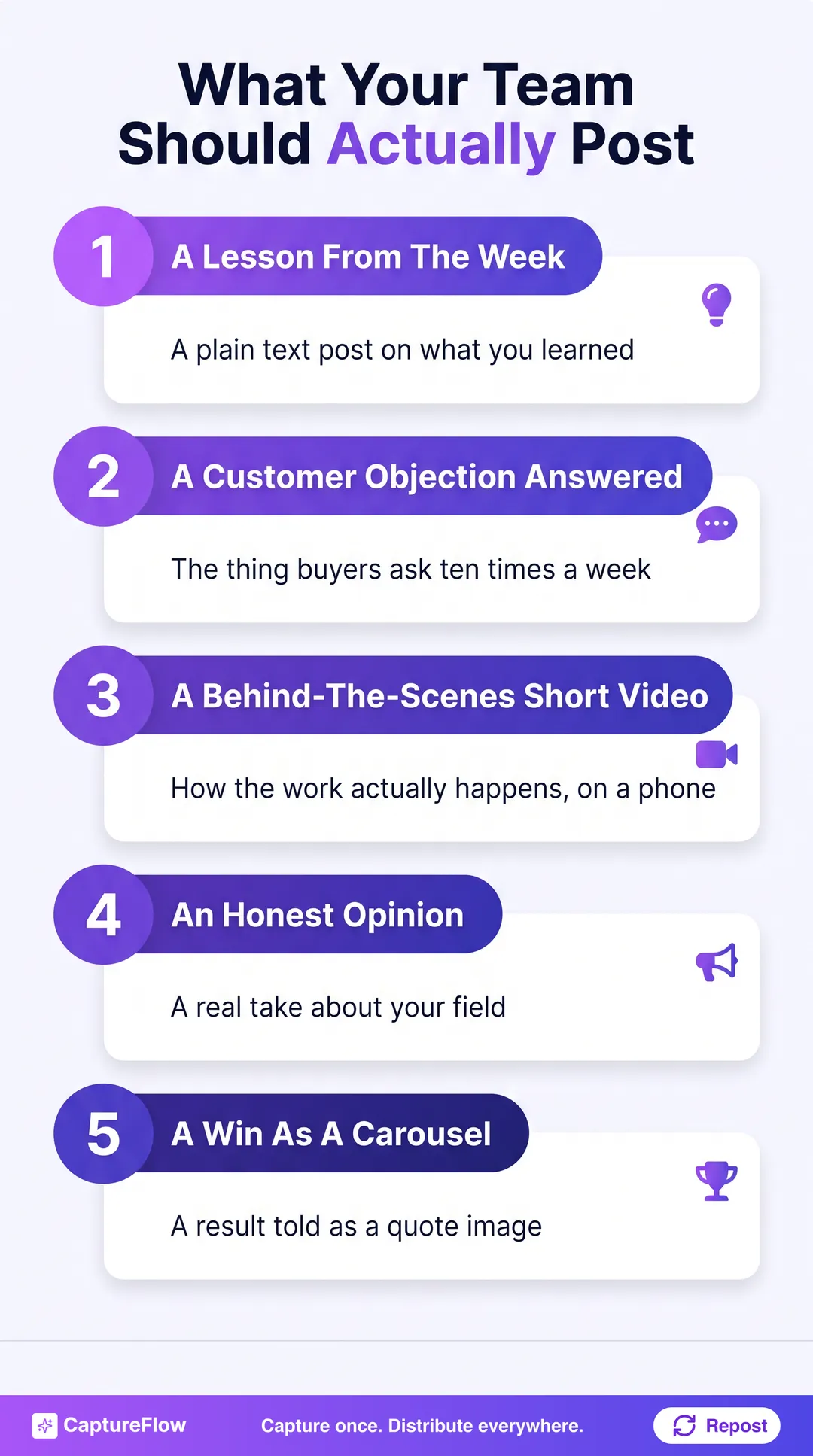 Five repeatable post types. Any one of these is five minutes of work, not a research project.
- A lesson from the week, as a plain text post. What went wrong, what you learned, what you would do differently.
- A customer objection, answered. The thing buyers say ten times a week is a post the tenth buyer wishes they had read first.
- A behind-the-scenes short video. How the work actually happens, filmed on a phone. Native, human, and impossible for a brand account to fake.
- An honest opinion about your field. A real take, not a hot take for its own sake. Expertise reads as expertise.
- A win, told as a carousel or quote image. A milestone, a result, a before-and-after, turned into a scannable visual.
Every one of these draws on what the person already knows. None requires a content calendar or a strategy session.
Step 5: Turn it into a rhythm, not a chore
Habits beat intentions. Pick a light, sustainable cadence, one post a week is plenty to start, and protect it with a rhythm rather than a nag.
A shared 20-minute "post something" slot on Friday works better than scattered reminders. So does a small channel where people drop a rough idea and get a draft back before lunch. The goal is to make posting the default rather than a decision they re-litigate every week.
Reshares warm the room. When a teammate posts, a few colleagues engaging in the first hour gives it real early momentum, which the LinkedIn feed reads as a signal to show it to more people. Build that into the rhythm: post, then support each other's posts.
Step 6: Celebrate participation, and measure it
Feedback is the fifth blocker, and it is the one you control completely. Make the wins visible. When a team member's post drives a demo, a great hire, or just a thread of good comments, say so publicly inside the company.
Then measure the thing that actually reflects activation: participation, not vanity reach. The number that matters is how many people posted this month, and whether that number is climbing. A program where six of ten people post something is healthier than one where a single star carries the whole thing.
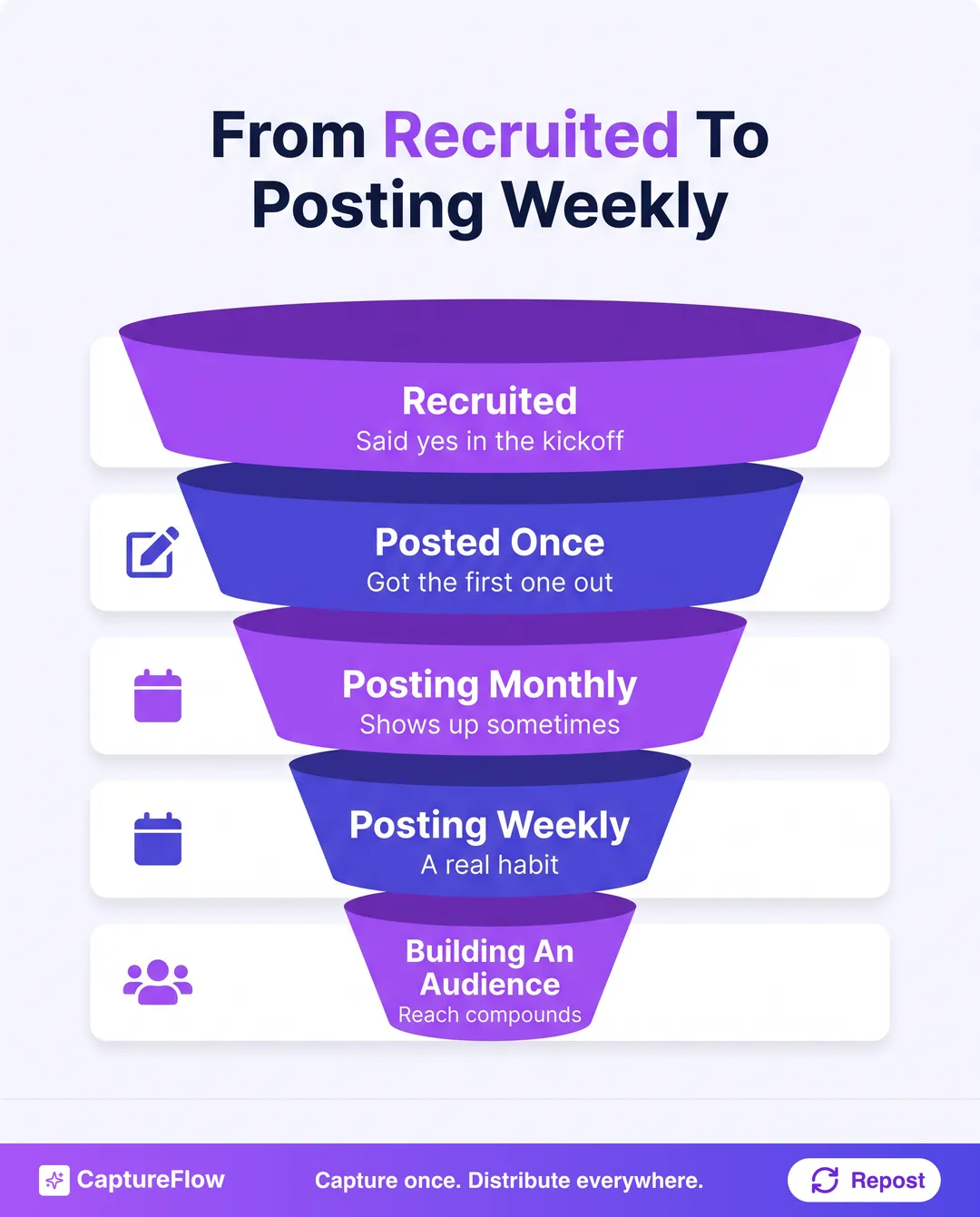 Activation is the work of moving people down this funnel, one stage at a time.
Reach and clicks still matter, and our guide to a good LinkedIn engagement rate covers those honestly. But if you optimize for reach before participation, you will crown your one natural poster and quietly lose the other nine.
The activation ruleEmployees do not need more convincing that posting matters. They need the blank page, the clock, and the fear taken off the table. Remove the friction and the willingness that was already there does the rest.
The move
Getting your team posting on LinkedIn is not a motivation problem you solve with reminders. It is a friction problem you solve by design. Name the blocker, give each person a lane, get the path from idea to posted under five minutes, hand them a menu, build a rhythm, and celebrate participation out loud.
Do that and the reach and trust take care of themselves, because your team's networks already dwarf your page and their voices already carry weight your logo never will. If the bottleneck is giving each person on-brand content they can make their own in five minutes, that is exactly what CaptureFlow is built to do. From there, the best employee advocacy tools covers the software side honestly, and it all sits inside a wider LinkedIn marketing strategy for B2B companies.
Sources
- LinkedIn Marketing Blog, How to Increase Employee Social Sharing for More Organic Reach (employee networks ~10x the company audience; shares 2x more likely to be clicked).
- Edelman, 2026 Edelman Trust Barometer ("My Employer" the most trusted institution at 78 percent).
Frequently asked questions
How do I get my employees to actually post on LinkedIn?+
Remove the friction before you add the pressure. Give each person a defined topic so they never face a blank page, hand them the raw material instead of a script, and get the whole path from idea to posted draft under five minutes. People post consistently when it is easy and they can see it working, not when they are reminded to.
Why won't my team post even though they agreed to?+
Agreeing costs nothing, posting costs time and exposes them to judgment. The usual blockers are no time in a full day, the blank-page problem, fear of saying something wrong in public, genuinely not knowing what to write about, and getting zero feedback when they do post. Each one is fixable, and none of them is about willingness.
What should employees post about on LinkedIn?+
The things only they can say: a lesson from the week, a customer objection they hear constantly, a behind-the-scenes look at how the work actually happens, a genuine opinion about their field, and the occasional win. Give each person two or three lanes they own so posting becomes a reflex, not a research project.
Chris is the founder and CEO of CaptureFlow, which he builds so founders can turn their expertise into content without hiring a team. After 10+ years building products and growing audiences from scratch, he writes about founder-led content, AI, and distribution from inside the problem he is solving: distributing consistent, on-brand content as a team of one.
Founder & CEO of CaptureFlow · 10+ years building products and audiences
One playbook a week from founders who actually create and distribute lots of content. No spam, unsubscribe anytime.
Keep reading

Employee Advocacy Content Ideas: What Your Team Should Post on LinkedIn
Your team is willing to post, they just do not know what to say. Here is the content employees should share on LinkedIn, and how to make it take 5 minutes.

Employee Advocacy Tools vs Letting Employees Post on Their Own
Do you need an employee advocacy platform, or is letting employees post on their own better? The honest answer depends on your size, and mostly on adoption.

What Is Employee Advocacy? The Complete Guide
Your employees' networks are bigger and more trusted than your company page. Employee advocacy is how you put that to work. Here is the complete guide.