Employee Advocacy Content Ideas: What Your Team Should Post on LinkedIn
The content employees should actually post on LinkedIn for B2B reach: 6 idea categories, what to avoid, and how to make posting take 5 minutes.


Your team wants to help. You have told them the company is on LinkedIn, that their posts matter, that advocacy is a priority this quarter. Then they open the compose box, stare at the cursor, and close it.
The blocker was never willingness. It was the blank page. Nobody knows what to actually post.
Employee advocacy content is the posts your team publishes in their own voice about their work, their expertise, and their company, written to inform a peer rather than sell to a prospect. The best of it does not look like marketing at all, which is exactly why it works.
This guide answers the question every advocacy program stalls on: what kind of LinkedIn content should employees share for maximum B2B reach. You have the program and maybe the tools. This is the part in between, the ideas themselves.
What kind of LinkedIn content should employees share for maximum B2B reach?
Before the list, the principle. A post from an employee earns reach when it clears five simple bars.
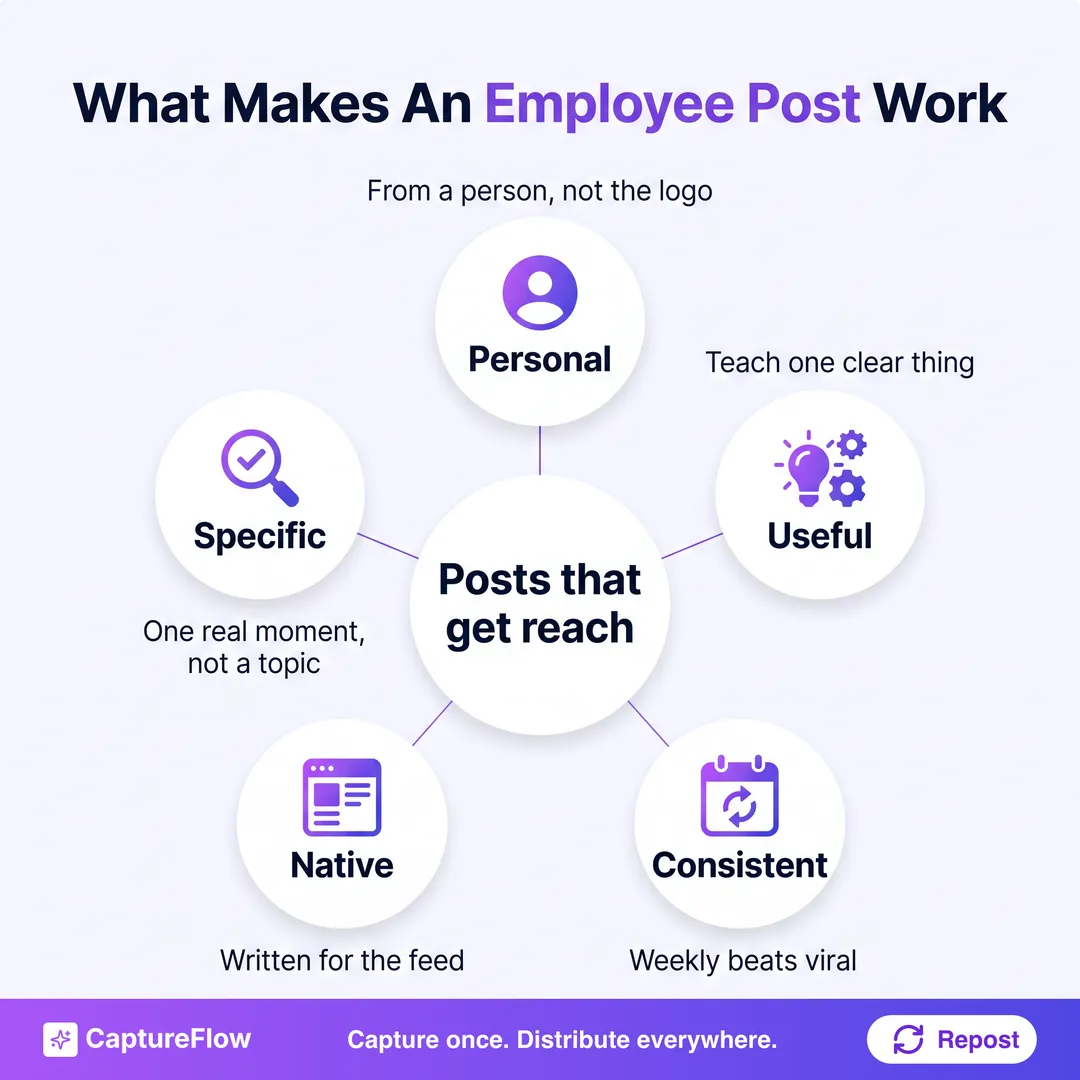
- Personal. It comes from a named human, not the company logo. Buyers extend more trust to a person than to a brand account. The 2026 Edelman Trust Barometer found "my employer" is one of the most trusted institutions there is, and an individual employee inherits that.
- Specific. One real moment, not a topic. "Here are my thoughts on leadership" gets scrolled past. "The hire I almost didn't make" gets read.
- Useful. It teaches one thing a peer can use. Value is what earns the save and the follow.
- Native. It is written for the feed, not pasted from a press release.
- Consistent. A person who shows up weekly compounds. One viral post that is never followed up does not.
The payoff for clearing those bars is real distribution. LinkedIn reports that employee networks are on average about ten times larger than a company's follower base, and that content shared by employees earns meaningfully more engagement and clicks than the same content from the brand page. Your team is a bigger, more trusted channel than your company page, sitting unused.
Six employee advocacy content ideas that actually get shared
Give people categories, not a blank page. These six cover most of what a team should post, and every one of them is sitting in a normal work week.
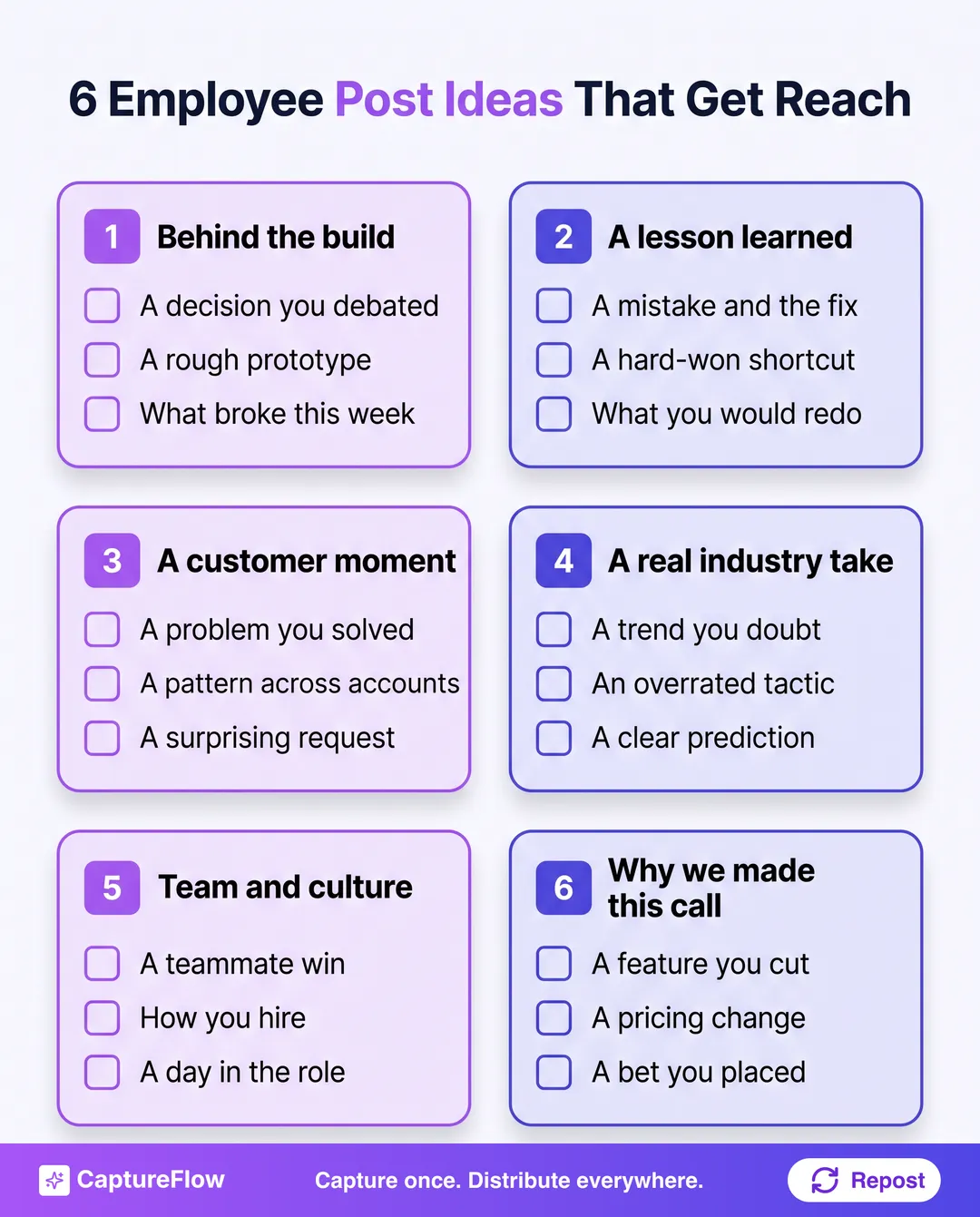
1. Behind the build. The messy middle of the work. A decision the team debated, a rough prototype, the thing that broke this week and how it got fixed. Process is inherently interesting because almost nobody shares it.
2. A lesson learned. Teach what something cost you. A mistake and the fix, a hard-won shortcut, what you would do differently. Lessons travel because the reader gets the payoff without paying the price.
3. A customer moment. Reframe a win as an insight, kept anonymous. A problem you solved, a pattern you noticed across accounts, a request that surprised you. This is the most on-brand content there is, and it never sounds like a sales pitch when it leads with the insight.
4. A real industry take. Say something a reasonable person could disagree with. A trend you doubt, an overrated tactic, a clear prediction. A genuine point of view is the thing people follow a person for.
5. Team and culture. Show the people. A teammate's win, how you actually hire, a day in the role. This carries the double weight of advocacy and recruiting, since candidates read what employees say before they apply.
6. Why we made this call. Explain a decision in the open. A feature you cut, a pricing change, a bet you placed. Transparency reads as confidence, and it teaches your market how you think.
One more that is not on the grid: a reshare with a personal angle. When an employee reposts a company update, the caption should add their own take, not "Great read!" The angle is the whole value. A bare reshare arrives as the brand's voice, one step removed, which is the difference between advocacy and employee-generated content.
Keep a running list of these six prompts pinned where your team already works. Most people are not out of ideas, they are out of ideas in the moment they sit down to post. The prompt in front of them is what turns a blank page into a draft.
What good employee content looks like
The fastest way to teach the difference is to show it. Same company, same week, two very different posts.
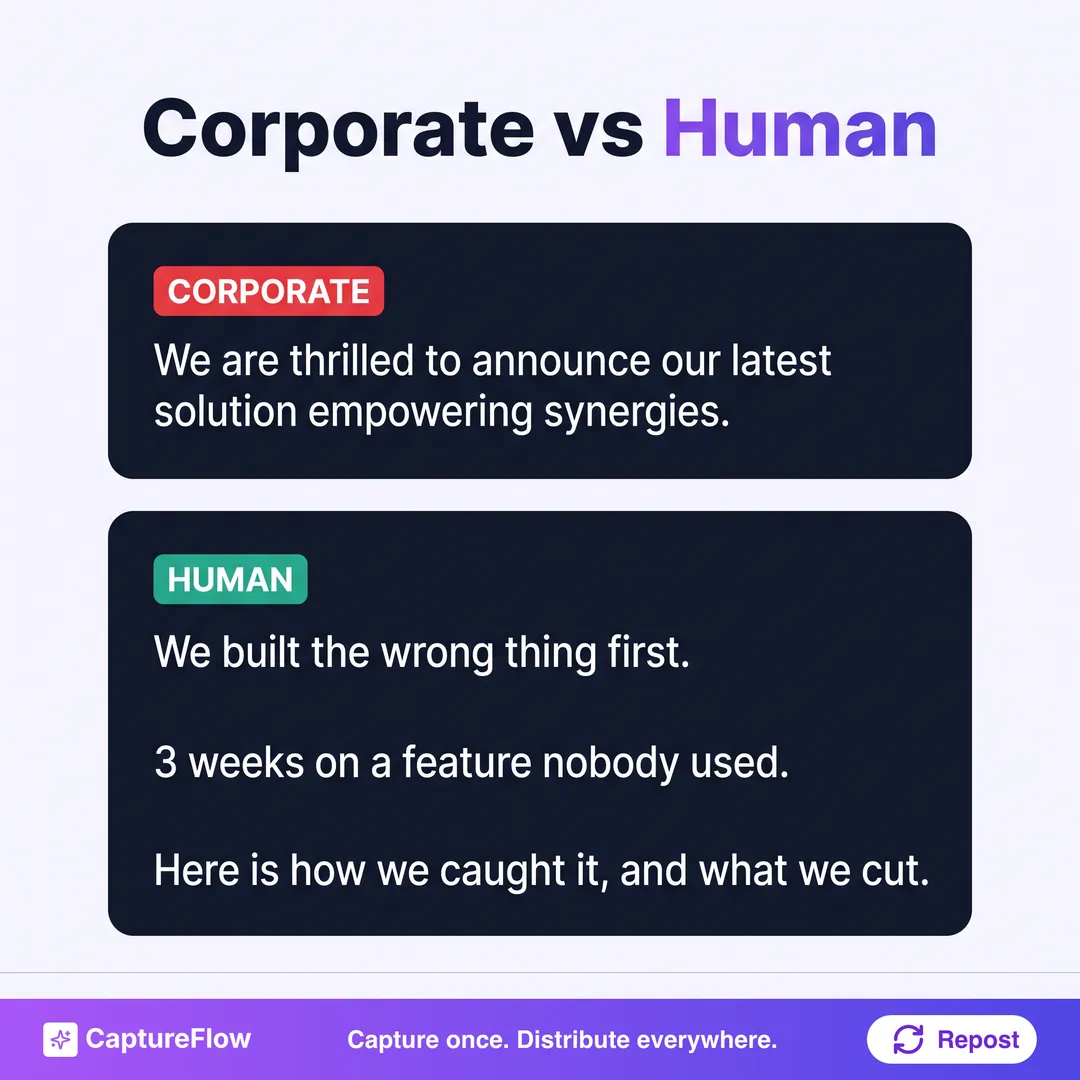
The corporate version is safe, polished, and invisible. The human version admits something, teaches something, and reads like a person you would want to work with. It will out-reach the announcement every time.
What to avoid is the mirror image of the six ideas:
- Sales pitches. If it reads like an ad, it performs like one. Lead with the insight, not the offer.
- Jargon and buzzwords. "Synergies," "solutions," "empowering." Nobody says these out loud.
- Humblebrags with no lesson. A win is only interesting when the reader takes something from it.
- Bare reshares. "Excited to share this!" adds nothing. The personal angle is the point.
The test for any draft: would a person actually say this to a colleague over coffee. If not, cut it.
How to make these posts actually happen
Ideas are the easy half. The hard half is that a good idea still dies if turning it into a finished post takes thirty minutes and a blank page. Get it under five minutes and advocacy stops being a chore.
That is the job an AI content agent does. CaptureFlow is an AI content agent that turns your expertise into weeks of on-brand content for every platform. An employee talks through one of the six ideas as a 5-minute voice note or a few rough lines, and it comes back shaped into a native LinkedIn post in their voice, ready to review and distribute. The idea is theirs. The friction is gone.
The idea is the easy part. Removing the thirty minutes between the idea and the post is what turns willing employees into consistent ones.
Pair the ideas here with a system for actually getting people posting, and you have a program instead of a policy. The employee activation playbook covers the human side, and CaptureFlow's features cover the friction. When you are ready to run it across a team, see pricing.
Your team already has the ideas. They live in every week of real work. If someone wants even more angles to draw from, our LinkedIn content ideas bank goes deep. All you are doing is naming them, and making them a five-minute job to post.
Frequently asked questions
What kind of LinkedIn content should employees share for maximum B2B reach?+
Personal, specific, and useful posts in their own voice, not reshared brand announcements. The highest-reach content is one real moment from their work (a decision, a lesson, a customer pattern) written to teach a peer, because buyers trust a named person far more than a company page and employee networks are much larger than the brand's.
What should employees avoid posting?+
Corporate announcements, sales pitches, jargon, and low-effort reshares with a 'Great read!' caption. These read as marketing and get skipped. The test is simple: would a person actually say this out loud to a colleague.
How do you get employees to post consistently?+
Remove the friction. Give them the idea categories, let them capture a rough thought in a voice note or a few lines, and use AI to shape it into a native post so the whole thing takes about 5 minutes. Consistency dies the moment posting feels like a second job.
Chris is the founder and CEO of CaptureFlow, which he builds so founders can turn their expertise into content without hiring a team. After 10+ years building products and growing audiences from scratch, he writes about founder-led content, AI, and distribution from inside the problem he is solving: distributing consistent, on-brand content as a team of one.
Founder & CEO of CaptureFlow · 10+ years building products and audiences
One playbook a week from founders who actually create and distribute lots of content. No spam, unsubscribe anytime.
Keep reading
How to Get Your Team Posting on LinkedIn: An Activation Playbook
The strategy was fine. The recruiting was fine. Six weeks in, two people post and the rest have gone quiet. Activation is the missing step, and this is the playbook for it.
Employee Advocacy Tools vs Letting Employees Post on Their Own
Do you need an employee advocacy platform, or is letting employees post on their own better? The honest answer depends on your size, and mostly on adoption.

What Is Employee Advocacy? The Complete Guide
Your employees' networks are bigger and more trusted than your company page. Employee advocacy is how you put that to work. Here is the complete guide.