LinkedIn Content Ideas: 50 Posts to Steal When You're Not an Influencer
50 specific, copy-pasteable LinkedIn content ideas organized into 6 buckets, for founders who do not have a personal brand or a content team.


You are not out of things to say. You are out of shapes to say them in.
That is the real problem behind every "what do I post on LinkedIn" spiral. You did not run out of experiences this week. You had a hard conversation, fixed something broken, lost a client, or noticed something everyone in your industry gets wrong. The ideas happened. They just never got filed anywhere, so by Thursday they feel like nothing, and you open a blank post box and freeze.
This is a list of 50 LinkedIn content ideas built to fix that, organized into 6 buckets so you can find the shape that fits whatever happened to you this week. Not generic prompts like "share a tip." Specific, copy-pasteable starting points you can fill in with your own details in the next 5 minutes.
A good LinkedIn content idea is not a topic, it is a specific moment, opinion, or process turned into a shape you can write in one sitting. "Share a lesson you learned" is a category. "The client I almost fired on a Tuesday, and what her one email taught me about pricing" is an idea. That difference is the whole gap between a blank box and a post half-written in your head before you sit down.
I run CaptureFlow, so this is my daily work. CaptureFlow is an AI content agent that turns your expertise into weeks of on-brand content for every platform. But the ideas below do not require a tool, they require 5 minutes and a little honesty about what actually happened this week.
Why "content ideas" isn't really your problem
Most people who say they are out of LinkedIn content ideas are actually out of specific ones. They have plenty of topics: leadership, growth, their industry, their product. What they lack is a single, small, true moment attached to any of them, and topics without moments read like a memo. Nobody stops scrolling for "here are my thoughts on leadership." That specificity is not a nice-to-have, it is the difference: it is exactly what content grows a personal brand fastest instead of blending into the feed.
The fix is not more topics, it is narrowing every idea down to a scene, a number, or an opinion you actually hold.
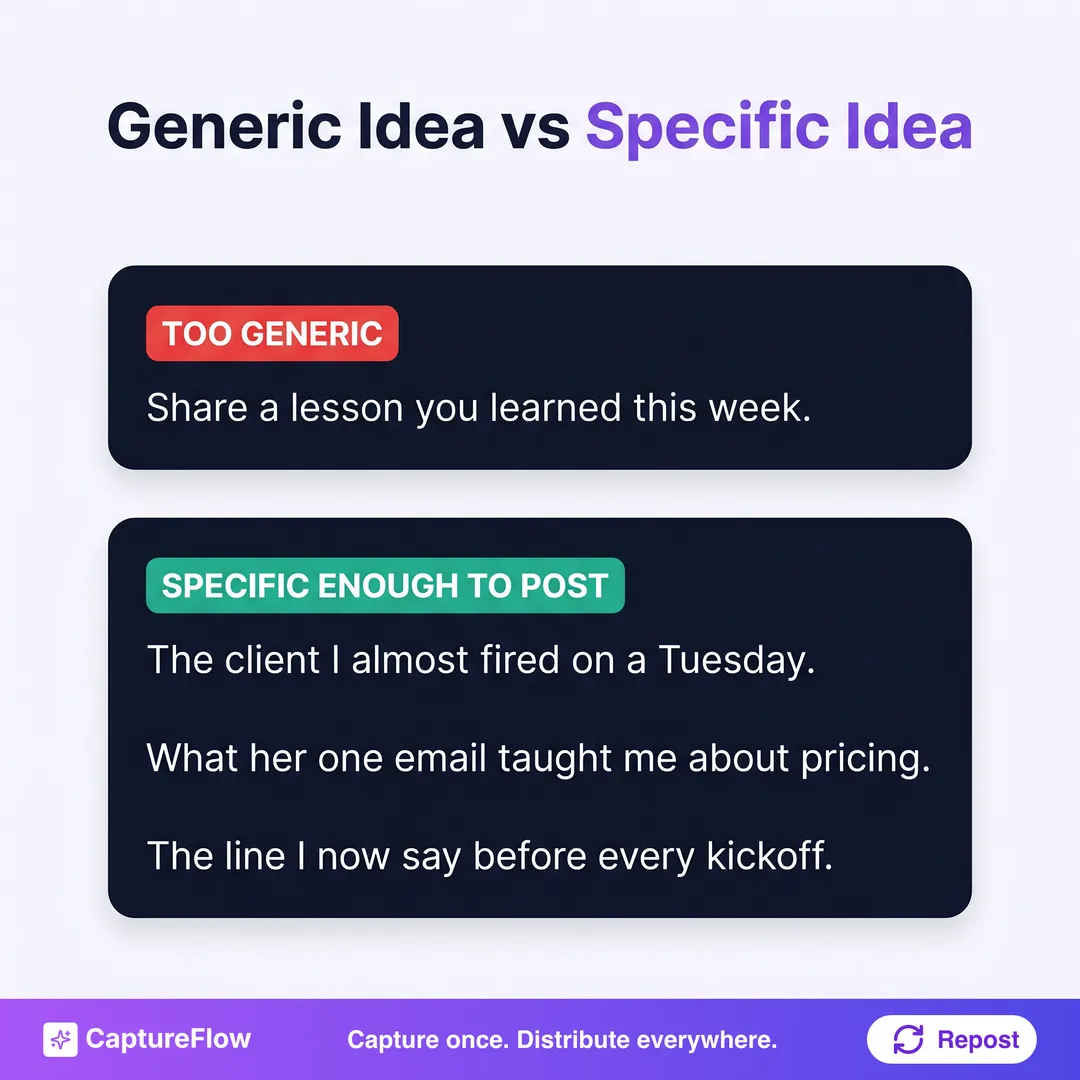 Same underlying week, two different posts. Only one of them is finishable in 5 minutes.
A fast test for whether an idea is specific enough: could you write the first line right now, from memory, without opening a document? If yes, it is a post. If you need to "think about how to phrase it," it is still a topic.
The 6 buckets these LinkedIn post ideas for founders live in
Every one of the 50 ideas below sorts into one of six buckets: lessons learned, contrarian takes, behind-the-scenes proof, customer stories, teardown and how-to, and personal reckoning. These are not buckets we invented. We build teardowns of real LinkedIn accounts at /playbooks, and the same six shapes show up behind creators with six- and seven-figure followings, just written in their own voice.
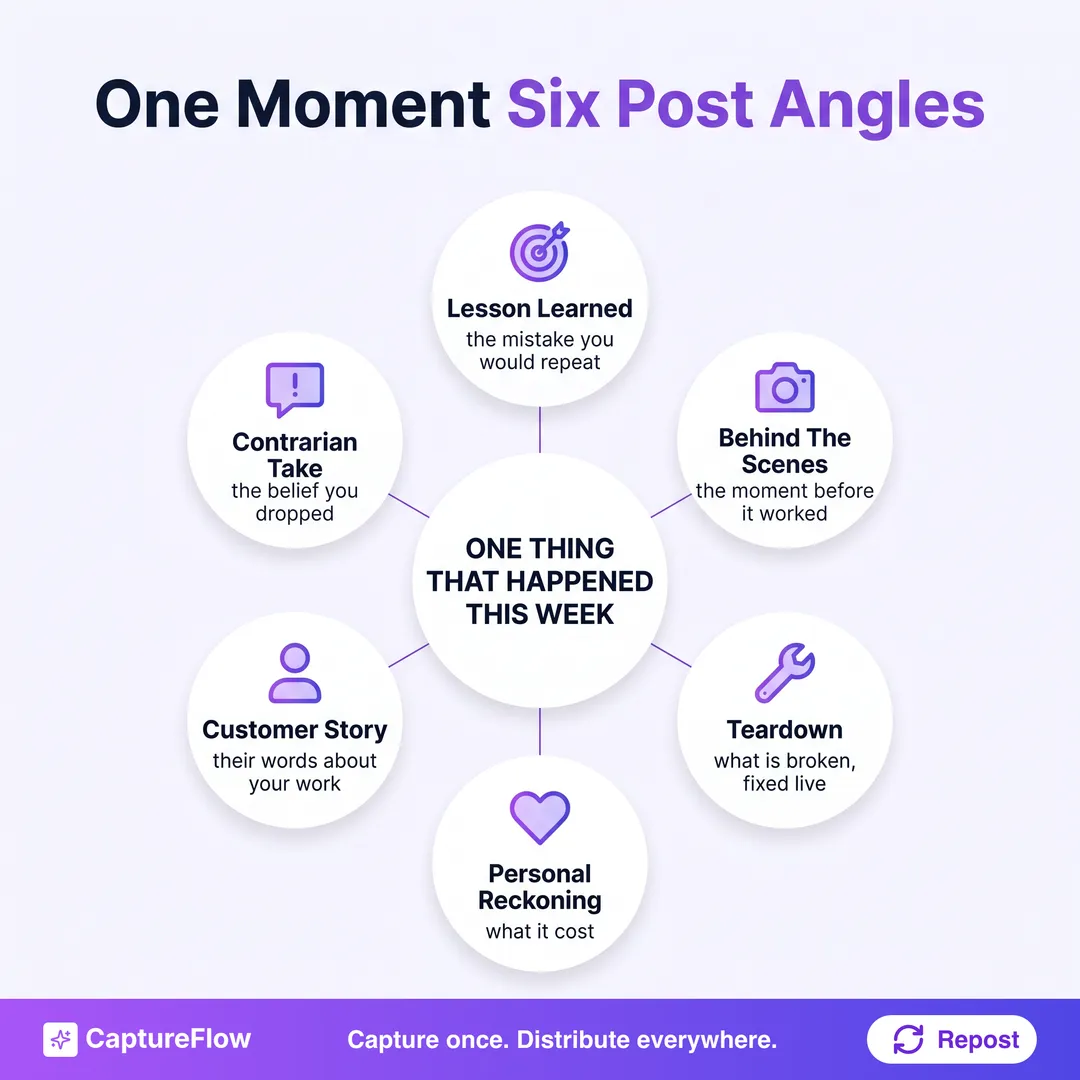 The same Tuesday can become six different posts, depending on which bucket you write it through.
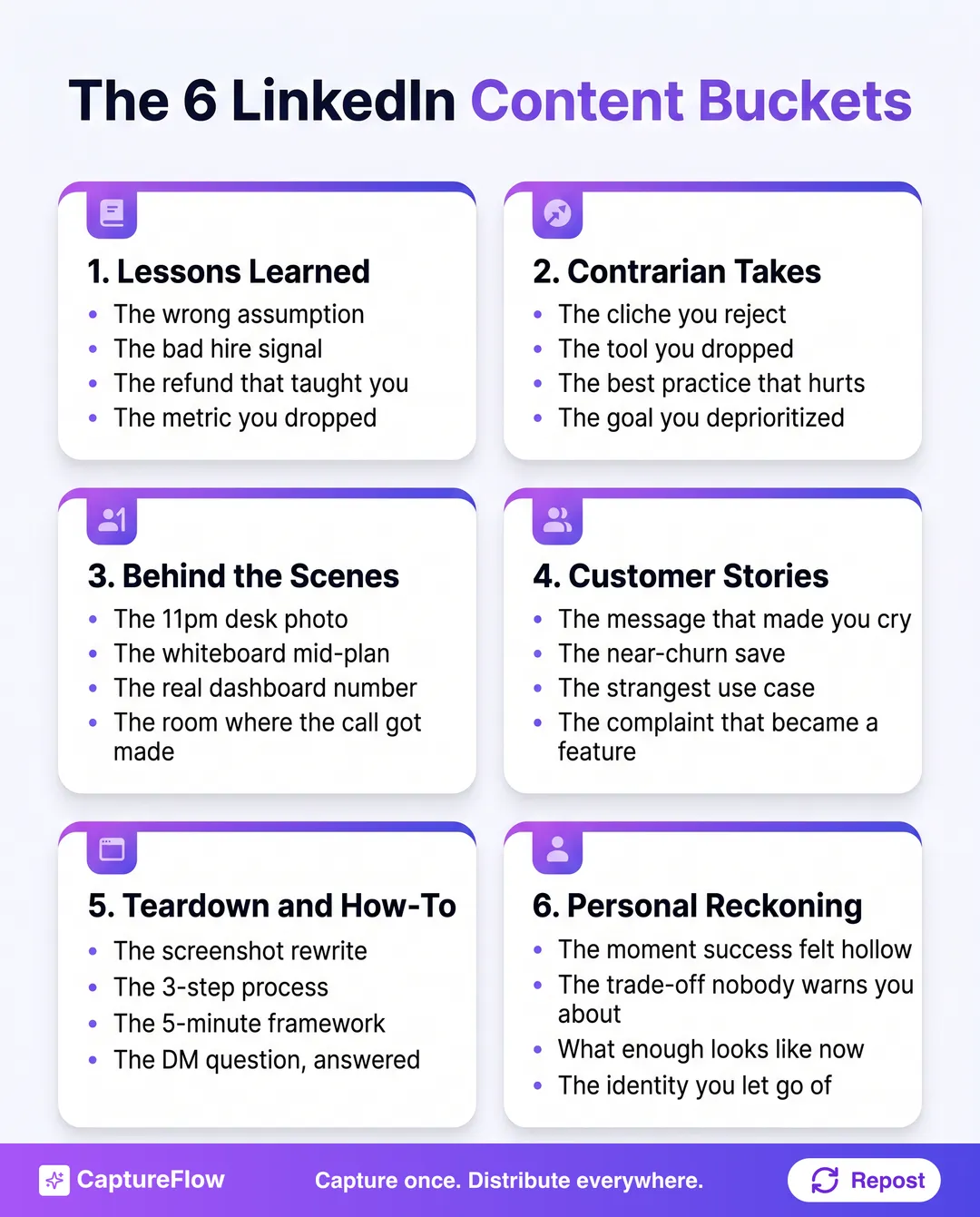 Six buckets, one moment each week. Pick whichever fits what actually happened.
Bucket 1: Lessons learned and near-misses
This is the easiest bucket to start in, it just needs an honest account of something that almost went wrong. Katelyn Bourgoin built her audience on exactly this kind of radical honesty: our teardown of Katelyn Bourgoin's playbook shows how her confessional, buyer-psychology posts consistently outperform her polished ones.
- The wrong assumption about your customer: the thing you believed about who buys from you, and the exact moment you found out you were wrong.
- The feature nobody asked for: what you built because you assumed it mattered, what actually happened when you shipped it, and what you would build instead now.
- The hire you almost made: the resume detail or interview answer that almost got past you, and the one thing that made you pause.
- The price increase you were scared to send: the email you rewrote five times, and what actually happened after you hit send.
- The metric you used to obsess over: the number you tracked religiously for months, and the moment you realized it was a vanity metric.
- The advice you ignored: what a mentor or investor told you, why you brushed it off, and how long it took you to admit they were right.
- The refund that taught you more than the sale: what the customer said when they asked for their money back, and what you changed because of it.
- The pitch that failed: the exact line in the deck or the call where you lost the room, reconstructed honestly.
Bucket 2: Contrarian takes
A contrarian take is not being difficult for attention, it is naming the belief your industry repeats and explaining why you stopped believing it. Our teardown of Dan Koe's playbook shows how his point-of-view essays work: he builds the entire post around defending one clear, ownable stance.
- "Everyone in [your industry] says X. Here is why that's backwards": name the cliché advice you hear at every conference, then argue the opposite from your own experience.
- The popular tactic you deliberately stopped doing: the thing every "expert" tells founders to do, and why you quietly dropped it.
- The overrated tool or practice: name the thing your peers rave about that you think is a waste of time or money, and say why.
- The "best practice" that actually hurts customers: the industry-standard move that looks good internally but is bad for the people you serve.
- Why the goal everyone chases is the wrong goal: pick a metric your industry worships (growth, followers, funding) and argue for a better one.
- The unpopular opinion about your own customers: something true about the people who buy from you that nobody in your industry says out loud.
- The thing everyone in your niche does that you refuse to do: and what you do instead, with the reasoning.
- Why the move everyone fears is actually the safe one: niching down, raising prices, saying no to a big client, whatever the "risky" move was that turned out to be the smart one.
- The framework you were taught that you now think is wrong: the rule you followed for years before you figured out it did not hold up.
Bucket 3: Behind-the-scenes proof
These posts trade on being real, not polished. Codie Sanchez built a huge following on short, plain captions under unpolished photos. Our teardown of Codie Sanchez's playbook shows how a single sentence under a real photo consistently beats a paragraph with no image at all.
The pattern behind every behind-the-scenes post that worksA blurry photo with one honest sentence beats a polished graphic with none. Proof is not about production value, it is about being willing to show the unfinished part.
- The desk photo at 11pm: whatever you were actually working on late, with one line of honest context, no polish.
- The whiteboard mid-plan: a photo of the messy plan before it was a clean deck, captioned with what changed between that photo and the final version.
- The real dashboard number: a screenshot of an actual metric (blur what needs blurring) with one line on why that number mattered that week.
- The room where the hard call got made: describe where you were, physically, when you made a decision that mattered, and what the room looked like.
- The exchange that led to a big decision: an anonymized excerpt from a Slack thread, email, or text that shows the actual reasoning behind a call you made.
- The product mid-build: a photo or screen recording of the thing before it looked finished, with a caption on what was still broken.
- The day something almost fell apart: a photo from a real day at work, captioned with what was actually happening off-camera.
- The thing you almost quit over: a photo of the moment or the object tied to your lowest point that quarter, told plainly.
Bucket 4: Customer stories
Customer stories work because they let someone else's words carry the proof, which reads as far more credible than you describing your own product. The goal is specificity: their actual words, not your summary of them.
- The message you still have saved: quote, verbatim, the customer note that made you tear up, laugh, or rethink something about your product.
- The customer who almost churned: what they said when they asked to cancel, what you asked in response, and what changed their mind.
- A real before-and-after: with permission, walk through one customer's actual result in specific numbers or specific language, not "great results."
- The strangest way a customer uses your product: the use case you never designed for, that someone found anyway.
- The complaint that became your best feature: the exact frustration a customer raised, and the feature it turned into.
- A day in the life of your ideal customer: told through one real problem a real customer had this week, not a persona you invented.
- What a customer taught you about your own product: the moment someone explained your own offer back to you in a way you had never said it.
- The objection you hear most, answered for one person: take the pushback you get in every sales call and answer it as if writing to the one person who asked it last.
- The referral you did not expect: who sent you a customer, what they told that person about you, and what it taught you about how your best buyers actually describe your product.
Bucket 5: Teardown and how-to
Jess Ramos built her audience teaching her niche in public, breaking down real examples instead of speaking in generalities. Our teardown of Jess Ramos's playbook shows how naming the exact thing that is broken, then fixing it live, outperforms abstract advice.
- Screenshot teardown: take a real landing page, post, pitch deck slide, or email (yours or a public example) and mark up exactly what is wrong and how you would fix it.
- The exact process you use for one task: the 3 to 5 steps you actually follow for something specific, not a vague "here is my process" post.
- A before-and-after rewrite: show the weak version of something (a headline, a cold email, a bio) next to your rewritten version, with the reasoning.
- The 5-minute framework for one decision: the mental checklist you run through to decide something specific, laid out as steps.
- The most misunderstood skill in your field: pick one thing people in your industry get wrong constantly, and explain the correct version simply.
- A mini glossary: 3 to 5 terms in your industry that people misuse, defined the way you actually use them.
- The checklist you personally run before you ship: the exact list you go through before publishing, launching, or sending something out.
- Teach the thing you get asked about most in DMs: whatever question keeps landing in your inbox, answer it publicly instead of one more time in private.
If you are staring at one of these ideas and cannot find the angle, our free content idea generator will turn your niche into 10 specific, ready-to-use ideas in seconds, a faster way to fill this bucket when you are stuck.
Bucket 6: Personal reckoning
Justin Welsh's entire account runs on this bucket: reframing ambition and money around the life it is supposed to buy, backed by a real proof point from his own story. Our teardown of Justin Welsh's playbook shows how one honest reckoning, repeated in new forms, built one of LinkedIn's largest solopreneur followings.
- The moment success did not feel the way you expected: the specific day or milestone that should have felt bigger than it did.
- What you would tell yourself on day one: one real piece of advice for the version of you that started this, not generic wisdom.
- The trade-off nobody warns founders about: the thing you gave up that nobody mentions in the highlight reel.
- The year that looked good on paper and felt terrible in reality: the specific year, the specific numbers, and what was actually happening underneath them.
- Why you turned something down: the money, opportunity, or client you said no to, and what you chose instead.
- What the thing you are proud of actually cost: the honest ledger, health, a relationship, a friendship, behind one visible win.
- What "enough" looks like for you now: the number or milestone that used to feel like the finish line, and what replaced it.
- The identity you had to let go of: the version of yourself (the hustler, the perfectionist, the person who never says no) you had to retire to get here.
Turning any of these into an actual post
Picking the idea is most of the work. The rest is a shape: a sharp first line, short lines, one point, and a real question instead of a hard sell. We cover that shape in how to write a LinkedIn post that gets engagement, and the opening line alone in how to write LinkedIn hooks.
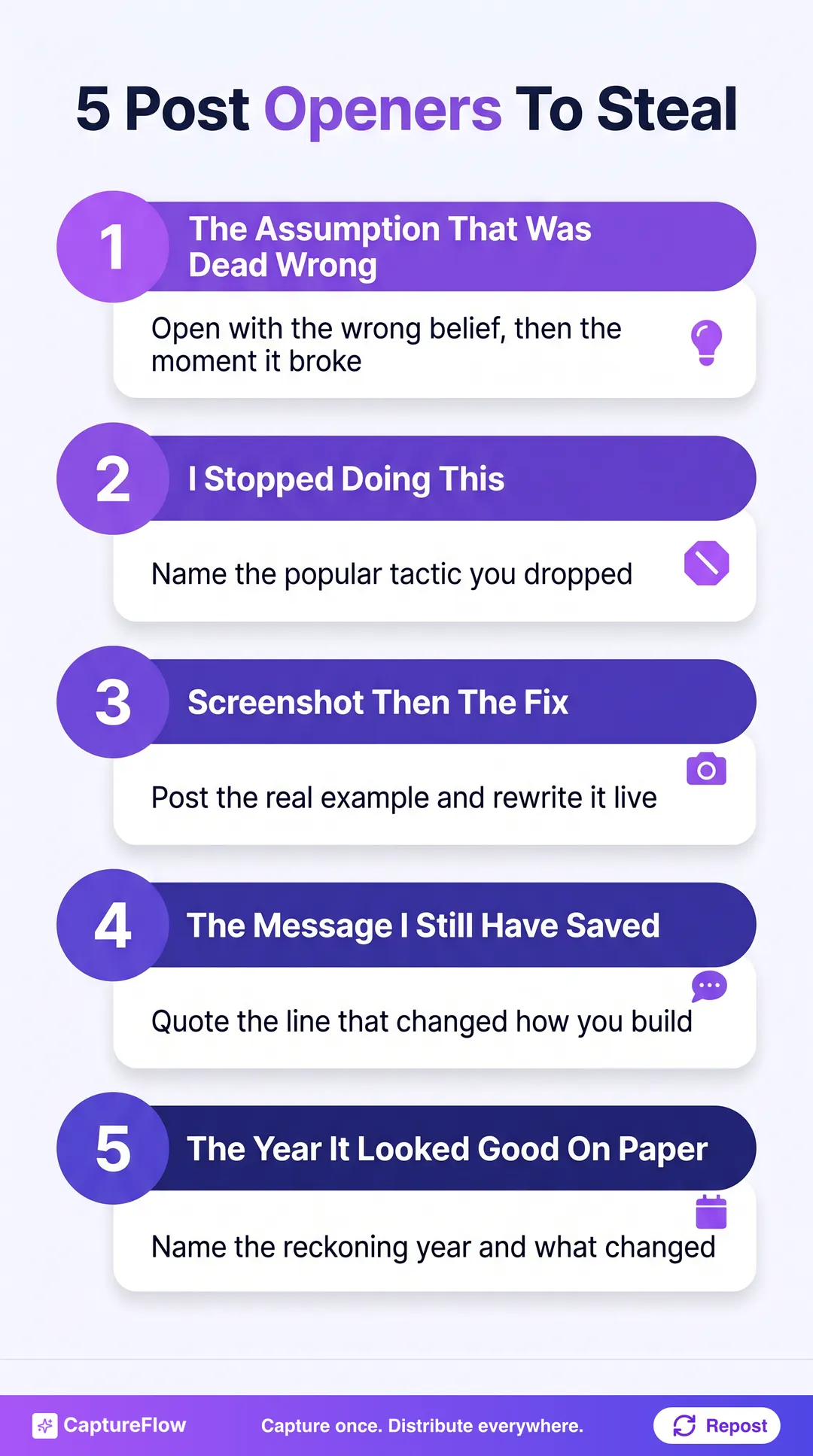 Five first lines, one for each of the buckets above. Swap in your own specifics.
Whichever idea you pick, the fastest way to see it as a post instead of a paragraph in your head is to write the first line first. If that line alone does not make you want to keep reading, the idea probably is not specific enough yet, go back and find the smaller, truer version of it. Stuck on the line itself, not just the idea? Our free hook generator will turn any of the 50 ideas above into 10 opening lines in seconds, one per style, so you edit instead of stare.
If you want the whole system, not just the ideas, our LinkedIn content strategy guide covers positioning, pillars, and cadence end to end.
Pick one and post it today
You do not need all 50 of these. You need one, from whichever bucket matches something that actually happened this week, written down before it stops feeling like "nothing worth posting."
That is the whole trick behind a LinkedIn that never seems to run dry: writing the specific version down the day it happens, instead of waiting for a topic to feel big enough. Pick a bucket, pick a moment, post it.
Or skip the blank box: start a free trial and let your content agent turn one idea into a week of on-brand posts while you approve them.
Frequently asked questions
What should I post on LinkedIn if I feel like I have nothing to share?+
You almost certainly have something, it is just filed under 'not interesting enough' in your head. Pick one bucket from this list (lessons learned is the easiest place to start), then write down the most specific, smallest version of a moment that fits it. Specific beats interesting every time.
How many LinkedIn content ideas do I actually need to stay consistent?+
Fewer than you think. Six to eight ideas, one from each bucket in this list, is enough to post two to three times a week for a month. The goal is not a stockpile, it is a system: one real moment a week, reshaped through a bucket, becomes a post.
What is the difference between a content idea and a hook?+
The idea is what happened or what you believe, the hook is the first line that makes someone stop scrolling to read it. 'The client I almost fired' is the idea. 'I fired my best client on a Tuesday' is the hook. Our guide on how to write LinkedIn hooks covers that second step in detail.
Do I need to be an influencer or have a big following for these ideas to work?+
No, and that is the point. Every idea in this list is built from a real moment in your work, not a persona. Founders with 500 followers post the exact same 6 shapes as founders with 500,000, they just have not always been told the shapes are ideas worth writing down.
Chris is the founder and CEO of CaptureFlow, which he builds so founders can turn their expertise into content without hiring a team. After 10+ years building products and growing audiences from scratch, he writes about founder-led content, AI, and distribution from inside the problem he is solving: distributing consistent, on-brand content as a team of one.
Founder & CEO of CaptureFlow · 10+ years building products and audiences
One playbook a week from founders who actually create and distribute lots of content. No spam, unsubscribe anytime.
Keep reading

What Drives LinkedIn Engagement: 2,500 Posts Analyzed
We pulled the public LinkedIn history of 25 founders, 2,500 posts in total, to build our playbook teardowns. The engagement pattern hiding in that data surprised us.

LinkedIn Content Strategy: The Complete 2026 Guide
Most founders post on LinkedIn at random and wonder why nothing compounds. This is the complete LinkedIn content strategy, from positioning to pillars to cadence to tooling.

How to Make a Scroll-Stopping LinkedIn Carousel in 2026
A LinkedIn carousel is the highest-dwell format in the feed. Here is how to make one that earns the swipe, from one idea to a finished PDF.