Employee Advocacy Tools vs Letting Employees Post on Their Own
Employee advocacy tools vs letting employees post on their own: which works better? An honest decision framework by company size, cost, and adoption.

You have decided employee advocacy is worth doing. Good. Now comes the question the vendors gloss over: which actually works better, employee advocacy tools, or letting employees post on their own?
It is a real fork, and the honest answer is not the one a platform's sales deck gives you. Both can work. Both can also fail quietly, one by burning budget on a tool nobody opens, the other by never getting off the ground because posting stays hard.
The choice between employee advocacy tools and letting employees post on their own is really a choice about how you solve adoption, because a program only works if people actually post. Everything else, the reporting, the leaderboards, the curated feeds, is secondary to that one thing.
This is a different question from build vs buy. If you are weighing a paid platform against building a program in-house, our employee advocacy software vs in-house breakdown is the companion piece. This one is narrower: given that you want advocacy, do you run it through a tool, or just let people post?
What each option actually is
An advocacy platform gives you a curated feed of approved posts, a way for employees to reshare them in a click, and analytics: reach, clicks, a leaderboard of who posted. It is a coordination layer. You can see our honest ranking of them in best employee advocacy tools.
Letting employees post on their own means no shared queue. People post from their own profiles, in their own words, about their own work. You support them with a bit of enablement (topics, examples, maybe a tool that drafts the first version), but the post is theirs, not the company's.
Neither is automatically right. Here is how they stack up.
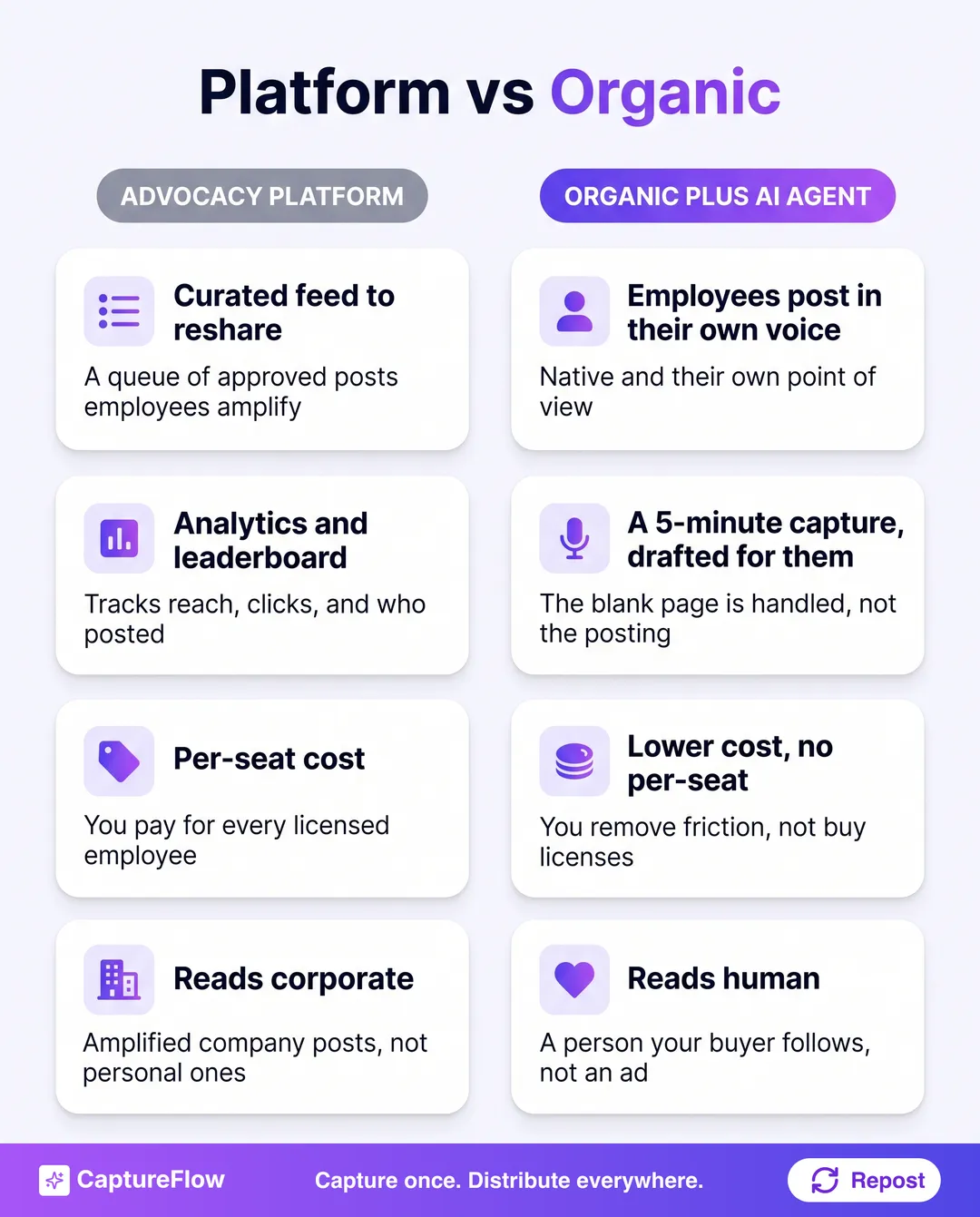 The platform buys you coordination and reporting. Organic buys you trust and a lower bill.
Where a platform genuinely wins
Let me be fair to the tools, because they are good at real things.
At scale, coordination is hard. When you have three hundred people across five regions and legal wants sign-off, a leaderboard, and an audit trail, a platform earns its keep. It gives you approval workflows, compliance controls, and reporting a spreadsheet cannot match. If your advocacy is a formal program with a headcount attached to it, that infrastructure is worth paying for.
Platforms also lower the very first barrier. One click to reshare is genuinely easy, and for a reluctant employee who will never write their own post, one click is better than zero.
So if you are a larger enterprise with compliance needs and a program manager, a platform is a reasonable call. Do not let anyone talk you out of the tool that fits your size.
Where letting employees post on their own wins
Now the other side, and it is the side most B2B companies underrate.
The whole reason advocacy works is trust. In the 2024 Edelman-LinkedIn B2B Thought Leadership Report, 73 percent of decision-makers said an organization's thought-leadership content is a more trustworthy way to judge it than its marketing. And the 2026 Edelman Trust Barometer puts "my employer" among the most trusted institutions, at 78 percent. That trust lives in a person, not a corporate feed.
Here is the catch. A queue of pre-approved posts that fifty people reshare word for word does not read like fifty people. It reads like one company post, fifty times. The feed notices. Your buyer notices. You get reach without the trust, which is the expensive half.
A post in someone's own voice does the opposite. It is native, it carries their point of view, and it lands in their personal network, which is usually far larger and warmer than the company page, and drives meaningfully more engagement, according to LinkedIn's own data. You give up the tidy leaderboard. You keep the thing that actually converts.
The trade in one lineA platform optimizes for who posted. Organic optimizes for whether anyone believes it. Only one of those closes deals.
The decision, by company stage
There is no universal answer, but there is a pattern by size.
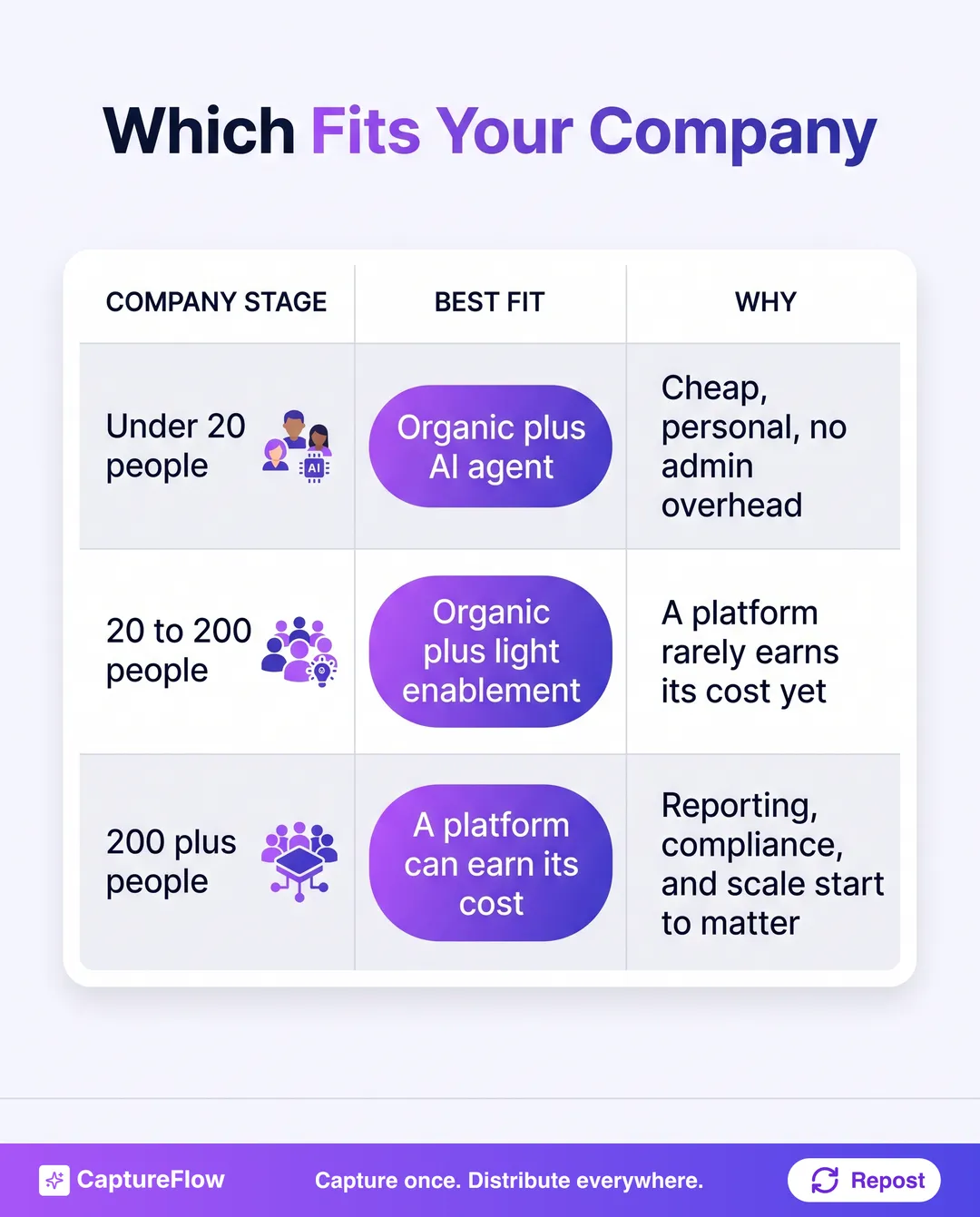 Smaller teams win on personal and cheap. Platforms start to pay off where scale and compliance kick in.
- Under 20 people. Let people post on their own, full stop. A platform is overkill, the per-seat cost is hard to justify, and your advantage is that your team is close enough to sound like real humans. Add a tool that drafts posts, not a tool that queues them.
- 20 to 200 people. Still organic, with light enablement. Give people topics and remove the writing friction. A platform rarely earns its cost at this stage, and the corporate-reshare feel starts to hurt you.
- 200 plus. Now a platform can pay off. Reporting, compliance, and coordinating that many contributors are genuine problems, and a tool solves them. Even here, protect the personal voice, do not turn everyone into an amplifier.
The cost nobody puts in the deck
When you price a platform, you see the per-seat number. That is not the real cost.
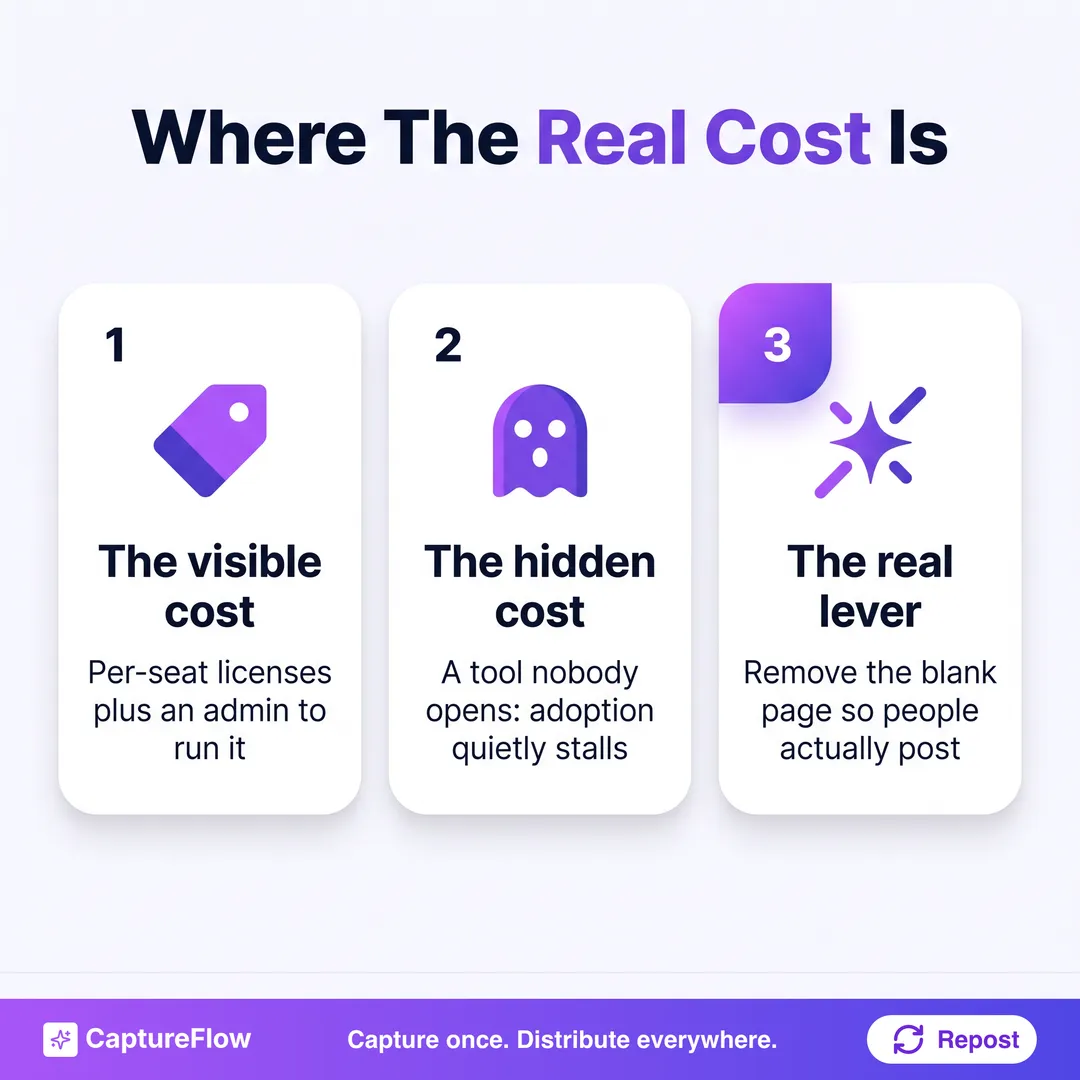 The license is the number you see. Adoption is the number that decides whether any of it worked.
The visible cost is per-seat licenses plus an admin to run the thing. The hidden cost is worse: a tool people register for and never open. That is the classic advocacy failure, and it is expensive precisely because it looks fine on paper while producing nothing.
The real lever sits underneath both options. People do not skip posting because they lack a queue. They skip because the blank page is hard and their day is full. Remove that, and adoption follows, tool or no tool. Our employee activation playbook goes deep on exactly this.
Where CaptureFlow fits
CaptureFlow is an AI content agent that turns your expertise into weeks of on-brand content for every platform. It is not an advocacy scheduler, and it does not replace one. It solves the part that actually stalls advocacy: the blank page.
An employee talks for 5 minutes, a rough idea, a customer story, a strong opinion into their phone, and it comes back as a post in their own voice that they review and distribute. Not a company line to amplify. Their take, made easy. That works whether you run a platform on top or let people post on their own, because it attacks adoption, which is the real bottleneck either way. This is also the line between resharing and genuine employee-generated content: one amplifies the company, the other turns employees into creators.
Before you buy anything, time your most willing employee from idea to posted. If it takes 30 minutes and a blank doc, no platform will fix your adoption problem, and if it takes 5 minutes, you may not need the platform at all.
A 30-day test before you buy anything
Here is the move if you are genuinely torn. Do not buy first. Run organic for 30 days, then decide with real numbers instead of a demo.
Pick five to ten willing people. Give each a lane (two or three topics they own) and a fast way to draft a post, so the blank page is gone. Ask for one post a week. That is it. No platform, no leaderboard, no seats.
At the end of the month, look at two things. Did people actually post, week after week? And did anything come back, comments, replies, a DM that turned into a call? If participation held and the replies started, you have your answer, and you did not spend a cent on licenses to get it.
If it stalled even at ten willing people, a platform will not save you. The problem is upstream, in supply and friction, and that is what to fix next. If it worked and you now want reporting and scale across hundreds of people, that is the moment a platform earns its cost. You will be buying it to scale something that already works, which is the only good reason to buy one.
The bottom line
Employee advocacy tools vs letting employees post on their own is not really a tools question. It is an adoption question wearing a tools costume.
If you are large, regulated, and coordinating hundreds of people, buy the platform and protect the personal voice inside it. If you are anyone smaller, let people post on their own and spend your money removing the blank page, not buying seats. Either way, the program lives or dies on whether people actually post, so put your effort there.
See how CaptureFlow works, or if you are weighing the spend, the pricing is built around removing that friction, not licensing seats.
Sources
- Edelman and LinkedIn, 2024 B2B Thought Leadership Impact Report (73 percent trust thought leadership over marketing).
- Edelman, 2026 Trust Barometer ("my employer" among the most trusted institutions, 78 percent).
- LinkedIn, What is employee advocacy (employee networks and engagement vs the company page).
Frequently asked questions
Do I need an employee advocacy tool, or can I just let employees post on their own?+
For most companies under a few hundred people, letting employees post on their own, with light enablement to remove the blank page, works better and costs less. A dedicated platform starts to earn its cost once you need formal reporting, compliance controls, and a way to coordinate hundreds of contributors.
What is the main downside of an employee advocacy platform?+
Adoption. The most common failure is a licensed tool that people register for and then never open, so you pay per seat for reach that never happens. And a feed of pre-approved posts everyone reshares tends to read corporate, which is the opposite of why advocacy works.
Why does letting employees post in their own voice work better for reach?+
Buyers trust a person over a brand account. A post in someone's own words reads native to the feed and reaches their personal network, which is usually far larger and warmer than the company page. That trust is the whole point, and it is easy to lose by making everyone amplify the same corporate line.
Chris is the founder and CEO of CaptureFlow, which he builds so founders can turn their expertise into content without hiring a team. After 10+ years building products and growing audiences from scratch, he writes about founder-led content, AI, and distribution from inside the problem he is solving: distributing consistent, on-brand content as a team of one.
Founder & CEO of CaptureFlow · 10+ years building products and audiences
One playbook a week from founders who actually create and distribute lots of content. No spam, unsubscribe anytime.
Keep reading

Employee Advocacy Content Ideas: What Your Team Should Post on LinkedIn
Your team is willing to post, they just do not know what to say. Here is the content employees should share on LinkedIn, and how to make it take 5 minutes.

How to Get Your Team Posting on LinkedIn: An Activation Playbook
The strategy was fine. The recruiting was fine. Six weeks in, two people post and the rest have gone quiet. Activation is the missing step, and this is the playbook for it.

Employee Advocacy Software vs In-House Program
Should you buy an employee advocacy platform or build the program in-house? An honest build-versus-buy framework, the real trade-offs, and the one layer both options skip.