Employee Advocacy Software vs In-House Program
Employee advocacy software vs building in-house: an honest build-versus-buy framework for B2B teams, the real trade-offs, and the layer neither option solves.

Every VP of marketing eventually gets the same question in a planning meeting: do we buy an employee advocacy platform, or run the program ourselves? A demo made the software look effortless, but the annual quote has a comma in it, and someone always asks whether a spreadsheet and a Slack channel would do the same job for free.
That is the real employee advocacy tool vs building in-house decision, and it gets answered badly all the time. Teams buy a platform to fix a problem the platform does not touch, or they try to run everything by hand and drown in the reporting. Both failure modes come from the same mistake: treating this as a tooling question when it is really a question about where your bottleneck actually sits.
So let us make the build-versus-buy call the honest way. What each option genuinely does well, what it costs, and the one layer that neither the software nor the in-house program actually solves.
What the employee advocacy tool vs building in-house question actually asks
Start with a clean definition, because the two things get conflated constantly.
Employee advocacy software is a platform that organizes and measures distribution through your employees' own social profiles: a curated feed to share from, gamification to drive participation, and analytics to track reach. Building in-house means running those same functions yourself, usually with a shared content doc, a posting cadence, and a person who chases participation.
Notice what is identical on both sides: the goal. You want employees posting on their own profiles because a person your buyer already follows carries trust a brand account never will. According to LinkedIn's own data, employees' combined networks are on average about ten times the size of a company's follower base, and in the 2026 Edelman Trust Barometer, "My Employer" is the most trusted institution at 78 percent. Whether you buy or build, that is the prize.
The build-versus-buy question is not about the goal. It is about which parts of the machine you pay a vendor to run, and which parts you run yourself. If you have never mapped what employee advocacy even involves, our guide to what employee advocacy is is the primer to read first. And if the question underneath is whether you need a tool at all, our employee advocacy tools vs letting employees post on their own breakdown covers that fork.
The case for buying a dedicated advocacy platform
Let us be fair to the software, because it is genuinely good at what it does.
A dedicated advocacy platform gives you a curated feed of approved posts, one-click resharing, gamification like points and leaderboards, per-person share tracking, and enterprise controls for roles and compliance. If you have hundreds of employees and a legal team that needs to sign off on what gets shared, that machinery is worth real money. Doing the same thing in spreadsheets at that scale is a part-time job nobody wants.
The reporting alone justifies it for many teams. When your CMO asks "what reach did advocacy drive last quarter," a platform answers in a dashboard. An in-house program answers with a marketer manually reconciling screenshots, which is exactly the kind of work that quietly stops happening.
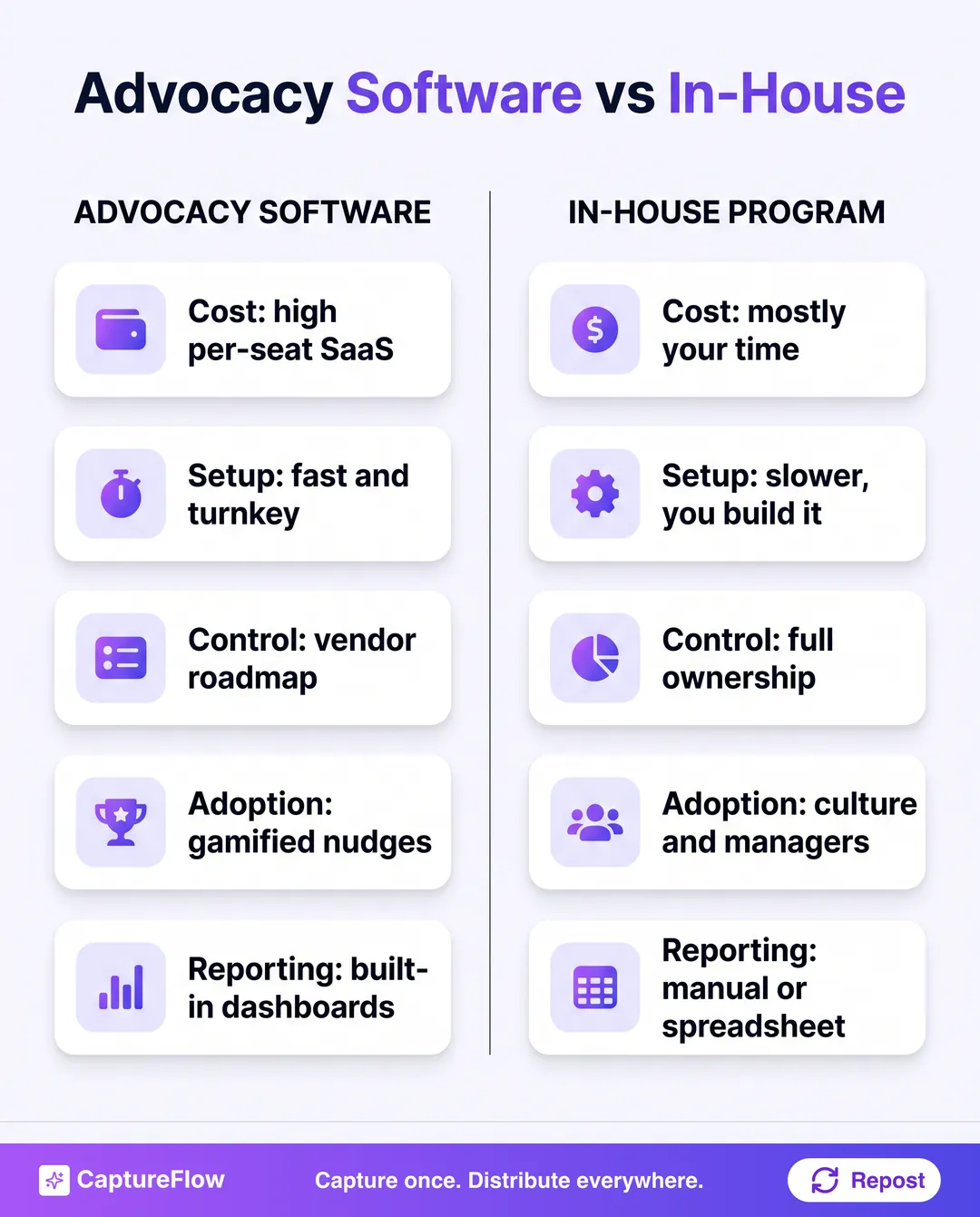 The same five dimensions, opposite trade-offs. Neither column is wrong, they fit different companies.
Buy the platform when the bottleneck is coordination at scale. Lots of people, real compliance stakes, and a genuine need for share-level analytics. That is the software's home turf, and our honest ranking of the best employee advocacy tools breaks down which platform fits which job.
The case for building in-house
Now the other side, which is stronger than most vendors want you to believe.
Building in-house means you own the whole thing: the content, the cadence, the relationships, and the roadmap. Nothing is gated behind a per-seat fee, and nothing breaks when a vendor reprioritizes. For a team of five to fifty, a shared content doc, a simple posting rhythm, and a manager who models the behavior can drive more real participation than a six-figure platform that employees log into twice and abandon.
The reason is adoption. Software tries to manufacture participation with points and leaderboards. In-house programs earn it with culture: a founder who posts, managers who reshare, and small public wins that make the next person want in. Gamification is a substitute for motivation, and it is a weak one. The mechanics of actually getting people to post, whether you buy or build, are their own discipline, which is why we wrote a full playbook on getting your team posting on LinkedIn.
Build in-house when the bottleneck is not coordination but momentum. A small, willing group, a founder setting the tone, and a budget that would rather go to headcount than SaaS seats. If you are formalizing this, our guide to building an employee advocacy program is the step-by-step.
The three trade-offs that actually decide it
Strip away the feature lists and the decision comes down to three things.
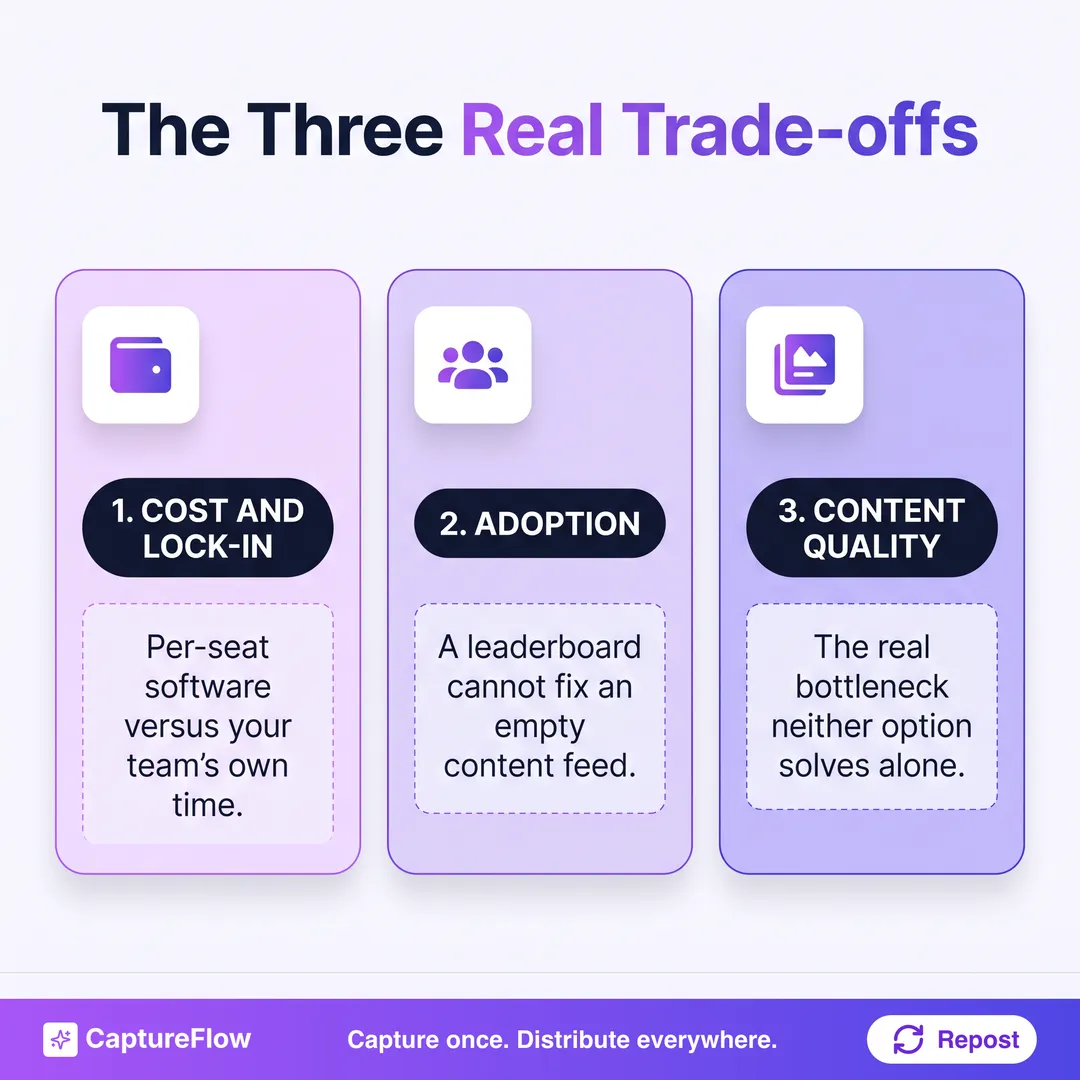
Cost and lock-in. Software is a predictable per-seat line item; in-house is mostly your team's time. Past a certain headcount the software is cheaper than the labor. Below it, the labor is cheaper than the seats.
Adoption. This is where most buyers get it wrong. They assume the platform's gamification will drive posting. It will not, because a leaderboard over an empty or dry feed just measures how few people are posting. Participation follows good content, not the other way around.
Content quality. The one nobody demos. Both a platform and an in-house program assume you already have a steady supply of posts worth sharing. Most companies do not, and that single gap is why so many programs stall regardless of which side of build-versus-buy they picked.
The most common failure is buying a platform to fix low participation, when the real cause is that employees have nothing on-brand to post. A better distribution tool cannot fix a supply problem. Diagnose the bottleneck before you sign anything.
Which fits your company stage
The honest answer to build-versus-buy changes with your size and stage. Here is the rough map.
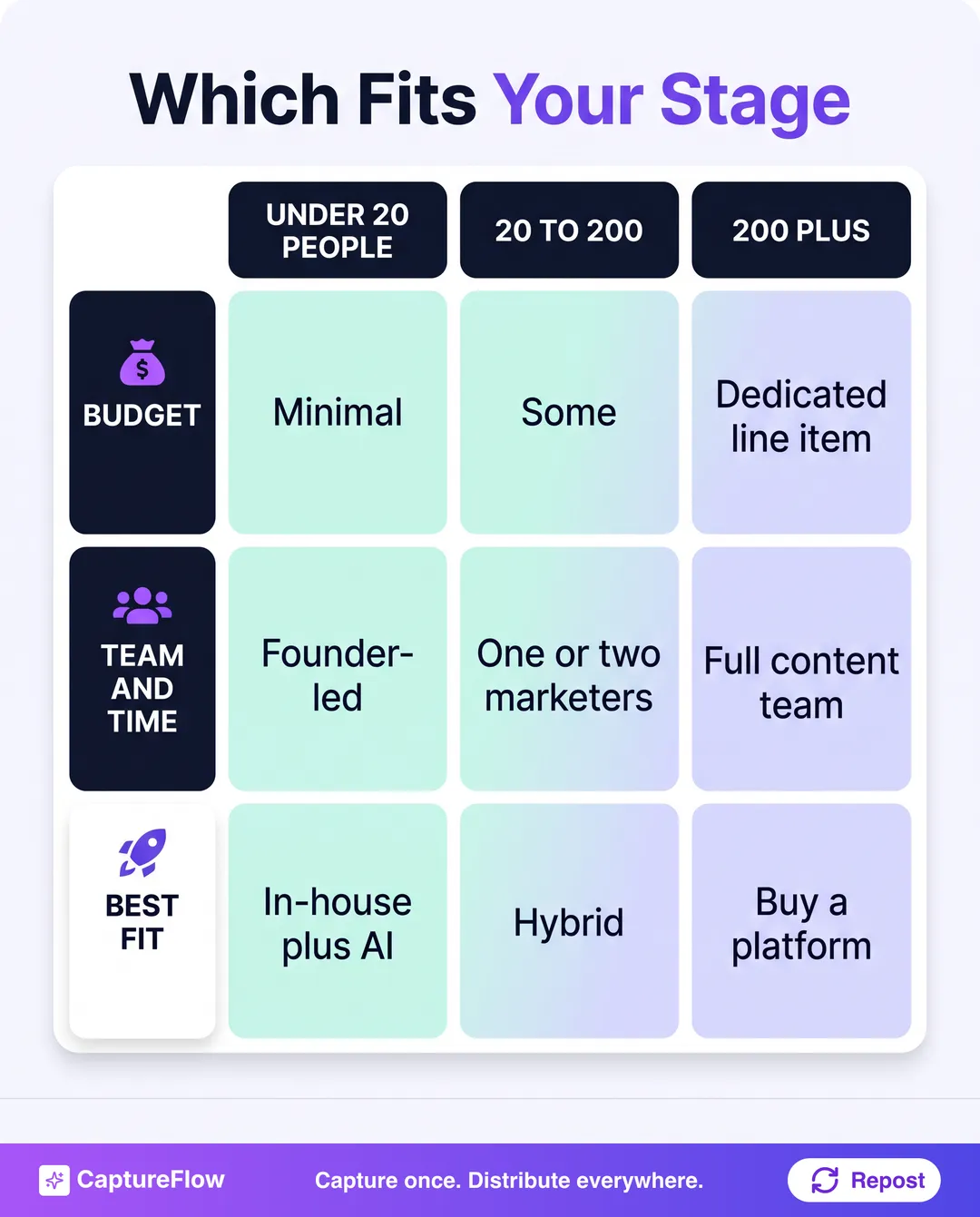 Build-versus-buy is not one answer, it moves with your headcount and budget.
Under about 20 people, in-house plus an AI content agent almost always wins: you do not have the volume to justify a platform, and you do need help producing the content. In the messy middle, 20 to 200, a hybrid is common: a content layer to create, and a lightweight tool or shared system to distribute and track. Past 200, with a full content team and compliance needs, a dedicated platform starts to earn its price.
The layer neither option solves
Here is the part both the sales demo and the "we'll just do it ourselves" plan skip.
Buy or build, you still have to get real, on-brand posts out of busy people who did not sign up to be creators. That is the actual bottleneck, and it is a content problem, not a distribution one. It is also the reason advocacy is worth the effort at all: the 2024 Edelman-LinkedIn B2B Thought Leadership Impact Report found that 73 percent of decision-makers consider an organization's thought-leadership content a more trustworthy basis for judging it than its marketing materials. Thin, copy-paste advocacy does not clear that bar. Real, in-voice content does.
This is where a content layer sits underneath whichever choice you make. CaptureFlow is an AI content agent that turns your expertise into weeks of on-brand content for every platform. An employee captures one idea in minutes, a voice note or a rough thought, and it comes back as a native post in their voice, ready to review in about 5 minutes. It does not distribute for them and it is not an advocacy scheduler. It removes the blank page, which is the thing that actually stalls programs. Pair it with the distribution side, whether that is a platform or your own cadence, and you have both halves. It is the same logic behind employee-generated content for B2B brands.
The build-versus-buy trapMost teams argue about how to distribute advocacy content before they have solved how to create it. Fix supply first, and the distribution question gets a lot smaller.
So which should you choose?
Cut to the recommendation.
Choose a dedicated advocacy platform if you have 100+ employees, real compliance requirements, a marketing team that lives in dashboards, and, crucially, a content supply that is already healthy. The software will scale what is already working.
Build in-house if you are a lean team, founder-led or close to it, with a small group of willing people and a budget better spent on headcount than seats. Add an AI content agent so the program has something to distribute, and formalize it as you grow.
Do both, in order, if you are in the middle. Solve content supply first, prove participation with a simple in-house cadence, then buy the platform once the reporting and scale actually hurt. Buying it earlier just puts a dashboard over a problem you have not fixed yet.
Whichever way you lean, do not let the tool choice distract from the work. The program lives or dies on whether real people post real things consistently, and that starts with making it easy. See how CaptureFlow fits your flow, or compare plans when you are ready to remove the blank page for your team.
Sources
- LinkedIn Marketing Solutions, How to increase employee social sharing for more organic reach
- Edelman, 2026 Edelman Trust Barometer
- Edelman and LinkedIn, 2024 B2B Thought Leadership Impact Report
Frequently asked questions
Is employee advocacy software worth it, or should we build in-house?+
Buy a platform when you have 100+ employees, real compliance requirements, and a marketing team that needs share-level analytics to report reach. Build in-house when you are a lean team whose real problem is that employees have nothing on-brand to post. In that case a content layer plus a shared doc beats another SaaS seat.
What does employee advocacy software do that an in-house program does not?+
It automates the distribution mechanics: a curated feed of approved content, gamification to nudge participation, share tracking per person, and enterprise controls for roles and compliance. An in-house program can replicate most of this manually, but the reporting and scale get painful past a few dozen active sharers.
Can an AI content agent replace an employee advocacy platform?+
Not exactly, because they solve different jobs. An advocacy platform distributes and measures. An AI content agent like CaptureFlow removes the blank-page problem so employees actually have on-brand posts to publish. Most stalled programs need the content layer first, and only need the platform once supply and participation are healthy.
Chris is the founder and CEO of CaptureFlow, which he builds so founders can turn their expertise into content without hiring a team. After 10+ years building products and growing audiences from scratch, he writes about founder-led content, AI, and distribution from inside the problem he is solving: distributing consistent, on-brand content as a team of one.
Founder & CEO of CaptureFlow · 10+ years building products and audiences
One playbook a week from founders who actually create and distribute lots of content. No spam, unsubscribe anytime.
Keep reading
Employee Advocacy Tools vs Letting Employees Post on Their Own
Do you need an employee advocacy platform, or is letting employees post on their own better? The honest answer depends on your size, and mostly on adoption.

Employee Advocacy Content Ideas: What Your Team Should Post on LinkedIn
Your team is willing to post, they just do not know what to say. Here is the content employees should share on LinkedIn, and how to make it take 5 minutes.
How to Get Your Team Posting on LinkedIn: An Activation Playbook
The strategy was fine. The recruiting was fine. Six weeks in, two people post and the rest have gone quiet. Activation is the missing step, and this is the playbook for it.