LinkedIn Marketing for B2B Companies
A LinkedIn marketing guide for B2B companies: why it is the top channel, the three-layer content stack, what to post, and how to run it consistently in 2026.

Ask a B2B marketer where their next deal will come from, and increasingly the honest answer is LinkedIn. Not their website, not a cold email sequence, not a paid search ad. A buyer saw a founder's post, followed the company, read a few employee updates, and arrived at the demo already half-sold.
That is how B2B buying works now, and most companies are still treating LinkedIn like a place to reshare blog links from the company page. They are leaving the entire channel on the table.
LinkedIn marketing for B2B companies is using LinkedIn as the primary channel to build trust and demand, through the company page, the personal voices of founders and executives, and the collective reach of employees. This is the practical guide: why LinkedIn is the B2B channel, the three-layer stack that actually works, what to post, and how to keep it running.
Why LinkedIn is the channel for B2B
LinkedIn is where B2B decisions get shaped, and the data backs it up.
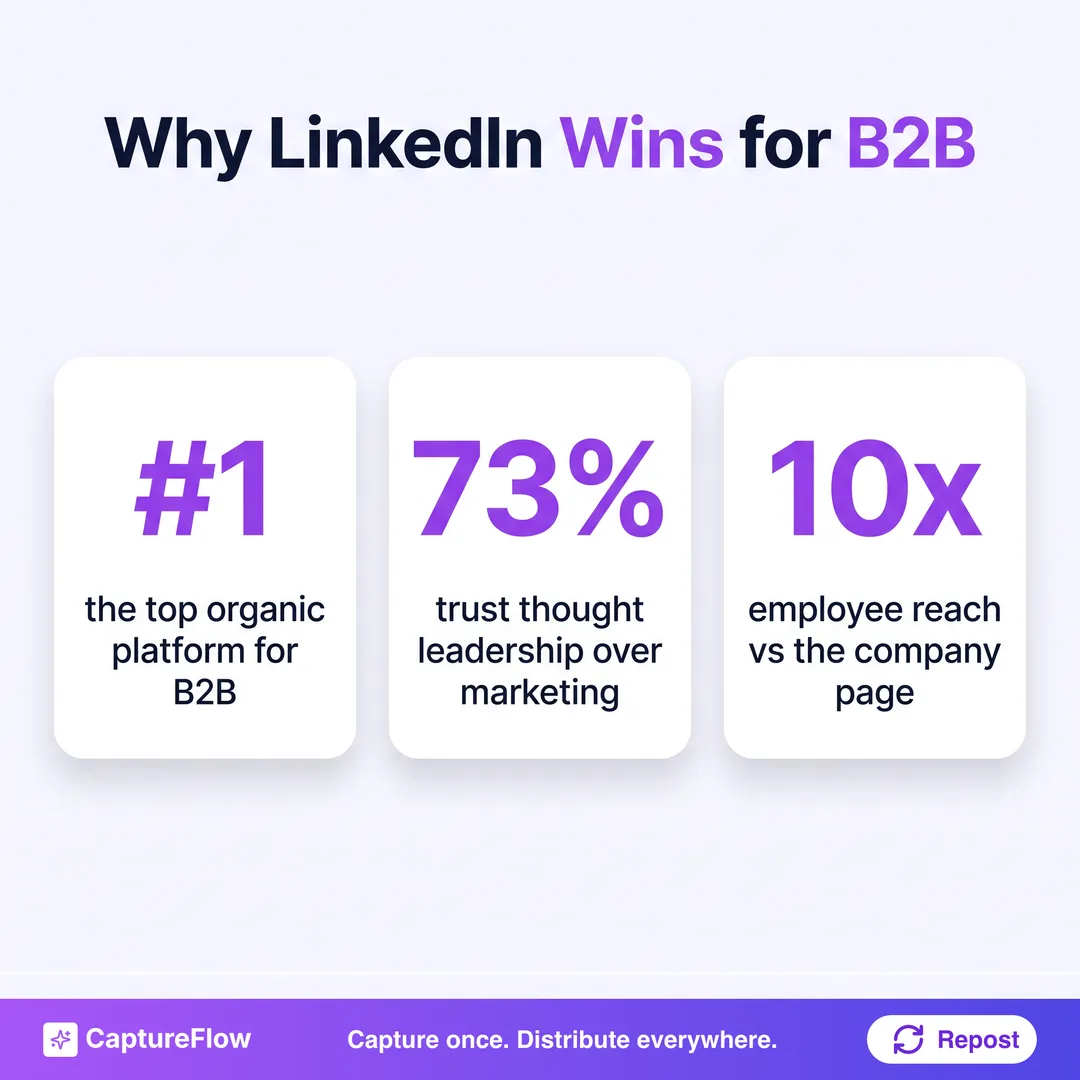 The B2B case for LinkedIn in three numbers.
It is the top-performing organic platform for B2B marketers, year after year in Content Marketing Institute's B2B research, ahead of every other social channel for both usage and results. And its organic reach is unusually generous for an owned channel, which makes showing up consistently actually pay off.
More importantly, it is where trust gets built. In the 2024 Edelman-LinkedIn B2B Thought Leadership Report, 73 percent of decision-makers said thought-leadership content is a more trustworthy basis for judging an organization than its marketing, 75 percent said strong thought leadership led them to research a product they were not considering, and 90 percent said they are more receptive to companies that publish it consistently. That is the entire B2B funnel, influenced before a sales conversation starts.
The B2B LinkedIn content stack
Here is the mistake almost every B2B company makes: they run LinkedIn entirely through the company page. The page is important, but on its own it is the weakest lever you have. The channel works when you use it as three layers.
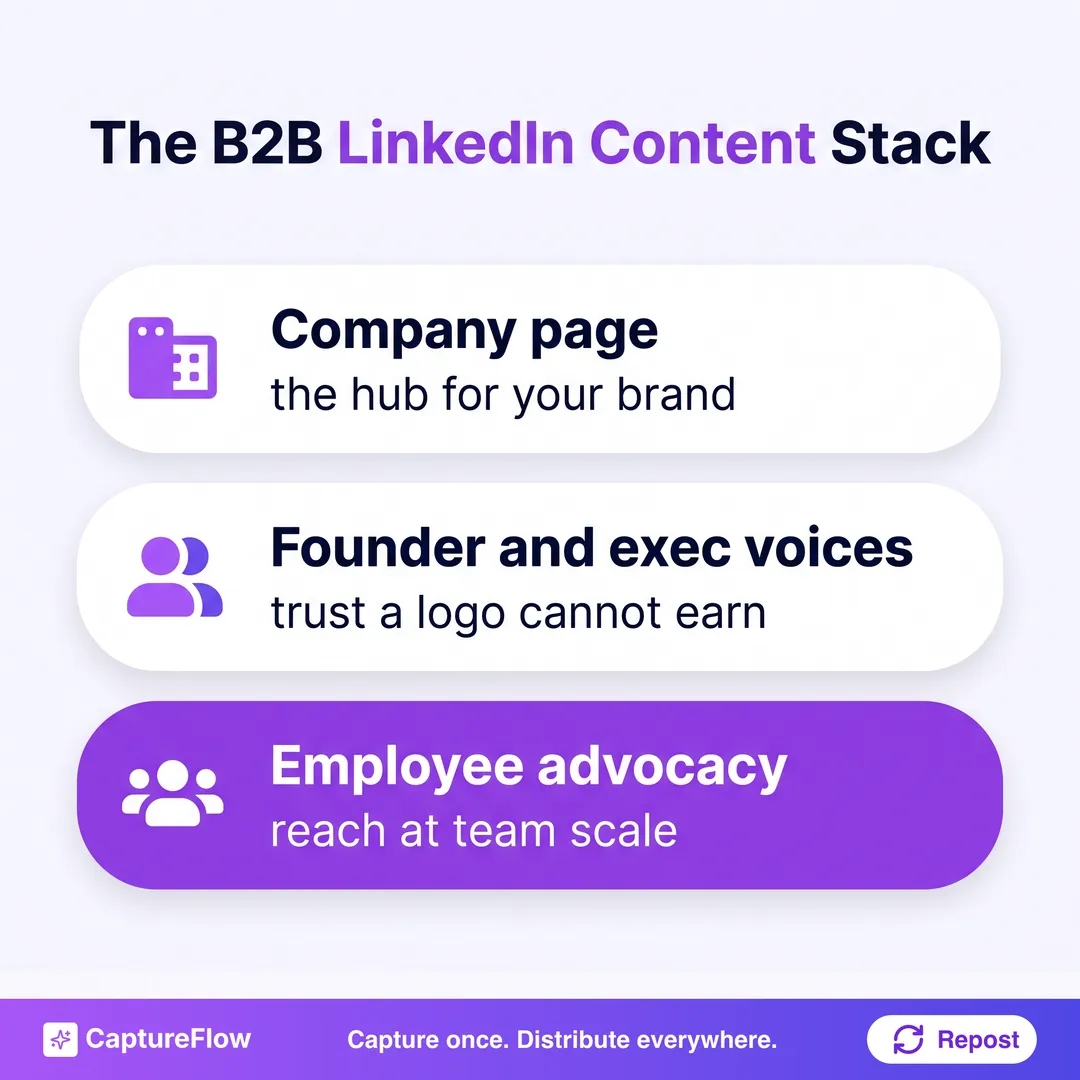 One channel, three layers. The page is the base; the people are the reach.
Layer 1: The company page. Your brand hub and official record. It is where a buyer confirms you are real, sees your positioning, and follows for updates. Necessary, but its organic reach is limited and its posts read as a brand, not a person.
Layer 2: Founder and executive voices. This is where trust lives. A post from your CEO about a hard lesson, or from your head of product about a decision, earns credibility a company page structurally cannot. This is founder-led marketing: the company's growth running through its leaders as its most trusted channel.
Layer 3: Employee advocacy. The scale layer. LinkedIn's own data shows employees' combined networks are on average about ten times the size of the company's follower base. When your team posts in their own voices, you unlock reach the page could never buy. The how is in our employee advocacy program playbook, and the content that fuels it is employee-generated content.
Run all three together and they compound: the page anchors the brand, the leaders earn the trust, and the employees carry the reach. If pipeline is the specific goal, our playbook on a LinkedIn content strategy that generates B2B leads turns these three voices into a lead-focused system.
What to post: the B2B content pillars
A consistent presence needs a small set of repeatable themes, so nobody is inventing from scratch each week. Four pillars cover almost everything a B2B company should say.
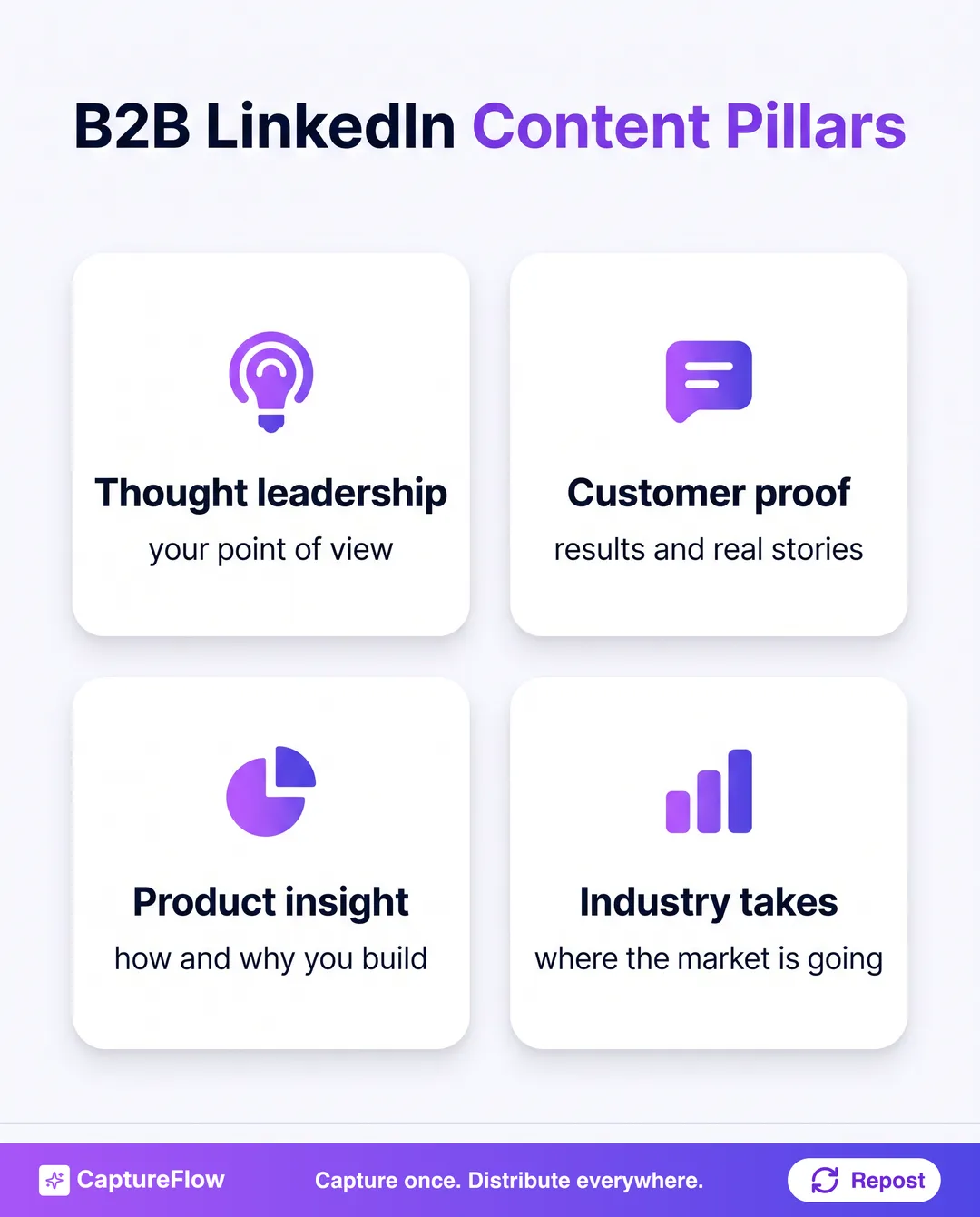 Four wells to draw from. Rotate through them and you never run dry.
- Thought leadership: your genuine point of view on the problem you solve. Opinions, frameworks, contrarian takes. This is the pillar that moves buyers, so weight it heavily.
- Customer proof: results, stories, and outcomes. Not testimonial graphics, but the real narrative of a problem solved. Proof beats claims every time in B2B.
- Product insight: how and why you build what you build. The decisions, the tradeoffs, the philosophy. It demonstrates competence without a sales pitch.
- Industry takes: where your market is heading and what it means. Reacting to news and trends keeps you current and positions you as a guide.
Map these to your LinkedIn content strategy and assign them across your layers: leaders take thought leadership and industry takes, the page and customer teams carry proof, product folks own insight.
Do not spread the same four pillars identically across every profile. Let each person own the pillars that fit their role and voice. Ten people posting authentic, different angles on your space beats ten people reposting the same company update.
How to actually keep it running
Here is the truth every B2B team learns: the strategy above is not the hard part. The hard part is producing enough good content, consistently, across a page and a dozen people, without it becoming everyone's second job.
That is a supply problem, and it is where most B2B LinkedIn programs quietly die. A brilliant three-layer strategy with an empty content pipeline produces silence. Consistency is what compounds, and consistency requires a system for turning ideas into posts fast. The companies that dominate B2B LinkedIn are almost never the ones with the biggest budget or the cleverest campaign. They are the ones who made posting easy enough that their leaders and team actually keep doing it, week after week, while everyone else burns out after a strong month.
This is exactly the gap an AI content agent closes. CaptureFlow is an AI content agent that turns your expertise into weeks of on-brand content for every platform. A leader or employee captures one idea, a voice note after a customer call, a strong opinion, a lesson, and it drafts on-brand LinkedIn posts, carousels, and short video in that person's voice, ready to review in minutes. The whole stack, page, leaders, and employees, can stay consistent because posting stops competing with the actual work.
The B2B LinkedIn ruleBuyers do not trust your company page. They trust the people who work there. Win B2B on LinkedIn by turning your leaders and your team into the channel, and giving them a way to post that does not cost an hour a day.
Common B2B LinkedIn mistakes
A few patterns sink otherwise-good B2B LinkedIn programs, and they are worth naming so you can avoid them:
- Running everything through the company page. It is the layer with the least reach and the least trust. If the page is your whole strategy, you are using maybe a third of the channel.
- Posting only promotional content. A feed of product announcements and "we are hiring" reads as an ad and gets ignored. Weight the thought-leadership and proof pillars far above the promotional one.
- Handing leaders a script. Ghostwritten posts that all sound like the marketing team defeat the point. The trust comes from the person's real voice, so protect it even as you help them produce.
- Treating it as a campaign, not a habit. B2B trust compounds over months of consistency. A big quarter followed by silence resets you to zero. The steady drip wins.
- Measuring followers instead of pipeline. Company-page follower count flatters you and predicts nothing. Track the conversations, inbound, and deals that trace back to LinkedIn instead.
Avoid those five and the strategy above does the rest. The teams that win are rarely the most creative; they are the most consistent, with a system that keeps every layer of the stack supplied.
The move
LinkedIn marketing for B2B companies is not a company-page posting schedule. It is a three-layer system, page, leaders, employees, publishing around a few clear pillars, consistently, so trust and demand build before a buyer ever reaches sales.
Build the stack, pick your pillars, and solve the supply problem so it actually runs. If producing enough on-brand content across your whole team is the thing standing in the way, that is exactly what CaptureFlow is built to remove. You can see how it works, or if you lead the function, the B2B execs use case maps it to your goals.
Sources
- Content Marketing Institute, B2B Content Marketing Benchmarks and Trends (LinkedIn the top-performing organic platform for B2B).
- Edelman and LinkedIn, 2024 B2B Thought Leadership Impact Report (73 percent trust thought leadership over marketing; 75 percent prompted to research; 90 percent more receptive to consistent publishers).
- LinkedIn Marketing Blog, How to Increase Employee Social Sharing for More Organic Reach (employee networks ~10x the company audience).
Frequently asked questions
What is the best LinkedIn marketing strategy for a B2B company?+
Use LinkedIn as three layers, not one. The company page is the brand hub, founders and executives post in their own voices to earn trust a logo cannot, and employees extend reach across their networks through advocacy. Publish consistently around a few clear content pillars (thought leadership, customer proof, product insight, industry takes) and measure trust and pipeline, not vanity followers.
Should a B2B company post from the company page or personal profiles?+
Both, but the personal profiles do the heavy lifting. LinkedIn's own data shows individual employees' networks are far larger than the company page and their content earns more engagement, and buyers trust a named person over a brand account. Use the company page as the hub and official record; use founder, executive, and employee profiles for the reach and trust that actually move B2B buyers.
How often should a B2B company post on LinkedIn?+
Consistency beats frequency. A steady cadence of a few posts a week from the page plus regular posting from a handful of leaders and employees, sustained for months, outperforms a burst that fades. The practical limit is usually content supply, so the teams that win are the ones with a system for producing on-brand posts without it becoming a full-time job.
Chris is the founder and CEO of CaptureFlow, which he builds so founders can turn their expertise into content without hiring a team. After 10+ years building products and growing audiences from scratch, he writes about founder-led content, AI, and distribution from inside the problem he is solving: distributing consistent, on-brand content as a team of one.
Founder & CEO of CaptureFlow · 10+ years building products and audiences
One playbook a week from founders who actually create and distribute lots of content. No spam, unsubscribe anytime.
Keep reading
Content Operations for B2B Teams: Build a Scalable System
More content is demanded than any B2B team can produce, so the work fragments across five tools and quality slips. Content operations is the fix. Here is the system.

How to Build an Employee Advocacy Program on LinkedIn (2026)
Your company page has 2,000 followers. Your fifteen employees have 30,000 connections nobody is reaching. Here is the 6-step program that fixes that.

What Is Employee Advocacy? The Complete Guide
Your employees' networks are bigger and more trusted than your company page. Employee advocacy is how you put that to work. Here is the complete guide.