How to Build a LinkedIn Content Strategy That Generates B2B Leads
A LinkedIn content strategy that generates B2B leads: what to post, who should post it, and a weekly plan that turns expertise into pipeline, not just likes.


Most B2B LinkedIn strategies are built backwards. You pick a posting cadence, fill a calendar, chase reach, and six months later you have a nicer follower count and a sales team that still has no idea which posts came from the pipeline they closed.
So let me answer it straight. How do you build a LinkedIn content strategy that generates leads for B2B? You start from your buyer, not your calendar. A LinkedIn content strategy that generates B2B leads is a system for turning the questions your buyers ask before they buy into public content, then turning the people who engage with it into conversations. Reach is a side effect. Pipeline is the point.
This is the version for a company that wants leads, not applause. If you want the personal-brand angle instead, our LinkedIn content strategy guide covers that, and the broader LinkedIn marketing playbook for B2B companies sets the wider context. This piece is narrower and more stubborn: everything here points at a booked call.
Stop optimizing for reach
Here is the trap. LinkedIn shows you impressions, likes, and follower growth, so those become the scoreboard. None of them pay.
A post that reaches 40,000 people and gets 300 likes from other marketers is a worse business outcome than a post that reaches 400, and one of them is a VP at an account you have been chasing for a year, and she comments. The first feels great. The second books the meeting.
Trust is what actually moves a B2B deal, and the data on this is not subtle. In the 2024 Edelman-LinkedIn B2B Thought Leadership Impact Report, which surveyed nearly 3,500 management-level professionals, 73 percent of decision-makers said a company's thought-leadership content is a more trustworthy way to judge it than its marketing materials. Sixty percent said they would pay a premium to work with an organization whose thinking they respect. And roughly 70 percent said a single piece of thought leadership had made them question whether to stay with a current supplier.
Read that last one again. Your competitor's buyers are one good post away from doubting their current vendor. That is the game. Not reach. Doubt, trust, and a reason to reply.
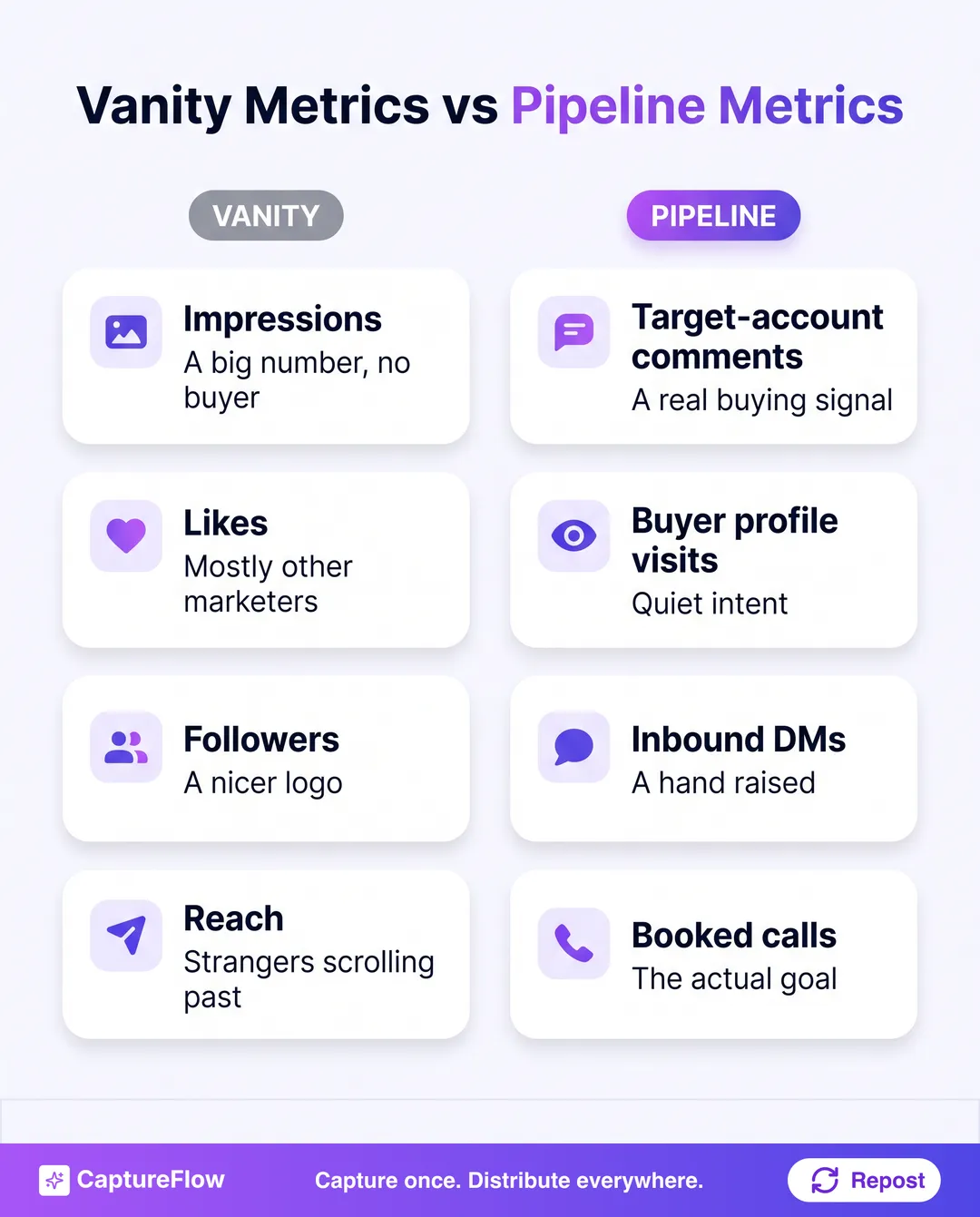 One column feels good. The other pays. Build the strategy around the right one.
If you cannot name a single deal that started on LinkedIn, the problem usually is not reach. It is that nobody has a reason to reply, and nothing captures the ones who would. Fix the reply, then fix the measurement.
Use three voices, not one
The single biggest mistake B2B companies make is posting everything from the company page and wondering why it feels like shouting into a void. Logos do not build trust. People do.
A working B2B LinkedIn strategy runs three voices at once, and each does a different job.
- The company page. Reach and proof. Customer results, product news, data you own, the occasional big swing. Necessary, but nobody follows a logo for its personality. Treat the page as the receipt, not the relationship.
- Employees. Trust and distribution. A team of ten posting from their own profiles will out-reach and out-convert the company page every week, because a person your buyer already follows is worth more than any ad. This is the engine most companies leave switched off. Our employee advocacy content ideas covers exactly what they should post.
- The founder or an exec. Point of view. This is the voice that makes people care, take sides, and hit follow. A founder narrating real decisions is the highest-trust content a B2B company can make.
Run all three and they compound. The founder sets the angle, employees amplify and add their own take, the company page backs it with proof. One voice is a broadcast. Three is a conversation the whole market can see.
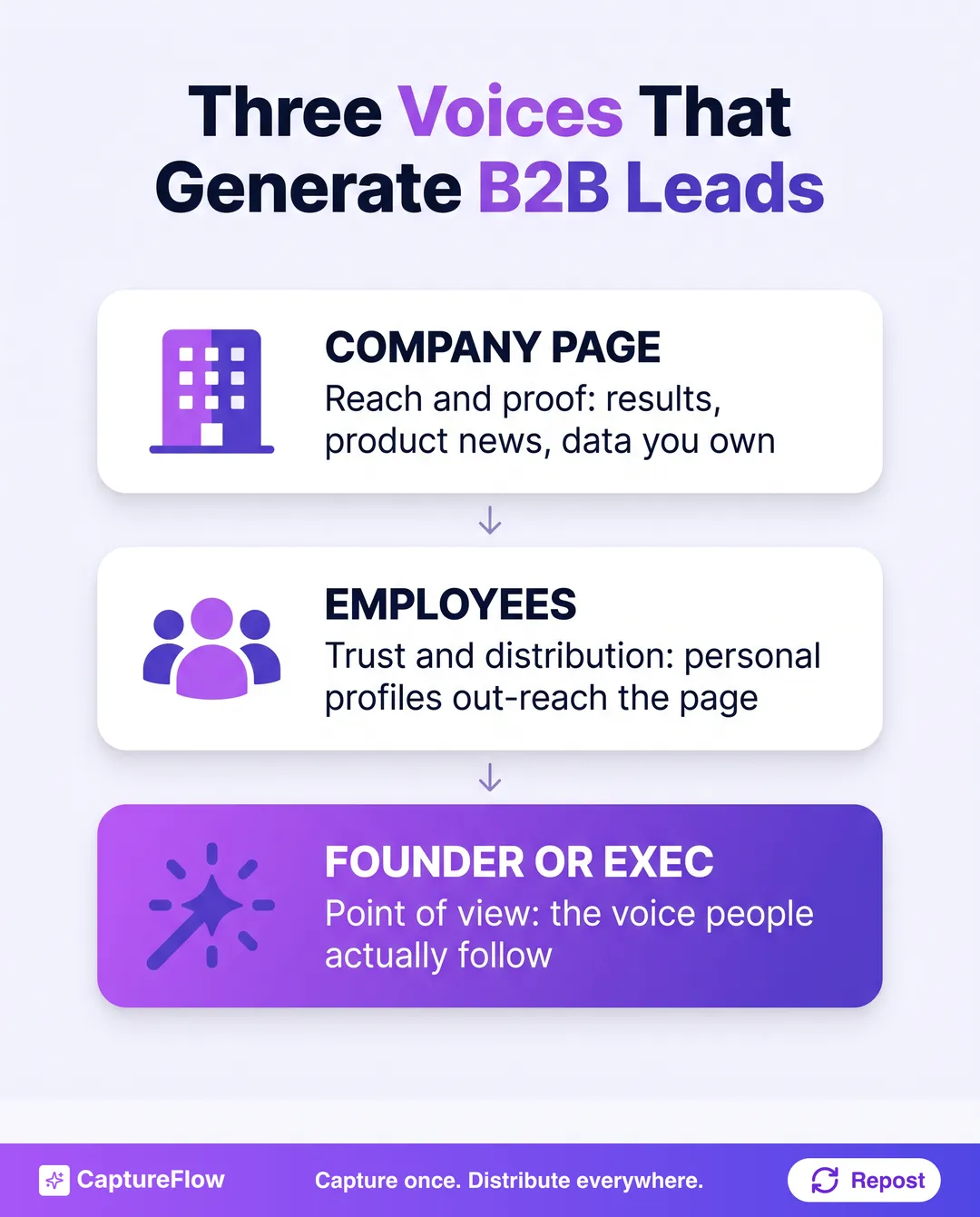 Three voices, three jobs. The founder leads, employees amplify, the page proves it.
Build the plan around buyer problems, not topics
Now the content plan itself. Most fail because they are organized by theme ("we post about productivity on Tuesdays"), which is a calendar, not a strategy.
Organize around your buyer's actual questions instead. Sit with your sales team for an hour and write down every objection, every "but what about," every thing a prospect needs to believe before they sign. That list is your content plan. Each item is a post, and the person who hears it most often is the one who should write it.
Here is a realistic weekly plan for a lean B2B team. It is not a lot. It is repeatable.
| Day | Voice | Post | Job it does |
|---|---|---|---|
| Monday | Founder | A lesson or a contrarian take on your space | Sets the point of view, earns follows |
| Tuesday | Employee (sales) | Answer a real objection buyers raise | Pulls in people mid-decision |
| Wednesday | Company page | A customer result, told as a short story | Proof, plus reach for the page |
| Thursday | Employee (product) | A behind-the-scenes short video of the work | Trust, native and hard to fake |
| Friday | Founder | A metric or a decision, building in public | Keeps the conversation human |
That is five posts across three voices, and only two of them fall on the founder. If building in public is your founder's lane, Monday and Friday write themselves. The whole plan runs on things your team already knows, not a research project.
Do not gate everything behind a form. The objection you answer on every sales call, posted in public for free, will generate more qualified inbound than a gated whitepaper nobody downloads. Give away the insight. Capture the interest in the replies.
Write posts that create demand
A post that generates leads does one of three things: it makes a buyer realize they have a problem, it makes them trust that you understand it, or it gives them a reason to raise their hand. Everything else is filler.
The formats that actually convert for B2B are boring and reliable. A real customer result with the specifics left in. A strong opinion about how your category should work. The objection, answered honestly, before a salesperson has to. A short video of the actual work. None of these need a content team. They need someone who knows the subject and a way to get the thought out of their head. If you want the mechanics of the post itself, our guide on how to write a LinkedIn post that lands covers structure and hooks.
The hard part was never the ideas. It was the time. A busy exec has the take; they do not have 40 minutes and a blank document on a Tuesday. That gap is exactly what an AI content agent closes. CaptureFlow is an AI content agent that turns your expertise into weeks of on-brand content for every platform. Someone records a two-minute voice note about the objection they answered on this morning's call, and 5 minutes later it is a LinkedIn post, a carousel, and a short video in their voice, ready to review. The plan above stops being aspirational and becomes something a two-person team can actually sustain.
Turn engagement into pipeline
This is the step almost everyone skips, and it is where the leads actually come from. A post is not the conversion. The conversation after it is.
When the right person comments, that is a buying signal, so treat it like one. Reply properly, not with a thumbs up. Look at who is viewing your profile, because in B2B a spike in profile views from a target account is a lead the ad platforms will never show you. Move the good conversations to DMs without pitching. The goal of a comment is a DM, and the goal of a DM is a call, and none of that happens if you post and disappear.
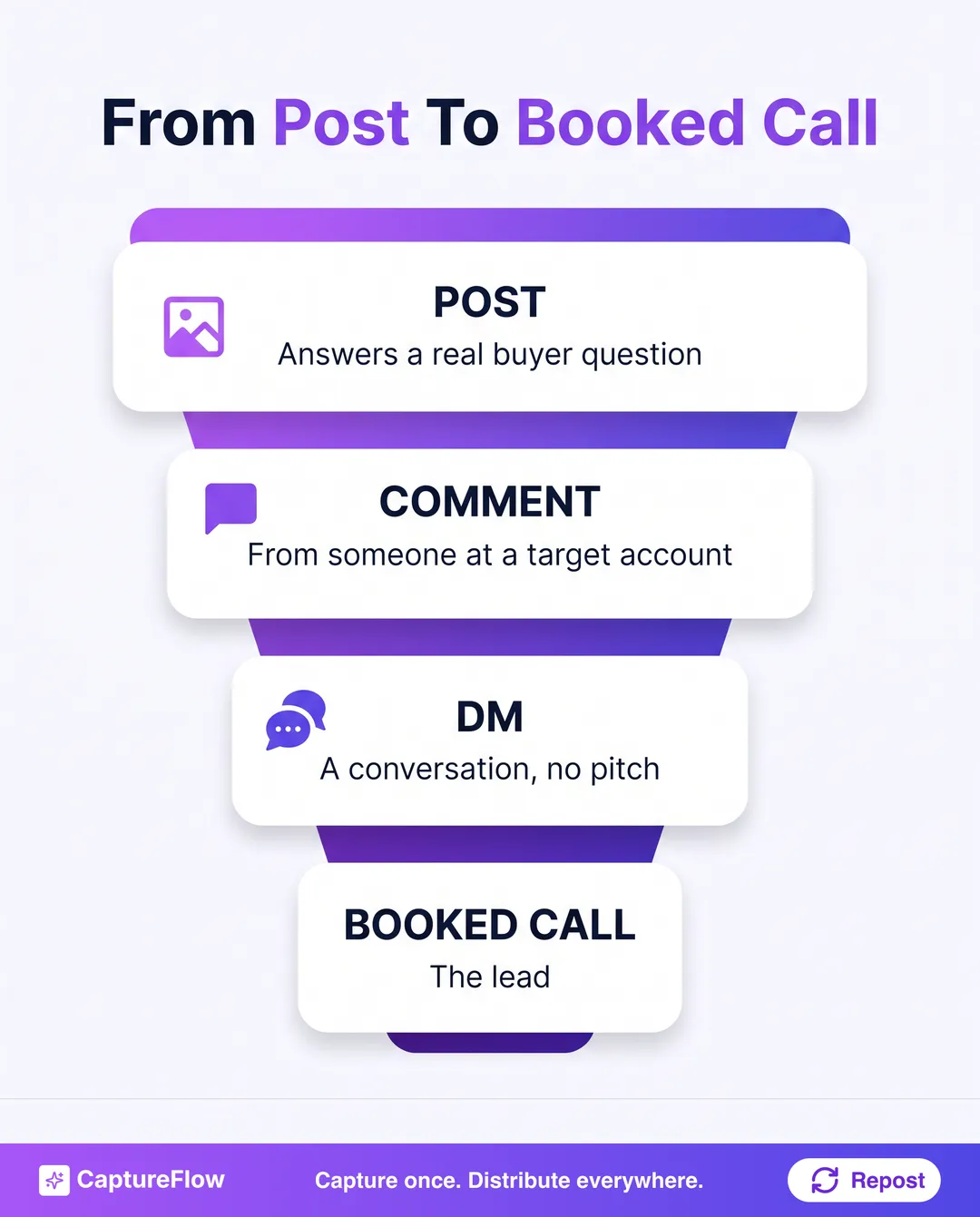 The post is the top of the funnel, not the conversion. The reply is where the lead starts.
Give people a low-friction way in, too. Not "book a demo" on every post, which reads as desperate. Something softer: an offer to share the template, a "happy to go deeper if useful," a genuine question that invites a reply. The Edelman-LinkedIn research found that buyers who respect your thinking will pay more and switch suppliers. Your job is to be visible and useful when that moment hits, then make it easy for them to reach you.
The whole strategy in one linePost the thing your buyer needs to believe. Then be there, like a human, when they reply.
Measure leads, not likes
If you take one thing from this, take the scoreboard. What you measure is what the strategy optimizes for, and if you measure likes you will get a popular account that sells nothing.
Track the metrics that map to pipeline. Comments and DMs from people at target accounts. Profile views, especially clusters from one company. Inbound messages that mention a specific post. Booked calls, and which post the person mentioned. Most of this you collect by hand at first, in a simple sheet, and that is fine. The point is that a real signal ("three people from our ICP commented on the pricing-objection post") beats a vanity one ("2,000 impressions") every time.
Then close the loop. Whatever drove replies from the right people last week decides what you post more of next week. Your buyers will tell you your content strategy if you watch what they respond to instead of what gets applause. That feedback loop, run for a few quarters, is what separates a LinkedIn presence from a lead source.
The move
A B2B LinkedIn content strategy that generates leads is not complicated, it is just disciplined. Start from your buyer's questions, split them across three voices, post two to four times a week, and chase replies from the right people instead of reach from everyone. Measure booked calls, not likes. Hold it for two quarters before you judge it.
The reason most companies never get here is capacity, not knowledge. The plan is simple; sustaining it while running the business is the hard part. That is the exact bottleneck CaptureFlow is built to remove, and you can see how the content strategy fits together if you want the full picture. The strategy is the easy half. Showing up every week is the half that wins.
Sources
- Edelman and LinkedIn, 2024 B2B Thought Leadership Impact Report (73 percent trust thought leadership over marketing; 60 percent pay a premium; ~70 percent questioned a supplier; nearly 3,500 professionals surveyed).
- LinkedIn Marketing Solutions, B2B lead generation resources (LinkedIn as the top-ranked channel for B2B lead quality).
Frequently asked questions
How do I build a LinkedIn content strategy that generates leads for B2B?+
Start from the questions your buyers ask before they buy, assign each to the right voice (company page, an employee, or your founder), post two to four times a week answering them in public, and track the outcomes that matter: comments from target accounts, profile visits, DMs, and booked calls. Pick next week's topics from whatever drove replies this week.
How often should a B2B company post on LinkedIn to get leads?+
Two to four founder or employee posts a week plus a couple of company-page posts is plenty. Consistency over months beats volume. A lean team can sustain that from short captures rather than writing every post from scratch.
Should leads come from the company page or from people?+
People. Personal profiles get far more reach and trust than a logo, so the company page is for proof and reach while employees and your founder carry the point of view that actually starts conversations. Run all three together.
Chris is the founder and CEO of CaptureFlow, which he builds so founders can turn their expertise into content without hiring a team. After 10+ years building products and growing audiences from scratch, he writes about founder-led content, AI, and distribution from inside the problem he is solving: distributing consistent, on-brand content as a team of one.
Founder & CEO of CaptureFlow · 10+ years building products and audiences
One playbook a week from founders who actually create and distribute lots of content. No spam, unsubscribe anytime.
Keep reading

Employee Advocacy Tools vs Letting Employees Post on Their Own
Do you need an employee advocacy platform, or is letting employees post on their own better? The honest answer depends on your size, and mostly on adoption.

Employee Advocacy Content Ideas: What Your Team Should Post on LinkedIn
Your team is willing to post, they just do not know what to say. Here is the content employees should share on LinkedIn, and how to make it take 5 minutes.

How to Get Your Team Posting on LinkedIn: An Activation Playbook
The strategy was fine. The recruiting was fine. Six weeks in, two people post and the rest have gone quiet. Activation is the missing step, and this is the playbook for it.