Build in Public: A Founder's Content Playbook
A build-in-public content strategy for founders: what to share, what to keep private, and a repeatable system to turn your startup journey into weekly posts.


Every founder you admire seems to run the same playbook. They share their revenue, their near-misses, and their half-finished thinking, and somehow it turns into inbound, hires, and a following that competitors would kill for.
Then you try it, and two things go wrong. You do not know where the line is between honest and reckless, and by week three you have run out of things to say.
Both problems have the same fix, and it is a system, not a personality trait. A build-in-public content strategy is the ongoing practice of turning your startup's real journey, the metrics, decisions, failures, and lessons, into public content as it happens. This playbook covers the two hard parts most advice skips: exactly where the share-versus-private line sits, and a repeatable loop that turns your actual week into content without stacking a second job on top of building. For the tactical companion, the exact post types to write, keep our guide on what to post when building in public open in the next tab.
What is a build-in-public content strategy, and why it works now
Most content marketing is invented. You sit down, decide what to say, and manufacture something to fill the calendar. Building in public inverts that: the content already happened, and your only job is to narrate it.
That inversion is why it works. A polished announcement reads like an ad, and people scroll past ads. A founder thinking out loud about a real decision reads like a person, and people stop for a person.
The trust data backs this hard. In the Edelman-LinkedIn B2B Thought Leadership Report, 73 percent of decision-makers said an organization's thought-leadership content is a more trustworthy basis for judging it than its marketing. Building in public is thought leadership with the suit off. The wider 2026 Edelman Trust Barometer shows the same current everywhere: trust is draining out of institutions and pooling in people, including "my CEO", up 9 points. A corporate page is an institution. You, narrating what you are building, are a person, and on a feed of 1.2 billion LinkedIn users the person wins the tie.
There is a second advantage that compounds: this content is un-copyable. A competitor can clone your features and undercut your price. They cannot clone two years of you being visibly, verifiably right in public. That public record is the real asset, and it is the same one that powers any founder personal brand.
The build-in-public premiseThe content already happened. You are not inventing posts, you are narrating a journey you are living anyway.
Where the line is: what to share and what to keep private
The fear that stops most founders is not "what do I post", it is "what if I share too much". So let us draw the line clearly, because it is not actually blurry.
The useful test has two axes: is it true and useful to your audience, and does sharing it expose someone or something you are obligated to protect. Sort every candidate into that grid and the decision makes itself.
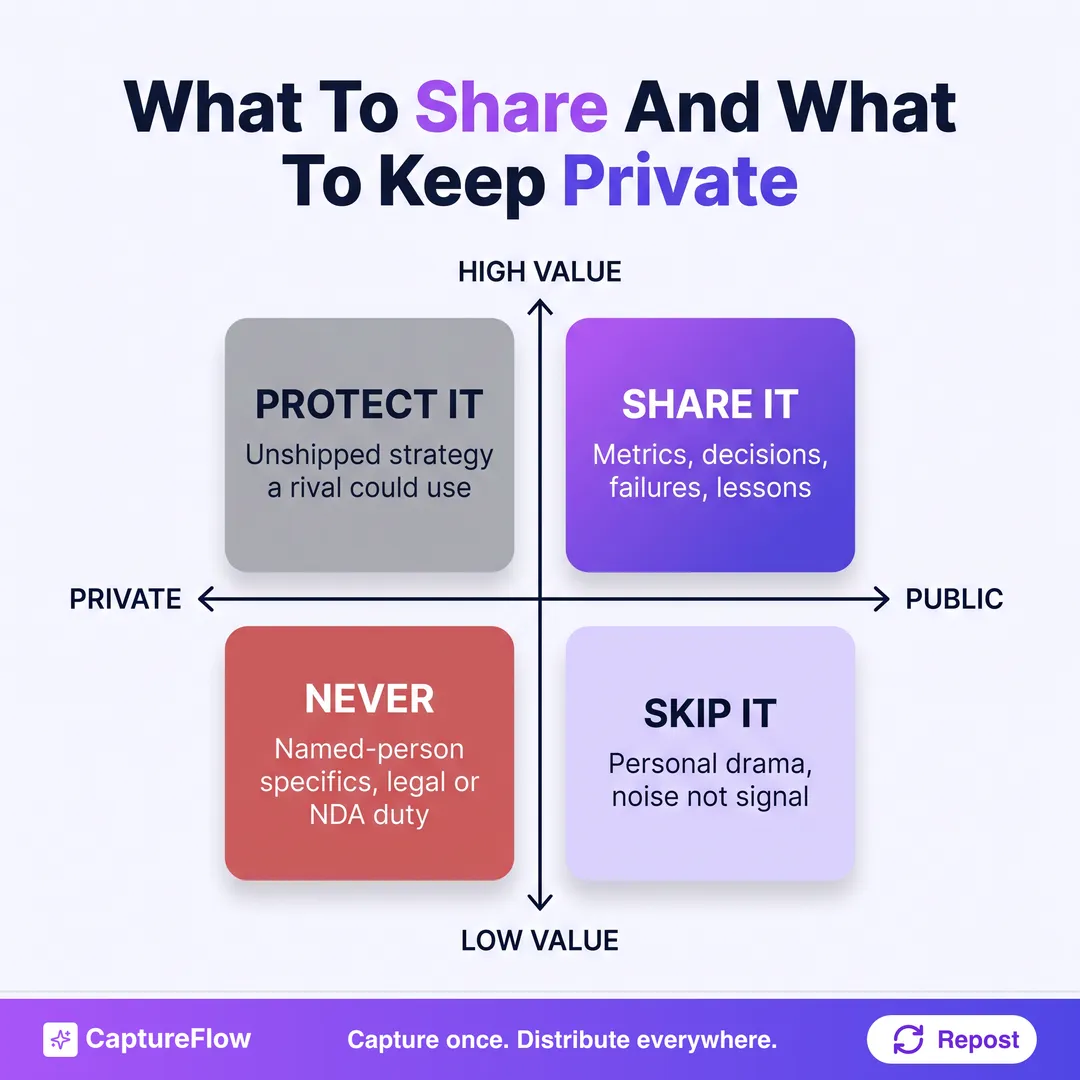 Every candidate post sorts into one box. Only the top-right one gets published.
The three things to genuinely keep private:
- Specifics that harm a named person. Share that a hire did not work out and what you learned about hiring. Never name the person or share details they would recognize as theirs. The lesson is public, the individual is not.
- Unshipped strategy a competitor could act on. You can share that you are weighing two directions and the tradeoff you feel. You do not hand a rival your unlaunched positioning or your pricing move before you make it.
- Anything you are under legal or contractual duty to protect. Customer data, an NDA, pre-announcement financials for a regulated raise. When in doubt here, the answer is do not.
Everything outside those three is almost always more valuable shared than hidden. Your churn number, the launch that flopped, the feature you cut and why, the thing you got wrong last quarter: that is the exact material that earns trust, precisely because nobody fakes it.
A fast gut-check before you post: would you say this to a founder friend over coffee? If yes, it is almost certainly safe and probably your best post of the week. The honest, slightly-too-real version is the one that lands.
The build-in-public content system
Here is the whole playbook in one sentence: your week generates the raw material, one short capture records it, and an AI content agent distributes it natively across every platform. That loop is the difference between building in public for three weeks and doing it for three years.
1. Mine your startup journey for the four raw materials
You are not short on material. Running a company generates postable moments daily. They cluster into four wells you can draw from forever, and they map directly to the honest content that works.
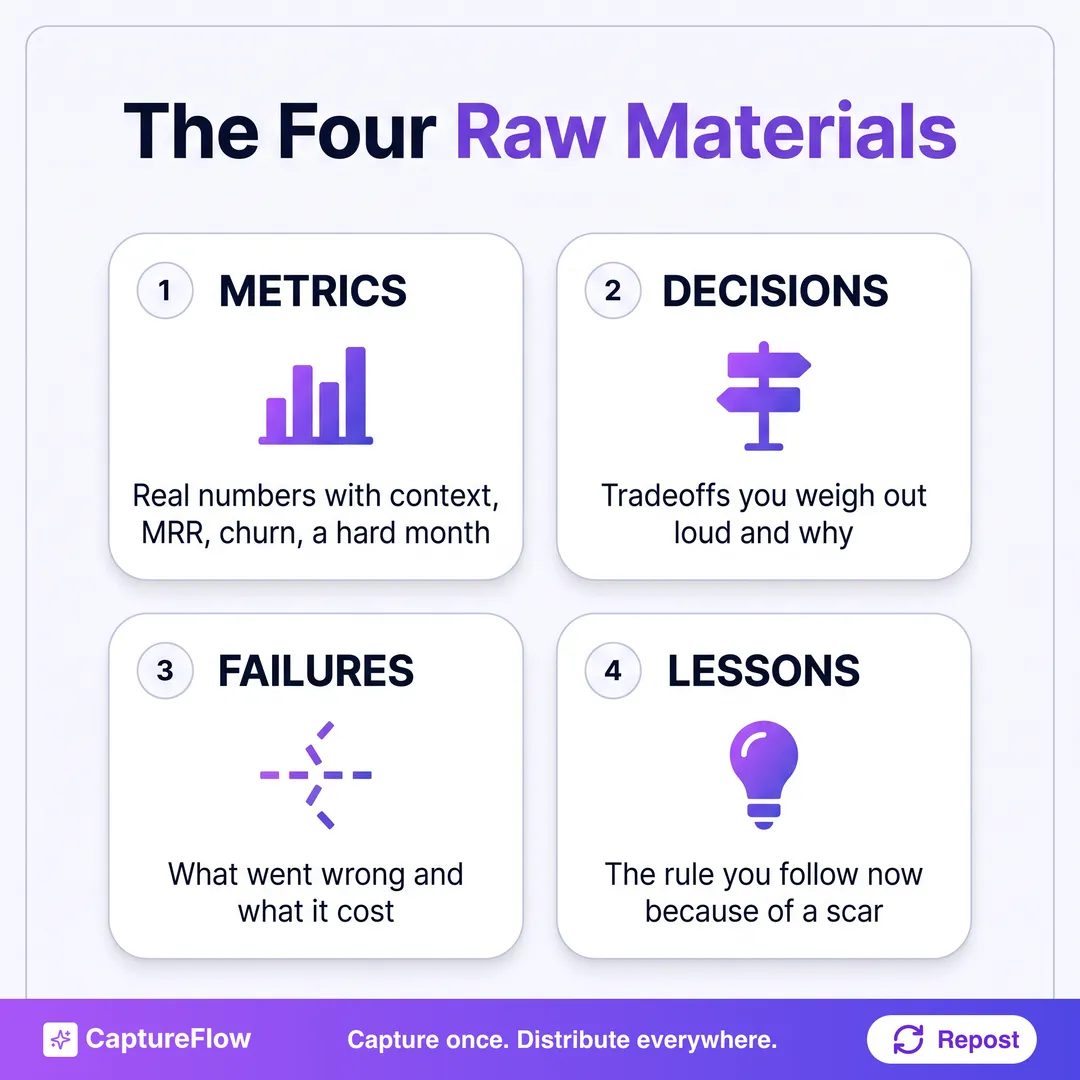 Four wells. Every week refills all of them whether you post or not.
- Metrics. Real numbers with context. "We hit $12k MRR and here is the one thing that moved it" beats "growth is going well" every time.
- Decisions. The tradeoffs you are weighing, live. Pulling people into the thinking often makes the decision better, and the comments become free advice.
- Failures. What went wrong and what it cost. The single most trusted format, because it cannot be ghostwritten.
- Lessons. The rule you now follow because of a scar. Vulnerability plus a takeaway is the most shareable founder content on any platform.
The point of naming them is that on any given Friday, at least one well is full. You do not brainstorm content. You look back at your week and pick the moment that was already interesting.
2. Capture the week in one 5-minute voice note
This is the step that makes the system survivable. Do not sit down to write. Talk.
Once a week, open a voice memo and spend 5 minutes narrating the moment that mattered: the metric that surprised you, the call you almost got wrong, the thing you shipped and what it took. You are not scripting a post, you are telling the story the way you would tell a friend. The voice-note-to-content workflow breaks down exactly how one recording becomes a week of material.
The reason this beats writing is that your spoken voice is already your brand voice. It is specific, it has opinions, and it does not read like AI, because it is not. The blank page never appears because you are not looking at a page, you are looking at your week.
The most common failure mode is not bad posts, it is a 3-week sprint followed by 6 weeks of silence. The feed forgives mediocre content. It does not forgive disappearing. Pick a cadence you can hold on your worst week, then protect it.
3. Let an AI content agent distribute it across platforms
A 5-minute voice note is raw material, not a finished post. Turning it into native content for LinkedIn, X, Instagram, and video used to be the job of a content team. That is the function you are replacing.
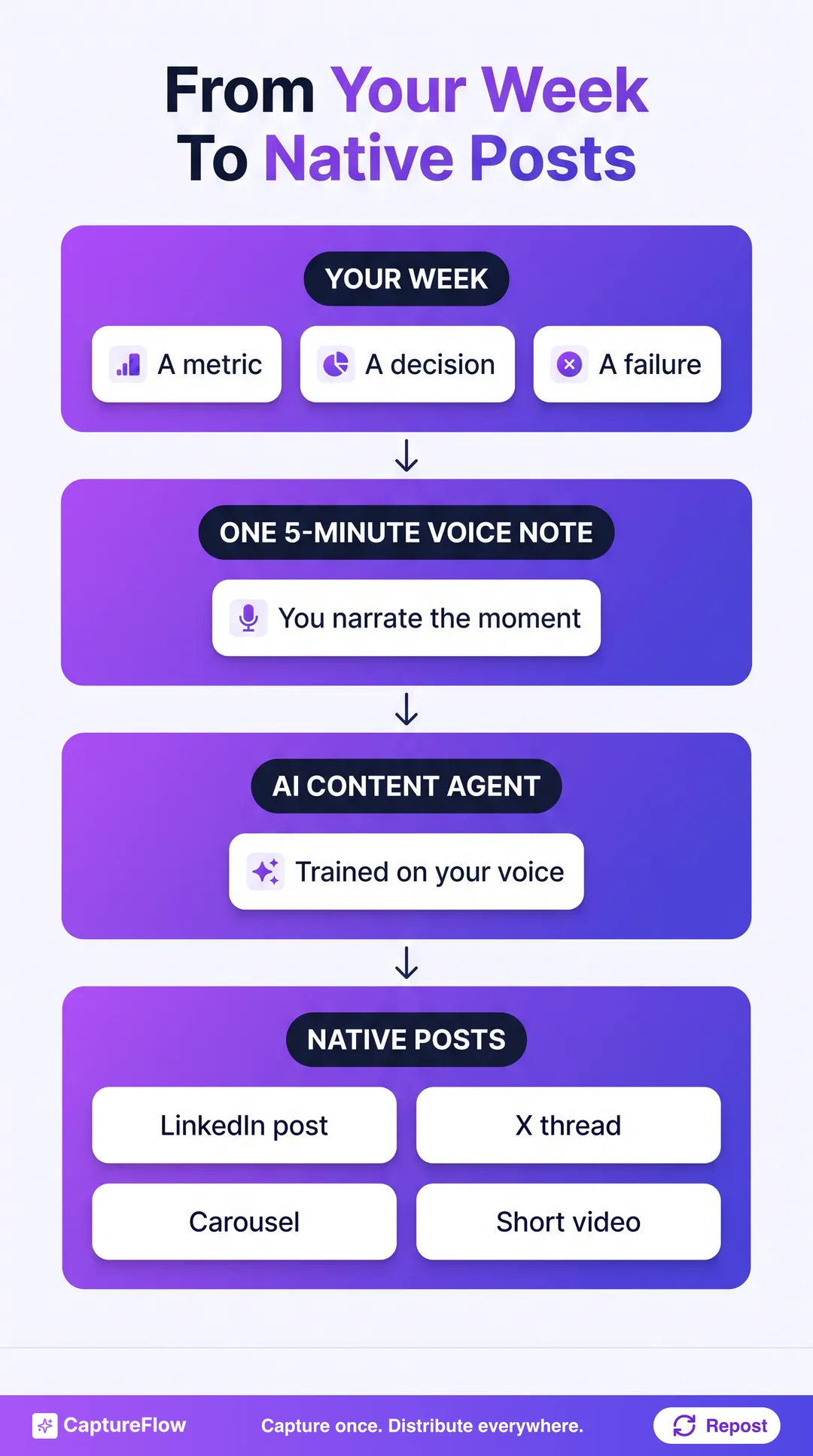 One capture in, a week of native content out. You review, you do not write from scratch.
CaptureFlow is an AI content agent that turns your expertise into weeks of on-brand content for every platform. You capture the moment in minutes, the voice note, a screenshot of the metric, a quick thought, and 5 minutes later it has reshaped that one capture into a LinkedIn post, an X thread, a carousel, a short video, and a quote image, each written natively for its platform and in your voice. You review and approve, you do not start from a blank document. That is the same machine behind a full founder content operating system, pointed at the messy middle instead of the highlight reel. When you do want to hand-craft a post, our guide on how to write a LinkedIn post that lands covers the structure.
The economics quietly moved in your favor here. In HubSpot's State of Marketing report, roughly two-thirds of marketing teams say AI now saves them 10 or more hours a week. The tooling that used to require a hire fits inside a founder's Monday.
4. Hold a weekly cadence and protect it
Building in public is not a launch, it is a habit. Commit to one or two honest posts a week and hold it for at least 90 days before you judge anything.
The weekly budget, once the system runs, is small:
| Activity | Time |
|---|---|
| Capture one moment (voice note) | 5 min |
| Review and approve drafts in your voice | 15 min |
| Distribute the week and reply to comments | 15 min |
That is roughly 35 minutes to turn your real week into content across every channel. The compounding starts around day 60, right after most people quit, which is exactly why holding the cadence is the whole edge.
5. Engage, because the conversation is the point
Building in public is not a broadcast, it is an invitation. The trust, and the inbound, happens in the replies.
Spend 15 minutes a week genuinely responding: answer the question in the comments, thank the person who pushed back, take the good idea and credit it publicly. A founder who replies like a human converts attention that a founder who only posts never will. The DMs that turn into customers, hires, and intros almost always start as a comment on an honest post.
The move
Building in public is the highest-trust content a founder can make, and the two things that stop people, where is the line and how do I keep going, are both solved above. Sort every post into the share-versus-protect grid, mine your week for the four raw materials, capture one moment in 5 minutes, and let an agent distribute it everywhere.
If the blank page and the second-job feeling are what stand between you and doing this consistently, that is exactly what CaptureFlow is built to remove. You can see how it works, or if this is your entire go-to-market, the build-in-public use case maps the system to your goals. The tools help, but the only non-negotiables are your real journey, your real voice, and showing up every week.
Sources
- Edelman and LinkedIn, 2024 B2B Thought Leadership Impact Report (73 percent trust thought leadership over marketing).
- Edelman, 2026 Trust Barometer (trust shifting to people, including "my CEO").
- DataReportal, LinkedIn Users, Stats, Data and Trends (1.2 billion members).
- HubSpot, State of Marketing report (AI time savings).
Frequently asked questions
What is a build-in-public content strategy?+
It is a repeatable system for turning the real, in-progress story of your company into public content: the metrics you hit, the decisions you are weighing, the failures you learned from, and the lessons behind them, shared as they happen rather than announced once polished. The goal is trust and inbound, built from your actual journey instead of invented content.
What should I not share when building in public?+
Keep three things private: specifics that could harm a named person (a fired employee, a lost customer's identity), unshipped strategy a competitor could act on before you ship, and anything you are under legal or contractual duty to protect. Everything else, the process, the numbers, the mistakes, is usually more valuable shared than hidden.
How often should I post building-in-public content?+
One or two honest posts a week, sustained for months, beats a burst that fades. The way to keep it up is to capture moments as they happen, a voice note after a hard call or a screenshot of a metric, so you never start from a blank page.
Chris is the founder and CEO of CaptureFlow, which he builds so founders can turn their expertise into content without hiring a team. After 10+ years building products and growing audiences from scratch, he writes about founder-led content, AI, and distribution from inside the problem he is solving: distributing consistent, on-brand content as a team of one.
Founder & CEO of CaptureFlow · 10+ years building products and audiences
One playbook a week from founders who actually create and distribute lots of content. No spam, unsubscribe anytime.
Keep reading
What to Post When Building in Public on LinkedIn
Building in public is the highest-trust content a founder can post, and the easiest to run out of ideas for. Here are the six things to actually post, and how to keep going.

What Content Grows a LinkedIn Personal Brand Fastest
Not all LinkedIn content grows a personal brand at the same speed. Here are the content types that compound fastest, ranked, and the ones quietly wasting your time.

LinkedIn Personal Branding Tips That Actually Work
Most LinkedIn personal branding advice is fluff. These nine tips are the ones that actually move the needle, from fixing your profile to staying consistent.