What Content Grows a LinkedIn Personal Brand Fastest
The content types that compound a LinkedIn personal brand fastest, ranked. Personal stories and specific takes win; generic advice stalls. Here is why.

You can post every weekday for a year and still watch your follower count crawl. Meanwhile someone in your industry writes three posts a month and their audience compounds like a savings account. The difference is almost never effort. It is what they choose to post.
So let me answer the question directly. What content grows a personal brand fastest on LinkedIn is the content only you could have written: a real story, a specific how-to, or a take you can defend. Everything else, the recycled tips and the reshared quotes, fills your feed and builds nothing.
This is not a list of hooks or posting times. It is a ranking of content types by how fast they compound a following, why the winners win, and how to sustain them without turning content into a second job.
What content grows a personal brand fastest on LinkedIn
Rank content by one question: could anyone else have posted this? The more the answer is no, the faster it grows your brand. That single test sorts almost everything.
Here is how the main content types stack up by growth leverage.
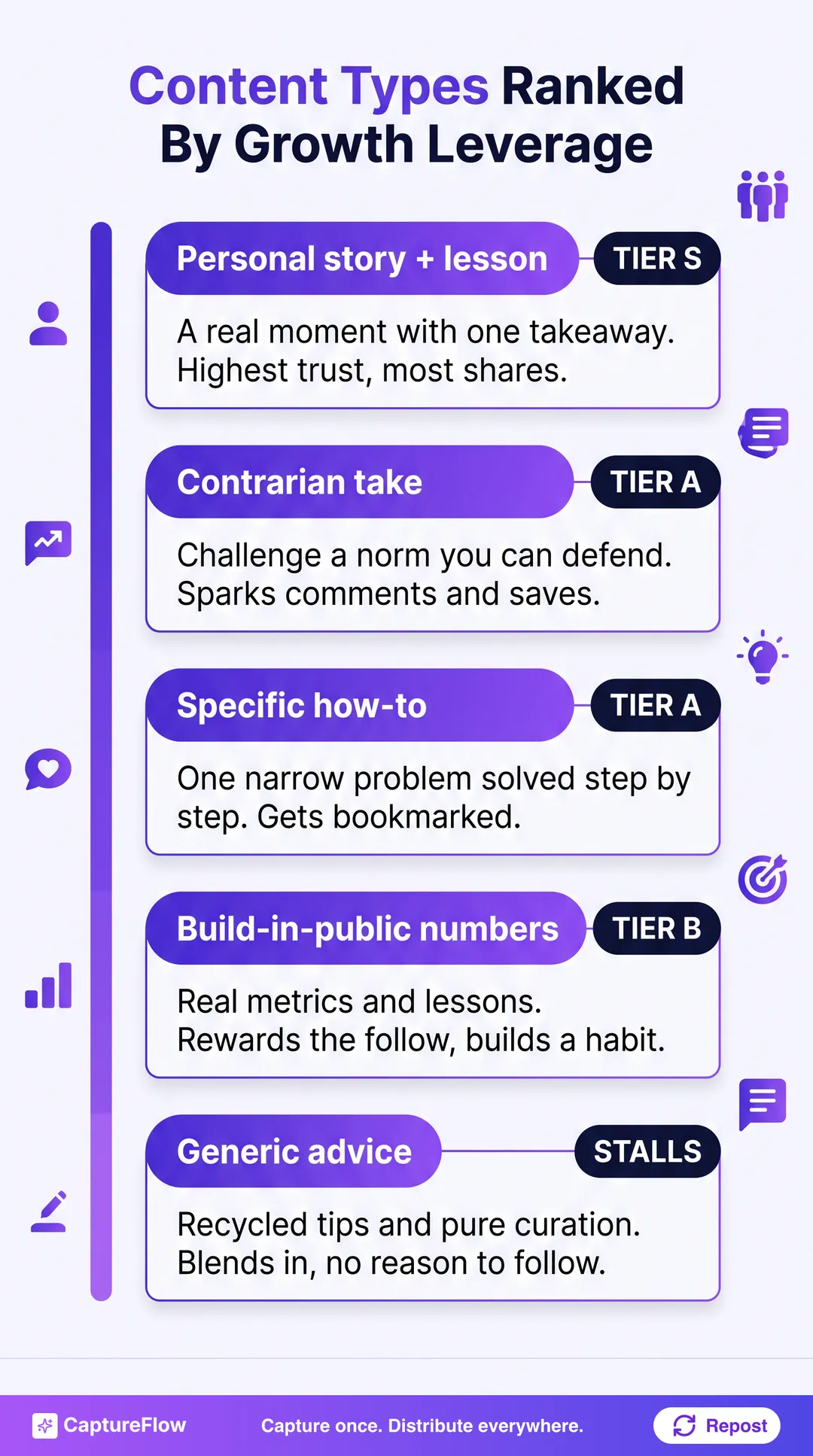 Ranked by one test: could anyone else have posted this?
Personal story with a lesson (Tier S). A real moment from your work, ending in one takeaway the reader can use. Nobody else lived it, so nobody else can copy it. Stories carry proof and emotion in a way advice never does, and they are the most shared thing on the platform because sharing them says something about the sharer too.
Contrarian take (Tier A). A widely held belief in your field that you think is wrong, and the reasoned case for why. This is the highest-comment content type because disagreement is participation. The rule: only post a contrarian take you can actually defend in the replies. A hot take you abandon under the first pushback costs you more trust than it earned.
Specific how-to (Tier A). Not "how to grow on LinkedIn," but "how I cut our onboarding email from 600 words to 90." One narrow problem, solved step by step, with the real details. Specific how-tos get saved, and saves are the quietest, strongest signal that your content was worth keeping.
Build-in-public numbers (Tier B). Real metrics and the lessons behind them: what you shipped, what it cost, what broke. It rewards the follow, because people come back for the next update, and that recurring reason to return is exactly what a growing brand needs. It sits a notch below the top only because raw numbers without a lesson can read as a scoreboard.
Generic advice and pure curation (Stalls). "Consistency is key." "Here are 10 productivity tips." Reshared quotes with a one-line reaction. These can get likes, because people agree with things they already believe, but they build nothing. There is no reason to follow you for content anyone could have posted.
Before you publish, run the anyone-else test. Read your draft and ask: could a hundred other people in my field have written this exact post? If yes, add the one thing that makes it yours, a specific number, a real moment, or a genuine opinion, before it goes out.
The three ingredients of compounding content
Look closely at everything in the top tier and the same three ingredients show up. The fastest-growing content is personal (it came from your actual experience), useful (the reader can apply it), and specific (it makes one narrow point instead of five vague ones).
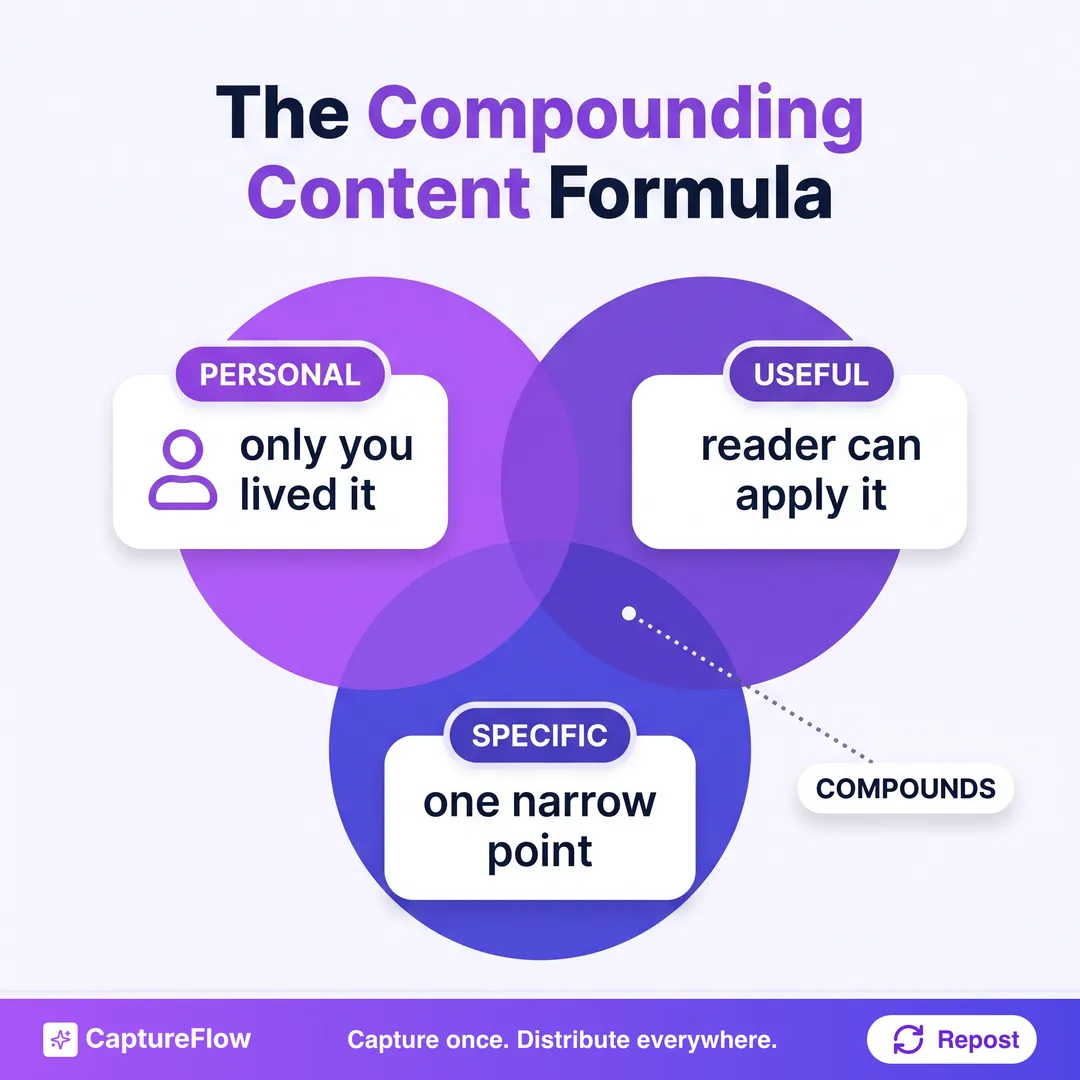 Hit all three and the post compounds. Miss one and it blends into the feed.
Miss any one and the post underperforms in a predictable way:
- Personal but not useful is a diary. Nice for you, forgettable for everyone else.
- Useful but not personal is a textbook. Correct, but it could have come from anyone, so it grows no one's brand.
- Specific but not personal or useful is trivia. Precise and pointless.
The overlap is the whole game. A post that is personal, useful, and specific gives the reader something they can act on, wrapped in proof that you have actually done it. That is the combination that earns a follow instead of a like.
The test that mattersLikes reward agreement. Follows reward the sense that you will teach them something next week too.
This is also why chasing engagement directly backfires. Engagement-bait ("Agree?" under a platitude) optimizes for the like, which is the cheap signal. Compounding content optimizes for the follow and the save, which are the signals that actually predict a growing audience.
Format is a multiplier, not the message
Once the idea passes the three-ingredient test, format decides how far it travels. And this is where founders get the order backwards. They obsess over whether to post video or a carousel before they have anything worth filming.
Get the sequence right: idea first, format second. Format is a multiplier on a good idea and a magnifier of a weak one.
That said, the multipliers are real. LinkedIn reports that video is its fastest-growing content format, and native formats (text posts, carousels, video) consistently outrun posts that push people off the platform with an external link. Here is a fair way to match a top-tier idea to a format:
- Text post. The default, and still the fastest to write and to read. Best for a personal story or a sharp contrarian take where the words carry everything.
- Carousel. Best for a specific how-to with steps or a framework. The swipe format forces one idea per slide, which suits teaching.
- Short video. Best when your delivery is the value: tone, energy, a face to the name. It is the format LinkedIn is pushing hardest right now, and the one that best builds familiarity over time.
- Quote image or infographic. Best for a single memorable line or a stat that deserves to be seen, not just read. Useful as the repostable version of a longer text post.
Notice what is not on that list. The point is not to produce every format for its own sake. It is to pick the one that makes this idea land, then let the strongest ideas travel across a few of them.
The honest part: consistency beats virality
Here is the thing most "grow fast" advice skips. One viral post does almost nothing for a personal brand. It spikes your impressions for a week, brings a wave of followers who forget you by the next scroll, and then it is over.
What actually compounds is showing up. A steady stream of top-tier posts trains two audiences at once: the humans, who start to associate your name with a specific kind of insight, and the algorithm, which learns your content reliably earns dwell time and starts showing it to more people by default. Neither of those trusts you after one hit. Both reward the founder who is still there in month six.
And the payoff is not vanity. In the 2024 Edelman-LinkedIn B2B Thought Leadership Impact Report, which surveyed roughly 3,500 business decision-makers, 73 percent said an organization's thought leadership is a more trustworthy basis for judging it than its marketing materials, 75 percent said a piece of thought leadership led them to research a product they were not considering, and 60 percent said strong thought leadership makes them willing to pay a premium. Personal brand is not a popularity contest. It is trust that converts.
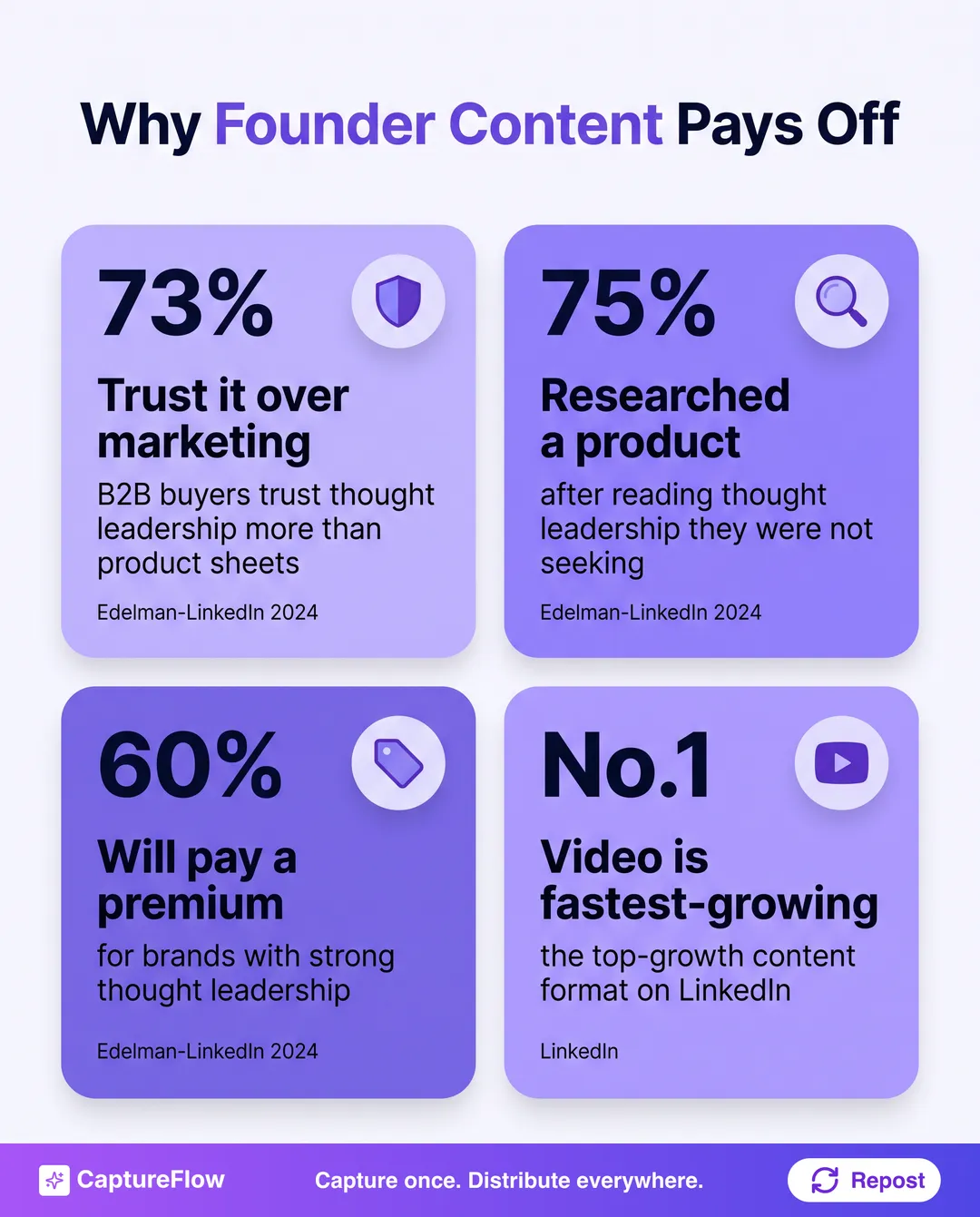 Sources: 2024 Edelman-LinkedIn B2B Thought Leadership Impact Report; LinkedIn.
The problem is that consistency is where nearly everyone quits. Writing one great personal story is easy. Writing one every week, on top of the actual job that gives you stories to tell, is the wall people hit. This is a linkedin audience growth strategy problem, not a talent problem. If you want the bigger picture, our guide to building a founder personal brand sets the strategy, our LinkedIn content ideas library and our personal branding tips guide go a level deeper on each type, and how to write LinkedIn hooks covers the opening line that decides whether any of it gets read.
How to actually sustain the winning content
The realistic way to grow personal brand LinkedIn presence is not to write more from scratch. It is to capture the raw material you already generate and turn it into the top-tier types on a schedule you can keep.
You have the stories. The client call, the thing that broke in production, the decision you reversed, the number that surprised you. Those are Tier S posts trapped in your week. The gap is the time and the blank page between having the moment and publishing it.
That is the job an AI content agent is built for. CaptureFlow is an AI content agent that turns your expertise into weeks of on-brand content for every platform. You capture one idea in 5 minutes, a voice note walking out of a meeting, a short video, a file, or a link, and CaptureFlow, trained on your voice and past posts, reshapes it into native content for each channel: a text post telling the story, a carousel of the how-to, a short-form video, a quote image of the best line. You review it, or leave it to your agent, and it distributes content across every platform on a schedule.
The winning content types do not change. Personal, useful, specific still wins. What changes is that a five-minute capture becomes the week's posts instead of a note you never get around to writing up. That is how consistency stops being a second job. See how it works or compare plans when you are ready to make the compounding automatic.
The fastest way to grow a personal brand on LinkedIn was never a hack. It is posting the things only you can say, often enough that people start to expect them.
Sources
- 2024 Edelman-LinkedIn B2B Thought Leadership Impact Report (Edelman)
- 13 Top Tips for Compelling B2B Video Content on LinkedIn (LinkedIn Marketing Solutions)
Frequently asked questions
What content grows a personal brand fastest on LinkedIn?+
Content that carries your specific perspective and proof: a real story with one clear lesson, a narrow how-to that solves a single problem, or a contrarian take you can defend. These are the posts only you could have written, so they earn trust and shares. Generic advice anyone could have posted grows a brand slowly, if at all.
Does video grow a personal brand faster than text posts on LinkedIn?+
Video is LinkedIn's fastest-growing format and it can widen reach, but format is a multiplier on the idea, not a substitute for it. A specific, personal story wins as a text post or a short video. A generic tip loses either way. Pick the format that suits the message, then stay consistent.
How long does it take to grow a personal brand on LinkedIn?+
It compounds over months, not weeks. Reach is usually slow at first, then accelerates as consistency builds a following and the algorithm learns to trust you. The people who win are rarely the best writers, they are the ones who kept posting the right kind of content after the quiet early stretch.
Chris is the founder and CEO of CaptureFlow, which he builds so founders can turn their expertise into content without hiring a team. After 10+ years building products and growing audiences from scratch, he writes about founder-led content, AI, and distribution from inside the problem he is solving: distributing consistent, on-brand content as a team of one.
Founder & CEO of CaptureFlow · 10+ years building products and audiences
One playbook a week from founders who actually create and distribute lots of content. No spam, unsubscribe anytime.
Keep reading

Build in Public: A Founder's Content Playbook
Building in public is the highest-trust content a founder can make. Here is the full strategy: what to share, where the line is, and a system to turn your week into content.

LinkedIn Personal Branding Tips That Actually Work
Most LinkedIn personal branding advice is fluff. These nine tips are the ones that actually move the needle, from fixing your profile to staying consistent.
What to Post When Building in Public on LinkedIn
Building in public is the highest-trust content a founder can post, and the easiest to run out of ideas for. Here are the six things to actually post, and how to keep going.