TikTok for B2B: What Actually Works (And What Wastes Your Time)
TikTok for B2B works when you treat it as a search-driven teaching channel. The formats that work, the ones that waste time, and how to measure pipeline.

Most B2B teams decided years ago that TikTok was not for them. Dance trends, teenagers, nothing to do with selling software or services. The short answer on TikTok for B2B: it works when you treat it as a search-driven teaching channel for buyers who research on their own, and it wastes your time when you treat it as a place to post ads.
That first assumption made sense in 2020. It doesn't hold up now, and for some teams it's quietly costing pipeline. This playbook covers the formats that actually work for B2B brands on TikTok, the ones that burn hours, how to measure pipeline instead of views, and a two-videos-a-week system you can run without a video team.
TikTok for B2B is using TikTok's search and recommendation feed to teach business buyers something useful, so they find you while they are researching a problem you solve.
Notice what's missing from that definition. Entertainment. Virality. Ads.
Is TikTok for B2B worth it in 2026?
The "Gen Z app" label is the main reason teams skip it, and it's stale. Pew Research Center's 2025 data on Americans and TikTok puts overall use at 37% of US adults, up from 21% in 2021. That includes 44% of adults aged 30 to 49 and 30% of those aged 50 to 64. Those are the people who sit on buying committees.
And the buyers themselves have gotten younger. Forrester's research director Amy Hayes reported that Millennials and Gen Z made up 64% of B2B buyers in its 2022 survey, rising to 71% a year later.
The more interesting shift is how people use the app. In the same Pew roundup, 62% of adult TikTok users said product reviews or recommendations are a reason they're on it. TikTok has told advertisers that one in four users starts searching within 30 seconds of opening the app. And in TikTok's own B2B lead generation guide, 66% of company decision makers on TikTok say they use the platform to discover or learn about business products, software, or services.
A fair caveat: the 66% figure comes from a TikTok-commissioned survey of 759 US IT decision makers (2023), so read it as a direction, not gospel. The independent numbers from Pew and Forrester point the same way, though. Your buyers are on the app, and some of them are searching it.
One more thing that's different from LinkedIn. TikTok recommends videos on what people watch and engage with, not just who follows you. A new account can get a useful 45-second walkthrough in front of people searching for that exact problem in week one. On LinkedIn you mostly earn reach over months.
Your buyers are there. What's left to decide is whether they find your explanation, or a competitor's, when they search for the problem.
What actually works for B2B on TikTok?
Every format that performs for B2B on TikTok shares one trait: it's useful before it's promotional. Three formats do most of the work.
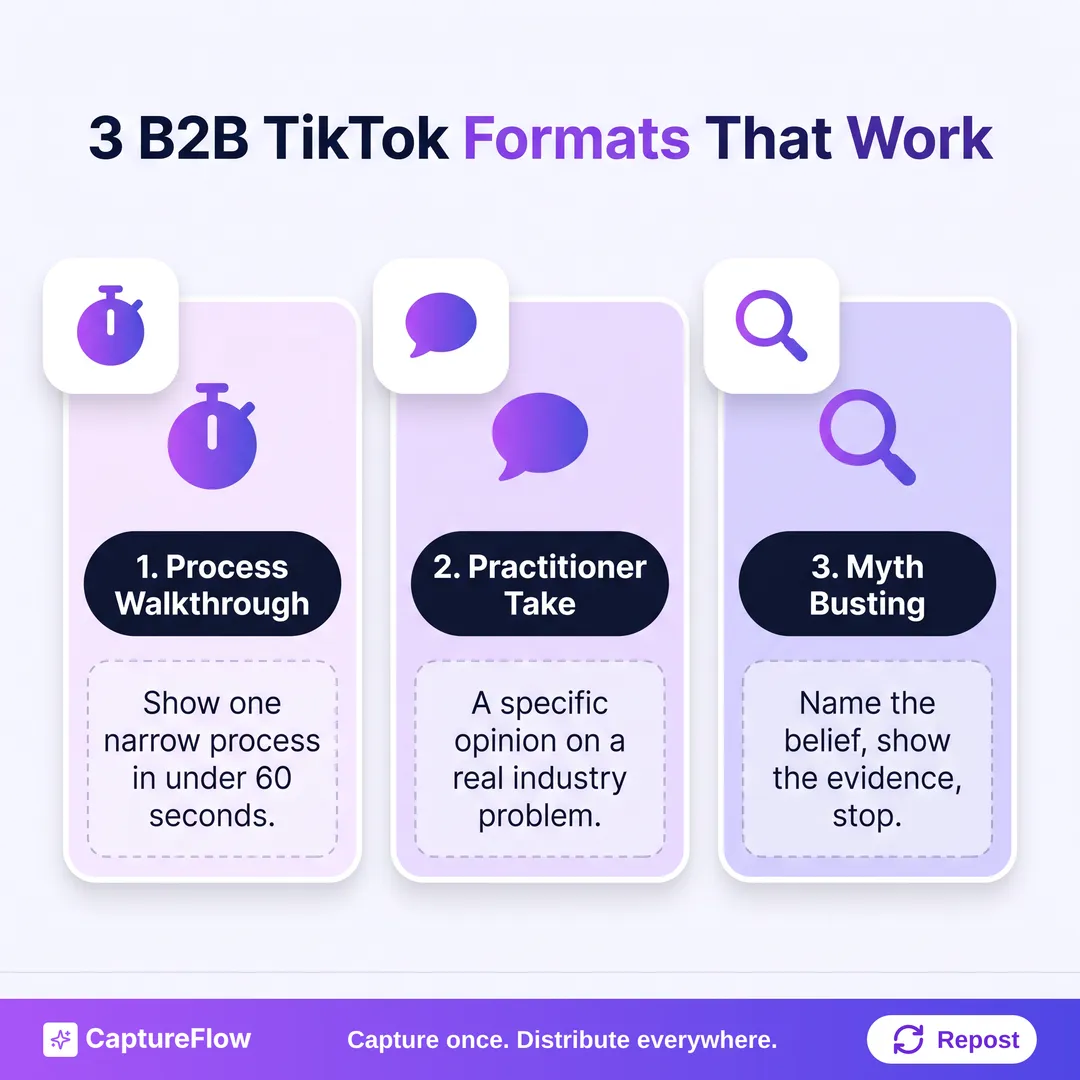 Three formats carry most B2B TikTok accounts.
1. Process walkthroughs under 60 seconds
Show how you do one narrow thing. Not a product demo, not a brand overview. "How we qualify a lead in under 3 minutes." "The exact prompt we use for client research." "Our three-question discovery call opener."
These work because they're searchable (someone typed that problem into the search bar), finite (one process, one video), and they prove you know your stuff without a pitch. A screen recording with your voice over it counts. So does you at a whiteboard with your phone propped on a stack of books.
Polish isn't the point. A phone camera, decent light, and a clear hook in the first three seconds is enough. If you need help with that opener, our free TikTok hook generator turns a topic into ten hook options in different styles.
2. Founder or practitioner point-of-view clips
A real person giving a direct take on something in their industry. "Most SaaS onboarding is built for the company, not the customer. Here's what I mean." Opinions get comments, and comments get distribution.
The trick is specificity. "My thoughts on AI" gets scrolled past. "Why I stopped using AI-generated outlines after 30 days of testing them" gets watched, because the viewer knows exactly what they'll learn and roughly how long it'll take.
This is the same founder-led instinct that works on LinkedIn (we cover the strategy side in our guide to building a founder personal brand). The difference on TikTok is that you say it out loud, on camera, in under a minute.
3. Myth-busting with evidence
Short, contrarian claims with proof. "Everyone says you need to post daily. Here's what the data actually shows." B2B audiences like being corrected when the correction saves them time.
Frame it as a correction, not a lecture. State the belief, say why it's wrong, show the evidence, stop. Under 60 seconds, ideally under 45.
If you would put it in a sales deck, don't put it on TikTok. If you would say it to a smart prospect over coffee, it probably works.
What wastes your time on TikTok?
The failures look a lot alike. They're all things that were made for somewhere else.
| Format | Why it fails |
|---|---|
| Polished corporate brand videos | Reads as an ad in the first second. People swipe. |
| Talking-head product demos | No hook, no tension, nothing for anyone to react to. |
| Generic "5 tips for [industry]" videos | Too broad to match a search, too shallow to save. |
| LinkedIn posts read aloud to camera | Wrong rhythm. Written posts are dense; TikTok wants one idea, fast. |
| Anything over 90 seconds without a strong hook | Viewers leave early, and the video stops getting shown. |
| Chasing dance trends and memes | Fun once. Attracts viewers who will never buy. |
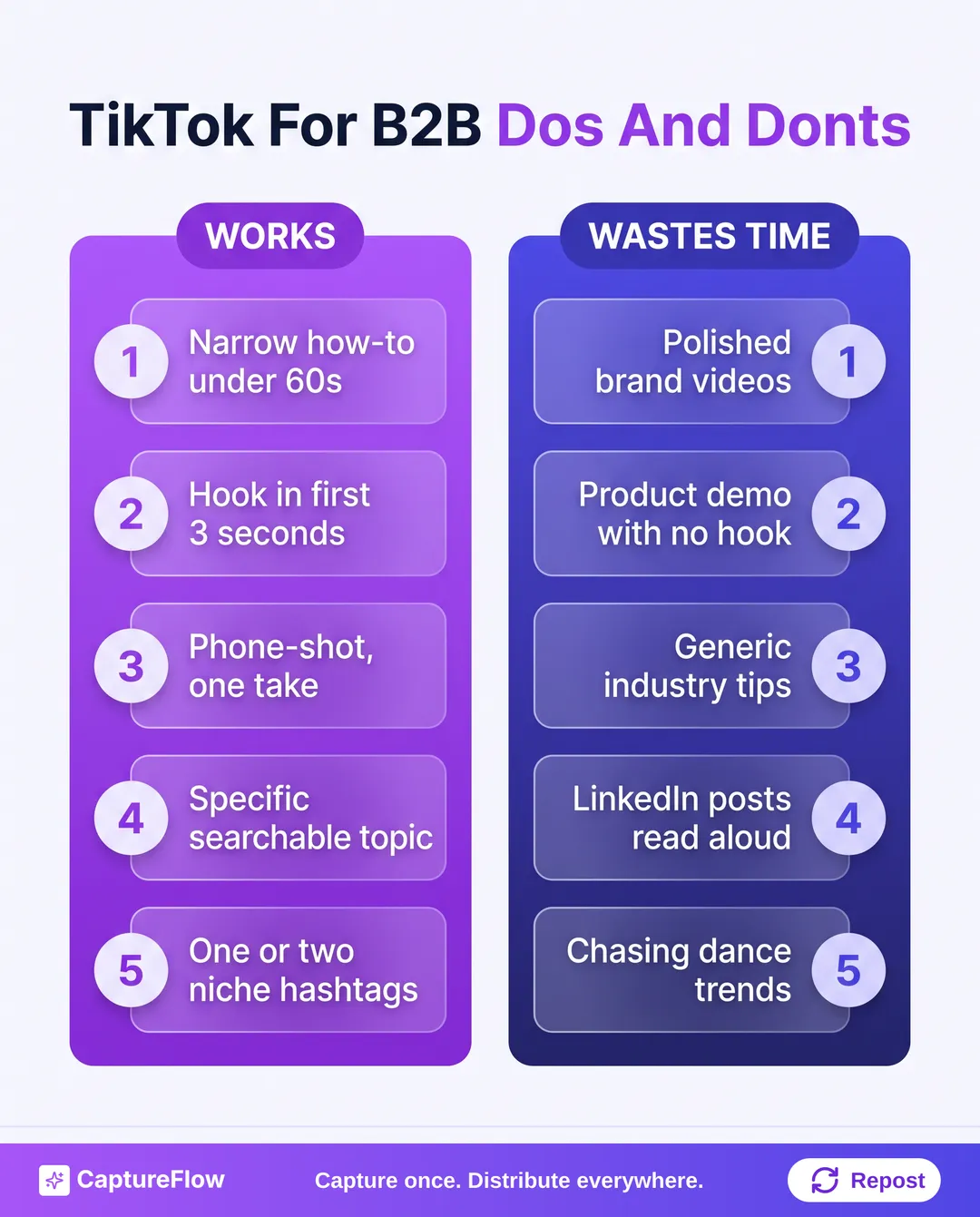 Keep this one next to your phone when you record.
That fourth row deserves a note, because it's the most tempting shortcut. Reusing ideas across platforms is smart; we built a whole company on it. Reusing the exact format is not. A LinkedIn post that runs 1,200 characters needs to become one sharp spoken point with a visual, not a teleprompter read. Our walkthrough on turning one video into content for every platform shows what changes between channels.
How do you measure TikTok for B2B pipeline, not vanity?
Views are the wrong scoreboard. A video with 200,000 views and zero pipeline is a nice afternoon. A video with 3,000 views that drives 40 profile visits and 12 link clicks to a real landing page is a channel.
Track these, roughly in order of intent:
- Saves. The strongest intent signal on the platform. Someone saving a B2B how-to plans to come back to it, often when they're actually doing the task.
- Profile visits after a video. TikTok Studio shows these per video. A spike tells you the video made someone curious about who you are, not just what you said.
- Link-in-bio clicks. Point the link at a high-intent page (a free tool, a specific landing page, a template), not your homepage. Rotate UTM-tagged links so you can tell which video drove the click.
- Comments that ask questions. Warm intent. Reply to every one; the reply is often your next video.
- Search-sourced views. TikTok's analytics break views down by traffic source, including search. For B2B, a rising search share means people are looking for exactly what you explain.
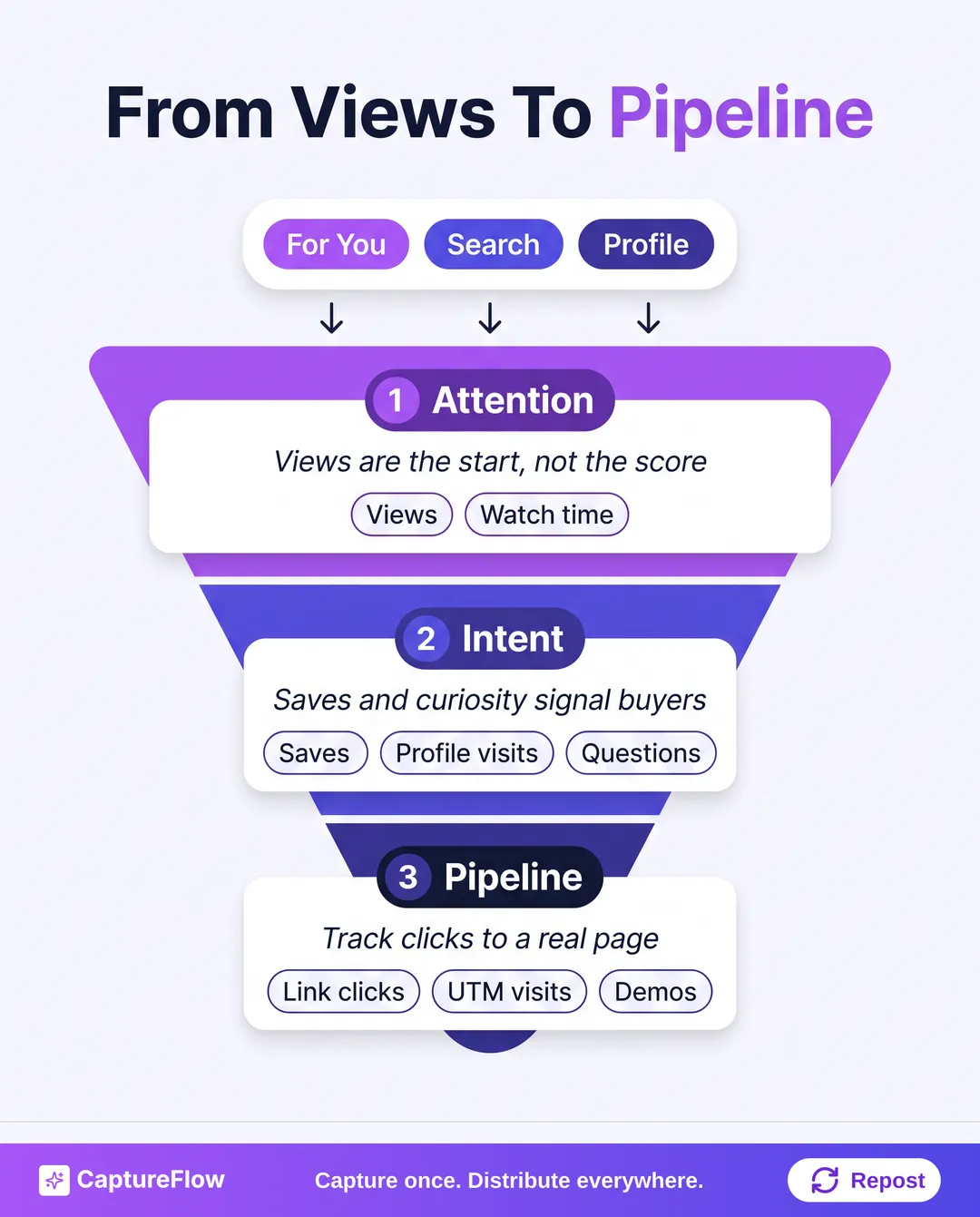 Read your analytics from the top of this funnel down.
What to ignore early: total views and follower growth. Both trail content quality, and chasing them pushes you toward trend videos that attract the wrong viewers.
For a benchmark, remember that TikTok divides engagement by views, not followers, so its rates look much higher than Instagram's. Our engagement benchmarks tool puts a median TikTok account in the 25k to 100k tier at about 4%. If you're well under that after a few weeks, the hook or the format is the problem, not the channel. You can check your own number with the TikTok engagement calculator.
A capture-first system for posting twice a week
B2B teams usually quit TikTok for a boring reason: they designed a workflow that needed a video team they didn't have. Here's one that needs one person and a phone.
Don't start with TikTok. Start with what you already explained this week. Every week has at least two moments where you walked a customer through something, made a call in a meeting, or had a strong opinion about how your industry does things. That's the content. (This is the core of the capture-first content system: you capture what you already said instead of inventing ideas from a blank page.)
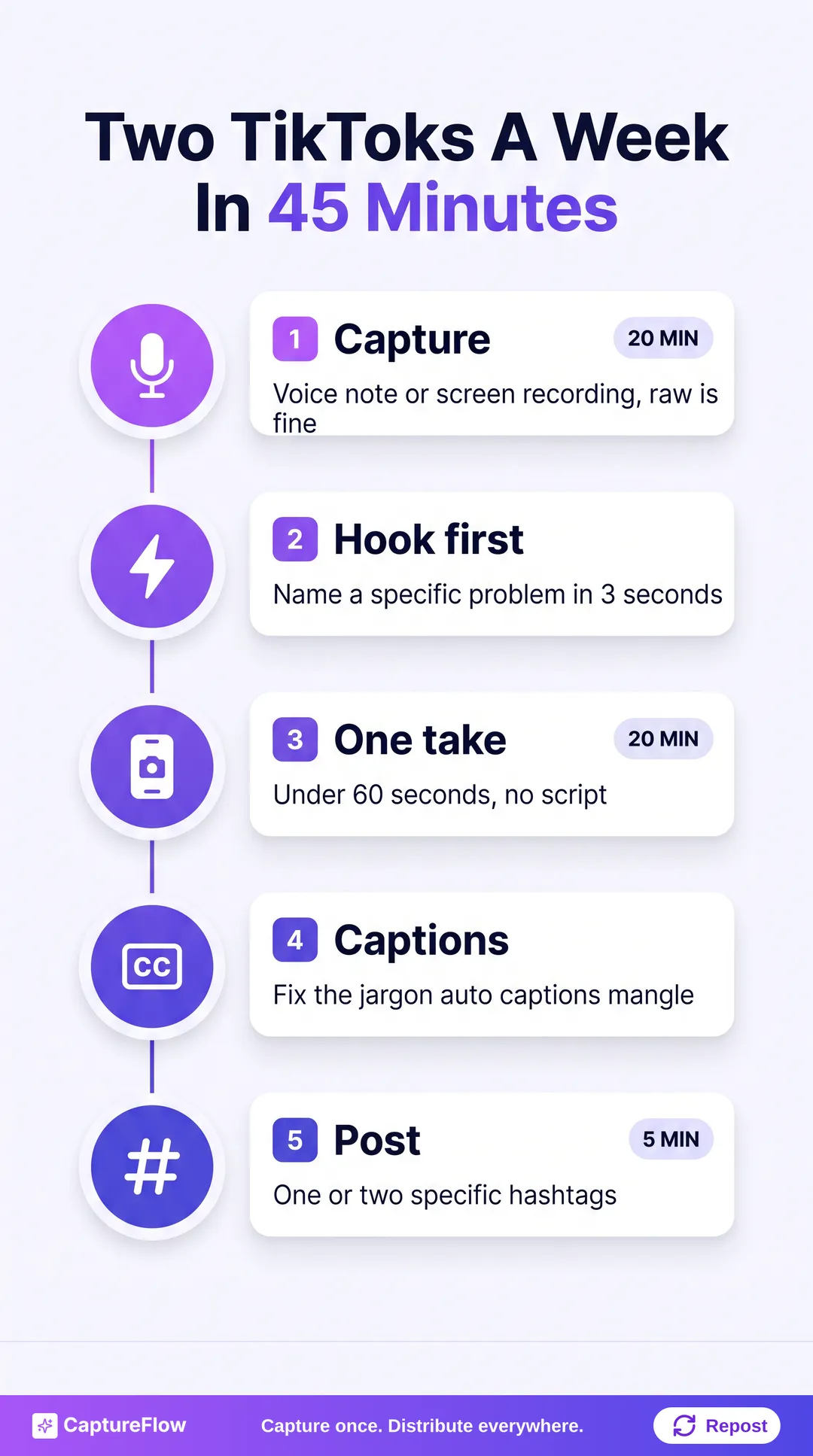 Two videos a week, one person, about 45 minutes.
- Capture the moment when it happens. A voice note after a sales call, a screen recording of a process you just ran, a 30-second phone clip. Raw is fine. You're catching the idea, not producing the video. If voice notes are your thing, here's how to turn voice notes into content.
- Write the hook first. The first three seconds decide whether anyone stays. Name a specific problem or make a specific claim. "Why your outbound sequence gets ignored" works. "Today I want to talk about outbound" doesn't.
- Record in one take. Natural delivery, no script, under 60 seconds. If you flub a line, keep going. Real beats rehearsed here.
- Check the captions. TikTok generates them automatically; read them and fix the jargon it mangles (it will mangle your product name). Plenty of people watch with the sound off.
- Post with one or two specific hashtags. #saasmarketing or #b2bsales, not #business. Specific tags match specific searches.
Realistically, that's about 45 minutes a week for two videos: 20 minutes spotting and capturing ideas, 20 minutes recording and captioning, 5 minutes scheduling.
Batch the recording. Capture ideas all week as they happen, then record both videos back to back in one sitting. Switching into "on camera" mode twice a week costs more than doing it once.
This is where CaptureFlow fits. CaptureFlow is an AI content agent that turns your expertise into weeks of on-brand content for every platform. You capture one idea in 5 minutes (a voice note, a video, a file, or a link), and CaptureFlow, trained on your voice and past posts, reshapes it into native content for each channel: a TikTok video with captions, a LinkedIn post, an X thread, a carousel. You review it, or leave it to your agent, and it schedules the lot. See how it handles TikTok specifically, or the full list of output formats.
Should you run a 30-day TikTok test?
Answer these honestly before you commit.
Run the test if:
- Your buyers are roughly 25 to 45 and research solutions on their own before talking to sales.
- A founder or subject-matter expert will appear on camera twice a week.
- You can name at least five specific problems your audience searches for that you could explain in under 60 seconds.
- You're willing to judge it on saves and profile visits, not views.
Skip it for now if:
- Your buyers are enterprise C-suite who find vendors through referrals and analysts.
- Nobody will be on camera and there's no budget to test creator partnerships.
- Your sales cycle is purely relationship-driven.
- You're already stretched on LinkedIn and haven't built a repeatable system there. Fix that first; our LinkedIn marketing guide for B2B companies is a good place to start.
What a real 30-day test looks like
Eight videos. Two a week. Each under 60 seconds and built around one searchable problem. At day 30, look at three numbers: total saves, link-in-bio clicks, and the share of views coming from search.
Our rule of thumb (not a platform benchmark): if saves are above roughly 2% of views and link clicks are sending real traffic somewhere useful, extend the test to 90 days. If all three are flat after eight videos with strong hooks, TikTok isn't the right channel for you right now. That's a fine answer. You found it out for about three hours of work and no ad spend.
The cost of not running it is never knowing. If you want the capture and drafting handled so the test is mostly just hitting record, take a look at CaptureFlow's pricing.
Sources
- Pew Research Center: 8 facts about Americans and TikTok
- Forrester: Younger Generations Are Shaking Up B2B Buying
- TikTok for Business: B2B Lead Generation Guide
- Adweek: TikTok adds AI-powered tools to woo marketers
- CaptureFlow: Engagement benchmarks by platform
Frequently asked questions
Does TikTok work for B2B companies?+
It can, if your buyers are under about 45 and research on their own before talking to sales. TikTok's own research says 66% of company decision makers on the platform use it to discover or learn about business products, software, or services. It works best as an educational, search-driven channel, not a place for ads that look like ads.
What type of B2B content performs best on TikTok?+
Short, specific, useful videos: a process walkthrough under 60 seconds, a practitioner's direct take on an industry problem, or a myth-busting clip backed by evidence. Native, phone-shot delivery tends to beat polished corporate production.
How do you measure B2B results on TikTok?+
Track saves, profile visits after each video, link-in-bio clicks with UTM-tagged links, question comments, and the share of views that come from search. Those signal buying intent. Total views and follower growth are lagging indicators, so don't optimize for them early.
How often should a B2B brand post on TikTok?+
Twice a week is enough for a fair test. Eight videos over 30 days gives you enough data to see whether saves, link clicks, and search traffic are moving without needing a video team.
Should a B2B company skip TikTok?+
Skip it for now if your buyers are enterprise C-suite who find vendors through referrals, if nobody on your team will appear on camera, or if you have not built a repeatable content system on LinkedIn yet.
Chris is the founder and CEO of CaptureFlow, which he builds so founders can turn their expertise into content without hiring a team. After 10+ years building products and growing audiences from scratch, he writes about founder-led content, AI, and distribution from inside the problem he is solving: distributing consistent, on-brand content as a team of one.
Founder & CEO of CaptureFlow · 10+ years building products and audiences
One playbook a week from founders who actually create and distribute lots of content. No spam, unsubscribe anytime.
Keep reading
Best Time to Post on TikTok in 2026 (Data-Backed)
TikTok is the one big platform where the weekend beats the workweek. Here is what the non-vendor data says about timing in 2026, and a 14-day test to find your own window.
Pinterest for B2B: Evergreen Traffic Without Algorithm Anxiety
Your LinkedIn post is dead by Thursday. A good Pin can still be sending traffic next spring. Here is how B2B teams use Pinterest as a search channel, what to pin first, and a 60-day plan to test it.
LinkedIn Marketing for B2B Companies
For B2B, LinkedIn is not one channel among many. It is the channel. Here is how B2B companies actually win on it: the stack, the pillars, and the cadence.