Best Time to Post on TikTok in 2026 (Data-Backed)
The best time to post on TikTok is weekday and weekend evenings, 6 to 9 pm, with Saturday, Friday, and Sunday leading. Here is the data and how to test it.


You film a good clip on Tuesday at 11 am between two calls, post it, and watch it stall at 300 views. The same idea, posted Saturday evening, would probably have done better, and not because the video changed. On TikTok, your audience is on the couch, not at a desk.
So here's the direct answer. The best time to post on TikTok in 2026 is the evening, roughly 6 to 9 pm in your audience's time zone, and the best days are Saturday, Friday, and Sunday. Monday and Tuesday are the weakest. That's backwards compared to LinkedIn timing, and it's the single most useful thing to know before you build a TikTok schedule. Below: where that answer comes from, how honest it is, why timing matters less than your hook, and a 14-day test to find your own window.
What is the best time to post on TikTok?
The best time to post on TikTok is the evening and the weekend: the hours when your audience has stopped working and opened the app to unwind.
The cleanest non-vendor number comes from HubSpot's TikTok timing research, based on a survey of 300+ marketers. A quarter of them said 6 to 9 pm was their best window, followed by 3 to 6 pm and then noon to 3 pm. On days, the order was Saturday, Friday, Sunday, with Monday and Tuesday at the bottom.
Two caveats, because you deserve them. First, that's a survey of what marketers saw, not a log analysis of billions of views. Second, HubSpot's own cross-platform timing guide is blunter about TikTok than about any other network: "Recommendations vary." Most of the precise, to-the-minute TikTok charts you'll find online come from scheduling tools analyzing their own customers, and they disagree with each other. We won't repeat those here.
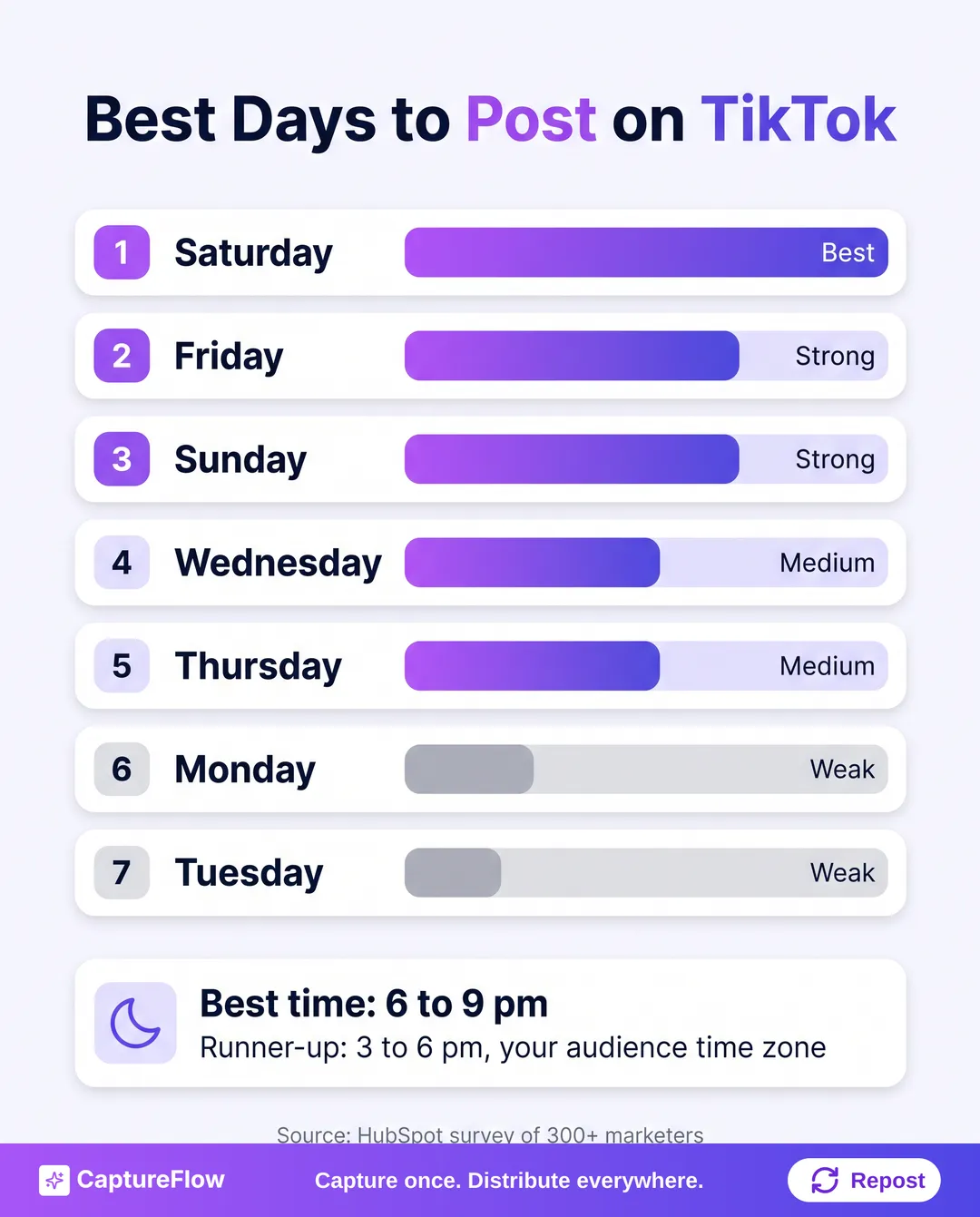 Day ranking from HubSpot's survey of 300+ marketers. Treat it as a starting hypothesis, not a law.
If a chart promises "Tuesday at 9:14 am is the magic minute," check who made it. Almost every hyper-precise TikTok timing chart comes from a scheduling vendor's own customer base. The pattern that survives across sources is simpler: evenings and weekends.
Why does TikTok peak on weekends when LinkedIn peaks on Tuesdays?
Because people use them for different things. LinkedIn is a work tool that lives in the 9-to-5. TikTok is entertainment: in Pew Research Center's TikTok fact roundup, 95 percent of adult users say entertainment is a reason they use it.
And it's a daily habit for a big slice of people. Pew's 2025 social media survey found 24 percent of US adults use TikTok every day, more than double X's 10 percent. Among 18 to 29 year olds, roughly half open it daily. Women (28 percent daily) are heavier users than men (19 percent).
Globally, DataReportal puts TikTok's ad reach at 2.33 billion users as of October 2026, split almost evenly between women and men, with 25 to 34 year olds the largest age group. That's not a teen app anymore. It's working adults, which is exactly why it fills up after work and on Saturdays.
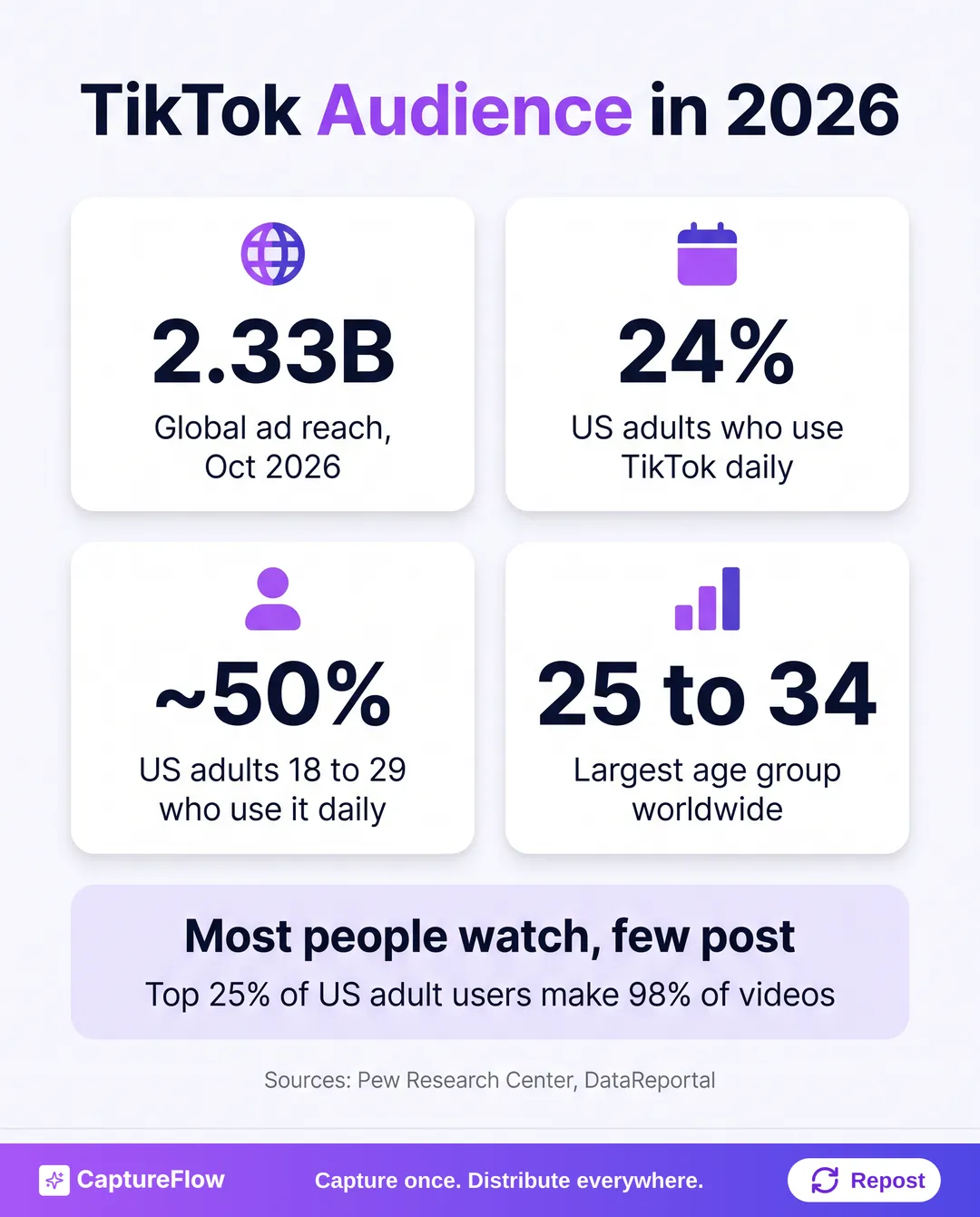 Who is on TikTok, and how often. Sources: Pew Research Center and DataReportal / Kepios.
There's one more number worth sitting with. Pew found that the most active 25 percent of US adult TikTok users produced 98 percent of the public videos. Most people on TikTok watch. Very few post. The watching happens in leisure hours, so that's when your video wants to land.
Does posting time affect the TikTok algorithm?
Less than the timing charts imply. Here's how TikTok itself describes it.
In its own explainer on how the For You feed works, TikTok says recommendations rank videos on a mix of user interactions, video information (captions, sounds, hashtags), and device and account settings, with that last group weighted lower. Strong signals count more than weak ones; TikTok's example is whether someone watches a longer video all the way to the end. And, good news for small accounts, follower count is not a direct factor.
Nowhere in that list is "posted at 7 pm."
What timing actually does is size your first audience. Post when your followers and lookalike viewers are scrolling, and the interactions TikTok weighs most (watch-through, rewatches, shares, comments) arrive faster and from more people. Post at 4 am, and the same video waits for an audience that is asleep.
A great hook at an average hour beats a weak hook at the perfect hour. Timing gets people in front of your video. The first two seconds decide whether they stay.
You'll sometimes hear that a mediocre hook at the right time beats a strong hook at the wrong time. I don't buy it, and TikTok's own description of its ranking doesn't support it: completion is a content signal, not a clock signal. If you have one hour to spend this week, spend it on writing better hooks, not on shaving 20 minutes off your posting time.
How do you find your own best time to post on TikTok?
Averages get you into the right neighborhood. Your own data gets you to the right door. TikTok gives you the data for free.
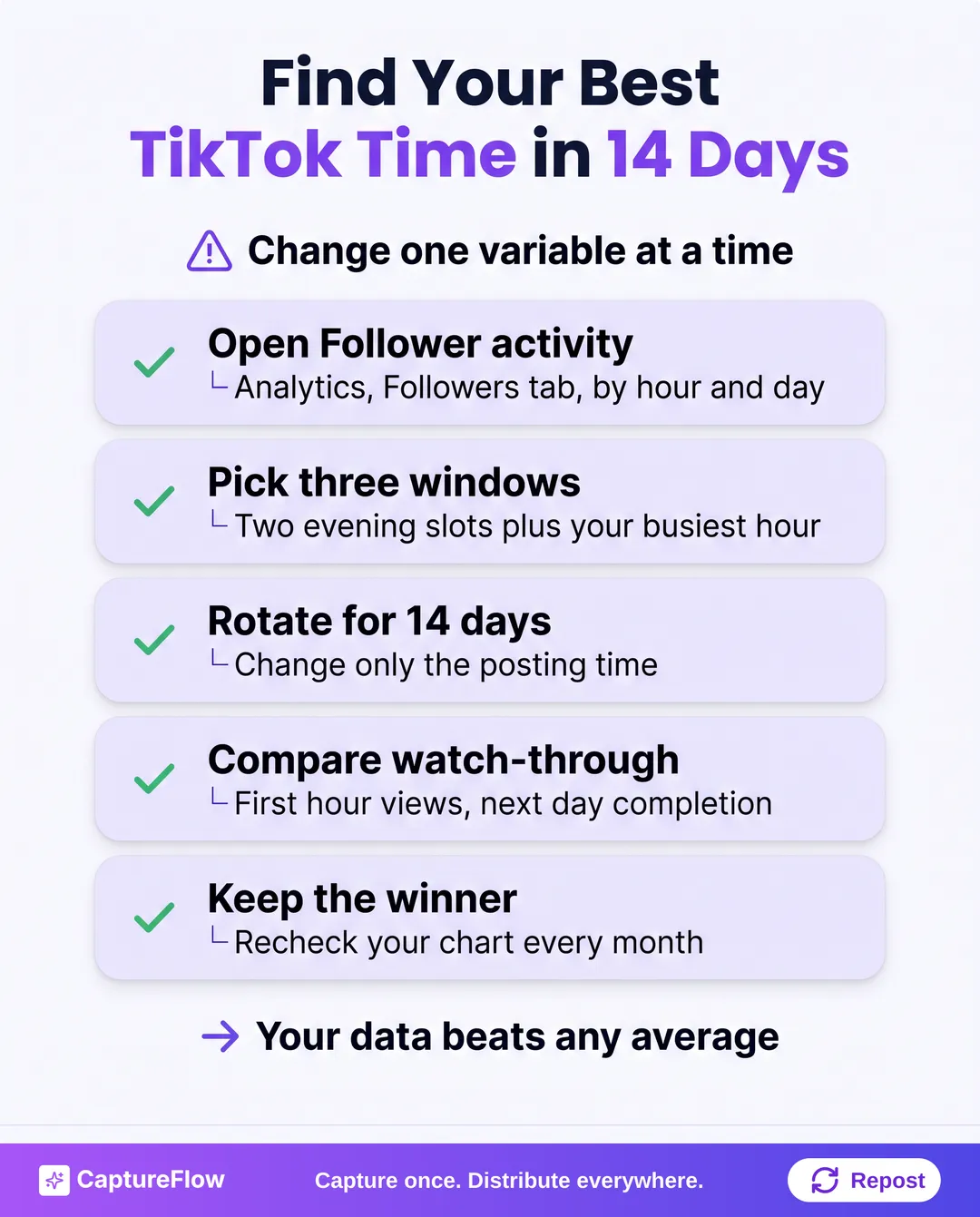 Two weeks, one variable, an answer built from your audience instead of a survey.
- Open Follower activity. In TikTok Studio or Creator tools, go to Analytics, then the Followers tab, and scroll to Follower activity. It shows when your followers are on the app, by hour and by day, in your local time zone. If your audience lives in another time zone (a Warsaw founder selling to US buyers, say), convert before you schedule.
- Pick three windows. Start from the data: one early-evening slot, one later-evening slot, and the busiest hour your own chart shows. At least one test day should be a Saturday or Friday.
- Rotate for 14 days. Keep format and length steady so the clock is the only thing that changes. If you swap the hook style, the topic, and the hour in the same week, you can't credit anything.
- Judge the first hour, then the next day. In the first 60 minutes, watch views and comments as a quick read on whether people were awake. A day later, check average watch time and the share of viewers who watched to the end, since that's the signal TikTok says it weighs most.
- Keep the winner, recheck monthly. Audiences drift with seasons, school terms, and your own growth. A window you trusted in March can go quiet by July.
The one metric to watch after you post: watch-through. If views come in fast but people leave in the first two seconds, the timing worked and the hook didn't. If views barely trickle in, try a different window before you blame the video.
What does a good TikTok posting schedule look like in 2026?
Here's a starter schedule built from the sourced patterns. Adjust it the moment your own Follower activity disagrees.
| Day | Priority | Suggested window (audience local time) |
|---|---|---|
| Saturday | Highest | 6 to 9 pm, or late morning if your chart shows it |
| Friday | High | 6 to 9 pm |
| Sunday | High | 3 to 6 pm or 6 to 9 pm |
| Wednesday, Thursday | Medium | 6 to 9 pm |
| Monday, Tuesday | Lowest | Skip, or post your experiments here |
On volume, TikTok's own posting cadence guidance suggests starting at about 3 posts a week and building up. That maps neatly onto the table: Friday, Saturday, Sunday to start, then add weekdays as your supply grows. We break down cadence across every platform in how often to post on social media. And if you're a B2B team wondering whether TikTok is worth it at all, read TikTok for B2B first; your buyers' evenings may look different from a consumer audience's.
The honest take: timing is the easy part
You can settle the timing question this afternoon. Evenings, weekends first, check Follower activity, test for two weeks. Done.
The hard part is having three or more good videos ready every week without TikTok becoming a second job. That's a supply problem, not a scheduling one. A perfect Saturday 7 pm slot is worthless if the queue is empty on Friday night.
That's what CaptureFlow is for. CaptureFlow is an AI content agent that turns your expertise into weeks of on-brand content for every platform. You capture one idea in about 5 minutes (a voice note, a video, a file, or a link), and CaptureFlow, trained on your voice and past posts, reshapes it into native content for each channel: a TikTok-ready short video, a LinkedIn post, an X thread, a carousel. Then it schedules them into the windows you just validated. You can see how it handles TikTok specifically on our TikTok page, or test your hooks first with the free TikTok hook generator.
Post into the evening and the weekend. Then make the exact hour matter less by never letting the slot go empty. If supply is your real constraint, see how CaptureFlow works or check pricing.
Sources
- HubSpot: When to Post on TikTok: A Simple Guide
- HubSpot: The Best Times to Post on Social Media in 2025
- Pew Research Center: Americans' Social Media Use 2025
- Pew Research Center: 8 facts about Americans and TikTok
- DataReportal / Kepios: TikTok Users, Stats, Data and Trends
- TikTok Newsroom: How TikTok recommends videos #ForYou
- TikTok Creator Academy: Posting cadence best practices
Frequently asked questions
What is the best time to post on TikTok in 2026?+
Evenings, roughly 6 to 9 pm in your audience's local time, with 3 to 6 pm as the runner-up. In HubSpot's survey of 300+ marketers, the 6 to 9 pm window was the most common pick for best results.
What is the best day to post on TikTok?+
Saturday, then Friday, then Sunday, according to HubSpot's marketer survey. Monday and Tuesday were the weakest days. TikTok behaves like a leisure app, so it peaks when people are off work.
Does posting time affect the TikTok algorithm?+
Only indirectly. TikTok says its For You feed ranks videos on user interactions, video information, and device settings, with signals like watching a video to the end weighted heavily. Posting when your audience is online just gives those signals a faster start.
How do I find the best time to post for my own TikTok account?+
Open TikTok Analytics, go to the Followers tab, and check Follower activity, which shows when your followers are on the app by day and hour. Then rotate posts across your top three windows for 14 days and keep the winner.
How often should I post on TikTok?+
TikTok's own creator guidance suggests starting at about 3 posts a week and building up. Many growth-focused accounts post 1 to 2 times a day once they have a steady supply of ideas.
Chris is the founder and CEO of CaptureFlow, which he builds so founders can turn their expertise into content without hiring a team. After 10+ years building products and growing audiences from scratch, he writes about founder-led content, AI, and distribution from inside the problem he is solving: distributing consistent, on-brand content as a team of one.
Founder & CEO of CaptureFlow · 10+ years building products and audiences
One playbook a week from founders who actually create and distribute lots of content. No spam, unsubscribe anytime.
Keep reading

TikTok for B2B: What Actually Works (And What Wastes Your Time)
Most B2B teams wrote TikTok off years ago. The buyers didn't. Here is what actually works for B2B on TikTok, what burns your hours, and a 30-day test that tells you whether it is worth it.

Pinterest for B2B: Evergreen Traffic Without Algorithm Anxiety
Your LinkedIn post is dead by Thursday. A good Pin can still be sending traffic next spring. Here is how B2B teams use Pinterest as a search channel, what to pin first, and a 60-day plan to test it.

LinkedIn Marketing for B2B Companies
For B2B, LinkedIn is not one channel among many. It is the channel. Here is how B2B companies actually win on it: the stack, the pillars, and the cadence.