Short-Form Video Script Writing: Hook Viewers in the First 3 Seconds
A short-form video script needs four parts: a hook, a promise, one idea, and a CTA. Here is how to write each, with 9 hook structures and a template.

Most founders script short-form video the way they'd write an essay. Context first, then the build, then the point. The viewer is gone before the point arrives. The fix is a short-form video script with four parts in a fixed order, and a hook that does its whole job in the first 3 seconds.
That sounds harsh, and it is. But it's also good news, because the structure is learnable in an afternoon. This guide gives you the four parts, nine hook structures you can steal, a fill-in template, and a way to turn the LinkedIn posts you've already written into scripts.
A short-form video script is a 30 to 90 second spoken outline built as hook, promise, one idea, and a call to action, written to be heard rather than read.
Why do the first 3 seconds decide everything?
Because the feed doesn't wait. Back in 2016, Facebook's research team found people spend about 1.7 seconds with a piece of mobile feed content on average, against 2.5 seconds on desktop. The same report noted that people can recall feed content after just 0.25 seconds of exposure. Feeds have only gotten faster since.
The platforms say the same thing in their own guidance. TikTok's creative best practices for ads tell advertisers to "introduce your content proposition in the first 3 seconds" and to put the hook in the first 6. That's written for paid ads, but organic video lives in the same feed and faces the same thumb.
And the ranking systems reward what happens after the hook. Instagram's head, Adam Mosseri, said in January 2025 that the top three ranking signals are watch time, likes, and sends. YouTube Studio reports a "viewed vs. swiped away" number for every Short. None of those numbers move if people leave in second two.
A fair caveat: nobody publishes a hard "3-second cutoff" in their algorithm. The 3 seconds is a design target, not a law. Treat it as the window in which the viewer decides whether you're worth the next ten.
The 4-part short-form video script framework
Every short video that holds attention does four jobs, in this order. They aren't interchangeable.
| Part | Its job | Time (60-second video) | Rough word budget |
|---|---|---|---|
| Hook | Stop the scroll | 0 to 3 seconds | 5 to 10 words |
| Promise | Say why to keep watching | 3 to 7 seconds | 10 to 15 words |
| Body | Deliver one idea or one process | 7 to 55 seconds | 100 to 120 words |
| CTA | Ask for one next action | 55 to 60 seconds | 10 to 15 words |
That's the whole script. Four moves. A 60-second video doesn't need a fifth.
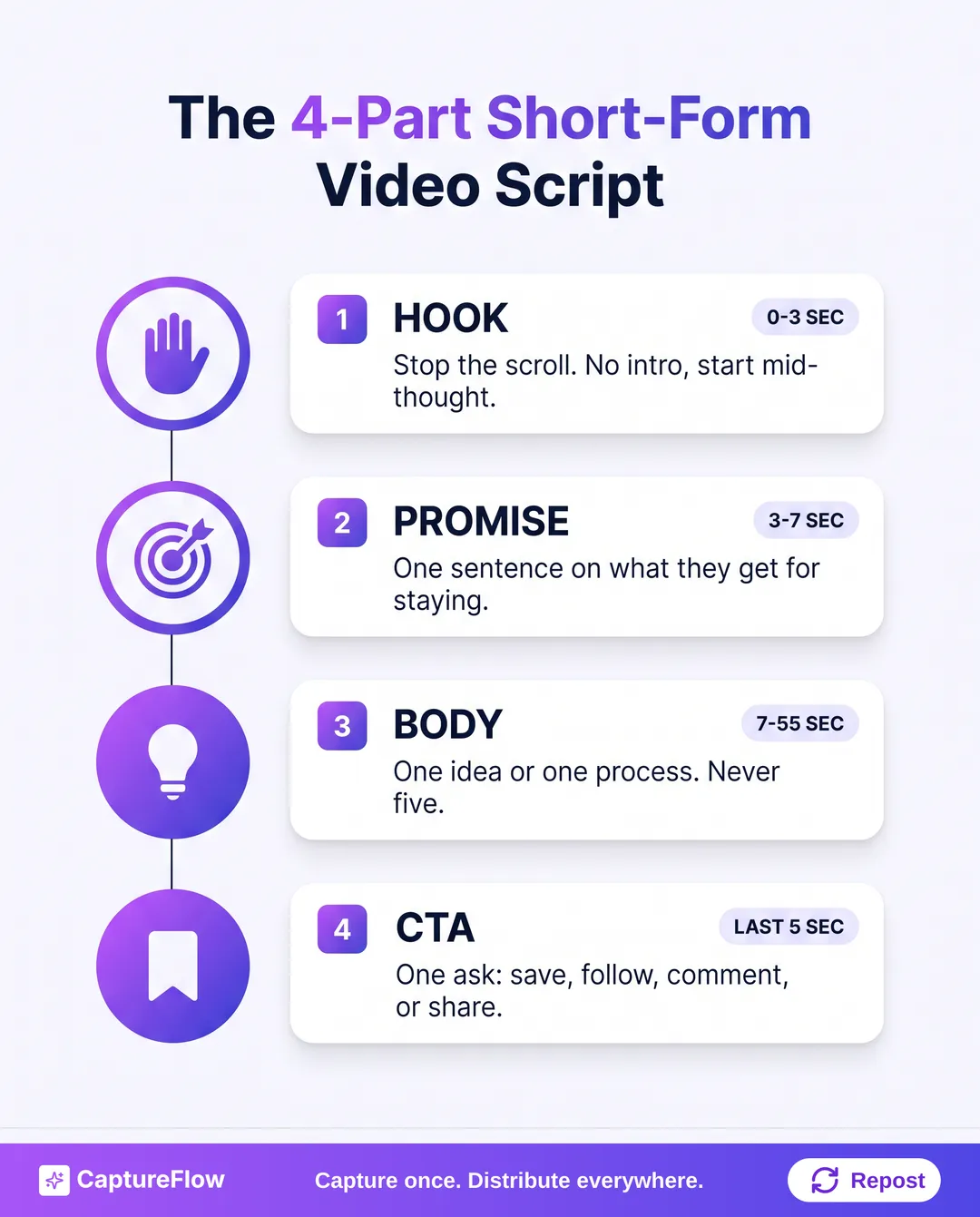 Hook, promise, body, CTA. Same order every time.
Part 1: The hook (0 to 3 seconds)
The hook is a pattern interrupt. It doesn't introduce you, list your credentials, or set the scene. It drops the viewer into the middle of something that's surprising or that matches a problem they have right now.
Openers that lose people:
- "Hey everyone, today I want to talk about..."
- "So I've been thinking a lot about..."
- "As a founder with ten years of experience..."
Openers that hold them:
- A specific claim: "Your demo is losing the deal before you share your screen."
- A counterintuitive line: "Posting more is why your reach is falling."
- A question that names the pain: "Still writing every post from a blank page?"
- A visible action before any words, like dropping a 40-page deck on the desk.
The hook has one job. Make them stop. It doesn't need to explain anything yet.
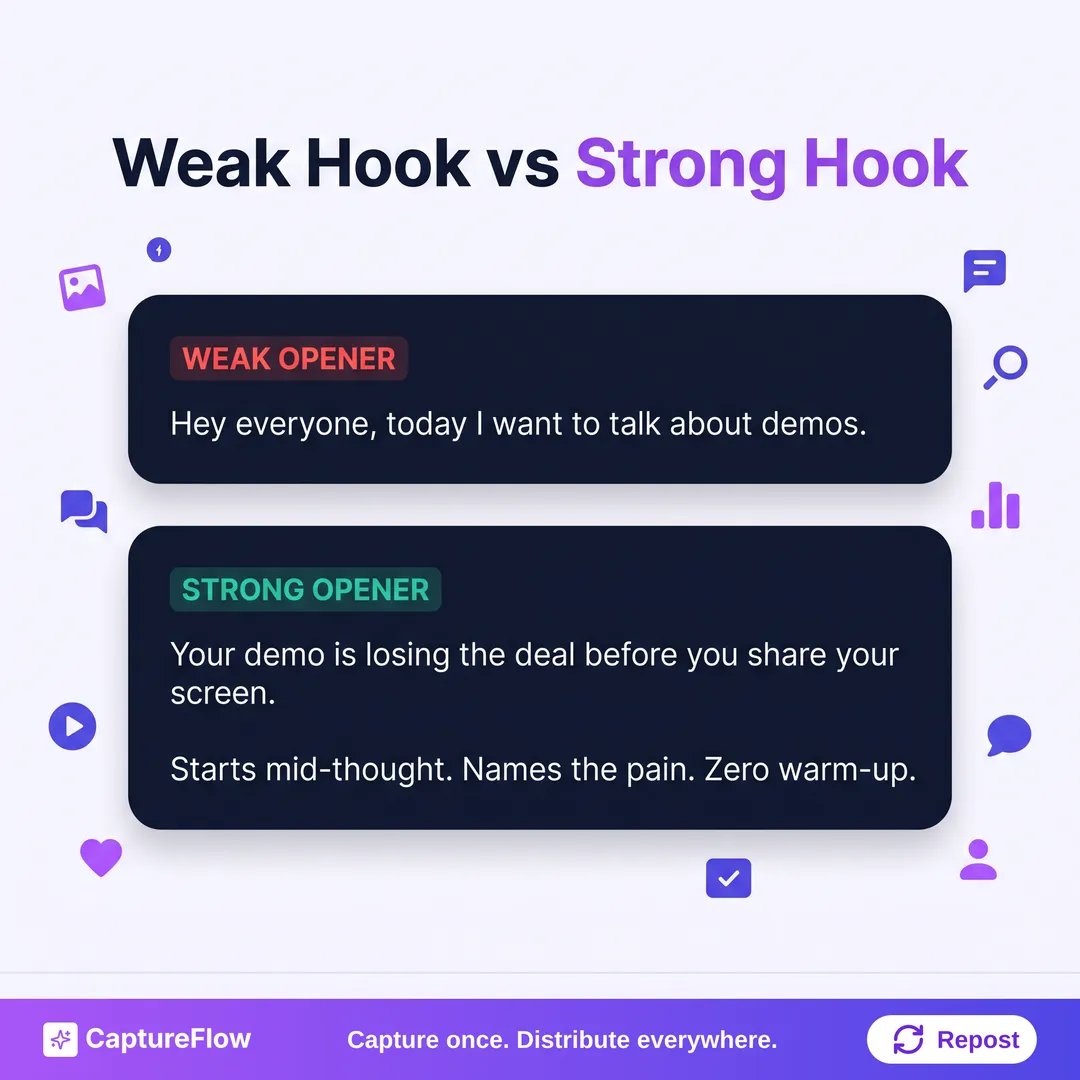 Cut the warm-up. Start where the interesting part starts.
Part 2: The promise (3 to 7 seconds)
The hook buys you a few seconds. The promise tells the viewer what they get for staying. One sentence, specific, about an outcome.
Weak: "I'm going to share some tips on content."
Strong: "In the next 40 seconds I'll show you how one voice note becomes a week of posts."
A specific promise works as a retention anchor, because viewers stick around to collect what you said they'd get. Vague promises give them nothing to wait for.
Part 3: The body (7 to 55 seconds)
This is where most first drafts fall apart. They try to teach five things in 45 seconds, and the video comes out rushed and impossible to act on.
The rule is one. One framework, one process, one mistake, one insight. If you've got five things to say, congratulations, you've got five videos.
Body formats that work:
- Step-by-step. "Three steps. One: record. Two: pull the best line. Three: post it." Then show the result.
- Before and after. "Most teams do X. The ones growing do Y instead."
- One insight plus proof. State it, give one real number or example, land what it means for the viewer.
- Myth vs. reality. Name the common belief, then knock it down with a specific counter-example.
Write it the way you talk. Short sentences, plain words, no "furthermore".
If you have five tips, you don't have a five-tip video. You have five videos.
Part 4: The CTA (the last 5 seconds)
A passive scroller won't leave the app because you asked nicely. So ask for something they can do with one tap:
- Save: "Save this for the next time you sit down to script."
- Follow: "Follow for one founder content tip a week."
- Comment: "Tell me the hook you're stuck on."
- Share: "Send this to the founder who keeps skipping video."
One ask per video. Saves and sends are the signals platforms read as "this is worth showing to more people", which is why they usually beat a link-in-bio request.
How long should a short-form video script be?
Shorter than you think. Speech moves fast. A University of Pennsylvania analysis of thousands of recorded phone conversations (Yuan, Liberman and Cieri, 2006) measured an average of 196 words per minute, with individual calls ranging from 111 to 291.
Talking to a camera from a script is slower than chatting on the phone, and it should be, since viewers are reading captions too. Our working rule (a rule of thumb, not a platform benchmark) is 2.5 words per second, or about 150 words a minute. So:
- 30-second video: about 70 words.
- 60-second video: about 140 to 150 words.
- 90-second video: about 220 words, and you'd better have a reason.
Most first drafts land near 300 words for a "60-second" video. Read yours aloud with a timer. If you're rushing, cut, don't speed up.
9 hook structures that work for B2B video
The hook is the hardest line to write because it does the most work in the least time. These nine structures cover nearly every situation a founder or B2B team runs into. Fill the brackets with your own specifics; the specifics are what make a hook land.
| # | Structure | Fill-in pattern | Example |
|---|---|---|---|
| 1 | Bold claim | "[Common thing] is [surprising verdict]." | "Your onboarding email is why trials don't convert." |
| 2 | Counterintuitive truth | "The [people who win] do [less of the obvious thing]." | "The founders with the biggest audiences post less than you." |
| 3 | Pain-point question | "Still [painful task]?" | "Still spending Sunday night writing Monday's post?" |
| 4 | Your own number | "[Specific result] in [time]. Here's what changed." | Use a real result from your business, never a borrowed stat. |
| 5 | Mistake callout | "Stop [common habit]." | "Stop opening your videos with your name." |
| 6 | Before and after | "[Before state]. Now [after state]." | "Six months ago our demo was 45 minutes. Now it's 12." |
| 7 | Direct challenge | "Your [strategy] is built on [wrong assumption]." | "Your content plan assumes people read your posts. They skim them." |
| 8 | Relatable frustration | A short scene they've lived. | "You hit publish. Three likes. All from coworkers." |
| 9 | Curiosity gap | "There's one [thing] most [people] never [do]." | "There's one question most founders never ask on a sales call." |
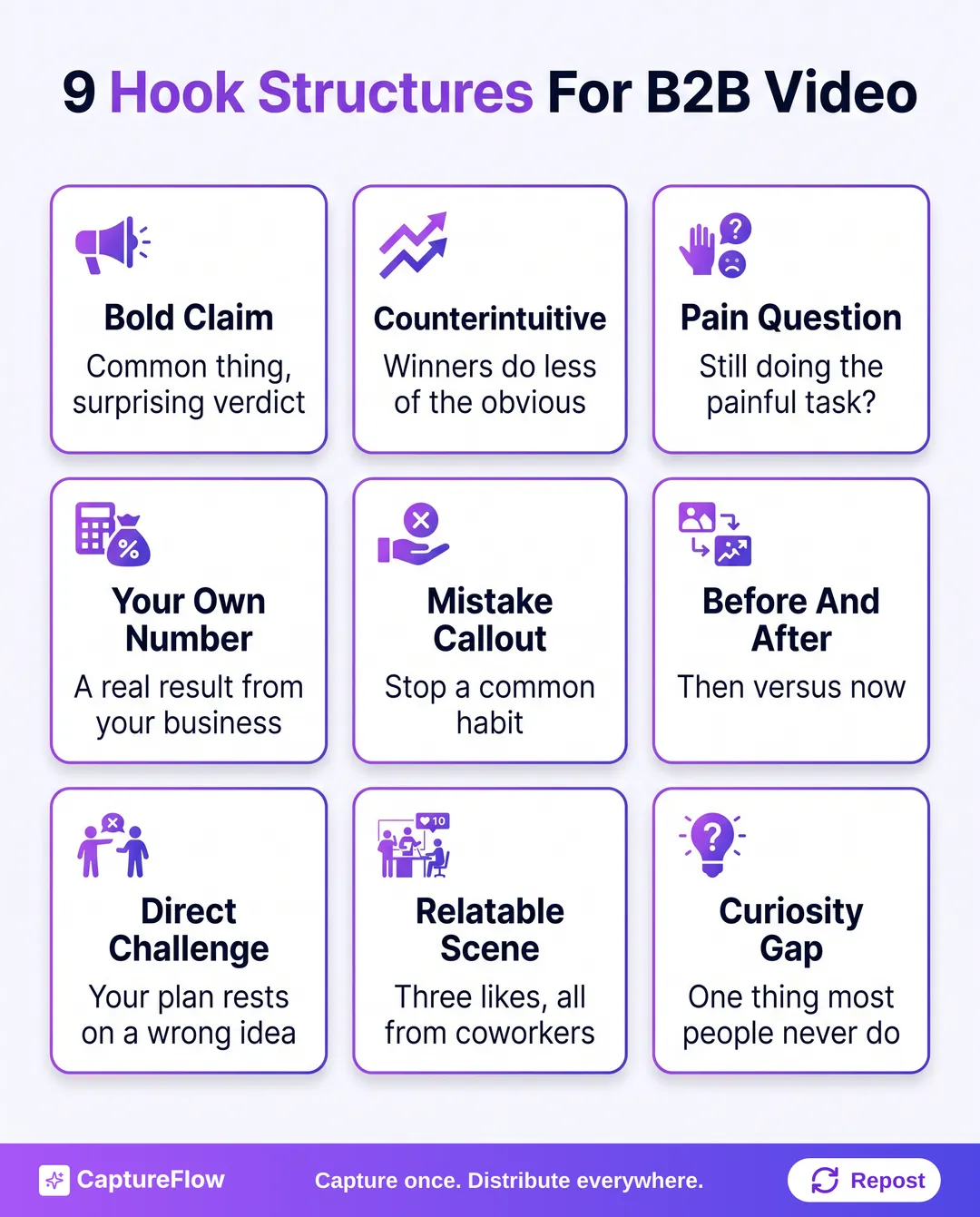 Pick the structure that fits the content, then fill it with your own specifics.
How to choose: match the hook to what the video does. Teaching a process? Use a mistake callout or a counterintuitive truth. Sharing a result? Before and after, or your own number. Pushing back on a belief? Direct challenge or bold claim.
One warning on number hooks. Use your numbers, from your own business or your own test. A round, borrowed stat with no source is the fastest way to lose the B2B viewer who actually knows the space. If you want more options to test, our free TikTok hook generator and Reels hook generator give you a batch of variations once you know which structure fits. The same thinking powers our guide to writing LinkedIn hooks, since the first line of a post and the first line of a video fail for the same reasons.
Write five hooks for every video and pick one. It takes ten minutes, and the second or third version is almost always better than the first. Read each one aloud. If it sounds like the start of a meeting, cut it.
A fill-in-the-blank 60-second script template
Copy this. Fill the brackets. You've got a script.
HOOK (0 to 3 seconds, 5 to 10 words): [Bold claim, counterintuitive truth, or pain-point question. No intro. Start mid-thought.]
PROMISE (3 to 7 seconds, one sentence): "In the next [X] seconds, I'll show you [specific outcome]."
BODY (7 to 55 seconds, about 110 words), pick one: Step-by-step: "Here's how it works. Step one: [action]. Step two: [action]. Step three: [action]. The result: [outcome]." Insight plus proof: "Most people [common behavior]. The problem is [why it fails]. What works is [your insight]. Here's a real example: [one case or number]." Myth vs. reality: "Everyone says [belief]. That's wrong. Here's what actually happens: [counterpoint]. Which means [implication for the viewer]."
CTA (last 5 seconds, one sentence): [Save, follow, comment, or share. One action only.]
Here it is filled in, on a topic we know well:
HOOK: "Stop writing posts from a blank page."
PROMISE: "In 40 seconds I'll show you how one voice note turns into a week of content."
BODY: "Here's how it works. Step one: after a customer call, record yourself answering the best question they asked. Two minutes, no editing. Step two: pull out the three sharpest lines. Each one is a post. The strongest one is also your next video hook. Step three: draft each line in the format of the platform it's going to, a short text post for LinkedIn, a thread for X, a quote image for Instagram. Then review and schedule. One recording, a week of posts, and you never stared at a blank editor."
CTA: "Save this for the next time you're stuck on what to post."
That's about 120 words. At 2.5 words per second it runs just under 50 seconds, with room to breathe.
How to turn a LinkedIn post into a 60-second script
If you already write LinkedIn posts, you already have video scripts. You just haven't converted them. Here's the process.
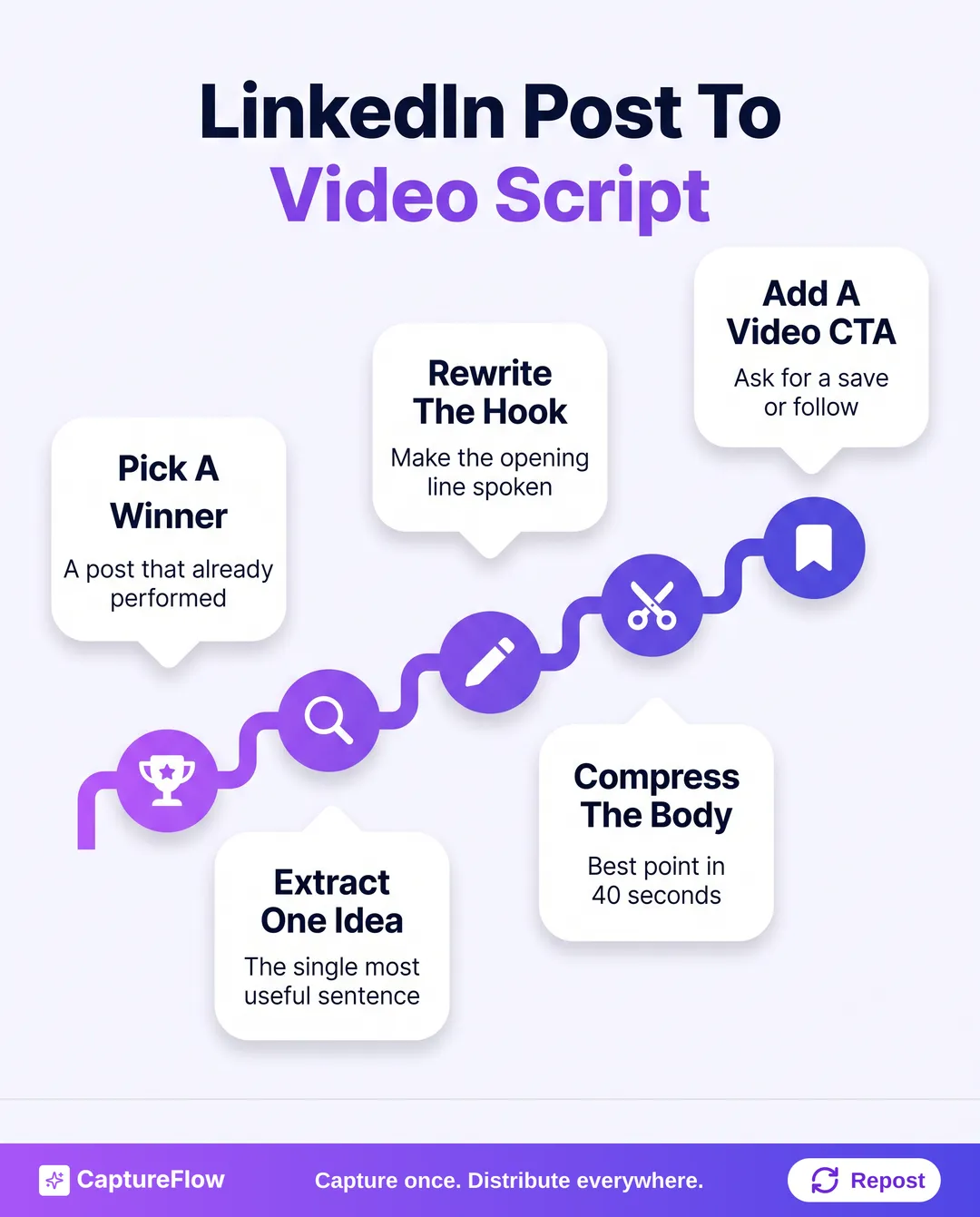 Your best-performing posts are pre-tested scripts.
- Pick a post that performed. Above-average engagement means the idea already landed with your audience. You aren't guessing.
- Extract one idea. A post usually holds three to five. Ask which single sentence is the most useful. That becomes your promise; everything else is raw material.
- Rewrite the opening as a hook. Posts that work tend to open with tension, and that line is your hook candidate. Make it more conversational. Written and spoken English are different languages, so read it aloud and cut anything stiff.
- Compress the body to one move. If the post had five tips, the video is the best tip, explained in about 40 seconds with one example.
- Add a video-native CTA. LinkedIn posts often end with a question. Keep it if you like, but put a save or follow ask first.
In practice: a 180-word post with five bullets on why content doesn't generate leads becomes a 140-word script. The hook is one of those five points reframed as a claim. The promise is "you'll know the fix in 40 seconds." The body is that one point with a real example. The CTA is a save.
Going the other direction, cutting a long recording into short clips, is a different job. Our guide to turning one long video into short-form clips covers that workflow end to end, and if you're weighing whether TikTok is worth it at all, start with TikTok for B2B.
Where CaptureFlow fits
CaptureFlow is an AI content agent that turns your expertise into weeks of on-brand content for every platform. You capture one idea in about 5 minutes (a voice note, a video, a file, or a link), and CaptureFlow, trained on your voice and past posts, reshapes it into native content for each channel: a LinkedIn post, an X thread, a carousel, a short video, and more.
For scripting, that means you don't start from the template above with an empty page. You talk through the idea once, and the agent pulls the hook candidates and the one-idea body out of what you said. You still pick the hook (you should, it's your name on the video). See how it works on the content formats page, or try the free video script generator first.
Write the script, then record
Here's the order, start to finish:
- Pick a topic you know cold, or a LinkedIn post that already performed.
- Choose a hook structure from the table.
- Write five hooks, keep one, then write the promise, body, and CTA with the template.
- Read it aloud with a timer. Cut anything that pushes past 60 seconds.
- Record.
You don't need a studio or a teleprompter. You need a first sentence that earns the second one, and one thing to teach.
One last check before you hit record: read the hook out loud. If it sounds like something you'd say at the start of a meeting, rewrite it. If it would make you stop scrolling, you're ready. And if you'd rather capture the idea once and let the drafting happen for you, have a look at CaptureFlow's pricing.
Sources
- Facebook IQ (Meta): Capturing Attention in Feed: The Science Behind Effective Video Creative
- TikTok Ads Manager Help Center: Creative best practices for performance ads
- Social Media Today: Instagram shares key ranking signals for 2025
- Yuan, Liberman and Cieri, University of Pennsylvania (Interspeech 2006): Towards an Integrated Understanding of Speaking Rate in Conversation
Frequently asked questions
How long should a short-form video script be?+
For a 60-second video, aim for about 140 to 150 words. That assumes roughly 2.5 words per second of delivery to camera, which leaves room for pauses. For a 30-second video, cut to around 70 words and keep one idea.
What is a good hook for a short-form video?+
A good hook names something specific the viewer cares about within the first 3 seconds: a bold claim, a counterintuitive truth, a pain-point question, or a mistake callout. It never starts with your name or a greeting.
Why do the first 3 seconds of a video matter so much?+
Feeds are fast. Meta's research found people spend about 1.7 seconds with a piece of mobile feed content on average, and TikTok's own creative guidance says to introduce your content proposition in the first 3 seconds. If the opening does not earn the next swipe-free second, the rest of the script never gets heard.
What CTA works best at the end of a short video?+
Ask for one low-friction action the viewer can take without leaving the app: save, follow, comment, or share. Saves and shares tell the platform the video is worth showing to more people. Link-in-bio clicks are a harder ask, so use them sparingly.
Can I turn a LinkedIn post into a video script?+
Yes. Take a post that performed, use its opening line as the hook, pick its single strongest point as the body, cut it to about 150 words, and read it aloud until it sounds like you talking rather than writing.
Chris is the founder and CEO of CaptureFlow, which he builds so founders can turn their expertise into content without hiring a team. After 10+ years building products and growing audiences from scratch, he writes about founder-led content, AI, and distribution from inside the problem he is solving: distributing consistent, on-brand content as a team of one.
Founder & CEO of CaptureFlow · 10+ years building products and audiences
One playbook a week from founders who actually create and distribute lots of content. No spam, unsubscribe anytime.
Keep reading

How to Write LinkedIn Hooks That Stop the Scroll (30 Examples)
A great LinkedIn post dies on line one if the hook is boring. Here is how to write LinkedIn hooks that stop the scroll, with 30 examples across 10 styles.

What Drives LinkedIn Engagement: 2,500 Posts Analyzed
We pulled the public LinkedIn history of 25 founders, 2,500 posts in total, to build our playbook teardowns. The engagement pattern hiding in that data surprised us.

LinkedIn Content Ideas: 50 Posts to Steal When You're Not an Influencer
You are not out of things to say, you are out of shapes to say them in. Here are 50 specific LinkedIn content ideas, organized into 6 buckets, that you can post starting today.