How to Scale Content With AI Without Losing Your Brand Voice
How marketing teams use AI to scale content production without losing brand voice: a shared voice guide, one trained agent, guardrails, and a review loop.


Every scaling marketing team makes the same trade without noticing. Leadership wants more content on more channels, so the team reaches for AI, and volume jumps. Then a quieter thing happens: the posts start sounding like posts. Competent, confident, and completely interchangeable with every other company drafting from the same models.
So the real question is not whether AI can help you produce more. It obviously can. The question is how do marketing teams use AI to scale content production without losing brand voice, because the default answer to "make more, faster" is "make more that sounds like everyone else."
Here is the short version. Scaling content with AI without losing your voice means centralizing your voice into one shared layer that every contributor and every agent drafts from, instead of leaving it to each person's private prompts. Do that, and volume and voice stop being a trade-off.
Why scaling with generic AI flattens your voice
The flattening is not a vibe, it is measurable. In a study published in Science Advances, writers using AI assistance produced work that was measurably more similar to each other than writers working unaided. The model nudges everyone toward the same center.
Now multiply that by a team. One founder prompting ChatGPT drifts toward the average. Ten contributors each prompting their own way drift toward the average and away from each other. You do not get one slightly generic voice, you get ten flavors of beige with your logo on top.
Meanwhile the pressure to scale is real and not going away. In HubSpot's 2026 State of Marketing report, 86 percent of marketers now use AI and 74 percent use it to repurpose a single asset into many formats. The productivity is genuine too: a widely cited study of support agents found generative AI raised output roughly 14 percent, with the biggest gains for less-experienced people. AI makes a small team produce like a big one. It just does not, on its own, make them produce like you.
The danger is not that AI writes badly. It is that AI writes fine. "Fine" is exactly what a distinctive brand cannot afford, because fine is forgettable, and forgettable content does not build the audience the volume was supposed to earn.
What brand voice at scale actually means
When one founder writes everything, voice is automatic. It lives in their head and leaks into every sentence. The problem starts the moment more than one person, or one model, is drafting on the brand's behalf.
Brand voice at scale is the ability to keep one recognizable voice across many contributors and many drafts, without a single person hand-writing or rewriting all of it. That is a systems problem, not a talent problem. Your best writer cannot personally edit every post once you are publishing daily across platforms, and if voice depends on them doing exactly that, it does not scale, it bottlenecks.
The teams that solve it stop treating voice as something each person carries and start treating it as shared infrastructure: a written, trainable record of how the brand talks that everything is built from. Once voice lives in the system, adding a contributor or a channel does not dilute it.
The system: scale output, keep one voice
Four parts. Set them up once and volume stops threatening consistency.
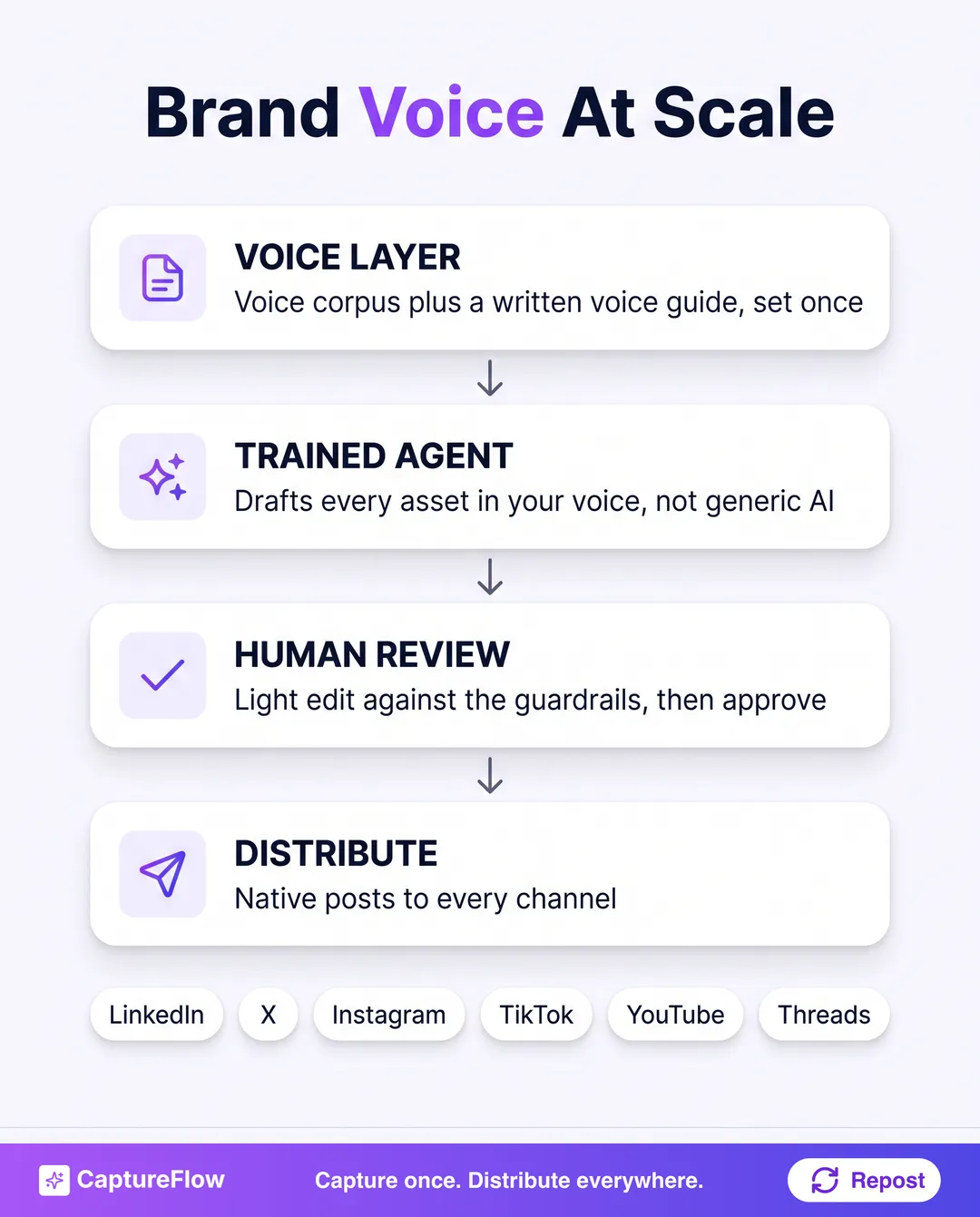 The voice lives in the first block, so everything downstream inherits it.
1. Build one shared voice guide and corpus
Before you scale drafting, write the voice down once, for everyone. Not adjectives ("bold, human, witty") which train nothing, but concrete patterns: signature phrases, the stances your brand repeats, sentence rhythm, and a banned list of words you never use. Back it with a corpus of real examples, and favor transcripts of your team actually talking, because spoken language carries your rhythm before it gets self-edited into corporate mush.
This is the single source of truth. Every contributor and every tool references the same document, so "on-brand" stops being a matter of opinion.
2. Train one agent on it, not ten private prompts
Here is where most teams lose the plot. They give everyone access to a general AI and let each person prompt it their own way. That guarantees drift, because you are averaging ten different prompting styles on top of a model that already averages the internet.
Instead, train a single voice and knowledge base once, and have everyone draft from that. When the voice guide, the corpus, and every approved post live in one content agent, a junior hire's draft starts from the same patterns as the founder's. CaptureFlow is an AI content agent that turns your expertise into weeks of on-brand content for every platform, and this shared voice layer is exactly the point: the brand's voice is trained in one place, not re-explained in every chat window.
3. Set guardrails and a banned list
Voice is protected as much by what you refuse to say as by what you say. Maintain a living banned list: the AI phrases that make you wince ("game-changer," "in today's landscape," "excited to share"), the claims legal hates, the formats that are off-brand. Every time a draft slips, the fix is one line added to the guardrails, not a lecture to the writer.
Run a monthly voice audit. Pull five recent posts, strip the logos, and ask a teammate whose brand they sound like. If the answer is not obviously yours, your guide is missing a rhythm rule or a banned phrase. Add it, and the next hundred drafts inherit the fix.
4. Keep a human in the loop, reviewing for voice
AI does not remove the human, it relocates them. The bottleneck moves from production to judgment. So the team's job shifts from writing every post to deciding what is worth saying and approving what sounds right. A person still owns the editorial call and the final voice check.
The win is that reviewing is fast when the drafts start 90 percent on-brand. You approve, tweak a phrase, and move on, instead of rewriting a blank-page draft into something that sounds like you. That is what makes scaling with a small team sustainable rather than exhausting.
Generic AI vs a voice-trained agent
The difference is not output speed, both are fast. It is whether the voice survives contact with volume.
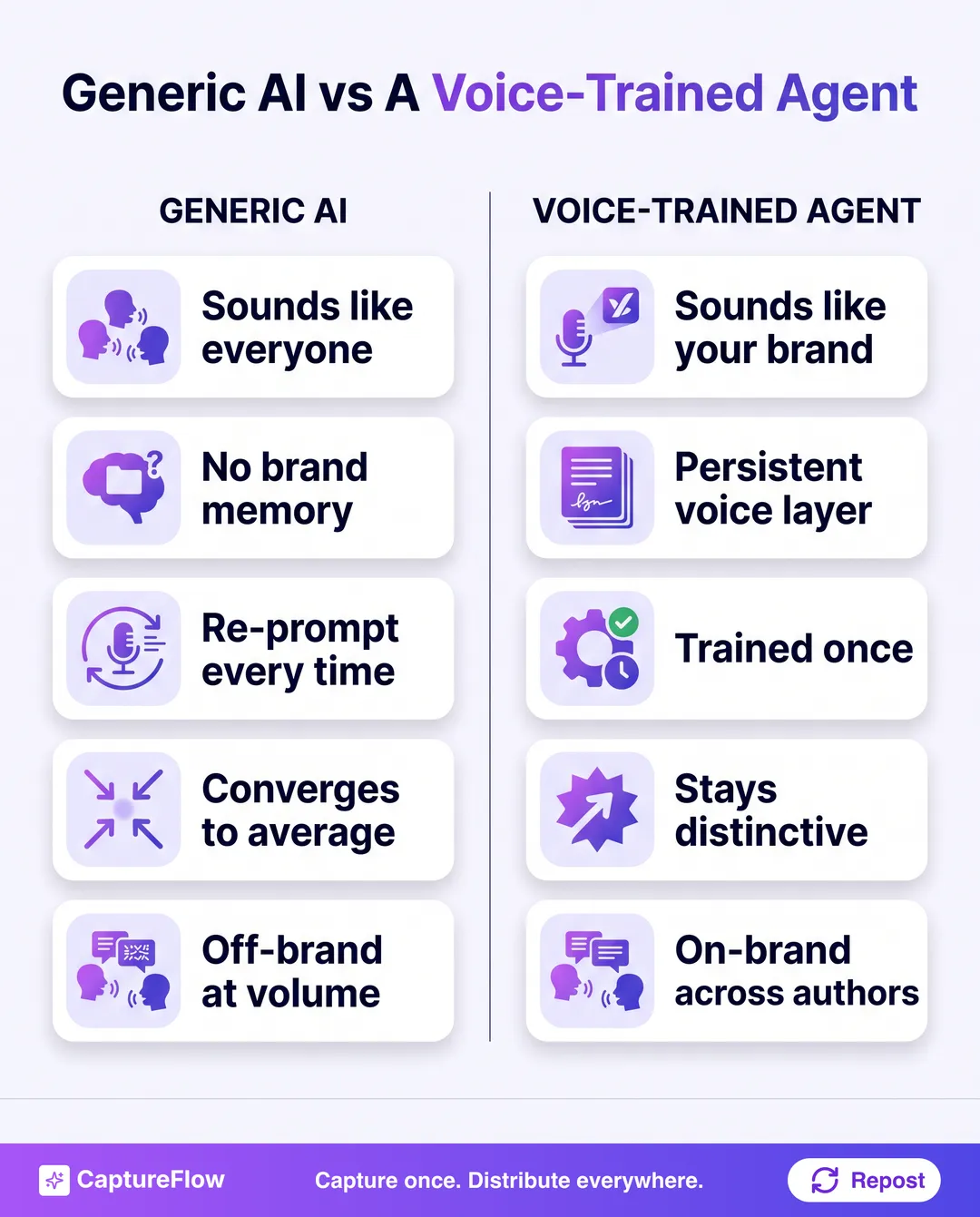 Both draft fast. Only one keeps sounding like your brand at volume.
Generic AI is a brilliant blank-page tool and a genuinely useful assistant, and for a one-off draft it is often all you need. Be honest about that. But it has no persistent memory of your brand, so every session starts from zero and every contributor re-teaches it from scratch. A voice-trained agent stores the voice once and applies it to every draft, which is the only version that holds up when ten people are publishing across eight channels. This is the same reason a shared voice layer beats a longer tool stack: consolidation protects consistency, sprawl erodes it.
Four guardrails that keep voice consistent
If you want the compressed checklist, it comes down to four moves that turn voice from a person into a system.
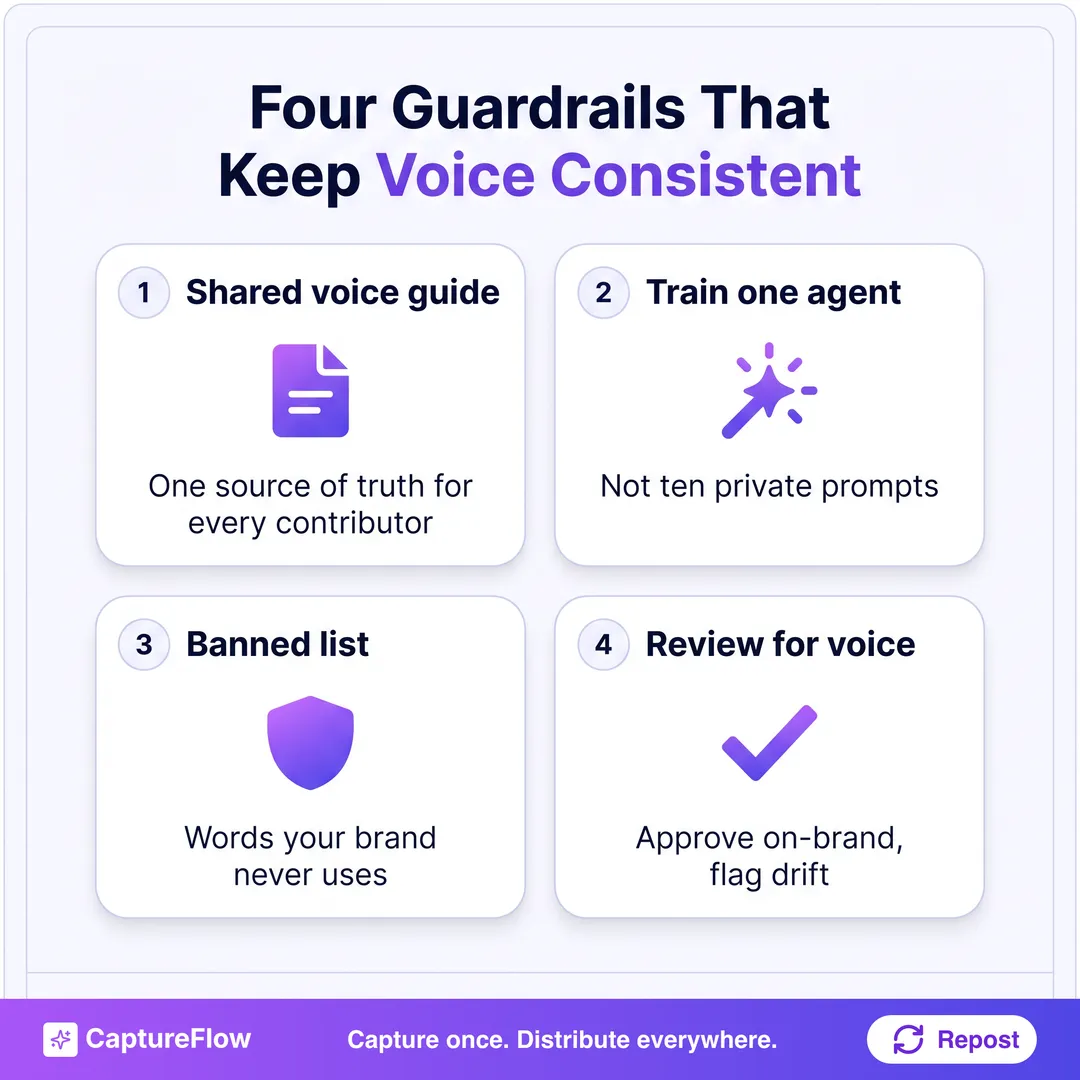 Set these once and adding people or channels stops diluting the voice.
The through-line: voice does not scale by trying harder, it scales by living somewhere every draft is built from. Put it in the system and the tenth contributor sounds as on-brand as the first.
Generic AI does not have a quality problem. It has a sameness problem. Scaling with it makes you sound like everyone. Scaling with a voice-trained agent makes you sound like you, a hundred times a week.
Where teams get it wrong
Two failure modes, both common.
The first is letting the model make editorial decisions. Teams that hand AI the whole job, topic through publish, produce the average content buyers already scroll past. Keep the human on judgment and voice; give the machine the drafting.
The second is over-fitting to your loudest contributor. If the voice guide is really just one person's habits, it does not scale past them and it alienates everyone else. Build the guide from the brand's best work across the team, not a single writer's tics, so it is a voice people can share rather than impersonate. The goal, as with fighting generic output anywhere, is the brand on its best day, made repeatable.
Start here
You do not need to solve all of this at once. Write the voice guide this week, load it into one place your whole team drafts from, and add a monthly voice audit. That alone moves you from "more content that sounds generic" to "more content that sounds like you."
And if you would rather the voice training, storage, and on-brand drafting happen automatically from what your team already says and approves, that is the layer we build. See how the voice and content agent works or what it costs. The model is not your moat. Your voice is, so scale it like one.
Sources
- Science Advances: Generative AI enhances individual creativity but reduces the collective diversity of novel content
- HubSpot: 2026 State of Marketing report
- Brynjolfsson, Li & Raymond: Generative AI at Work
Frequently asked questions
How do marketing teams use AI to scale content production without losing brand voice?+
They centralize voice instead of leaving it to each person's prompts. That means one shared voice guide and corpus, a single agent trained on it once so every contributor drafts from the same patterns, a banned list and guardrails that catch off-brand phrasing, and a review step that approves for voice rather than rewriting from scratch. The voice lives in the system, not in individual heads.
Why does AI content sound generic when a whole team uses it?+
Because each person prompts a general model in isolation, and general models converge on the internet's average. Without a shared, structured record of how your brand actually talks, ten contributors produce ten flavors of beige. The fix is a persistent voice layer every draft is built from, not better one-off prompts.
Can you scale content with AI and still keep quality high?+
Yes, if AI handles drafting and humans handle judgment. The teams that keep quality use AI to turn one input into many on-brand drafts, then spend their saved time reviewing and approving instead of writing from a blank page. Quality slips only when you let the model make the editorial decisions too.
Chris is the founder and CEO of CaptureFlow, which he builds so founders can turn their expertise into content without hiring a team. After 10+ years building products and growing audiences from scratch, he writes about founder-led content, AI, and distribution from inside the problem he is solving: distributing consistent, on-brand content as a team of one.
Founder & CEO of CaptureFlow · 10+ years building products and audiences
One playbook a week from founders who actually create and distribute lots of content. No spam, unsubscribe anytime.
Keep reading

AI Content Creation: The Complete Guide for Founders
Anyone can generate content with AI now. That is exactly the problem. Here is how founders create content with AI that still sounds like them.

How to Use AI Content Tools (Without Sounding Like a Bot)
Most people disappointed with AI content tools started with the tool instead of the problem. Here is the workflow that actually works: find the gap, match the tool, train it on your voice, and ship.

Content Atomization: Turn One Idea Into Many Posts
Most people make one post from one idea, then go hunt for the next idea. Content atomization is the opposite: one idea becomes a week of native posts.