How to Scale Content Production With a Small Marketing Team
A practical system for a lean B2B team of one to three people to scale content production and increase output, without burning out.


Your team is two people. Maybe three. The ask from leadership is a founder posting daily, the company page active, a weekly video, carousels, and "can we also be on TikTok." The gap between the headcount and the mandate is where most content operations quietly break.
Here is the reframe that fixes it: scaling content production on a small team is not about more hours or more people, it is about changing the unit of work. Stop producing one post at a time. Start producing one capture that fans out into a week of content.
This is the leverage playbook, distinct from the content operations framework that governs how a B2B team is structured. That post is the org chart. This one is the engine: how a lean team actually increases output without anyone drowning.
You are not alone in the squeeze. In the 2025 B2B Content Marketing benchmarks, the Content Marketing Institute found that 54 percent of B2B organizations with a content team run it with just two to five people, and only one in three marketers say they have a scalable model for creating content. The demand went up. The team did not.
Why small teams stall (it is not distribution)
When a lean team feels underwater, the instinct is to blame the last mile: scheduling, publishing, chasing approvals. That is rarely the real constraint.
Scheduling is a solved problem. Publishing is a button. The thing that actually eats a small team alive is the blank page: deciding what to say, and turning it into a first draft. Multiply that by daily posting across three platforms and you get 30 cold starts a month.
The bottleneck on a small content team is creation, not distribution. So creation is the only place leverage matters. Optimizing your scheduling tool while the drafting stays manual is polishing the fast part of the pipeline.
Cold starts are also expensive in a way that does not show on the calendar. Research on interrupted work by Gloria Mark at UC Irvine found it takes over 20 minutes to refocus after a task switch, and that people compensate by working faster at the cost of higher stress. Thirty content sessions a month is not 30 small tasks. It is 30 refocusing cycles bolted onto everyone's real job.
If your team's main content pain is "we can't keep up," resist the urge to add another scheduling tool or another freelancer first. Neither touches the blank page. Fix the unit of work, then decide if you still need the hire.
How a small team can scale content production
The move is to scale content production by changing what "one piece of work" means. On most teams, one unit of work is one post: one idea, one draft, one format, one platform. That is the most expensive possible unit, because the hard part (having the idea and shaping it) gets used exactly once.
Capture-first flips it. Capture-first content means starting from something you already said, not a blank page. You record a 5 minute voice note, a short video, or drop in a link, and that single capture becomes the source for many outputs at once.
One capture can fan out into text posts for every platform, a short video clip, a long-form video, a carousel, quote images, and an infographic. Same idea, many native formats. The thinking is paid for once and spent everywhere.
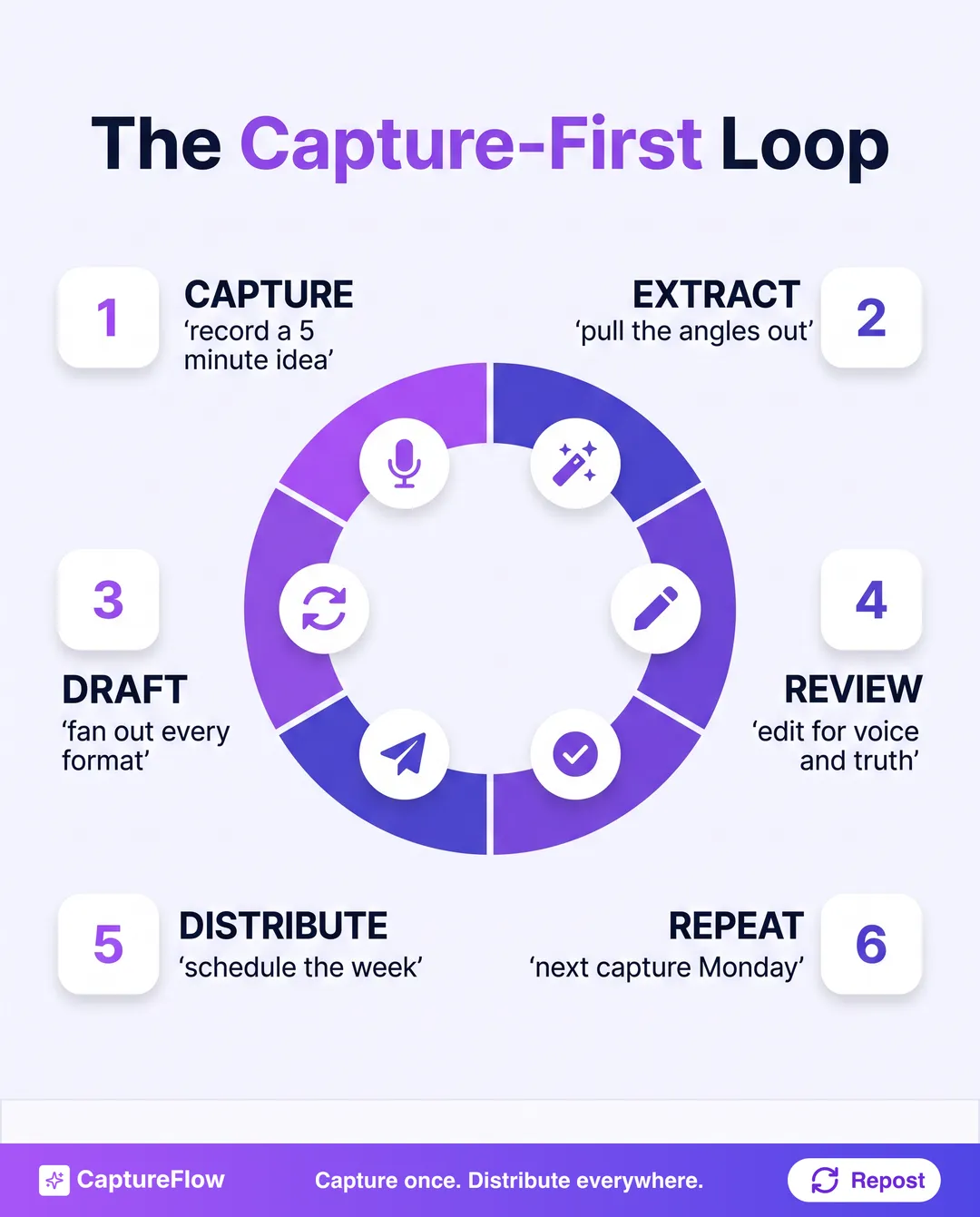 The loop a lean team runs weekly. The thinking happens once at capture, everything after it is formatting and judgment.
This is exactly the leverage that makes the batch-a-month workflow possible: batching only works because each capture yields many assets, not one. Do the same thing weekly instead of monthly and you have a sustainable production system for a team that cannot afford to burn a person on formatting.
the whole playbook in one linePay for the idea once. Spend it everywhere.
The system: four moves for a lean team
The whole playbook is four repeatable moves. A small team runs the full loop in about two focused hours a week and posts every day from it.
- Capture the thinking in a batch. One session, several short captures, no formatting yet.
- Fan out with an AI content agent. Turn each capture into many native drafts automatically.
- Keep humans on judgment. People edit for voice and truth, not for first drafts.
- Distribute on a fixed cadence. Schedule the batch into proven windows and move on.
Below, each move in practice.
Move 1: Batch the thinking, not the posting
Put one 60 to 90 minute block on the calendar each week. In it, you do only one thing: capture raw ideas. Record four or five short voice notes or videos on the topics your audience cares about. Do not write posts. Do not open the scheduler. Just talk.
Batching the hard part into a single block is what protects the team from those 30 cold starts. You pay the context-switch tax once a week instead of every morning.
From four or five short captures, you have enough raw material for a week or more of content across platforms. The ideas are the scarce resource. Everything downstream is formatting.
Cap each capture at 5 minutes. A 5 minute voice note holds more than a week of usable angles once it is broken apart. Longer captures do not add material, they add editing.
Move 2: Delegate formatting to an AI content agent
This is the multiplier. Instead of a person rewriting one idea into a LinkedIn post, then an X thread, then a carousel script, an agent does the formatting pass in parallel.
CaptureFlow is an AI content agent that turns your expertise into weeks of on-brand content for every platform. You capture one idea in minutes, and the agent, trained on your voice and past posts, reshapes it into native content for each channel: a LinkedIn post, an X thread, a carousel, quote images, a short video, and more.
The productivity math here is not hypothetical. In a controlled study summarized in the Stanford HAI 2025 AI Index, knowledge workers using AI completed 12.2 percent more tasks and finished them 25.1 percent faster, with output quality rated over 40 percent higher. The leverage is largest exactly where a small content team feels the pain: repetitive drafting and formatting.
The point is not to remove people. It is to remove the part of the work that never needed a person: turning one good idea into eight format variants by hand.
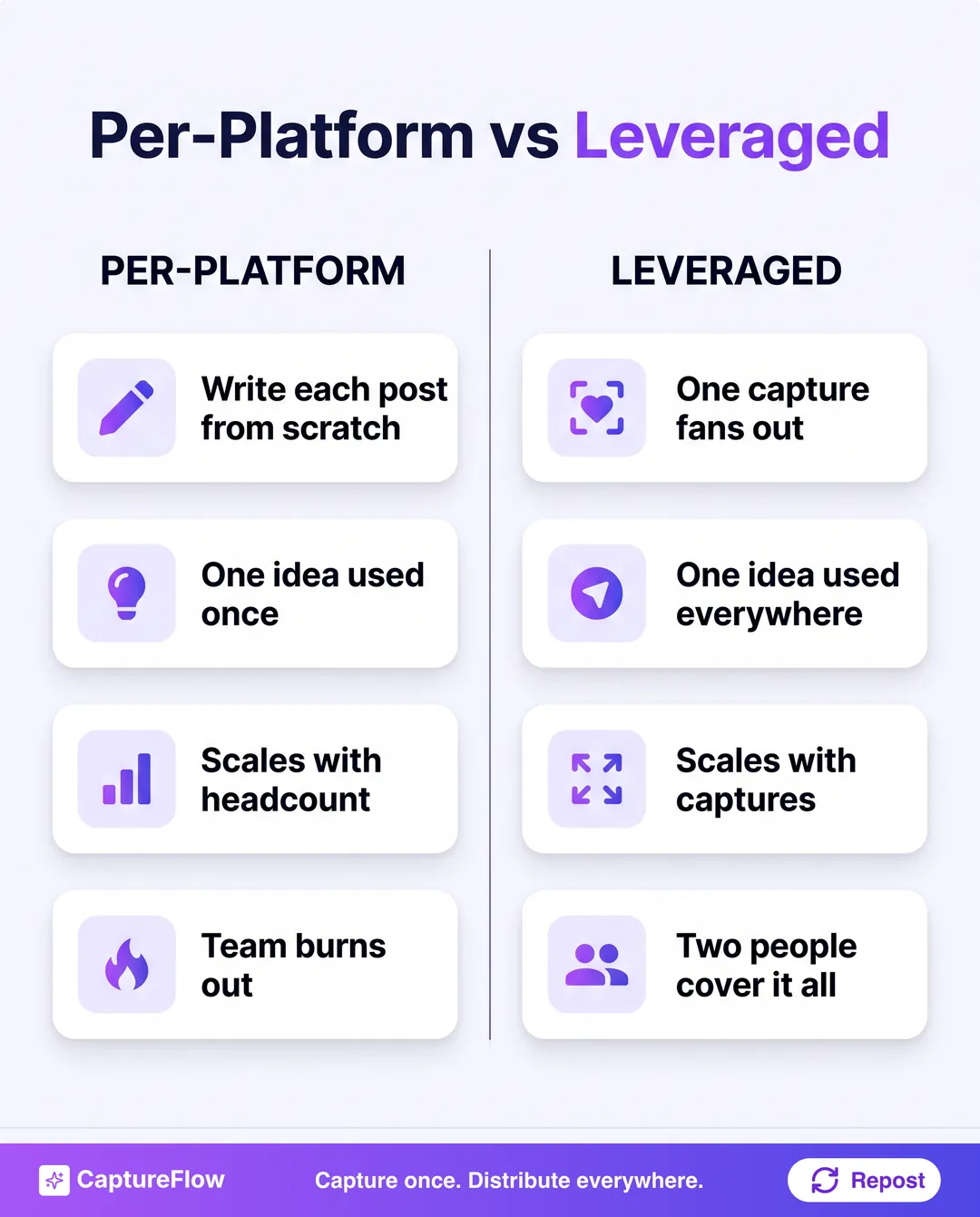 The old way scales linearly with headcount. The leveraged way scales with captures, which is why two people can cover what used to need a full desk.
Move 3: Keep humans on judgment, not first drafts
Here is the rule that keeps quality high while output climbs: people never make the first draft, and always make the final call.
Your one or two humans spend their time on the two things AI should not own: is this true, and does this sound like us. Read every draft aloud before it goes out. Fix the voice. Cut the claim you cannot back up. Approve.
That is a 10 minute review pass on a week of content, not a 10 hour writing marathon. The team's scarce human attention goes to judgment, where it is worth the most, instead of to formatting, where it is worth almost nothing.
Give the agent your best 10 to 20 past posts as voice training once. Every draft after that lands closer to your voice, which shrinks the human review pass from rewriting to approving.
Move 4: Distribute on a fixed cadence
Once the batch is reviewed, schedule it. Load the week (or month) into proven posting windows and close the tab. No daily "what should I post" decision, because the decision was already made in the batch.
Leave roughly 20 percent of your calendar open for reactive posts: a customer win, a hot take, a reply to something in the feed. Batched content covers the planned baseline. The open slots keep the team human and current. For the mechanics of automating this hand-off end to end, the agency content workflow guide breaks down the same pipeline at higher volume.
A realistic weekly cadence for two people
Here is what the loop looks like on an actual calendar for a two-person team producing daily content plus weekly video and carousels. For the day-by-day version, our weekly content workflow for a small marketing team maps each weekday to one job.
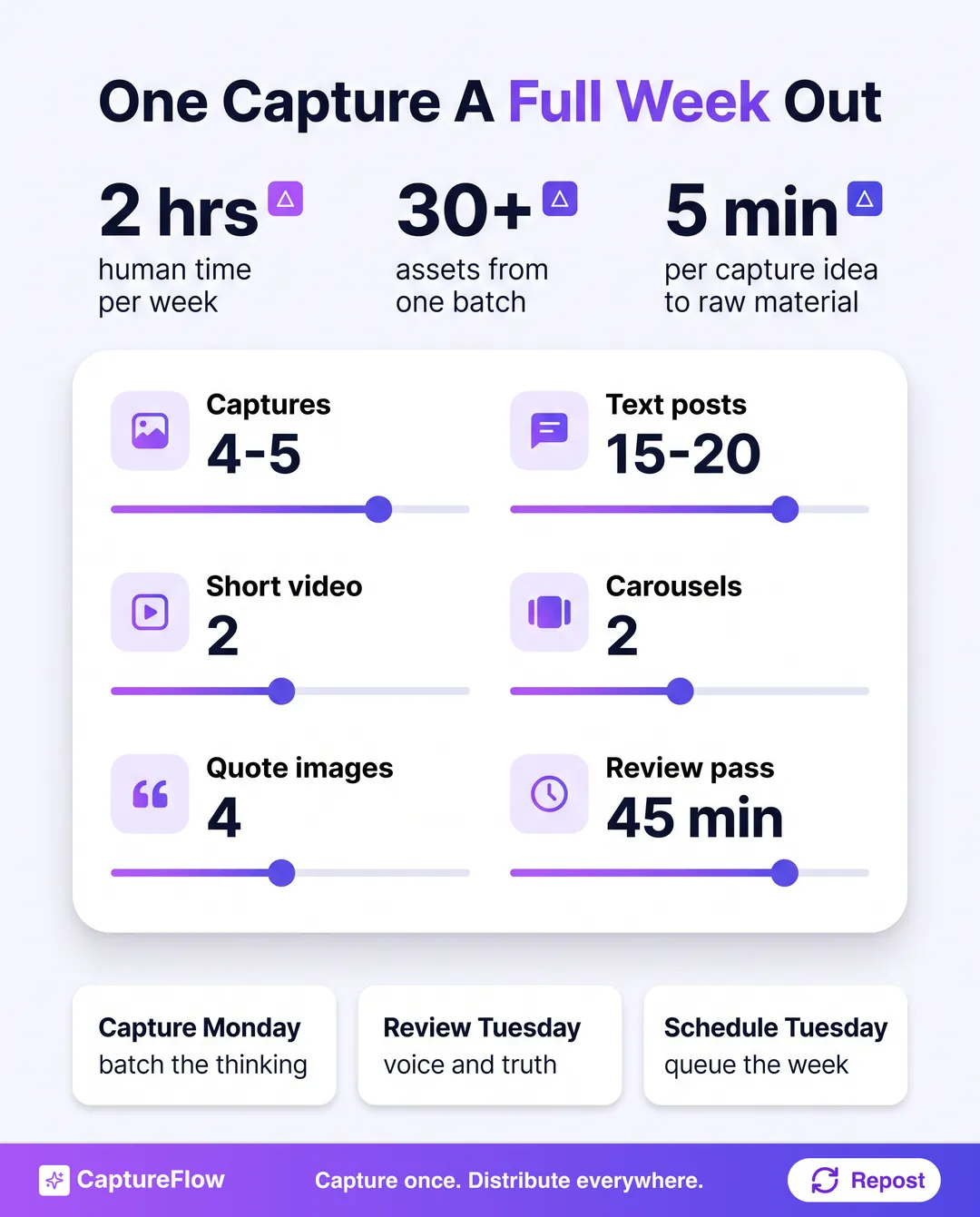 Roughly two hours of human time in, a full week of multi-format content out.
| Day | Block | Time | Output |
|---|---|---|---|
| Monday | Capture batch | 60–90 min | 4–5 raw captures |
| Monday | Agent fan-out | 5 min setup | 25–35 drafts across formats |
| Tuesday | Human review pass | 45–60 min | Edited, on-voice, approved |
| Tuesday | Schedule the week | 20 min | Daily posts + video + carousels queued |
| Wed–Fri | Reactive + reply | 15 min/day | Engagement and 1–2 live posts |
That is under three hours of focused human time producing a week of content across every platform you care about. The output is not capped by hours anymore. It is capped by how many ideas you captured on Monday.
What to stop doing (scaling is subtraction)
Most "we need to produce more" problems are really "we are doing too much of the wrong work" problems. Increasing output on a small team means killing the tasks that cost time without adding quality.
- Stop starting from a blank page daily. Capture in batches. The daily blank page is the single biggest tax on a lean team.
- Stop rewriting the same idea per platform by hand. Fan out once from the source capture. Manual reformatting is pure duplicated effort.
- Stop routing every post through a three-person approval chain. Approvals add days, not quality. One reviewer, reading for voice and truth, is enough.
- Stop chasing every new platform from scratch. A new channel is one more output of an existing capture, not a new content stream to staff.
- Stop measuring effort in hours. Measure it in captures. Hours are what burn people out, captures are what scale.
The teams that scale are not the ones that grind harder. They are the ones that quit the expensive habits and let the unit of work do the scaling for them. If you want the tooling side of this, our content strategy features and the best AI content tools for marketing teams both map to this exact loop.
The takeaway
You cannot hire your way to more content this quarter. You can change what one unit of work means. Capture once, fan out into every format, keep humans on judgment, and distribute on a cadence. That is how a team of two produces the output of ten, without any of them burning out.
Ready to make one capture do the work of a full content desk? See how CaptureFlow fits your flow.
Sources
- Content Marketing Institute, B2B Content Marketing: 2025 Benchmarks and Trends
- Stanford HAI, The 2025 AI Index Report
- Gloria Mark, UC Irvine, The Cost of Interrupted Work
Frequently asked questions
How can a small marketing team produce more content without hiring?+
Change the unit of work. Instead of writing one post at a time, capture one idea in 5 minutes, then fan it out into many formats. A single capture becomes text posts, a short video, a carousel, and quote images, so two people produce what used to take a full team.
What is the real bottleneck when scaling content production?+
Creation, not distribution. Scheduling and publishing are already fast and mostly automated. Lean teams stall on the blank page: deciding what to say and drafting it. Put your leverage there, and the rest of the pipeline clears itself.
How do you scale content without burning out the team?+
Batch the hard thinking into one session a week, hand the repetitive formatting to an AI content agent, and stop rewriting the same idea by hand for every platform. Burnout comes from 30 cold starts a month, not from the volume of posts itself.
How much content can a two-person team realistically produce?+
Enough to post daily on two or three platforms plus weekly video and carousels, from roughly two hours of capture a week. The output ceiling is set by how many ideas you capture, not by how many hours you spend formatting them.
Chris is the founder and CEO of CaptureFlow, which he builds so founders can turn their expertise into content without hiring a team. After 10+ years building products and growing audiences from scratch, he writes about founder-led content, AI, and distribution from inside the problem he is solving: distributing consistent, on-brand content as a team of one.
Founder & CEO of CaptureFlow · 10+ years building products and audiences
One playbook a week from founders who actually create and distribute lots of content. No spam, unsubscribe anytime.
Keep reading

The Weekly Content Workflow for a Small Marketing Team
Most small B2B teams do not have a content problem. They have a workflow problem. Here is the repeatable week that fixes it.

How to Turn One Video Into Content for Every Platform
You recorded one good video. Most people post it once and move on. Here is the workflow to turn that single video into native content for every platform.

Content Workflow Automation for Agencies (2026)
Every new client multiplies the manual work: another voice, another calendar, another five tools. Content workflow automation is how agencies scale output without scaling headcount.