Content Workflow Automation for Agencies (2026)
How agencies automate content creation and publishing across many clients: centralize each brand voice, automate the draft, batch approvals, and distribute natively.


Every agency hits the same ceiling, and it always arrives disguised as good news: you win another client. Now there is another brand voice to hold in your head, another content calendar, another approval chain, another five tools to log into. The work did not get more creative. It got more manual, and it multiplied.
That is the agency content trap. Your output scales linearly with headcount, so growth eats your margin instead of building it.
Content workflow automation for agencies is the system that turns one client input into finished, on-brand content for every channel, so you can produce for many clients without adding a person for each one. This is the practical guide to how agencies automate content creation and publishing across multiple clients in 2026, without letting any client's voice slip into generic sameness.
Why agency content does not scale
The root problem is not talent or effort. It is that the work fragments three ways, and every new client multiplies all three.
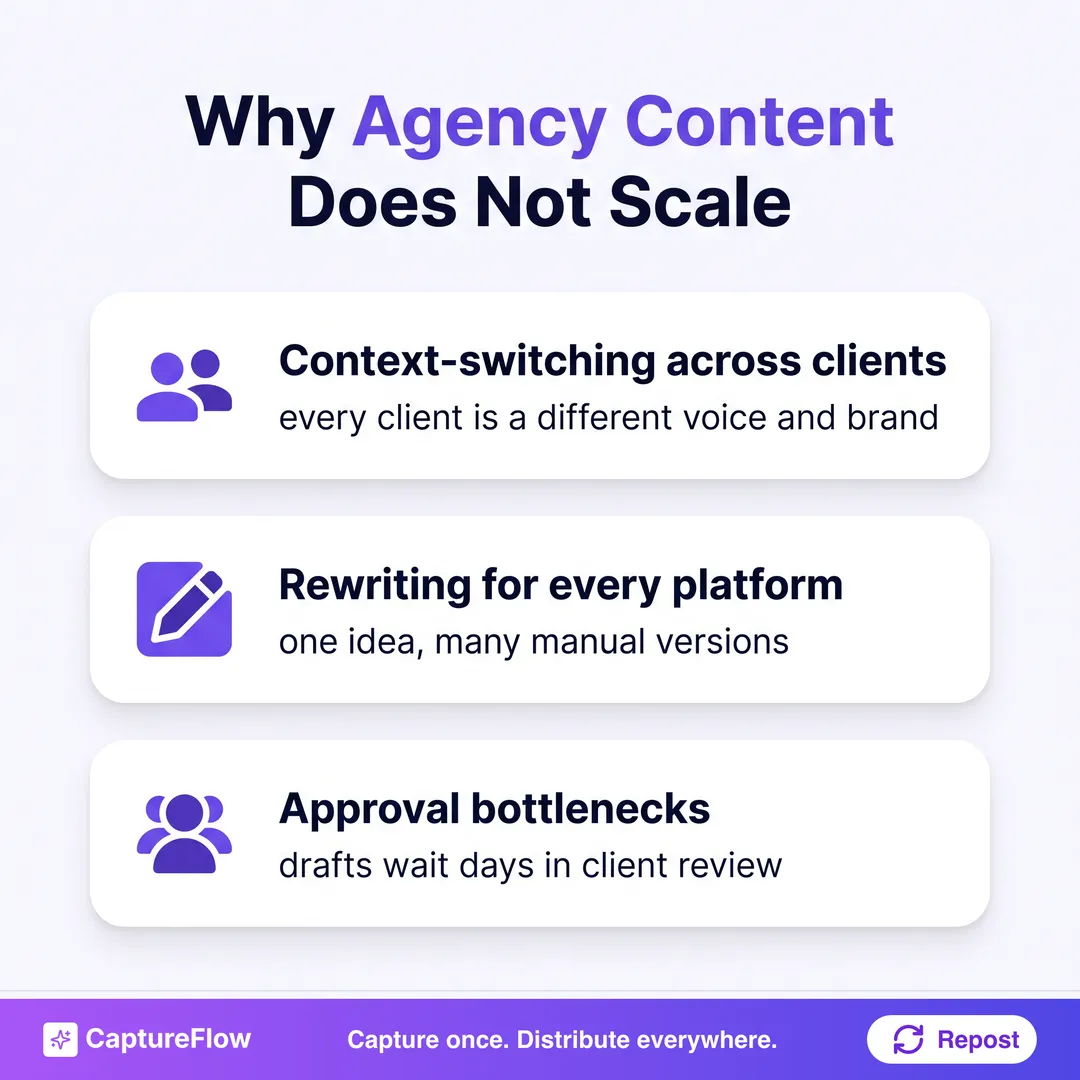 The agency tax: three manual costs, each multiplied by every client on the roster.
- Context-switching across clients. Each client is a different voice, audience, and brand. A strategist who moves between five accounts before lunch pays a mental tax at every switch.
- Rewriting for every platform. One idea becomes a LinkedIn post, an X thread, a carousel, and a short video, by hand, per client, every week.
- Approval bottlenecks. Drafts sit for days in client review, so the calendar stalls even when the work is done.
None of these is a creativity problem. They are all operations problems, which means they are automatable. This is the agency version of the content operations challenge every scaling team faces, turned up to the number of clients you serve. If you are still choosing software, we rank the best content workflow tools for agencies by where each one actually fits.
What content workflow automation actually looks like
Automation here does not mean a bot posting on autopilot with no human. It means removing the manual handoffs between the moment a client gives you raw material and the moment finished content is live, so your people spend their time on judgment and craft, not copy-paste.
AI made the production step cheap. In HubSpot's 2026 State of Marketing report, 86 percent of marketers now use AI and 67 percent of teams report saving 10 or more hours a week with it. For an agency, those saved hours are pure margin, but only if the AI holds each client's voice instead of flattening every account into the same generic tone. Speed without voice just produces average content faster, which is worse than slower content that sounds like the client.
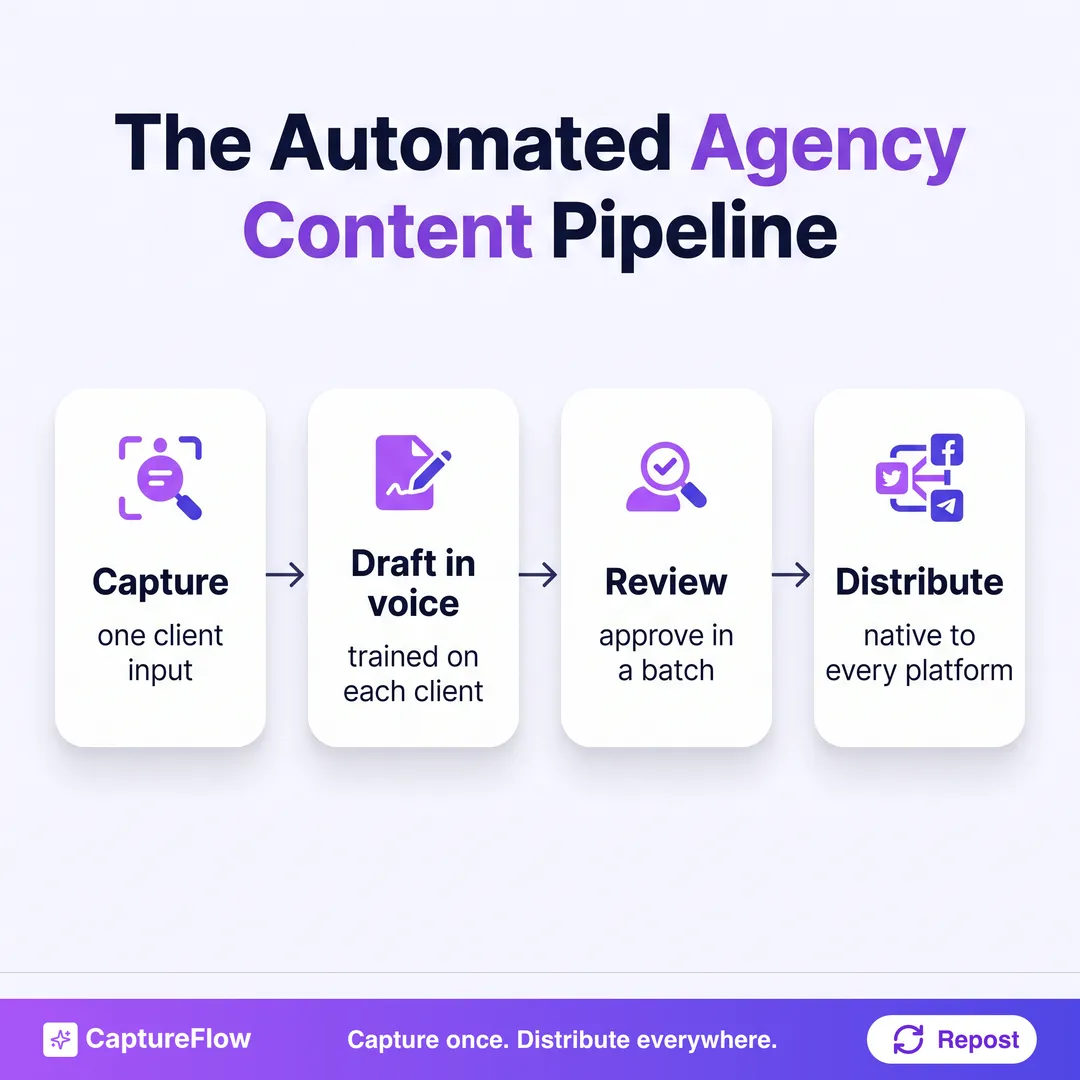 The pipeline. Each stage removes a manual handoff without removing the human judgment.
The 5-stage agency content automation system
Here is the whole system before the detail. Five stages, one goal each: cut a manual step, keep each client's voice.
- Centralize each client's voice and inputs into one source of truth.
- Automate the draft with AI trained per client.
- Batch the review and client approvals.
- Distribute natively to each client's channels.
- Report per client to prove the value.
Stage 1: Centralize each client's voice and inputs
The first leak is scattered raw material. A client's best content lives in their calls, their expert's head, and a shared drive nobody opens. Create one place per client where every reusable idea, recording, and brand-voice note lands. You cannot automate a pipeline on inputs you have to hunt for.
Onboard each client's voice once, deliberately: past posts, tone, three example pieces they love. That voice profile is the asset that lets everything downstream sound like them, not like your house style pasted across ten accounts.
Stage 2: Automate the draft in each client's voice
This is where the hours go, and where automation pays for itself. Instead of a strategist drafting every post from a blank page per client, an AI content agent trained on that client drafts native posts, carousels, and short video from a single input.
CaptureFlow is an AI content agent that turns your expertise into weeks of on-brand content for every platform. For an agency, that means one capture from a client, a call, a brief, a recording, becomes a week of on-brand drafts in that client's voice, ready for your team to review. The blank page, per client, per platform, is the exact cost it removes.
Keep a human in the loop on voice, always. The automation drafts; your strategist sharpens. The agencies that win with AI are the ones whose clients cannot tell it was involved, because a person still owns the final read.
Stage 3: Batch the review and approvals
The slowest part of most agency pipelines is not making the content, it is the wait between stages: a draft sitting three days for internal review, an approval lost in a client's inbox.
Batch it. Review a client's whole week in one sitting, send one approval package instead of ten, and give clients a single clear place to say yes. You attack the waits, not the work.
Give each client a standing weekly approval slot. A predictable 20-minute review beats ten ad-hoc "quick approvals" that each cost a context switch on both sides.
Stage 4: Distribute natively to every channel
Once approved, content should go out without a human copy-pasting into five platforms per client. Schedule natively to each client's channels from one place, formatted for each platform rather than the same block pasted everywhere.
This is the same one-input-many-outputs logic behind the best AI content repurposing tools, applied across a whole client roster instead of a single brand.
The nuance that separates good agencies here is native formatting. Pasting the identical caption to LinkedIn, X, and Instagram reads as robotic and underperforms on every channel. Each platform gets content shaped for it, in the client's voice, which is exactly the difference between automating distribution and automating quality.
Stage 5: Report per client to prove the value
Finally, close the loop with reporting that maps to what each client actually cares about: reach, engagement, and the pipeline or leads that follow. Automated per-client reporting is not busywork, it is how you renew the retainer. A client who can see the results in a clean monthly view rarely churns over price, because you have made the value legible. The agencies that lose accounts are usually the ones publishing plenty and proving nothing.
Report the outcome, not the activity. "Here is the reach and the three leads your content drove" retains a client. "Here are 40 posts we published" does not.
One workflow, every client
The mistake agencies make is solving the scaling problem by buying more tools: a writer here, a scheduler there, a design app, an analytics dashboard, times every client. That is more logins, more handoffs, and more places for a piece to stall.
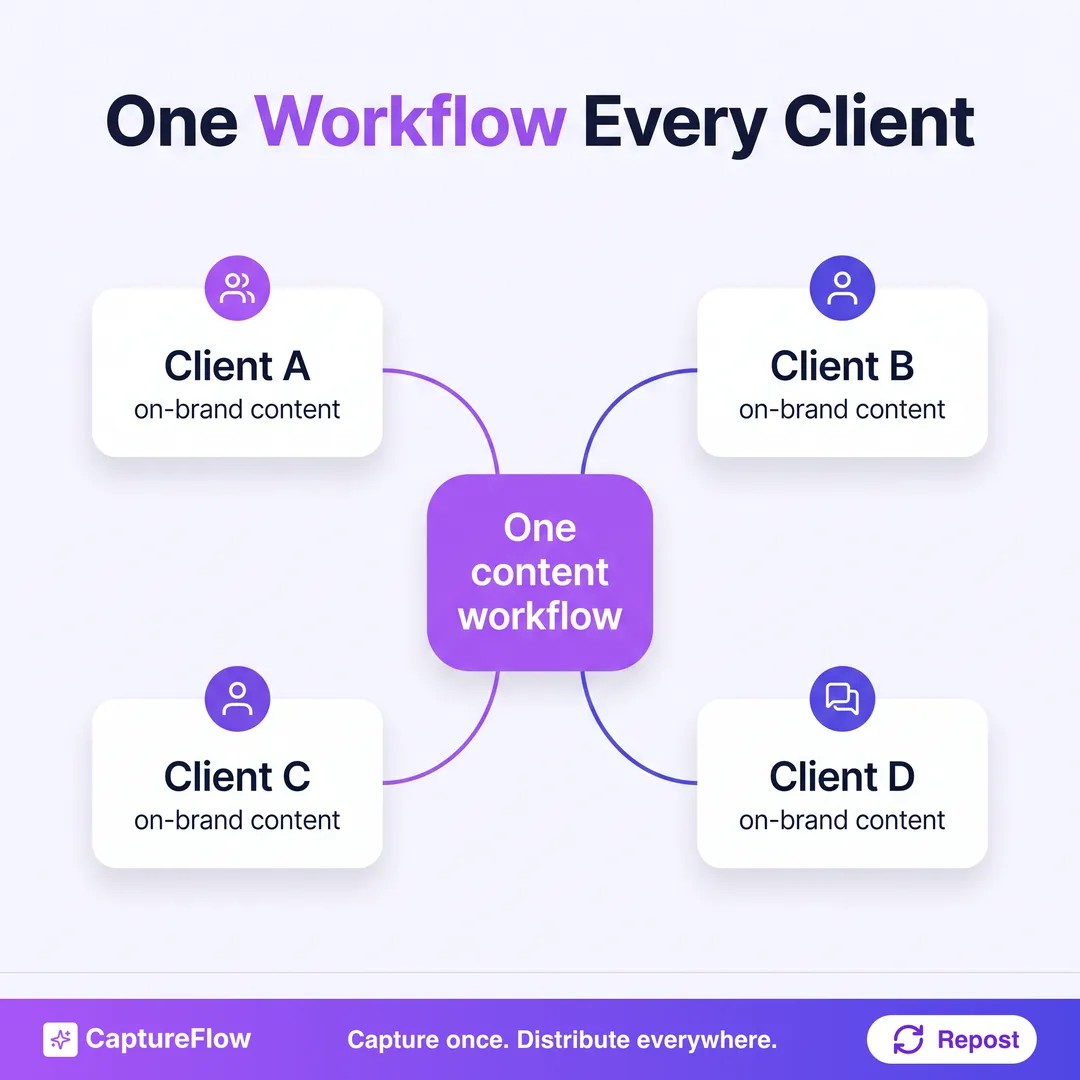 One workflow holding every client's voice beats one more tool bolted onto a five-app stack.
The higher-leverage move is one workflow that holds every client's voice separately and runs the whole pipeline from capture to published. That is what turns a new client from "more manual work" into "another account the system already knows how to serve." If you are comparing what to put at the center of that stack, our roundup of the best AI content tools for marketing teams breaks the category down by job.
The agency ruleGrowth should compound your margin, not consume it. If every new client means a new hire, you do not have a content operation, you have a content bottleneck with a sales team attached.
What automation actually buys an agency
It helps to be concrete about where the hours go back. Take a strategist managing five clients, each needing a week of content across three platforms. The manual version is fifteen blank pages a week, each requiring a context switch into that client's voice, then a round of internal edits, then a round of client edits, then manual scheduling into each platform.
The automated version replaces the fifteen blank pages with fifteen on-brand drafts the strategist reviews and sharpens, one batched approval per client, and native scheduling that runs itself. The creative judgment stays with your people. The mechanical repetition, the part that scaled linearly with your client count and quietly ate your margin, is what leaves.
That is the difference between an agency that has to hire for every account and one that adds a client to a system already built to serve it. The first is capped by headcount. The second is capped only by how many clients you can win.
Common mistakes when automating agency content
A few failure modes show up again and again:
- Flattening every client into one voice. The fastest way to lose the trust an agency is paid for is to let ten accounts start sounding identical. Voice per client is non-negotiable.
- Buying a tool per problem. More tools means more logins and more handoffs, multiplied by every client. Consolidate the pipeline before you add to it.
- Automating distribution before creation. Scheduling is the easy half. If your bottleneck is producing enough on-brand content, a scheduler just organizes the shortfall.
- Removing the human entirely. Full autopilot with no review is how off-brand posts reach a client's audience. Automate the production, keep a person on the final read.
The move
Content workflow automation is how an agency turns winning a client into a margin event instead of a staffing one. Centralize each client's voice, automate the draft, batch the approvals, distribute natively, and report the outcome. Do that, and another logo on the roster stops meaning another week of manual grind.
If the bottleneck is turning each client's raw material into on-brand content without the per-account, per-platform scramble, that is exactly what CaptureFlow is built to remove. You can see how it works, read how it maps to agencies specifically, or set the repetitive parts to run on routines.
Sources
- HubSpot, 2026 State of Marketing report (86 percent of marketers use AI; 67 percent of teams save 10+ hours a week).
Frequently asked questions
What is content workflow automation for an agency?+
It is the system that turns one client input, a call, a brief, a recording, into finished, on-brand content for every channel, with as little manual handoff as possible. For an agency, the goal is to produce for many clients at once without hiring a new person for every account, while keeping each client's voice distinct.
How do agencies automate content creation and publishing for multiple clients?+
Centralize each client's brand voice and raw material into one source of truth, use an AI content agent trained per client to draft native posts, batch reviews and client approvals instead of handling drafts one at a time, then schedule natively to each client's channels and report the results. The aim at every stage is to remove a manual handoff, not add a step.
What is the best content workflow automation tool for a digital agency?+
The best tool collapses the whole span, from a client's raw input to on-brand posts across every platform, into one workflow that holds each client's voice separately. That beats stitching a writer, a designer, a scheduler, and an analytics tool together per account, because the handoffs between those tools are exactly where an agency's time and margin leak.
Chris is the founder and CEO of CaptureFlow, which he builds so founders can turn their expertise into content without hiring a team. After 10+ years building products and growing audiences from scratch, he writes about founder-led content, AI, and distribution from inside the problem he is solving: distributing consistent, on-brand content as a team of one.
Founder & CEO of CaptureFlow · 10+ years building products and audiences
One playbook a week from founders who actually create and distribute lots of content. No spam, unsubscribe anytime.
Keep reading

The Weekly Content Workflow for a Small Marketing Team
Most small B2B teams do not have a content problem. They have a workflow problem. Here is the repeatable week that fixes it.

How to Scale Content Production With a Small Marketing Team
You cannot hire your way out of a content backlog this quarter. You can change the unit of work. Here is how a one to three person team produces more content without burning out.

How to Repurpose Podcast Clips, Voice Memos, and Automate Social Content: One System for Founders
Your podcast episode and the voice memo you recorded on the train are the same raw material. Here is one system that turns both into a week of native posts, then distributes them for you.