The Weekly Content Workflow for a Small Marketing Team
A repeatable Monday-to-Friday content workflow for a small B2B marketing team: the week, the roles, and a time budget you can actually hold.


Most small marketing teams do not have a content problem. They have a workflow problem.
The ideas are there. The expertise is there. What is missing is a repeatable week, so content keeps slipping to whenever someone has a free afternoon, which on a two-person team is never. This is the concrete answer to "how do I build a repeatable content workflow for a small B2B marketing team": a fixed Monday-to-Friday rhythm where each day owns one job.
Not another framework. The actual week.
If you want the wider thinking behind this, how to scale content production with a small team covers the philosophy and content operations for B2B teams covers the system. This post is the tactical week that sits inside both.
What a repeatable content workflow actually is
A repeatable content workflow is a fixed weekly rhythm where every day owns a single job, so producing content stops depending on motivation or a clear calendar. That is the whole idea. You are not trying to work harder. You are trying to make the work run on rails.
The reason small teams stall is not laziness or a lack of ideas. It is context switching. When you jump between planning, writing, designing, and replying to comments all day, every switch has a cost. Gloria Mark's research at UC Irvine found it takes about 23 minutes to fully refocus after an interruption. Do that ten times a day and the real work never gets a clean run.
A repeatable content workflow for marketing teams fixes that by giving each type of work its own day.
Batch by day, not by task
Here is the one rule the whole week is built on: each weekday does one kind of thinking.
Monday plans. Tuesday drafts. Wednesday reviews. Thursday distributes. Friday engages. You are still doing all five jobs every week, you are just not doing all five every day. That single change is what turns a frantic marketing team content process into a calm one.
You are still doing all five jobs every week. You are just not doing all five every day.
Protect the blocks like meetings, because they are. A recurring 45-minute "capture" hold on Monday that nobody can book over is worth more than three motivated hours you never actually find.
The weekly content workflow, Monday to Friday
This is the core. Five days, five jobs, same order every week.
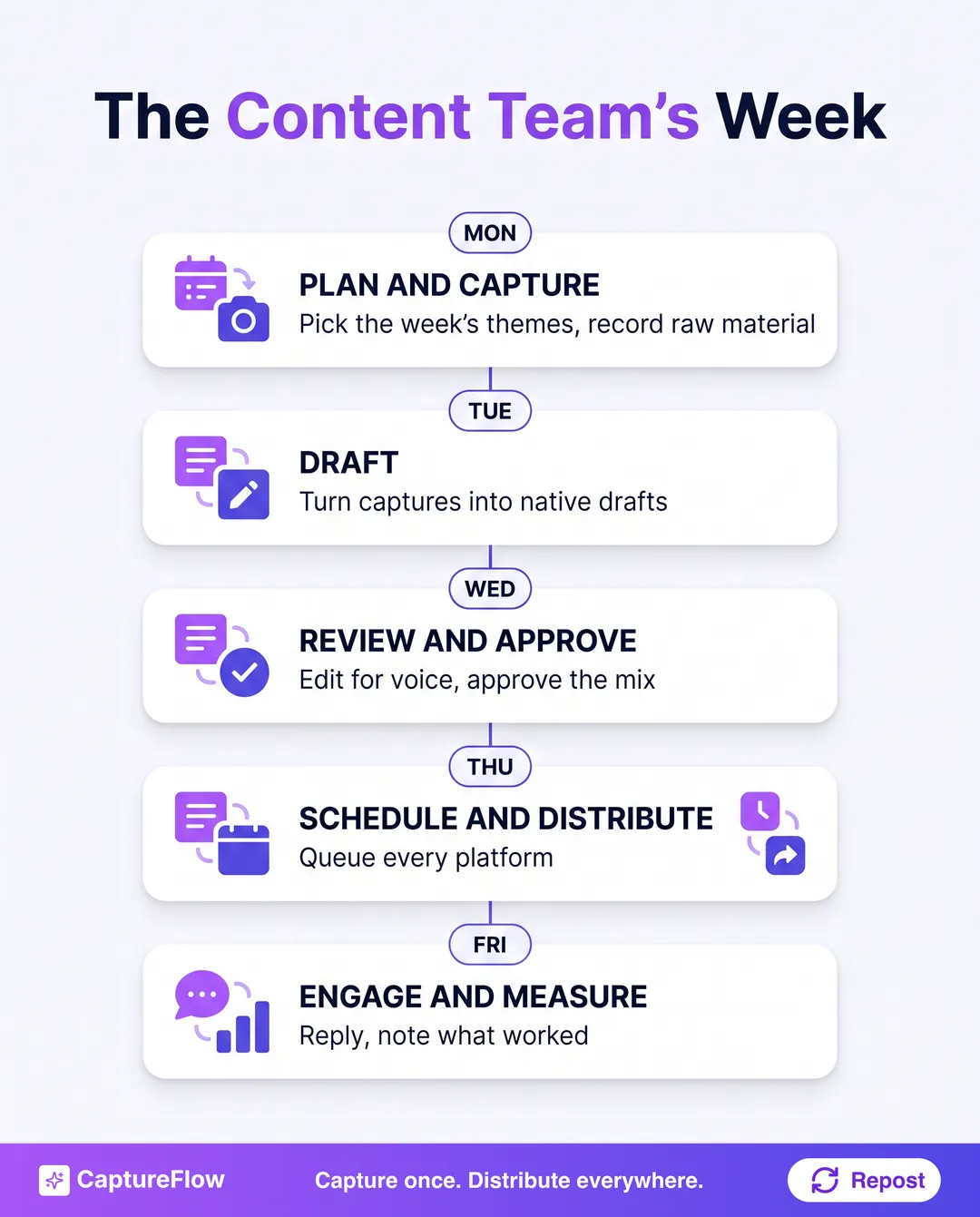 One job per day. The order never changes, which is what makes it repeatable.
Monday: plan and capture. Start with a 20-minute sync to pick the week's two or three themes, then capture the raw material while you have it. A voice note walking through a customer win, a quick screen recording of the product, a five-minute talk into your phone about a decision you made. You are not writing posts yet. You are collecting the source material the rest of the week runs on.
Tuesday: draft. Turn Monday's captures into first drafts. This is the day an AI content agent earns its place, more on that below. Nobody stares at a blank page, because the raw material already exists and the drafting is handled.
Wednesday: review and approve. Edit for voice and truth, not grammar. Approve the week's mix: a couple of text posts, a carousel, a short video, a quote image. Wednesday is a judgment day, not a writing day.
Thursday: schedule and distribute. Queue the approved posts across every platform you publish on. Space them out, set the times, done. Because everything was approved on Wednesday, Thursday is mechanical and fast.
Friday: engage and measure. Reply to comments from the week, thank the people who pushed back, note the two posts that landed and the one that flopped. That note becomes Monday's starting point. The loop closes.
Who owns what on a two-person team
A repeatable week only works if the handoffs are clear. On a two-person team, split it down the middle.
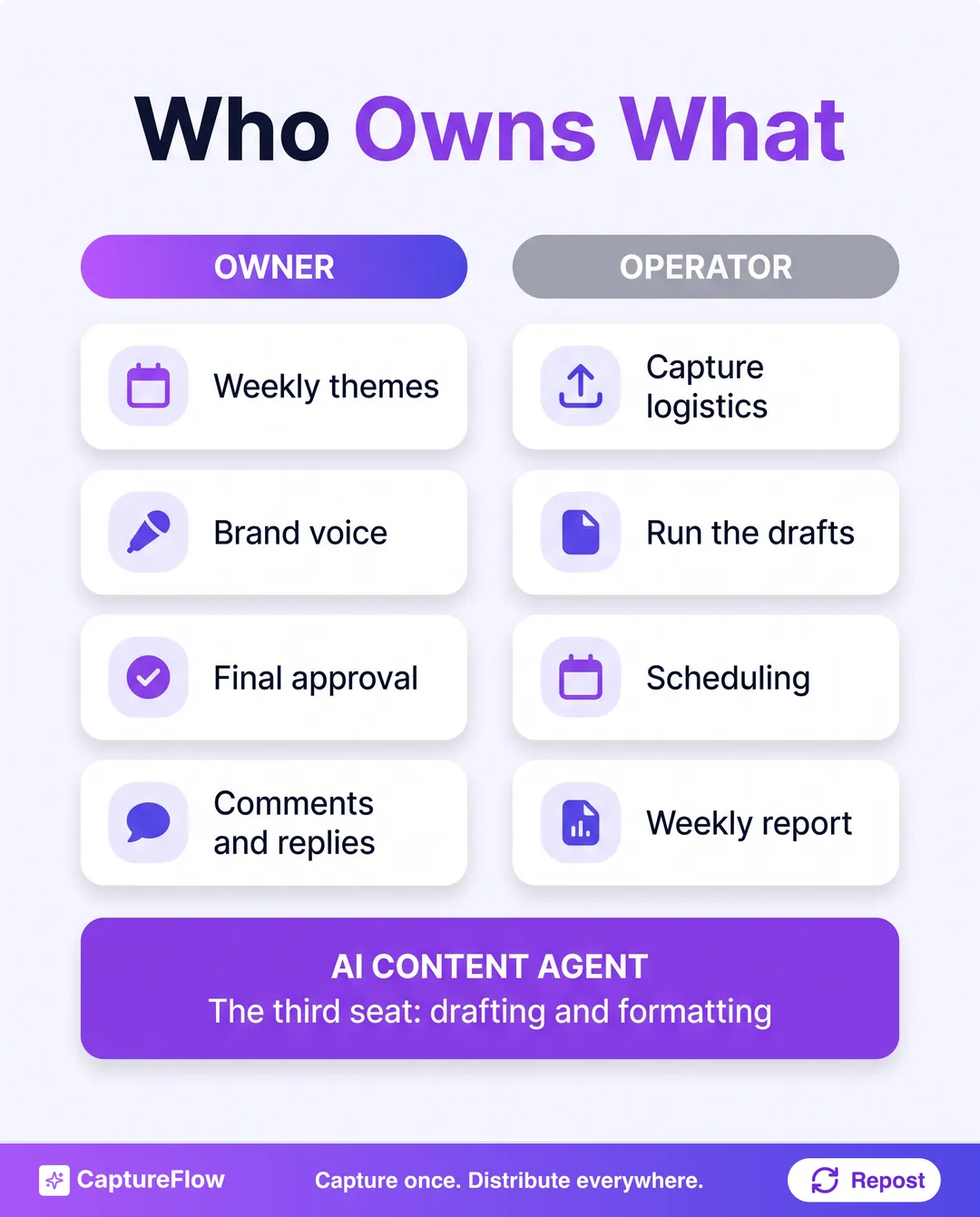 Two people, clear lanes, and an agent covering the third seat you do not have budget for.
The owner holds strategy: the weekly themes, the brand voice, the final yes or no, and the relationships in the comments. The operator holds the machine: capture logistics, running the drafts, scheduling, and the Friday report.
The honest problem is that most teams this size are really 1.5 people, not two. That is where the third seat comes from software, not a hire.
Where an AI content agent fits
Tuesday is the day a two-person team quietly becomes a team of four.
CaptureFlow is an AI content agent that turns your expertise into weeks of on-brand content for every platform. You hand it Monday's captures, the voice note, the screen recording, the rough thought, and it drafts native versions for each channel: a LinkedIn post, an X thread, a carousel, a short video, a quote image, each in your voice. The operator runs it, the owner approves it Wednesday. You review, you do not write from scratch.
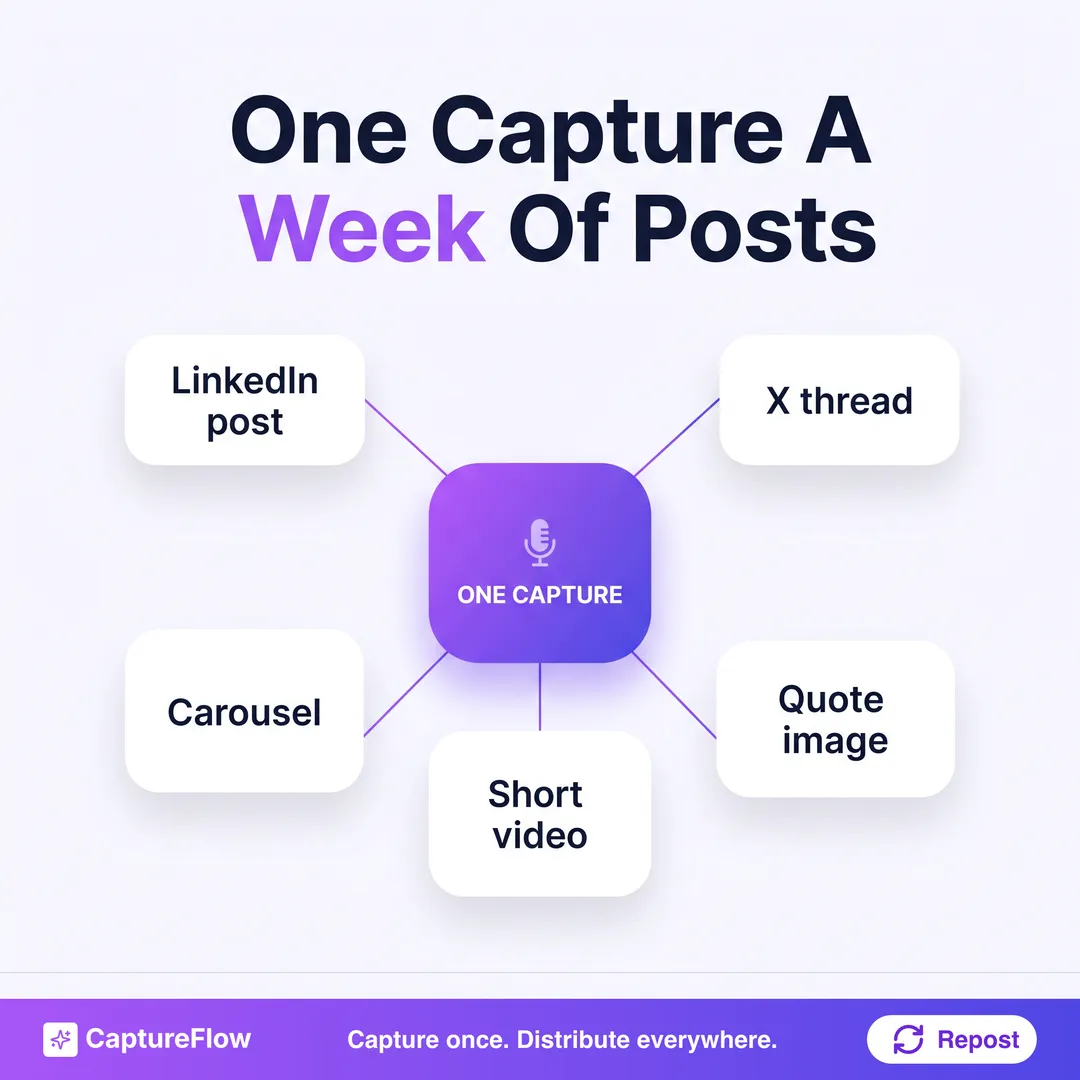 Monday's raw material, reshaped into a week of native posts the team only has to review.
The economics are on your side here. In HubSpot's State of Marketing report, roughly two-thirds of marketing teams say AI now saves them 10 or more hours a week. For a two-person team, ten hours is most of a person. If you want to see how the tools stack up, we ranked the best AI content tools for marketing teams honestly.
The agent does the drafting. Your team keeps the judgment. That division is the whole trick, and it is why the week fits in an afternoon instead of a full week.
The weekly time budget
Once the rhythm is set, the whole thing costs about 2.5 hours. Here is where it goes.
| Day | Job | Time |
|---|---|---|
| Monday | Plan the week and capture raw material | 45 min |
| Tuesday | Run drafts, first look | 15 min |
| Wednesday | Review and approve the week's mix | 45 min |
| Thursday | Schedule and distribute across platforms | 20 min |
| Friday | Engage and read what worked | 30 min |
That is a real week of content across every channel for a couple of small teams' worth of output, from about two and a half focused hours. Batching a whole month at once works too if you would rather go deep less often, how to batch a month of content walks through that variant.
The failure mode is not a bad post. It is skipping a Monday, then a week, then quietly stopping. Pick a cadence you can hold on your worst week, not your best one. One post a day you can sustain beats five you cannot.
The move
A small team does not need more hours or another hire. It needs a week that runs the same way every time.
Give each weekday one job. Plan Monday, draft Tuesday, approve Wednesday, distribute Thursday, engage Friday. Split the work into an owner and an operator, and let an agent cover the seat you cannot fill. Do that, and content stops being the thing that always slips.
If the drafting is where your week breaks, that is exactly what CaptureFlow is built to take off your plate. You can see how it fits a lean team, or the marketing teams use case maps the whole workflow to your setup.
Sources
- Content Marketing Institute, B2B Content Marketing Benchmarks (most B2B content teams are small).
- Gloria Mark, University of California, Irvine, The Cost of Interrupted Work (about 23 minutes to refocus after an interruption).
- HubSpot, State of Marketing report (AI time savings for marketing teams).
Frequently asked questions
How do I build a repeatable content workflow for a small B2B marketing team?+
Give each weekday one job and run them in the same order every week: plan and capture on Monday, draft on Tuesday, review and approve on Wednesday, schedule and distribute on Thursday, engage and measure on Friday. Assign an owner and an operator, and let an AI content agent handle the drafting so a two-person team can hold the cadence.
What does a content workflow look like for a two-person marketing team?+
One person owns strategy, brand voice, and final approval. The other owns capture, running the drafts, scheduling, and reporting. The AI agent acts as the third pair of hands that turns raw captures into native posts, so two people can produce like a small team of four.
How much time should a small team spend on content each week?+
Around 2.5 hours total once the rhythm is set: roughly 45 minutes to plan and capture, an hour to review and approve drafts, 20 minutes to schedule, and 30 minutes to engage and read what worked.
Chris is the founder and CEO of CaptureFlow, which he builds so founders can turn their expertise into content without hiring a team. After 10+ years building products and growing audiences from scratch, he writes about founder-led content, AI, and distribution from inside the problem he is solving: distributing consistent, on-brand content as a team of one.
Founder & CEO of CaptureFlow · 10+ years building products and audiences
One playbook a week from founders who actually create and distribute lots of content. No spam, unsubscribe anytime.
Keep reading

How to Scale Content Production With a Small Marketing Team
You cannot hire your way out of a content backlog this quarter. You can change the unit of work. Here is how a one to three person team produces more content without burning out.

How to Turn One Video Into Content for Every Platform
You recorded one good video. Most people post it once and move on. Here is the workflow to turn that single video into native content for every platform.

Content Workflow Automation for Agencies (2026)
Every new client multiplies the manual work: another voice, another calendar, another five tools. Content workflow automation is how agencies scale output without scaling headcount.