Instagram for B2B Founders: Grow Without Becoming an Influencer
Instagram for B2B founders works as a cold-reach channel: three formats, two posts a week, and metrics that track buyers, not likes. Here is the system.

Most B2B founders write Instagram off before they post anything. It's where people share holiday photos and gym selfies, so the logic goes, and deals happen on LinkedIn. The short answer on Instagram for B2B founders: it works when you treat it as a cold-reach channel for one sharp idea at a time, and you can run it on two posts a week without becoming an influencer.
You don't need to dance, chase trends, or post every day. You need three formats, a weekly rhythm you'll still be doing in March, and a habit of reusing what you already know.
Instagram for B2B founders means using Instagram's recommendation feed to put your expertise in front of buyers who don't follow you yet, in formats the platform rewards.
That's the whole idea. Everything below is how to do it.
Why should B2B founders care about Instagram?
The usual objection is "my buyers aren't on Instagram." They are. They're just not there in their work clothes.
Pew Research Center's social media fact sheet puts Instagram use at 64% of US adults aged 30 to 49. LinkedIn, in that same age group, sits at 37%. The VP of Engineering you want to reach is far more likely to scroll Reels at 9pm than to open LinkedIn on a Sunday. And globally, Instagram passed 3 billion monthly active users in September 2025, per Mark Zuckerberg and Adam Mosseri.
B2B deals don't close on Instagram. But the familiarity that makes a cold email land, or makes a buyer say "oh, I know her" on a discovery call? That builds across every feed they look at. The 2024 Edelman and LinkedIn B2B Thought Leadership Impact Report found that 75% of B2B buyers and C-suite leaders had researched a product or service they weren't considering because of a piece of thought leadership. It doesn't say where they read it. That's the point: useful expertise works wherever buyers happen to be.
The algorithm is built for strangers
Here's the part most founders miss. Instagram is built to show your posts to people who don't follow you.
In January 2025, Instagram head Adam Mosseri said the top three ranking signals are watch time, likes, and sends, and told creators to watch "average watch time, likes per reach, and sends per reach." He added that likes matter slightly more with followers, and sends (people DMing your post to a friend) matter slightly more for reaching non-followers.
None of those need a big following. They're rates, not totals.
Instagram even built a tool for it. Trial reels show a Reel to non-followers first, so you can test an idea on strangers before your existing audience sees it. And in April 2026, Instagram said 75% of recommendations in the US now come from original posts, after cutting reposting aggregators out of recommendations. Original expertise is exactly what a founder has and a meme page doesn't.
LinkedIn rewards a network you've spent years building. Instagram's recommendation feed is far more willing to show a new account's Reel to strangers. For a founder starting from zero, that's the whole appeal.
What are the best Instagram formats for B2B?
Most founders who try Instagram fail because they treat it as LinkedIn with a square crop. Three formats do most of the work for a B2B account, and each has a different job.
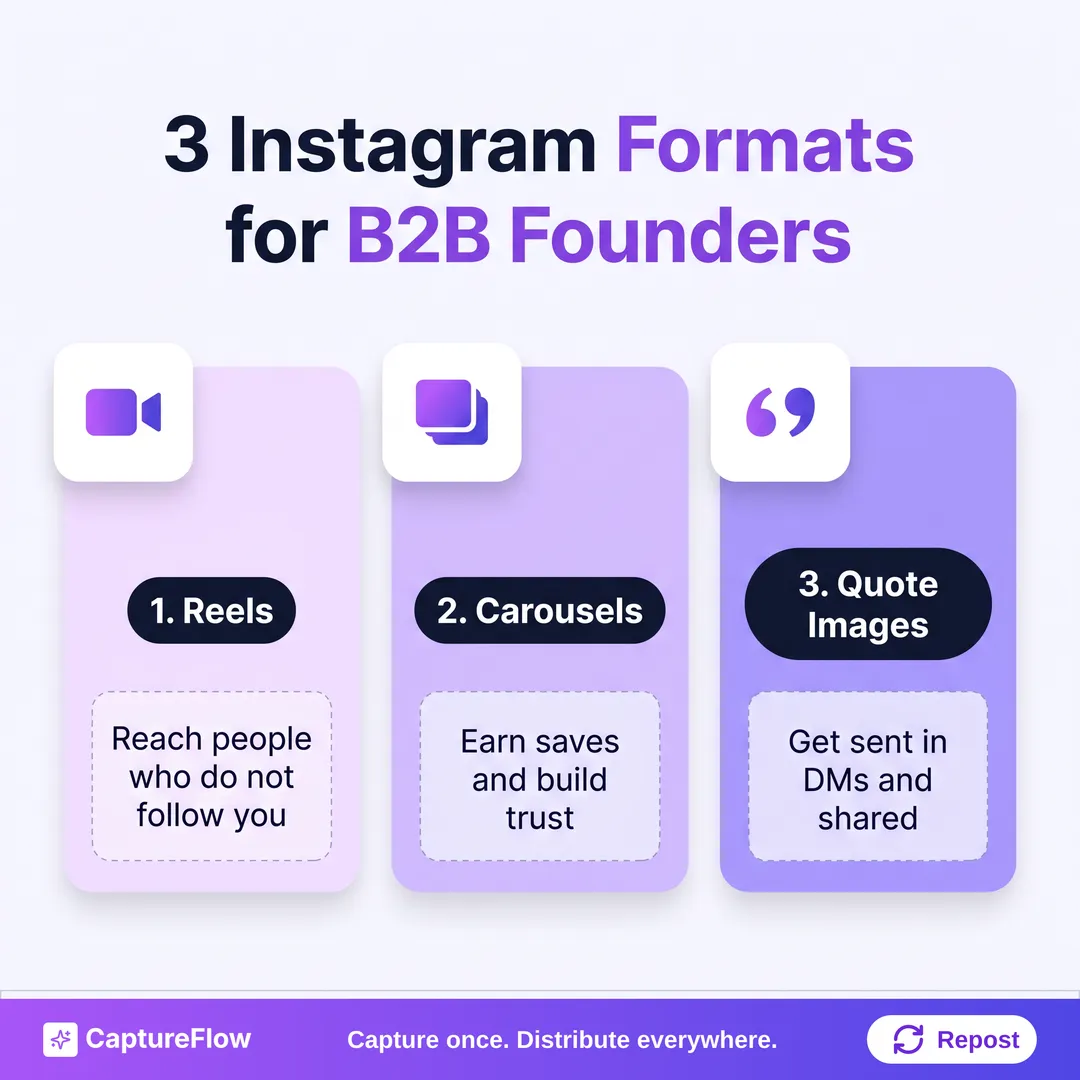 Each format has one job. Don't make a carousel do a Reel's work.
1. Short talking-head Reels (30 to 60 seconds)
This is your reach format. You on camera, phone on a stack of books, one sharp idea from your field. No studio, no b-roll.
The structure is simple. Open with a line that challenges something your industry believes. Deliver the insight in 30 to 45 seconds. End on a takeaway or a question. Skip "hey guys" and skip the intro; the first three seconds decide whether anyone stays, and average watch time is one of Mosseri's three signals. Our short-form video hooks guide has opening lines you can steal, and the free Reels hook generator will draft a few for you.
What to talk about? The stuff you already argue about. Pricing calls, a hire that went wrong, why you killed a feature, the objection every prospect raises. You don't need new ideas. You need your existing ones cut down to one point each.
2. Carousels (5 to 8 slides)
Carousels are your trust format. Reels get you seen; carousels get you saved. Someone who saves a slide deck on "how we price annual contracts" is telling you, and Instagram, that it's worth coming back to.
Frameworks, numbered steps, and before/after comparisons work best. "5 mistakes we made getting to 100 customers" beats "some thoughts on growth" every time. Instagram allows up to 20 slides, but you rarely need more than eight. One template, one font, two colors. If you've already made LinkedIn carousels, our LinkedIn carousel guide covers the slide structure; the logic carries over almost unchanged.
3. Quote images
The lowest-effort format and the most underrated. One strong sentence, clean background, your name. These get sent in DMs and reshared to Stories, which feeds the sends signal directly.
The test is easy: if you'd screenshot the line and text it to a cofounder, it works as a quote image.
| Format | Job | Signal to watch | Effort |
|---|---|---|---|
| Talking-head Reel | Reach non-followers | Watch time, non-follower reach | Medium (filming) |
| Carousel | Build trust | Saves | Medium (design) |
| Quote image | Get shared | Sends and Story reshares | Low |
How do you turn LinkedIn posts into Instagram content?
You don't need separate ideas for Instagram. You need to translate the ones you already have.
If you post on LinkedIn, you're sitting on months of hooks, frameworks, and opinions that already proved they land with your audience. The catch is the word "translate." Pasting a 300-word LinkedIn post into an Instagram caption doesn't work, because on Instagram the caption is secondary. The first frame of the Reel, or the cover slide, does the selling. If it doesn't stop the thumb, nobody reads your caption.
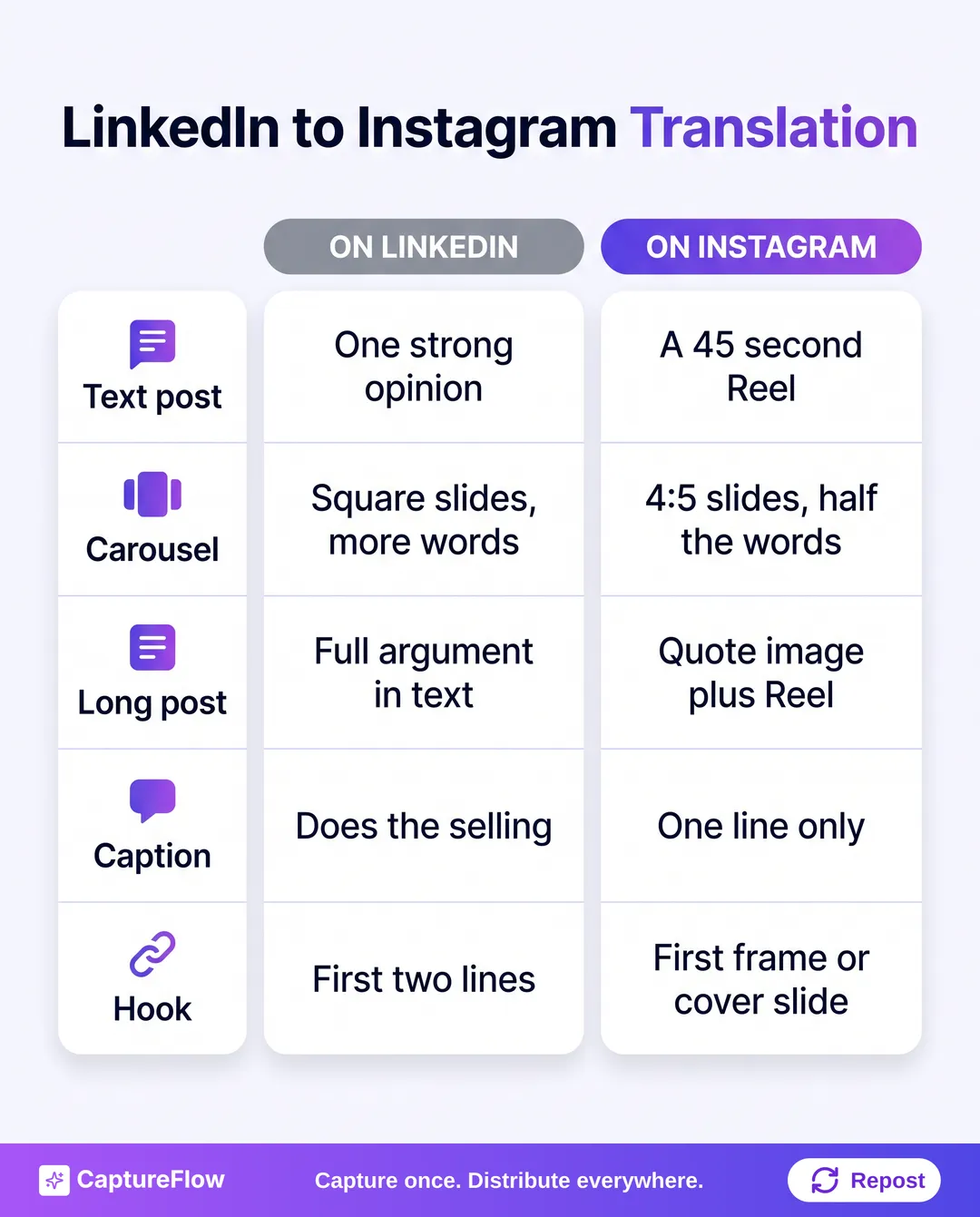 Same idea, different first impression.
Here's how the main formats map:
- LinkedIn text post → Reel. Strip it to the one point that made people comment. Record it in 45 seconds. Your caption becomes a single line.
- LinkedIn carousel → Instagram carousel. Resize to 4:5 portrait, cut the words on each slide roughly in half, and rewrite the cover slide as a specific outcome ("3 things that killed our first launch").
- Long LinkedIn post → quote image plus Reel. Pull the most surprising sentence for the quote. Talk through the argument in a short Reel.
So the effort moves. On LinkedIn you invest in the writing. On Instagram you invest in the hook, whether that's a first frame or a cover slide.
A starting move that takes one afternoon: open your five best LinkedIn posts from the last 90 days. Underline the single most provocative sentence in each. Those five sentences are your first five Instagram hooks.
This is also where most founders stall, because translating by hand every week gets old fast. CaptureFlow is an AI content agent that turns your expertise into weeks of on-brand content for every platform. You capture one idea in about 5 minutes (a voice note, a video, a file, or a link), and it reshapes it into native posts for each channel: a LinkedIn post, an Instagram carousel, a quote image, a short video. See how cross-platform publishing handles the reformatting, or how it works on Instagram specifically.
On LinkedIn you invest in the writing. On Instagram you invest in the first frame.
Which Instagram metrics matter for B2B?
Founders who try Instagram usually track the wrong numbers, then decide it doesn't work. A post with 200 likes can produce nothing. A post with 12 likes can start three sales conversations in your DMs.
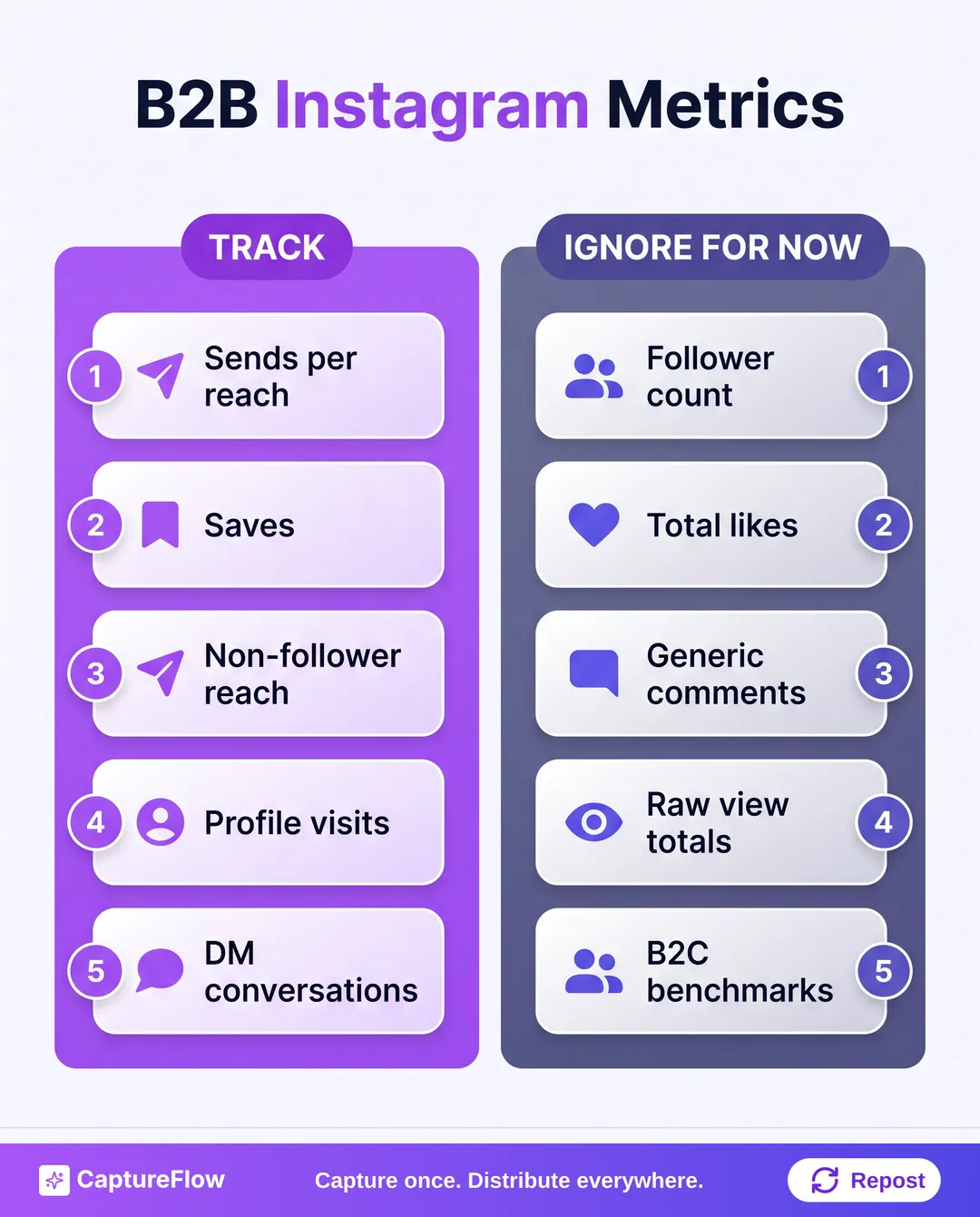 Rates beat totals, especially early on.
Track these
- Sends per reach. The share of people who DM your post to someone. Mosseri ties it to reaching non-followers, and for B2B it's a sign your post solved a problem someone else at their company has.
- Saves. Useful content gets saved. A low save rate on carousels usually means the advice was too general.
- Non-follower reach. Instagram's own Insights split accounts reached and engaged into followers and non-followers. If almost all your reach is followers, your hooks aren't pulling strangers in.
- Profile visits. A spike after a Reel means it made someone curious enough to check who you are. That's cold reach doing its job.
- DM starts. The highest-intent signal Instagram gives you. Keep a simple tally of conversations that started from a post, not from people who already knew you.
Ignore these (for now)
- Follower count, especially in the first six months.
- Total likes, which barely track business outcomes.
- "Great post!" comments from accounts that leave the same comment everywhere.
Want a number to compare against? Our guide to what a good Instagram engagement rate is breaks benchmarks down by account size, and the Instagram engagement calculator does the math for you. Just don't hold a B2B account to a fashion brand's numbers. A smaller audience that saves and DMs beats a big one that double-taps and scrolls on.
A 2-post-per-week Instagram system a founder can sustain
The most common way founders fail on Instagram isn't bad content. It's a bad cadence. They post daily for two weeks, burn out, vanish for a month, and conclude the platform doesn't work.
Two posts a week. That's the whole commitment. (If you're unsure whether that's enough, our breakdown of how often to post on social media explains why consistency beats volume.)
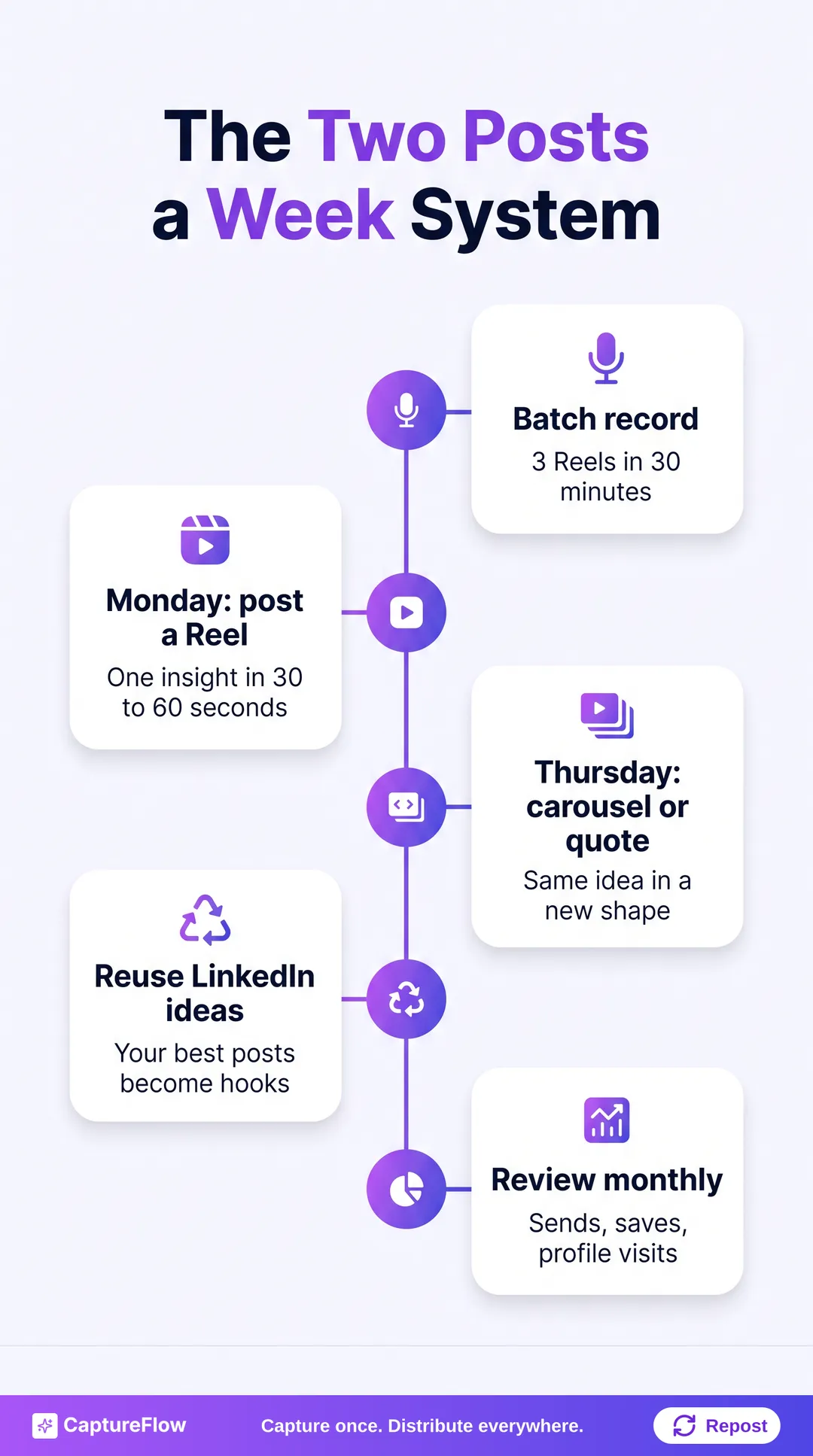 Thirty minutes of recording covers three weeks of Reels.
Post 1, Monday or Tuesday: one Reel. A 30 to 60 second clip on a single insight. No script needed, just a hook sentence and one clear point. Record three in one 30-minute session and you've covered three weeks.
A hook that reliably works: "[Common belief in your industry] is wrong. Here's what I learned after [specific experience]." It creates tension in the first second, and tension is what keeps the watch time up.
Post 2, Thursday or Friday: one carousel or quote image. Rebuild the same idea from your Reel as a carousel, or lift one line from that week's LinkedIn post into a quote image. Alternate the two week to week so the grid doesn't look repetitive.
The monthly rhythm
| Week | Reel topic | Static post |
|---|---|---|
| Week 1 | A contrarian take on your industry | Carousel: a framework or process |
| Week 2 | A founder story or lesson | Quote image from a LinkedIn post |
| Week 3 | A product or customer insight | Carousel: before and after |
| Week 4 | An answer to a common objection | Quote image: the week's best line |
Raw material you already have
You don't need to invent anything. Look at what's already lying around:
- LinkedIn posts from the last 90 days (hooks and frameworks)
- Sales and customer call recordings (objections, real questions, the phrases buyers use)
- Voice notes and ideas you jotted down and never used
- Talks, webinars, slide decks, or blog posts you've written (pull the sharpest paragraph)
If you capture your thinking in any format, you already have weeks of Instagram posts. The work is pulling them out and reshaping them. Our content repurposing strategy covers that step in more depth, and the TikTok for B2B playbook runs the same two-a-week logic on a different feed.
Where to start this week
Instagram doesn't ask you to become a different kind of founder. It asks you to take what you already know and put it in a shape the platform rewards.
Pick your best LinkedIn post from the last 30 days. Record a 45-second Reel on its core idea. Post it this week, as a trial reel if your account has access, and check non-follower reach, sends, and profile visits after seven days. That's your baseline.
If the reformatting is what will stop you by week three, let an agent handle it. See CaptureFlow's pricing and hand off everything after the capture.
Sources
- Pew Research Center: Social Media Fact Sheet
- TechCrunch: Instagram now has 3 billion monthly active users
- Edelman and LinkedIn: 2024 B2B Thought Leadership Impact Report
- Social Media Today: Instagram shares algorithm insights for 2025
- Instagram for Creators: Trial reels
- Instagram for Creators: Rewarding original creators on Instagram
- Instagram Help Center: Insights metrics
- PetaPixel: Instagram users can now share 20 photos in a post
Frequently asked questions
Is Instagram worth it for B2B founders?+
Usually yes, if your buyers are under about 50 and you can talk to camera for 45 seconds. Instagram's recommendation feed shows Reels to non-followers, so a small account can reach new people in its first weeks, which is harder on LinkedIn.
How often should a B2B founder post on Instagram?+
Twice a week is enough to learn what works: one short Reel and one carousel or quote image. Consistency over three months matters far more than daily posting for two weeks.
What should a B2B founder post on Instagram?+
The same expertise you share on LinkedIn, reshaped for the platform: a 30 to 60 second talking-head Reel on one sharp idea, a carousel that walks through a framework, and quote images pulled from your strongest lines.
Can I just repost my LinkedIn content to Instagram?+
Repost the idea, not the post. A pasted 300-word LinkedIn caption does poorly on Instagram, where the first frame or cover slide does the work. Take the core point and rebuild it as a Reel, carousel, or quote image.
Which Instagram metrics matter for B2B?+
Sends per reach and saves tell you the content is useful, non-follower reach tells you the hook works, and profile visits plus DMs tell you it reached a buyer. Follower count and total likes are lagging signals at best.
Chris is the founder and CEO of CaptureFlow, which he builds so founders can turn their expertise into content without hiring a team. After 10+ years building products and growing audiences from scratch, he writes about founder-led content, AI, and distribution from inside the problem he is solving: distributing consistent, on-brand content as a team of one.
Founder & CEO of CaptureFlow · 10+ years building products and audiences
One playbook a week from founders who actually create and distribute lots of content. No spam, unsubscribe anytime.
Keep reading
Pinterest for B2B: Evergreen Traffic Without Algorithm Anxiety
Your LinkedIn post is dead by Thursday. A good Pin can still be sending traffic next spring. Here is how B2B teams use Pinterest as a search channel, what to pin first, and a 60-day plan to test it.
TikTok for B2B: What Actually Works (And What Wastes Your Time)
Most B2B teams wrote TikTok off years ago. The buyers didn't. Here is what actually works for B2B on TikTok, what burns your hours, and a 30-day test that tells you whether it is worth it.
Best Time to Post on TikTok in 2026 (Data-Backed)
TikTok is the one big platform where the weekend beats the workweek. Here is what the non-vendor data says about timing in 2026, and a 14-day test to find your own window.