How to Stay Consistent on Social Media With Nothing to Say
How to stay consistent on social media when you have no ideas: three capture habits, a 30-idea bank, and five posts that work in an empty week.


You open LinkedIn, stare at the empty box, and nothing comes. So you close the tab and tell yourself you'll post tomorrow. Here's the fix for how to stay consistent on social media when you have nothing to say: you don't need more ideas, you need to catch the ones you already have before they disappear, and keep a small bank of them for the days the box stays empty.
Because you did have ideas this week. A client asked a question you've answered fifty times. You read a take you thought was wrong. You made a call and explained it to your team. Each of those was a post. None of them got written down.
Social media consistency is posting on a cadence your audience can count on, fed by ideas you captured before you needed them.
That second half is the part most advice skips. This piece covers why the blank page happens, three capture habits that take under two minutes each, a 30-idea bank you can build in one sitting, and five posts that still work in a week where nothing happened.
Why do you feel like you have nothing to say?
Try this. Answer five questions about the last seven days:
- What did someone ask you that surprised you?
- What decision did you make, and why?
- What did you read or hear that you disagreed with?
- What took longer than it should have?
- What would you redo if the week started over?
Two answers is two posts. Most founders get four.
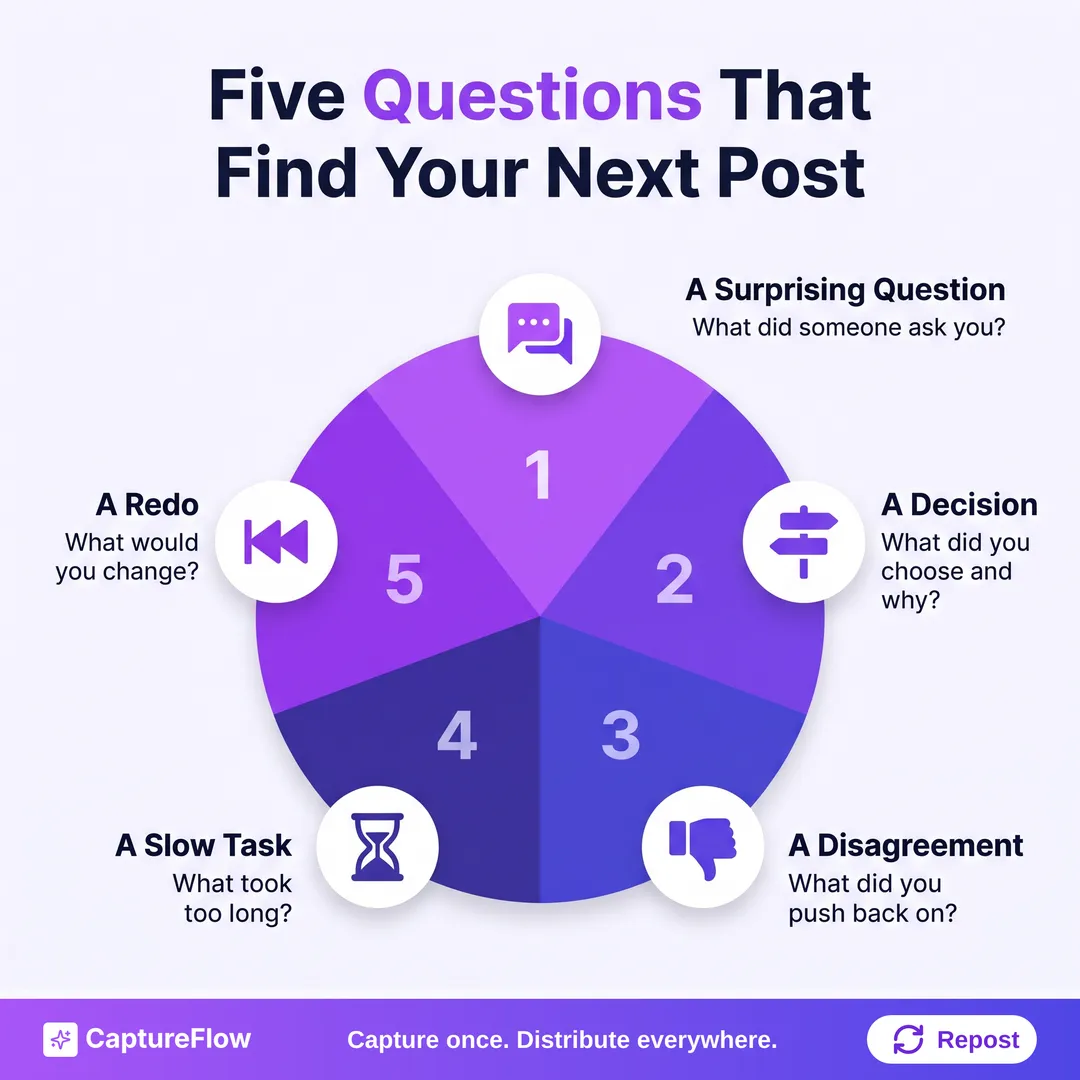 Run these five questions on any Friday. Two answers is two posts.
So why does Thursday's blank box feel so convincing? Memory. Hermann Ebbinghaus mapped how fast we forget newly learned material back in 1885, and a 2015 replication in PLOS ONE by Jaap Murre and Joeri Dros got almost the same curve: the steepest drop comes within the first hour, and it keeps sliding over the following days. That sharp observation from Monday's sales call? By Thursday it's a vague feeling that "something interesting happened."
The blank page isn't evidence that your work is boring. It's evidence you didn't write it down.
Why consistency beats brilliance (and why discipline isn't the fix)
Showing up regularly matters more than any single great post. In the 2024 Edelman and LinkedIn B2B Thought Leadership Impact Report, 90 percent of decision-makers said they're more receptive to outreach from companies that consistently produce high-quality thought leadership. Consistently is doing a lot of work in that sentence.
Most founders who go quiet blame themselves. "I'm just not disciplined about it." I don't buy that. Discipline solves a motivation problem, and motivation usually isn't what's missing. You can want to post badly and still have nothing to put in the box. What runs out is raw material.
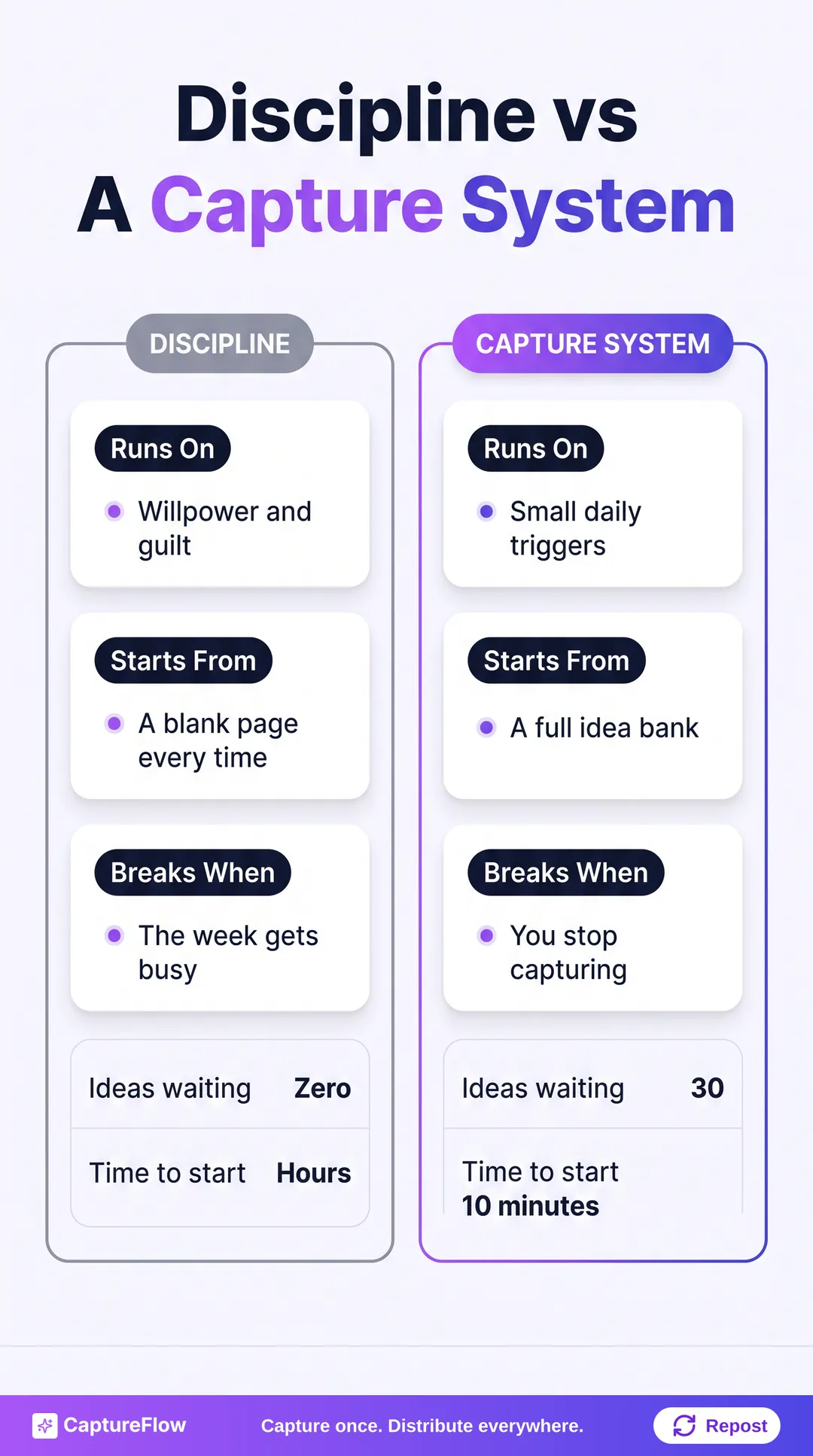 Willpower runs out. A full idea bank doesn't.
Consistency is an output, not a personality trait. Fix the supply of ideas and the posting takes care of itself.
There's good news buried in the habit research, too. In the well-known Lally et al. study at UCL, missing a single day didn't meaningfully derail people forming a new habit. Skip a week? Fine. Just don't let one skipped week turn into a skipped quarter.
How to stay consistent on social media: three capture habits
You don't need an elaborate system. You need three small habits, each attached to something you already do. Psychologists call this an implementation intention, an "if X happens, then I do Y" plan, and a meta-analysis by Peter Gollwitzer and Paschal Sheeran covering 94 studies found it gives a medium-to-large boost to actually following through, compared with just intending to. (Later bias-corrected analyses put the effect smaller, but still positive.) The trigger does the remembering so you don't have to.
Habit 1: If a call ends, then record one sentence
Before you open the next tab, hit record on your phone and finish this sentence out loud: "The most interesting thing in that call was..." Thirty seconds. You're not writing a post, you're saving the raw insight before your brain files it under "done."
Four to eight calls a week means four to eight ideas a week. If you want to see what a single recording can become, we walked through it in how to turn a voice note into a week of content.
Habit 2: If something makes you react, then screenshot it
A customer message that names their problem perfectly. A post you disagree with. A chart that surprised you. Screenshot it, one second, done. Good content is mostly a reaction made legible, and your camera roll is quietly collecting the reactions.
Skim the folder once a week. Half will be junk. The other half are posts.
Habit 3: If it's Friday at 4:30, then answer one question
Put a recurring five-minute block in your calendar and rotate through these:
- What did I learn this week that I wish I'd known a year ago?
- What assumption did I confirm, or break?
- What would I tell a founder six months behind me?
- What do I believe about my industry that most people don't?
One answer a week is 52 posts a year from five minutes on a Friday.
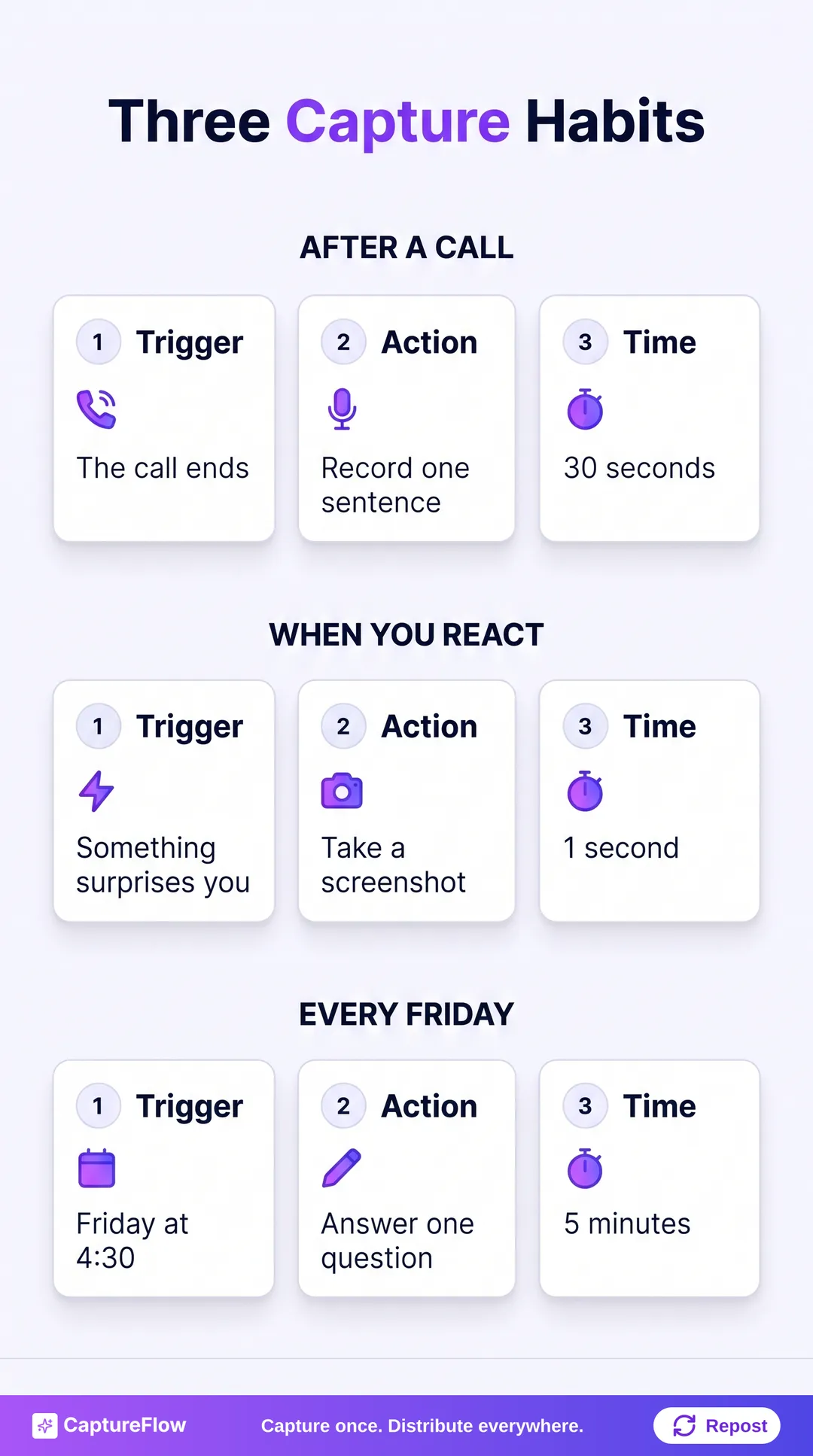 Attach each habit to a trigger you already have.
Put every capture in one place, a single note, folder, or tool. Ideas spread across your phone, Slack, and three notebooks are as good as lost. One inbox, reviewed weekly.
Build a 30-idea bank in one sitting
The habits keep the bank topped up. If you're starting from zero today, do this once: open a doc, set a 45-minute timer, and write six ideas in each of five categories. Don't write posts. Write the angle and one sentence on why it matters.
| Category | What goes in it | Example angle |
|---|---|---|
| Lessons learned | Hard-won mistakes and fixes | "The hire I made too early, and what it cost" |
| Contrarian takes | Things your industry gets wrong | "Why I stopped doing weekly reporting calls" |
| Process | How you actually do a routine task | "My 20-minute Monday planning, step by step" |
| Customer stories | Real situations, anonymized if needed | "A customer came in wanting X. They needed Y." |
| Reactions | Your take on news or someone else's post | "This week's big funding headline misses one thing" |
Six times five is 30. At three posts a week that's ten weeks of runway; at five a week, six. If a category stalls, borrow prompts from our 50 LinkedIn content ideas for founders.
And don't overthink the cadence. Our guide on how often to post on social media breaks it down by platform, but the short version is: pick a number you can hold for a year, not a month.
What to post in a week when nothing happened
Some weeks really are flat. No launches, no wins, five days of admin. The bank helps, but these five formats work even when the bank is thin:
- Answer a question you always get. The one customers ask on every demo call. You've rehearsed the answer, so writing it takes minutes.
- Revisit an old post. Pick something you wrote six months ago and say what you'd change now. Updating your own thinking in public is some of the most credible content there is.
- React to something you read. Agree, disagree, or add the missing piece. Link or name the source.
- Show the boring process. How you run a 1:1, review a contract, prep for a board meeting. Routine to you, new to most of your audience.
- Remix your best post. Your top post from last quarter can become a carousel, a quote image, or a short video. Most of your followers never saw the original anyway.
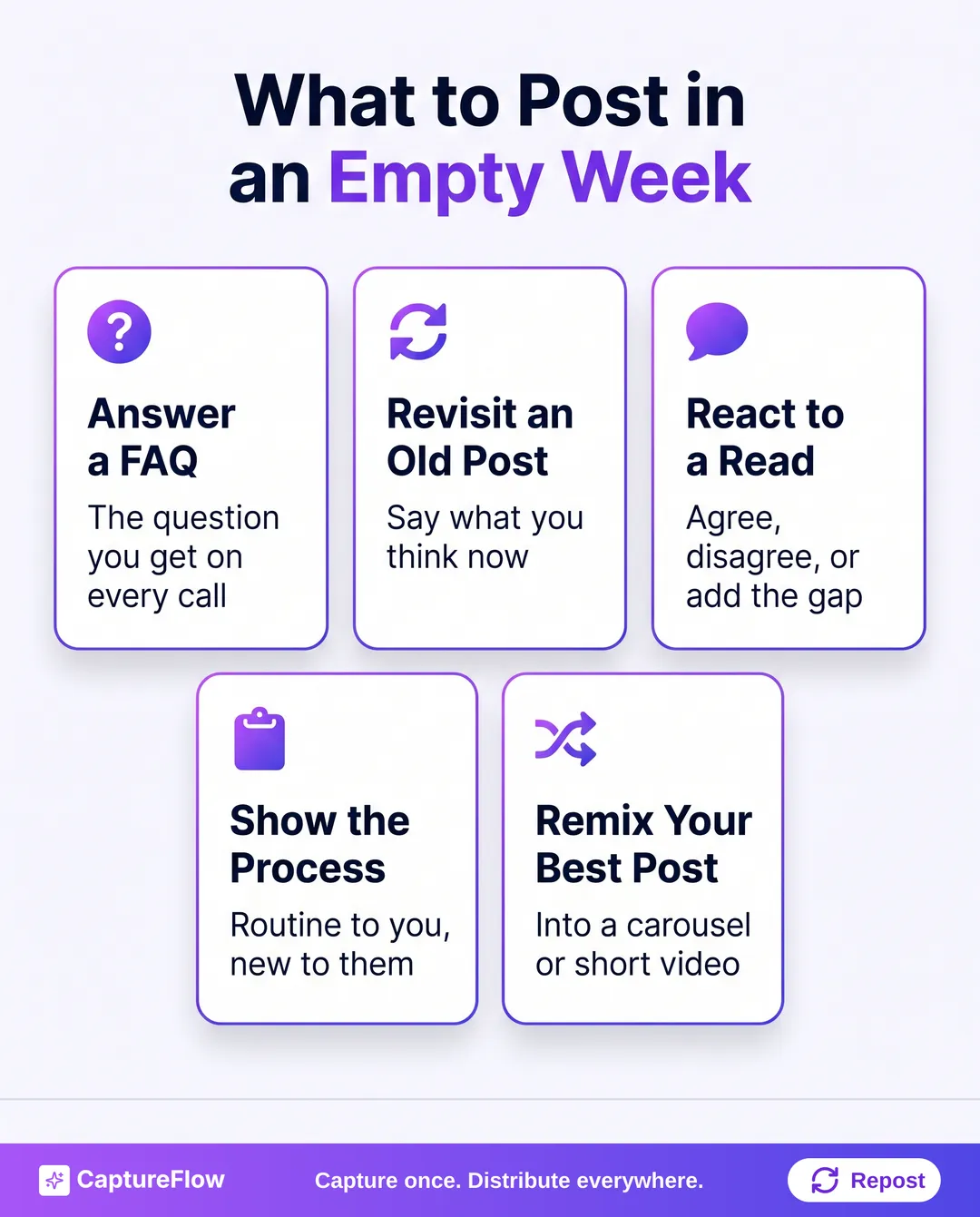 Five posts that need no news, no wins, and no launch.
The 10-minute post for a busy day
When the calendar's packed, use the bank like this:
- Minutes 1 to 2: pick the idea from the bank that fits this week best. Relevance beats perfection.
- Minutes 3 to 6: write the first line, then two to four short paragraphs. No editing yet.
- Minutes 7 to 8: cut every sentence that doesn't add something new. Most drafts lose a third here.
- Minutes 9 to 10: sharpen the first line (our guide to writing LinkedIn hooks helps) and post.
It works because you're not generating and writing at the same time. Generating is the hard part, and the bank already did it.
Three posts a week at ten minutes each is 30 minutes. Less than one meeting.
Where an AI content agent fits
You can run everything above with a voice memo app and a notes doc. Plenty of founders do. Where it breaks is the step between capture and post: turning thirty seconds of rambling into a LinkedIn post, an X thread, and a carousel that each read natively is real work, and it's the step people skip when the week gets busy.
That's the gap we built CaptureFlow for. CaptureFlow is an AI content agent that turns your expertise into weeks of on-brand content for every platform. You capture one idea in 5 minutes (a voice note, a video, a file, or a link), and CaptureFlow, trained on your voice and past posts, reshapes it into native content for each channel. You review it, or leave it to your agent, and it schedules the weeks ahead.
It's the same idea as the capture-first content system, just with the drafting and distributing handled for you. If you want the full weekly routine around it, read the founder's content operating system.
Start with one voice note today
Not Monday. Today. Open your voice memo app and spend 60 seconds on the most interesting thing that happened this week: one sentence to name it, a few more on why it matters.
That's your first capture. It's probably your next post, too.
Founders who stay consistent aren't more creative than you, and most aren't more disciplined either. They just write things down. When you're ready to hand off the drafting and distribution, see CaptureFlow's plans.
Sources
- PLOS ONE: Replication and Analysis of Ebbinghaus' Forgetting Curve (Murre and Dros, 2015)
- Edelman and LinkedIn: 2024 B2B Thought Leadership Impact Report
- European Journal of Social Psychology: How are habits formed: Modelling habit formation in the real world (Lally, van Jaarsveld, Potts and Wardle, 2010)
- Advances in Experimental Social Psychology: Implementation Intentions and Goal Achievement: A Meta-analysis of Effects and Processes (Gollwitzer and Sheeran, 2006)
Frequently asked questions
How do I stay consistent on social media when I have no ideas?+
Stop treating it as an ideas problem and treat it as a capture problem. Record a short voice note after meaningful calls, screenshot things that make you react, and answer one reflection question every Friday. Those three habits fill an idea bank you can pull from on any day.
What should I post when nothing interesting happened this week?+
Answer a question a customer or colleague asked you, revisit an older post with what changed since, react to something you read, show how you do a routine task, or turn your best past post into a carousel, quote image, or short video.
How many ideas should I keep in reserve?+
Aim for about 30. That's six to ten weeks of runway at three to five posts a week, which is enough to survive a busy month without going quiet.
Is it bad to miss a week of posting?+
One missed week won't undo anything. Habit research by Lally and colleagues at UCL found that missing a single day didn't meaningfully set back habit formation. What hurts is going quiet for months, so get back on the next week.
Chris is the founder and CEO of CaptureFlow, which he builds so founders can turn their expertise into content without hiring a team. After 10+ years building products and growing audiences from scratch, he writes about founder-led content, AI, and distribution from inside the problem he is solving: distributing consistent, on-brand content as a team of one.
Founder & CEO of CaptureFlow · 10+ years building products and audiences
One playbook a week from founders who actually create and distribute lots of content. No spam, unsubscribe anytime.
Keep reading

How to Build a Content Strategy That Generates Pipeline
Your buyers pick a favorite vendor before they ever talk to you. A content calendar will not change that. Here is the seven-step system that makes your content the reason you are the favorite.

How to Create Content as a Busy Founder Without Hiring a Writer
You do not need a writer or an agency. You need a way to catch one idea in 5 minutes and turn it into a week of posts. Here is the system.

Build in Public: A Founder's Content Playbook
Building in public is the highest-trust content a founder can make. Here is the full strategy: what to share, where the line is, and a system to turn your week into content.