How to Build a Content Strategy That Generates Pipeline
Build a content strategy that generates pipeline: own one problem, map content to buying stages, distribute before you produce, and track revenue signals.


Most founders have a content calendar. Very few have a content strategy that generates pipeline. The calendar fills up, the posts go out, the likes trickle in, and the sales team still cannot point to a single deal that content touched.
The fix is to build the strategy backwards from the deal. A content strategy that generates pipeline is a plan that decides who you want to buy, what they need to believe before they call you, and where they will find that belief, and only then decides what to publish. Topics, formats, and cadence fall out of those answers. Not the other way round.
This is the seven-step version I would run with a founder who has no marketing hire and about two hours a week. It is narrower than our LinkedIn lead-gen strategy, which goes deep on one channel. This one covers the whole system.
Why your content is the sales call you never get
Here is the uncomfortable part. Your buyers have mostly decided before you meet them.
The 6sense 2025 Buyer Experience Report, built on nearly 4,000 B2B buyer responses, found buyers make first contact with a vendor 61% of the way through their process. By that point, 94% of buying groups have already ranked their preferred vendors, and 77% end up buying from that early favorite. Gartner's 2025 survey of 632 buyers found 61% would rather skip the sales rep entirely.
So the shortlist gets written in a place you are not. A LinkedIn feed. A peer's DM. A recording of a talk someone forwarded. Content is how you get into that room.
And most of your audience is not even shopping. The B2B Institute's 95:5 rule, from Ehrenberg-Bass professor John Dawes, holds that only around 5% of potential buyers are in market at any given moment. Dawes himself calls it a mental model, not a precise law. But the point stands: your content has to be memorable to the 95% now so you are the obvious name when they move into the 5% later.
Pipeline content does two jobs at once. It gets you onto the shortlist of the few people buying today, and it gets you remembered by the many who will buy next year.
Step 1: Own one specific problem
Before topics or formats, answer this: what problem can you talk about more credibly than anyone else in your category?
"We help B2B companies grow" describes every company in your space. A position that builds pipeline is narrow enough to repel the wrong buyers and sharp enough to attract the right ones. It should feel a bit uncomfortable. That's usually the sign it's specific enough to matter to someone.
Look for the overlap of three things:
- What you have actually done. Built, fixed, sold, or survived. Real experience beats credentials.
- The problem under your buyer's problem. Not the one they name first on a call; the one that comes back after every fix they try.
- What your category's content gets wrong. The advice everyone repeats that doesn't survive contact with a real team.
| Too broad | Specific enough to own |
|---|---|
| "Content marketing for startups" | "Founder-led content for B2B teams with no marketing hire" |
| "Social media strategy" | "LinkedIn distribution for executives who hate writing" |
| "Sales enablement" | "Turning recorded sales calls into proof content" |
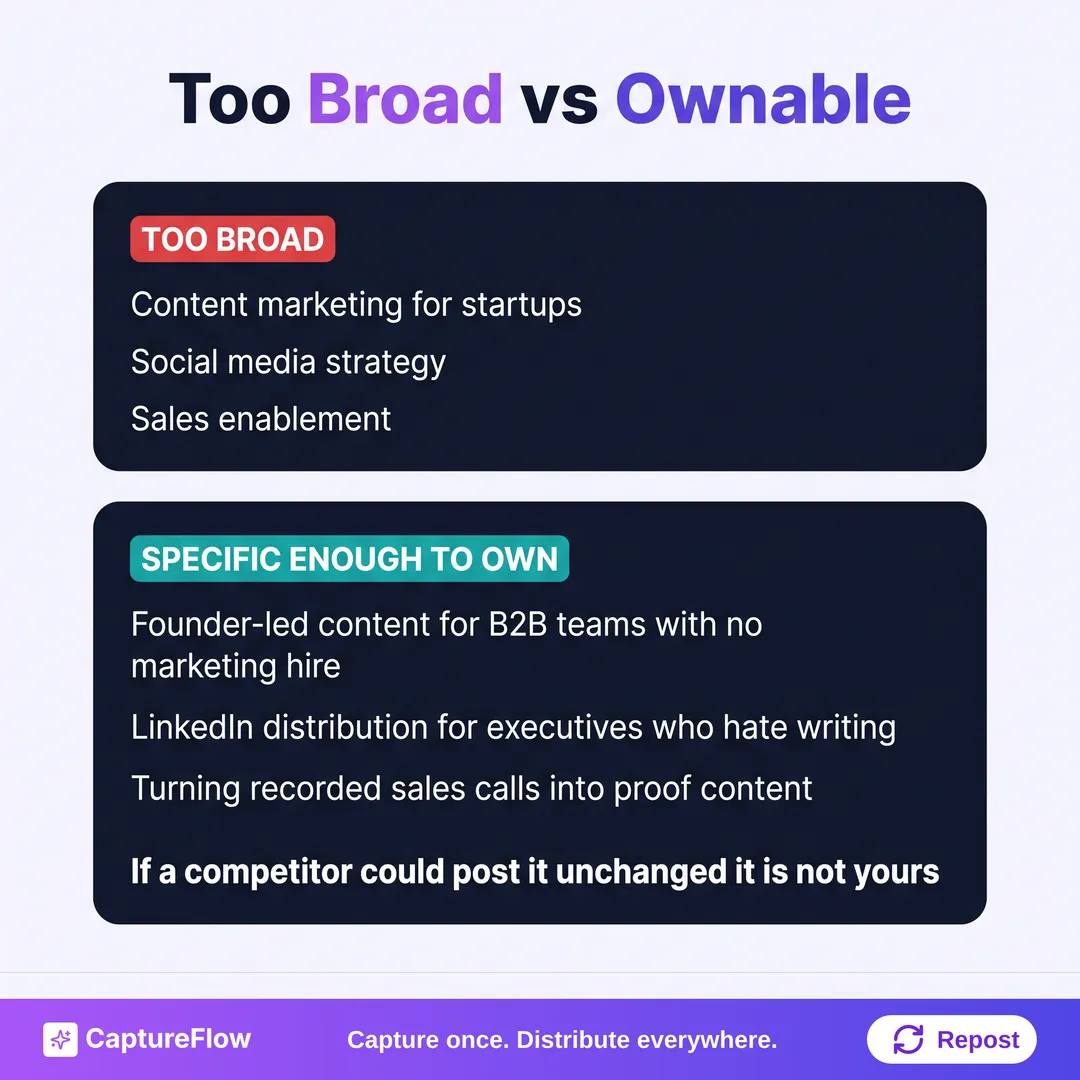 If a competitor could publish your post unchanged, it is not building your pipeline.
Step 2: Pick two or three pillars from your sales calls
A pillar is a theme broad enough for dozens of posts and narrow enough to keep reinforcing one area of authority. Two or three is plenty. Five is a hobby.
Don't pick pillars from what you find interesting. Pick them from the questions your buyers already ask:
- What does every discovery call circle back to?
- What were your best customers stuck on right before they found you?
- What objection kills the most deals in the last two weeks?
Then give each pillar a job:
| Pillar | Job | Example |
|---|---|---|
| Problem | Name the pain so precisely the reader feels seen | "Why founder content stops after week three" |
| Approach | Show how you think about solving it, and why it differs | "Capture once a week instead of writing every day" |
| Proof | Show it working, with numbers and names where you can | "What happened when a three-person team stopped writing posts from scratch" |
The discipline is saying no. If a post idea doesn't fit a pillar, it might earn traffic. It won't earn buyers.
Step 3: Audit what you already have
Most teams have far more raw material than they think. It is just scattered across Zoom, Google Drive, and someone's camera roll.
Spend one afternoon listing what you produced in the last 12 months:
- Recorded sales calls, demos, and customer interviews
- Webinars, conference talks, and podcast appearances
- Slide decks, onboarding docs, and internal FAQs
- Your own old blog articles, PDFs, and long LinkedIn posts that did well
- Voice notes and Slack threads where you explained something clearly
Tag each item with its pillar, the buying stage it serves, and whether it still reflects what you believe. You'll almost always find the same shape: lots of top-of-funnel education, very little that helps a buyer compare options, and almost no proof.
That gap is the strategy. One honest customer story with a real number will do more for pipeline than ten more "5 tips" posts. And a recorded call is often the fastest way to get it; here is how to turn meeting recordings into content, and the same works for an old slide deck.
Step 4: Map content to the three buying stages
Buyers don't jump from stranger to signed contract. They move through stages, and each stage needs different content.
- Awareness. They feel the problem but haven't named a fix. Describe their situation better than they can. Founder point of view, contrarian takes, and short video do well here.
- Consideration. They are comparing approaches: build it, hire it, or buy a tool. Give them evaluation criteria, honest tradeoffs, and your method shown step by step.
- Decision. They need to believe the risk is worth it. Customer stories, before-and-after numbers, implementation detail, and straight answers to the objections your sales team hears.
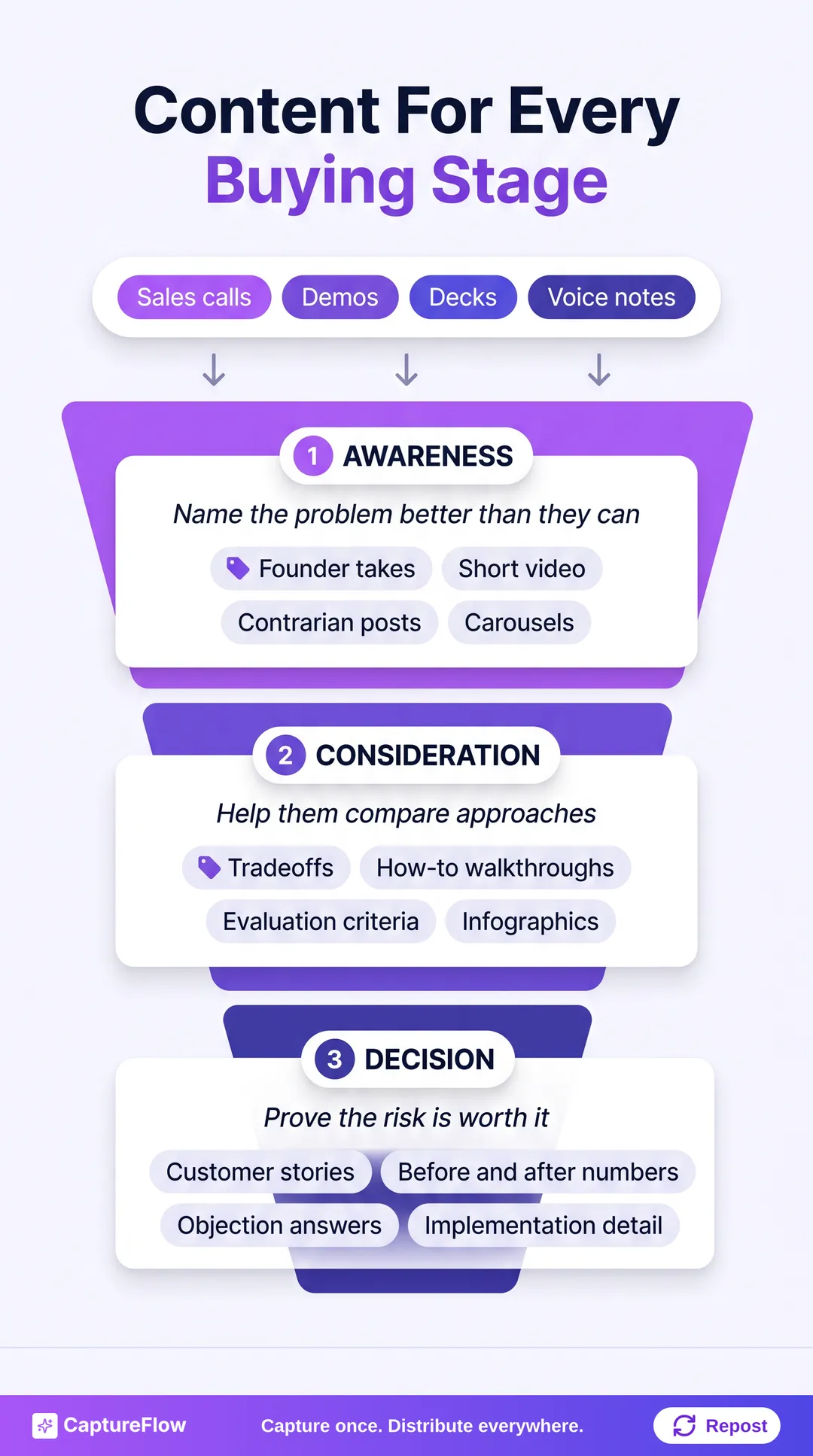 Most content programs build the top of this funnel and leave the bottom empty.
The decision stage matters for another reason: buyers rarely decide alone. In the 2025 Edelman-LinkedIn B2B Thought Leadership Impact Report, a survey of 1,934 executives, more than 40% of deals were said to stall over internal misalignment in the buying group. The same report found 95% of "hidden buyers" (the finance lead, the IT reviewer, the ops person nobody invited to the demo) say strong thought leadership makes them more receptive to outreach. Those people read your posts. They never fill in your form.
The test for every decision-stage postWould this help your champion win the argument in a meeting you are not in?
Step 5: Capture once a week, then distribute everywhere
This is where most strategies die. Not in planning. In week three, when the founder opens a blank doc on a Thursday night and nothing comes out.
The blank page isn't a talent problem. You are trying to have the idea and produce the content in the same sitting, and those are different jobs. So separate them. That is the whole idea behind capture-first content.
- Capture continuously. A customer asks a question you haven't heard before. You make a call and can explain why. A number surprises you. Record it right then, as a voice note, a 60-second video, a screenshot, a link. Takes a minute.
- Produce in one weekly block. Sit down with five to ten captures and shape them. The thinking is already done; you're just editing.
- Fill a distribution queue. What you approve in that block goes out across the week, on every channel, without you touching it again.
One 30-minute recorded call can carry a week of posts: a few LinkedIn posts, an X thread, a carousel, two short clips, a quote image. Same insight, reshaped natively for each feed. We walk through the full mechanics in the capture-first content system and our content repurposing strategy.
This is exactly the job CaptureFlow was built for. CaptureFlow is an AI content agent that turns your expertise into weeks of on-brand content for every platform. You capture one idea in about 5 minutes (a voice note, a video, a file, or a link), and CaptureFlow, trained on your voice and past posts, reshapes it into native content for each channel. You review it, or leave it to your agent, and it schedules the weeks ahead. Your content strategy settings keep every draft inside your pillars.
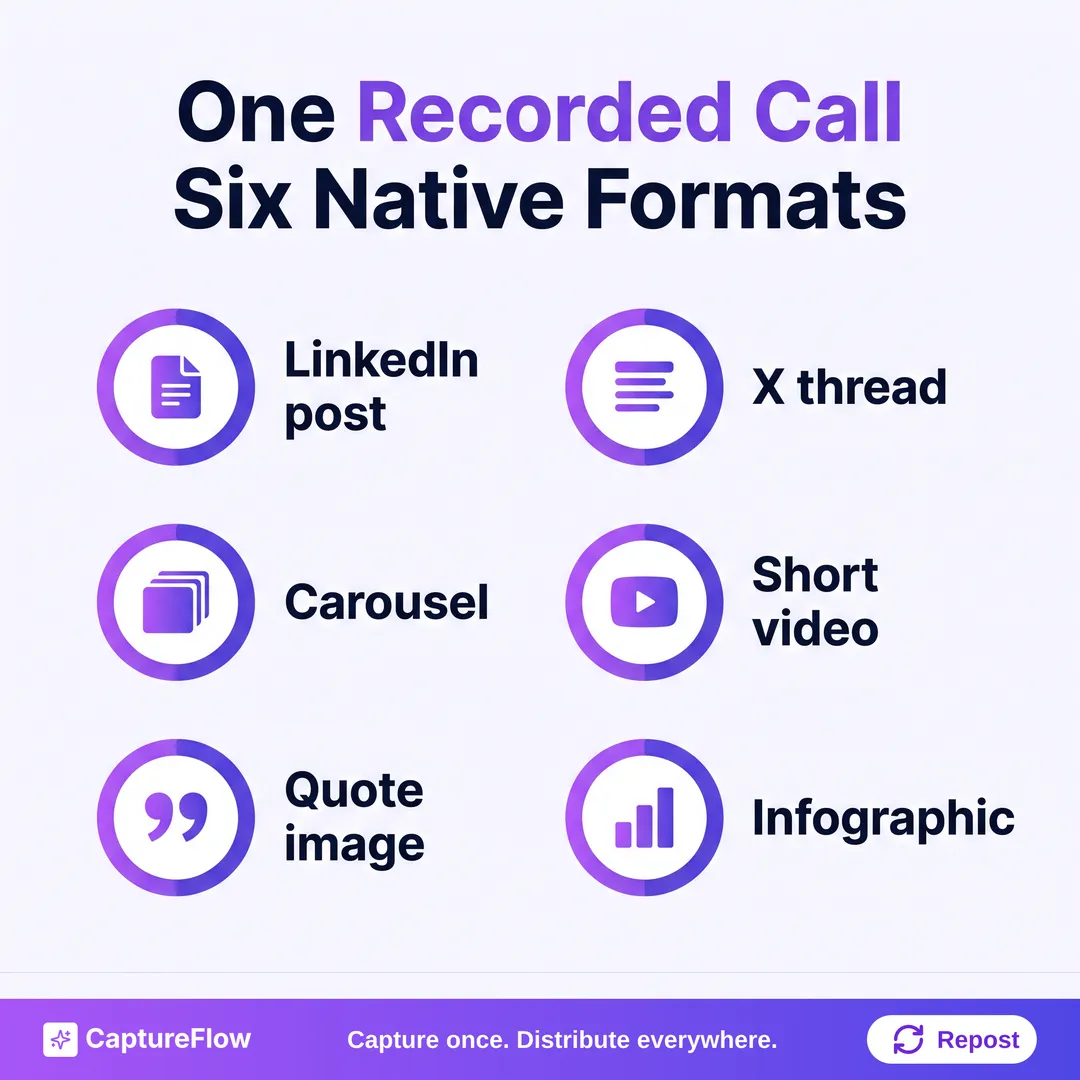 The insight is captured once. The format changes per channel.
Step 6: Plan distribution before production
Content that gets published once and never seen again is the default outcome when distribution is an afterthought. By the time a piece is finished, the energy is gone.
So decide where something will live before you make it. The channel sets the format, the length, the tone, and the call to action. A strong idea for LinkedIn text is a weak idea for a 30-second vertical clip, unless you plan for both from the start.
For most B2B founders, the shortlist is short:
- LinkedIn. Still the main room for B2B point of view. Native posts, carousels, and short video beat link posts.
- YouTube. A search engine for longer explanations, demos, and recorded talks.
- X and Threads. Quick takes and threads, especially if your buyers are technical.
- Your own site. Comparison and proof pages your sales team can send after a call.
A rule that works: every core idea goes out on at least three channels over at least two weeks. One post on launch day isn't distribution. It's a hope. If you're unsure how often to post on each, our cadence guide has the platform-by-platform numbers.
Write the distribution line first: "This becomes a LinkedIn post Tuesday, a carousel Thursday, and a 40-second clip next Monday." If you can't fill that line in, the idea isn't ready.
Step 7: Measure what touches revenue
Impressions, follower counts, and likes measure reach. They don't measure pipeline. Track them if you like, but don't let them pick next week's topics.
The signals worth your attention split into two groups.
Leading signals, which show demand forming:
- Replies and DMs from people who match your buyer profile
- Profile visits and connection requests from target accounts
- Inbound conversations where the prospect quotes your content back to you
- Visits to decision-stage pages: pricing, comparisons, customer stories
Lagging signals, which prove impact later:
- Deals where a content touch came before the first call
- Pipeline from leads who self-report content as the source
- Win rate and sales-cycle length for content-touched deals versus the rest
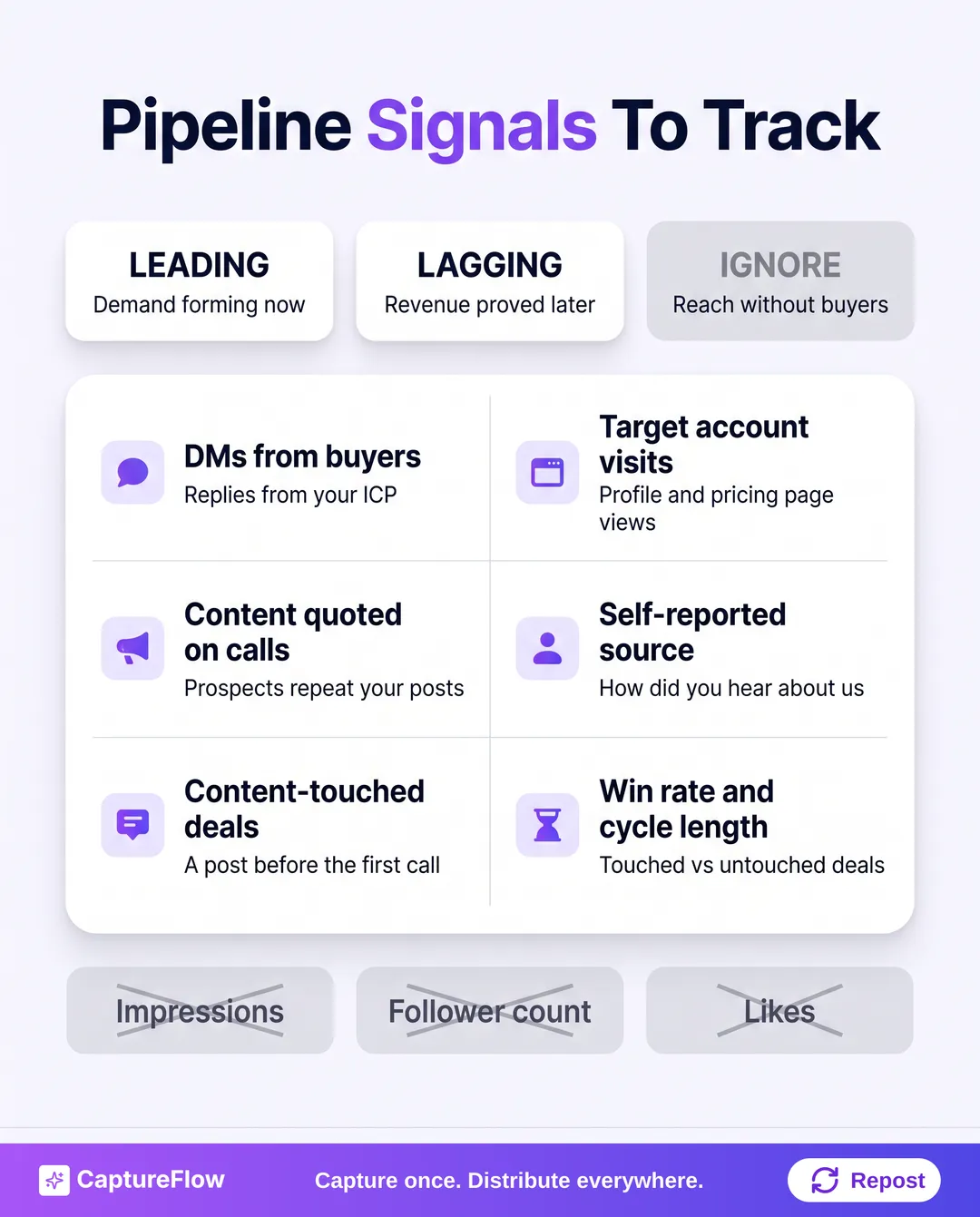 Leading signals tell you it's working this month. Lagging signals tell you it paid.
For a small team, the best attribution system costs nothing. Put a required free-text "How did you hear about us?" field on your demo form, ask the same question on every first call, and log the answer on the deal. Most B2B research happens in DMs, Slack groups, and forwarded posts that no tracking pixel sees. Your buyer will just tell you.
Then review monthly. Cut or refresh what earned neither attention nor conversations after 90 days. Double down on topics that show up in both columns. And when the audit says the decision stage is thin, make proof, not more awareness posts. Our analytics closes this loop by showing which captures turned into posts that performed, so the next capture is a better bet.
The two-minute checklist before you make anything
Before you create:
- Does it sit inside one of my two or three pillars?
- Which stage does it serve: awareness, consideration, or decision?
- Who exactly is it for, and what should they believe afterward?
- Which channels will it go to, and in what format on each?
Before you publish:
- Is it grounded in something real: a decision, a result, a conversation?
- Is there one detail only I could have written?
- Does it sound like me, or like a template?
Start with the deal, not the calendar
Your expertise is already the content. The strategy is the part that points it at buyers. Pick the problem you own, pull your pillars from sales calls, fill the decision stage first, and build the capture habit so you never face a blank page again.
If you want the production side handled, see how CaptureFlow fits your flow or check the plans. One capture a week is enough to start.
Sources
- 6sense, 2025 Buyer Experience Report, via CustomerThink: Research Round-Up: 6sense Study Provides Critical Insights on B2B Buyer Behavior
- Gartner: Gartner Sales Survey Finds 61% of B2B Buyers Prefer a Rep-Free Buying Experience (June 2025)
- Edelman and LinkedIn: 2025 B2B Thought Leadership Impact Report
- Marketing Week: The 95:5 rule is the new 60:40 rule (Peter Weinberg and Jon Lombardo, The B2B Institute)
Frequently asked questions
What is a content strategy that generates pipeline?+
It is a plan that starts from your buyer and your deals rather than a posting calendar. It defines the problem you own, the two or three pillars you publish on, the content each buying stage needs, where it gets distributed, and the revenue signals you track to decide what to make next.
How long does it take for content to generate pipeline?+
Leading signals like replies, DMs, and inbound conversations from the right people can show up within a few weeks of consistent posting. Influenced pipeline usually takes a quarter or two to become visible, because most of your audience is not in market on any given day.
How do I attribute pipeline to content as a small team?+
Add a required free-text 'How did you hear about us?' field to your demo form and ask the same question on every first call. Log the answers next to the deal in your CRM. It is crude, but it captures the dark-social research no tracking pixel sees.
How much content do I need to publish?+
Less than you think. Two to four strong posts a week, distributed natively across the channels your buyers use, beats a daily schedule that runs out of ideas by week three. Consistency over months matters more than volume.
Chris is the founder and CEO of CaptureFlow, which he builds so founders can turn their expertise into content without hiring a team. After 10+ years building products and growing audiences from scratch, he writes about founder-led content, AI, and distribution from inside the problem he is solving: distributing consistent, on-brand content as a team of one.
Founder & CEO of CaptureFlow · 10+ years building products and audiences
One playbook a week from founders who actually create and distribute lots of content. No spam, unsubscribe anytime.
Keep reading

What Is Capture-First Content?
Most content tools start you at a blank page. Capture-first flips it. Capture the idea once, and let a system turn it into everything else.

How to Stay Consistent on Social Media With Nothing to Say
You didn't run out of ideas. You ran out of captured ideas. Three tiny capture habits, a 30-idea bank you can build in one sitting, and five posts that still work in a week where nothing happened.

LinkedIn Thought Leadership Strategy for B2B Executives
Most executive LinkedIn reads like a press release nobody asked for. Here is the strategy that turns a leader's real point of view into B2B pipeline.