LinkedIn Thought Leadership Strategy for B2B Executives
An executive LinkedIn thought leadership strategy: what to post, why it drives B2B pipeline, and how busy leaders sustain it in about 5 minutes a week.

Open the LinkedIn feed of almost any B2B executive and you will find the same thing: a repost of a company announcement, a conference selfie, and a paragraph that could have been written by anyone about any company. It reads like a press release wearing a headshot. Nobody stops for it, and nobody remembers it.
That is a strategy problem, not a talent problem. Here is the direct version of a LinkedIn thought leadership strategy for an executive: executive thought leadership is a leader publishing their real, first-person point of view on the problems their buyers care about, consistently, under their own name. Not the company's voice. Not a ghostwriter's approximation of it. Yours.
This is different from a founder personal brand (though they overlap). A founder personal brand is the whole public record of who you are. Executive thought leadership is narrower and more commercial: it is the slice of that record that shapes how buyers, your board, and your best future hires think about your category, and about you as the person to trust in it.
Why executive thought leadership drives B2B pipeline
The case for this is not vibes. It is one of the most consistent findings in B2B marketing research.
In the Edelman and LinkedIn B2B Thought Leadership Impact Report, 73 percent of decision-makers said an organization's thought-leadership content is a more trustworthy basis for judging its capabilities than its marketing. Read that again. Buyers trust what a leader thinks out loud more than anything your marketing team produces on purpose. Strong thought leadership in that same research makes buyers more willing to pay a premium and to hand over the business. Weak thought leadership does the opposite, quietly, before you ever get the meeting.
The macro trend points the same way. The 2026 Edelman Trust Barometer shows trust draining out of institutions and pooling in people, including "my CEO," up 9 points. A company page is an institution. You, thinking plainly about a hard problem, are a person. On a feed of 1.2 billion LinkedIn members, the person wins that matchup almost every time.
Buyers trust what a leader thinks out loud more than anything your marketing team produces on purpose.
There is a compounding advantage too. A rival can copy your deck, undercut your price, and clone your feature list by next quarter. What they cannot copy is two years of you being visibly, verifiably right about where your category is heading. That track record is the asset. It is also the thing most executives never start building because they are waiting for a content plan that never arrives.
What a LinkedIn thought leadership strategy actually looks like
Strategy here is not a calendar. It is a small set of things you are willing to have an opinion about, in public, on repeat. Four pillars cover almost everything worth an executive's time.
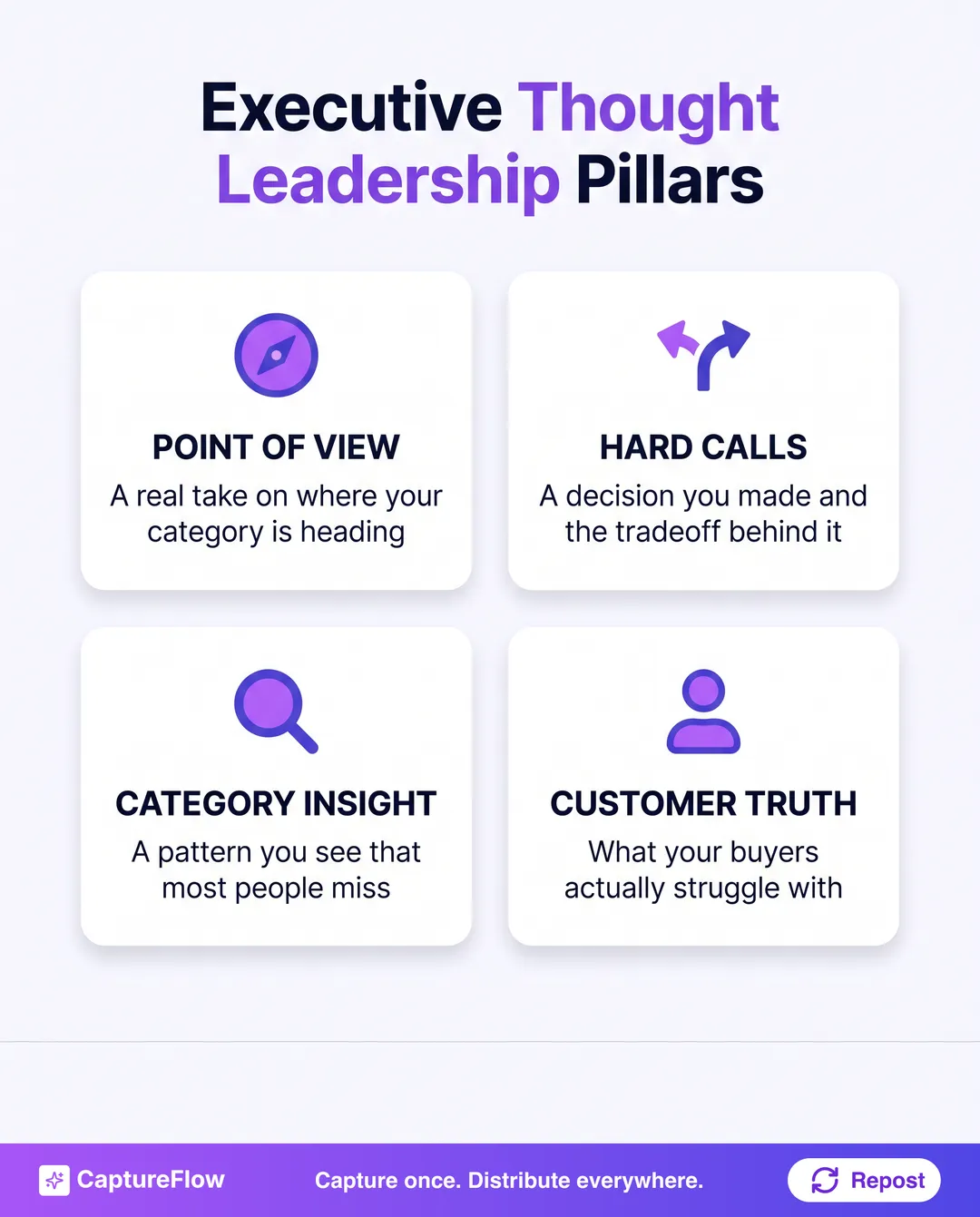 Pick from four pillars. Every post you publish should trace back to one of them.
- Point of view. Where is your category going, and what does most of the market have wrong about it? A real take, one your competitors would hesitate to sign.
- Hard calls. A decision you actually made, and the tradeoff underneath it. "We turned down a whole customer segment, here is why" beats any framework.
- Category insight. A pattern you see from your seat that others cannot. You talk to 40 buyers a month; that vantage point is content nobody else has.
- Customer truth. What your buyers genuinely struggle with, said plainly, without the product pitch attached.
Notice what is not on the list: product announcements, award reposts, motivational quotes. Those are company-page jobs. An executive who spends their scarce credibility amplifying the marketing team is wasting the one asset a marketing team cannot manufacture. If you want the demand-gen layer that sits underneath this, our guide on a LinkedIn content strategy that generates B2B leads covers how the company, the employees, and the executive voice compound together.
What to post: a real point of view, not corporate platitudes
Most executive content fails at the same place. It reaches for the safe, universal statement, the one so agreeable it says nothing. "Culture is everything." "AI will change our industry." True, and useless, because a bot could have written it and half your feed already did.
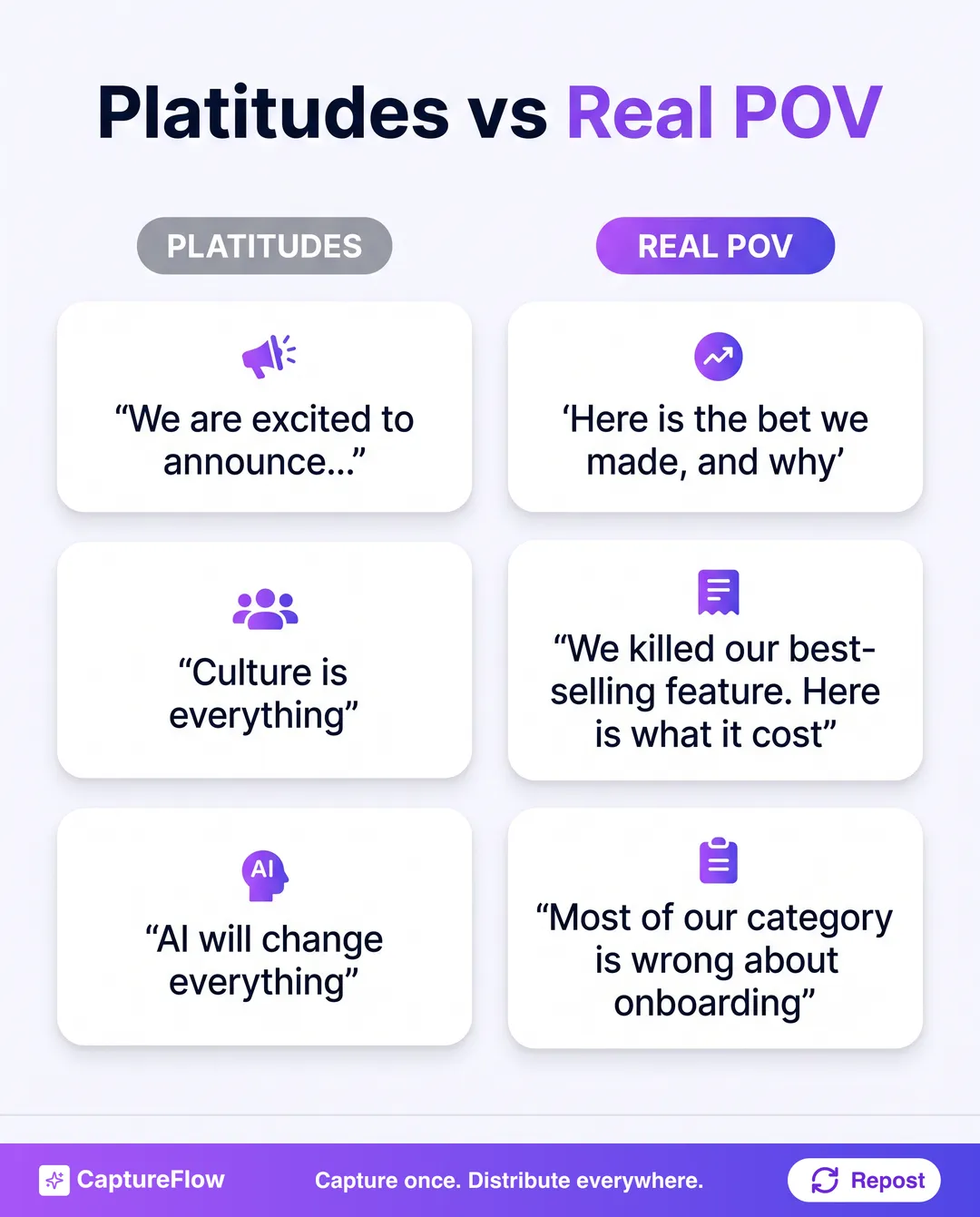 The difference is falsifiability. A real take is one someone could disagree with.
The test for a real point of view is simple: could a reasonable person disagree with it? If not, it is a platitude. "We killed our best-selling feature and here is what it cost us" is specific, a little uncomfortable, and unmistakably yours. That is what earns the follow, and eventually the meeting. The formats that grow a following fastest are the same ones executives are most tempted to sanitize, which is exactly what content grows a personal brand fastest: specific, opinionated, first-person.
The failure mode is not a bad post. It is a legal-and-comms-approved post so smoothed of opinion that it lands as nothing. If three people could not disagree with it, it will not work. Protect the edge, do not sand it off.
How busy executives actually sustain it
Here is the real objection, and it is fair: you do not have time to write LinkedIn posts. Good news, you should not be writing them from scratch anyway. The scarce input is your thinking, and you already do that all day.
The workable model separates the two jobs. The opinion has to be yours. The drafting and distribution do not.
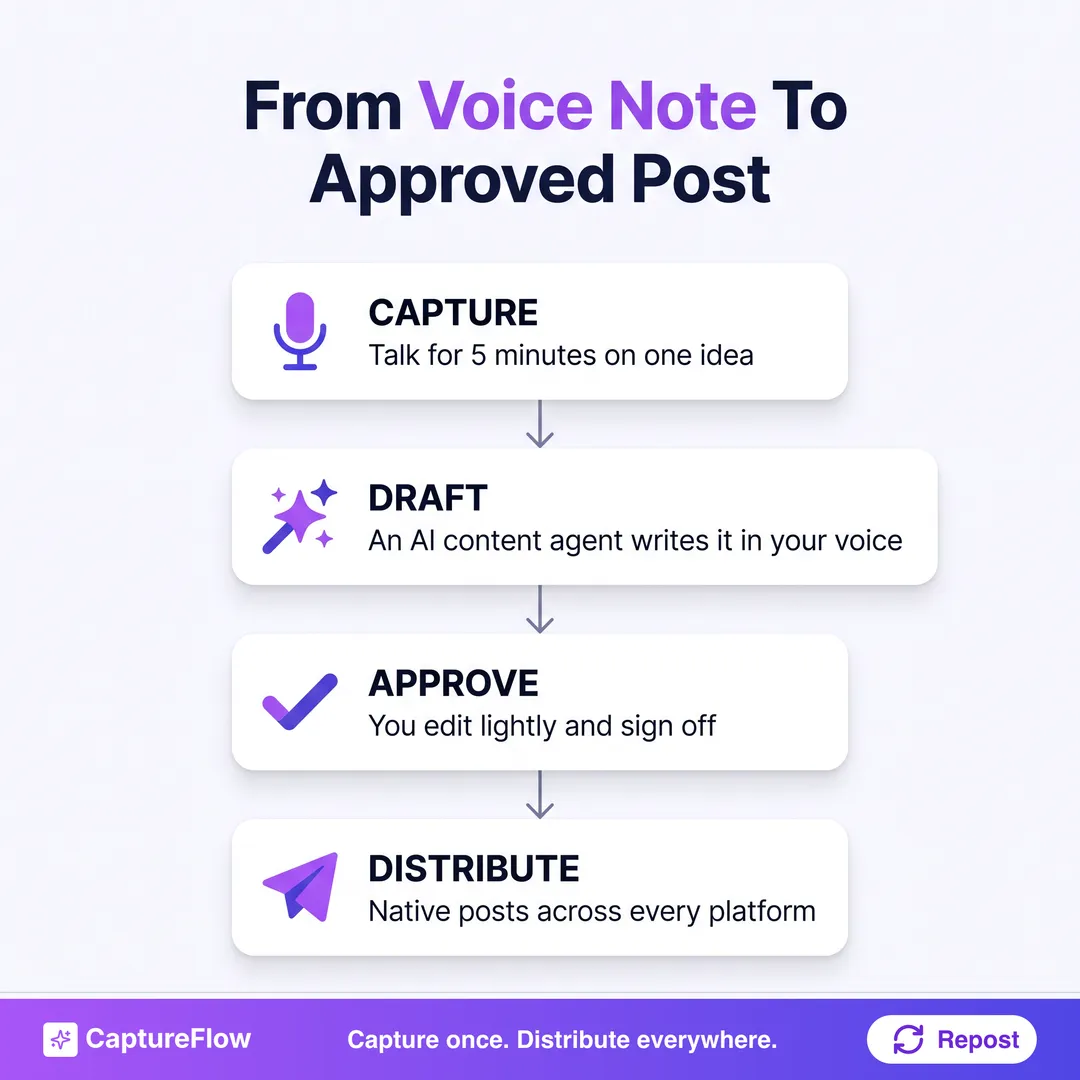 One capture in, a week of native posts out. You approve, you do not draft.
Once a week, talk for 5 minutes into your phone about one thing on your mind: a call you made, a pattern you noticed, a thing the market keeps getting wrong. That recording is the raw material. CaptureFlow is an AI content agent that turns your expertise into weeks of on-brand content for every platform. Trained on your voice and past posts, it reshapes that one capture into a LinkedIn post, an X thread, a short video, and a carousel, each written natively for its channel and in your register, and you review and approve rather than start from a blank page.
That is the whole system: one capture, a review, and 15 minutes in the comments. Call it 30 to 45 minutes a week. The mechanics are the same ones behind any strong LinkedIn content strategy, just pointed at a leader's actual point of view instead of a content calendar. For the broader company context, LinkedIn marketing for B2B companies shows where the executive voice fits alongside the brand.
The ghostwriting question, answered honestly
Plenty of executives outsource this entirely, and it half-works. A ghostwriter produces volume, hits the cadence, and keeps the feed alive. The tradeoff is real, though: the trust premium of executive content comes from it being verifiably you, and on a long enough timeline audiences sense a rented voice. The posts get engagement and somehow still do not convert, because the reader can tell there is no one home.
The honest middle path is not "write everything yourself" or "hand it off." It is to keep your real thinking as the source and use help only to shape and distribute it. A ghostwriter interviewing you weekly is doing that. An AI agent trained on your voice, drafting from your captures, is doing the same thing at lower cost and higher frequency. Both keep the opinion yours. Neither invents it. The moment the help starts manufacturing the point of view rather than dressing it, you are back to a press release with a headshot.
Executive thought leadership is not a campaign you run for a quarter. It is a small, sustained habit of saying what you actually think, in public, where your buyers can see it. The strategy fits on an index card: pick your pillars, hold a real point of view, capture 5 minutes a week, approve, repeat. If you want the workflow that makes the weekly version realistic, see how CaptureFlow works or what it costs. The tooling helps. The only non-negotiable is that the thinking is yours.
Sources
- Edelman and LinkedIn: 2024 B2B Thought Leadership Impact Report
- Edelman: 2026 Edelman Trust Barometer
- DataReportal: LinkedIn Users, Stats, Data and Trends
Frequently asked questions
What is executive thought leadership?+
It is a founder or C-suite leader publishing their own first-person point of view on the problems their buyers care about, under their own name, on a regular cadence. The value comes from it being verifiably the leader's thinking, not a corporate account or a ghostwriter talking in generalities.
How much time does a LinkedIn thought leadership strategy take for a busy executive?+
Less than an hour a week once it is set up. The realistic version is one 5-minute capture (a voice note on a single idea), a short review of the drafts it becomes, and 15 minutes replying to comments. The bottleneck is protecting the slot, not finding things to say.
Should executives use a ghostwriter for LinkedIn?+
A ghostwriter can produce volume, but the trust premium of executive content comes from it being genuinely you, and audiences eventually sense a rented voice. The better model keeps your real thinking as the raw material and uses help (or an AI agent trained on your voice) only to shape and distribute it, not to invent the opinion.
Chris is the founder and CEO of CaptureFlow, which he builds so founders can turn their expertise into content without hiring a team. After 10+ years building products and growing audiences from scratch, he writes about founder-led content, AI, and distribution from inside the problem he is solving: distributing consistent, on-brand content as a team of one.
Founder & CEO of CaptureFlow · 10+ years building products and audiences
One playbook a week from founders who actually create and distribute lots of content. No spam, unsubscribe anytime.
Keep reading

How to Create Content as a Busy Founder Without Hiring a Writer
You do not need a writer or an agency. You need a way to catch one idea in 5 minutes and turn it into a week of posts. Here is the system.

Build in Public: A Founder's Content Playbook
Building in public is the highest-trust content a founder can make. Here is the full strategy: what to share, where the line is, and a system to turn your week into content.

What Content Grows a LinkedIn Personal Brand Fastest
Not all LinkedIn content grows a personal brand at the same speed. Here are the content types that compound fastest, ranked, and the ones quietly wasting your time.