How to Create Content as a Busy Founder Without Hiring a Writer
Create content as a busy founder without hiring a writer: capture one idea in 5 minutes, let an AI agent draft it, review, and post weekly.


You know you should be posting. You have watched founders you respect turn a few honest updates into inbound, hires, and a following, and some part of you files it under "later." You are not deciding whether to do it. You are stuck on how: how do you create content as a busy founder without hiring a writer, an agency, or a content person you cannot yet justify.
Here is the good news, and it is not what most advice tells you. You are not short on things to say.
Creating content as a busy founder means turning ideas you already have into posts in minutes, not carving out hours you do not have to write from scratch. The whole problem is time and friction. Solve those two and the content takes care of itself.
The real reason you are not posting
It is not ideas. You have opinions about your market, war stories from last quarter, and a dozen takes you have shared out loud in sales calls this month. It is not talent either. You explain your product to skeptical buyers for a living.
It is time, and specifically the way content competes with your actual job and loses.
Writing a post the old way asks for a 30-minute block of deep focus. Founders do not have those. Your day is a stack of interruptions, and interruptions are expensive in a way that is easy to underrate. Research from Gloria Mark at UC Irvine found it takes an average of 23 minutes to refocus after a single interruption. So the "I will write something after lunch" plan runs straight into three Slack pings and a customer fire, and the blank doc is still blank at 6pm.
That is the trap. Not laziness. Not a missing skill. A blank page that needs a quiet hour you are never going to get.
The founders who post consistently did not find more time. They found a way to make each post cost 5 minutes instead of 60.
How to create content as a busy founder without hiring a writer
The fix is a system with three moving parts, and none of them is "block an hour to write." Catch the idea when it is fresh, hand the drafting to an agent, and keep a cadence you can actually hold.
- Capture one idea in 5 minutes, usually by talking.
- Let an AI content agent draft it in your voice.
- Review, approve, and hold a weekly rhythm.
That is the entire playbook. The rest is detail.
Step 1: Capture one idea in 5 minutes
Stop trying to write. Start talking.
Once a week, open a voice memo and spend 5 minutes on the thing that actually happened: the deal you almost lost and why, the feature you cut, the number that surprised you, the objection you answered for the tenth time. You are not scripting anything. You are telling a friend what your week was like. The voice-note-to-content workflow breaks down how one recording turns into a week of material.
Talking beats writing for a simple reason: your spoken voice is already your brand voice. It has opinions. It is specific. It does not sound like a press release, because you would never talk to a customer in a press-release voice. And there is no blank page, because you are not looking at a page. You are looking at your week.
Keep the bar embarrassingly low. A 90-second voice note in the car after a good sales call is a better raw input than a "content brainstorm" you keep rescheduling. The messy, specific version is the one that lands.
Step 2: Let an AI content agent draft it
A voice note is raw material. Turning it into a clean LinkedIn post, an X thread, or a carousel used to be the job you would hire a writer for. That is the job you are handing to software instead.
CaptureFlow is an AI content agent that turns your expertise into weeks of on-brand content for every platform. You capture the moment in minutes, a voice note, a screenshot of a metric, a quick thought, and a few minutes later it has reshaped that one capture into a LinkedIn post, an X thread, a carousel, a short video, and a quote image, each written natively for its platform and in your voice. This is what people mean when they search for founder content creation software: not a blank text box with an AI button, but something that starts from your input and hands you a draft.
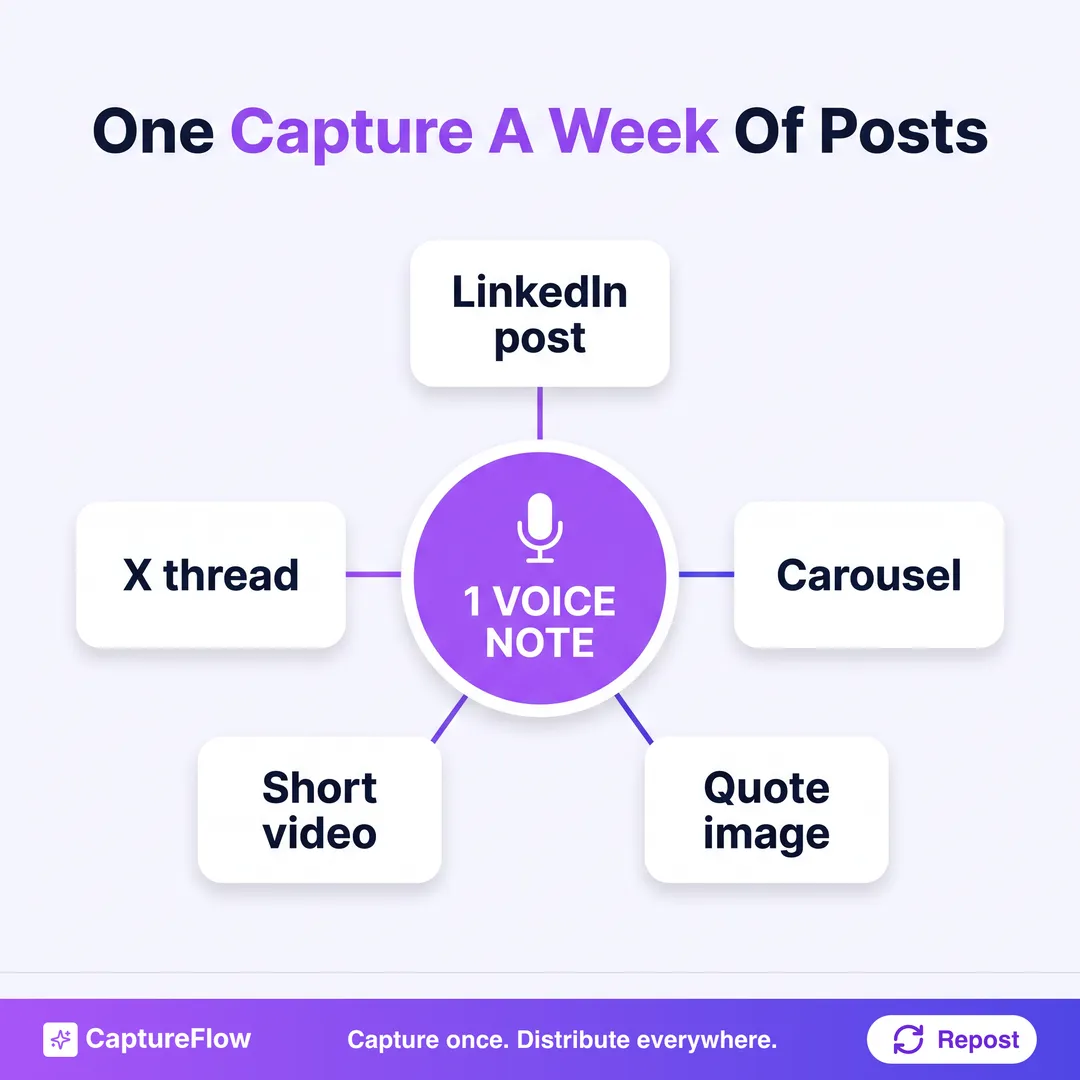 One 5-minute capture becomes a week of native posts.
The bar for "which tool" is lower than it looks. It has to start from a capture, and it has to sound like you. If it needs you to write the prompt, format the output, and fix the voice, you have not removed the work. You have moved it. Our honest breakdown of the best AI tool for founders to create LinkedIn content walks through where each option actually helps and where it just adds steps.
Step 3: Review, do not write
This is the mindset shift that makes the whole thing stick.
Your job is not to produce the post. It is to approve it. Reading a draft and tweaking two lines takes 3 minutes. Writing that same post from nothing takes 40, most of it spent staring. When the hard 90 percent is already done, you will actually do the last 10. When it is not, you will not, week after week, and that is exactly why most founder content dies in month two.
Approve fast. Cut the line that is not quite you. Publish. Move on.
Step 4: Hold a weekly cadence
Content is a habit, not a launch. Pick one or two posts a week and protect that slot like a customer call.
The economics quietly moved in your favor here. In HubSpot's State of Marketing report, roughly two-thirds of marketing teams say AI now saves them 10 or more hours a week. The work that used to justify a hire now fits inside a founder's Monday morning. And the payoff is real, not vanity: the Edelman-LinkedIn B2B Thought Leadership Report found 73 percent of decision-makers trust an organization's thought-leadership content more than its marketing. A founder showing up weekly is that, with the suit off.
Once the system runs, a week looks like this: 5 minutes to capture, 15 to review the drafts, 10 to distribute and reply to comments. Half an hour, and your real week becomes content across every channel. That is the same rhythm behind a full founder content operating system, just stripped down to the parts a solo founder can run alone.
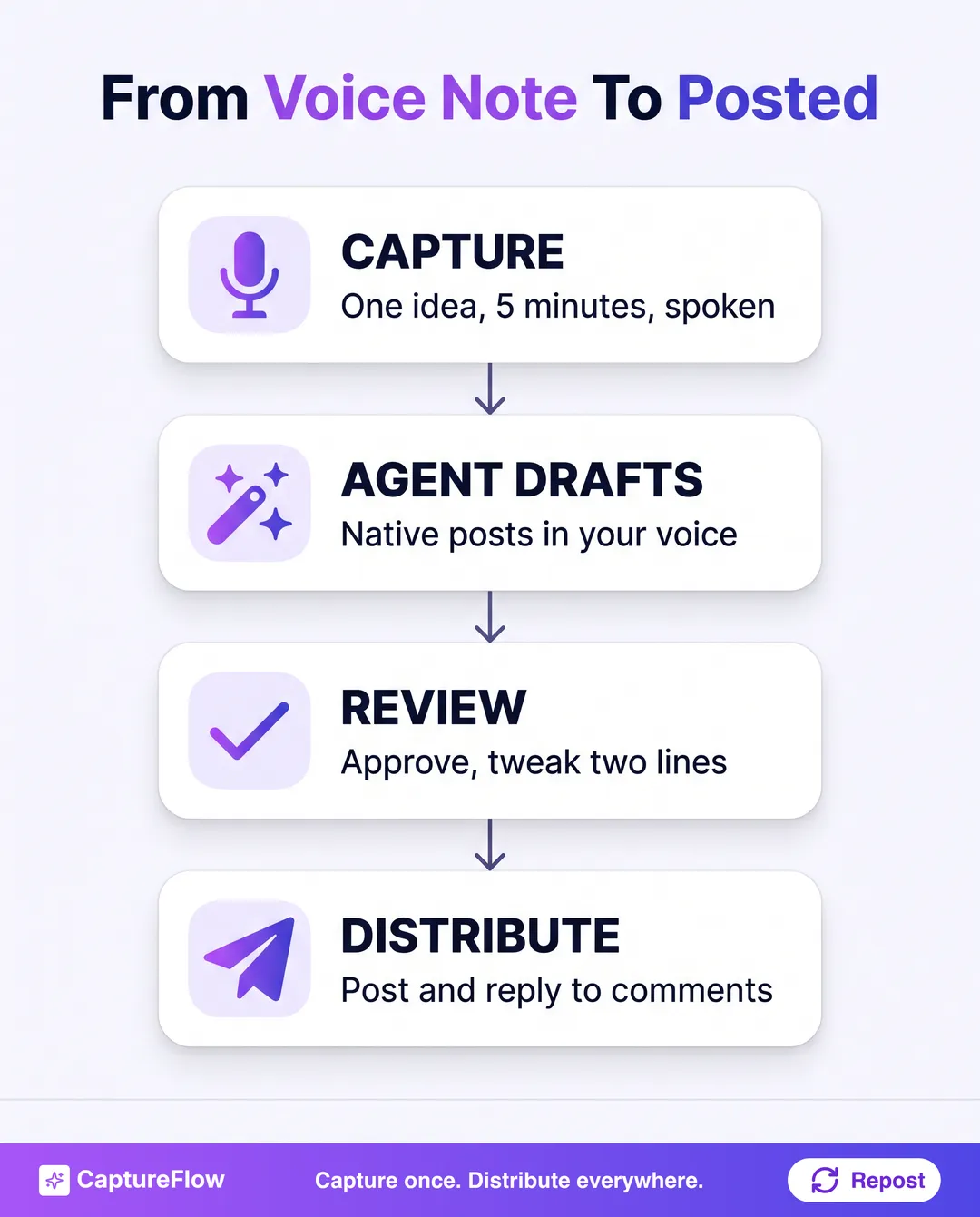 The weekly loop, start to posted, in about 30 minutes.
What to stop doing
Half of getting unblocked is dropping the habits that never worked.
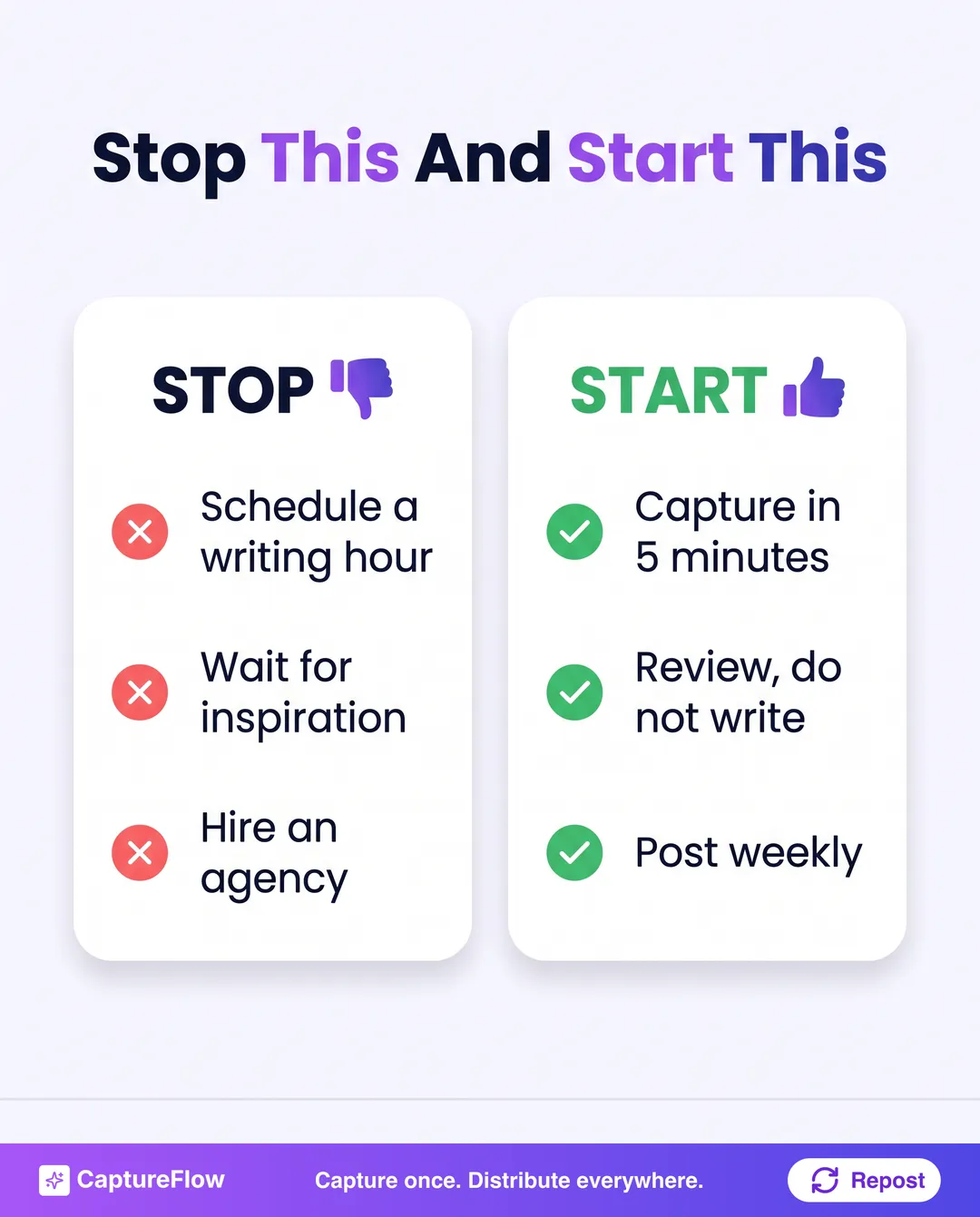 Drop the left column. Keep the right one.
Stop scheduling a "writing hour." It will not survive contact with your calendar. Stop waiting to feel inspired, because inspiration is not a strategy and it does not show up on Tuesdays. And stop assuming the only fix is spending money you do not have on an agency that will need three calls to sound vaguely like you.
Start capturing when the idea is hot, reviewing instead of writing, and posting on a schedule you can hold when the quarter is on fire.
The most common failure mode is not a bad post. It is a three-week sprint followed by two months of silence. The feed forgives mediocre. It does not forgive disappearing. Pick the cadence you can hold on your worst week, then guard it.
The move
You do not need a writer. You do not need an agency. You need a way to catch one real idea in 5 minutes and a system that turns it into posts you just approve.
Capture the moment. Let the agent draft it. Review, publish, repeat. If the blank page and the no-time problem are what have kept you off the feed, that is exactly what CaptureFlow is built to remove. See how it works, or if you are running solo, the solo founder use case maps the system to your week. The only things you truly cannot outsource are your real ideas and your real voice, and you already have both.
Sources
- Gloria Mark, UC Irvine, The Cost of Interrupted Work (about 23 minutes to refocus after an interruption).
- HubSpot, State of Marketing report (AI time savings for teams).
- Edelman and LinkedIn, 2024 B2B Thought Leadership Impact Report (73 percent trust thought leadership over marketing).
Frequently asked questions
Can I create content as a busy founder without hiring a writer?+
Yes. The bottleneck for most founders is time, not ideas or talent. If you capture one idea in about 5 minutes and use an AI content agent trained on your voice to draft it, you can hold a weekly cadence without a writer, an agency, or a content team.
What is the best AI content tool for a founder with no time?+
The one that starts from a capture instead of a blank page. A voice note or a rough thought should become a review-ready draft in your voice, not a prompt you have to babysit. See our rundown of the best AI content tools for founders for how the options actually compare.
How often should a solo founder post?+
Once or twice a week, sustained. A founder who posts every week for six months will beat one who posts daily for three weeks and then disappears. Pick a cadence you can hold on your worst week.
Chris is the founder and CEO of CaptureFlow, which he builds so founders can turn their expertise into content without hiring a team. After 10+ years building products and growing audiences from scratch, he writes about founder-led content, AI, and distribution from inside the problem he is solving: distributing consistent, on-brand content as a team of one.
Founder & CEO of CaptureFlow · 10+ years building products and audiences
One playbook a week from founders who actually create and distribute lots of content. No spam, unsubscribe anytime.
Keep reading

Build in Public: A Founder's Content Playbook
Building in public is the highest-trust content a founder can make. Here is the full strategy: what to share, where the line is, and a system to turn your week into content.

What Content Grows a LinkedIn Personal Brand Fastest
Not all LinkedIn content grows a personal brand at the same speed. Here are the content types that compound fastest, ranked, and the ones quietly wasting your time.

LinkedIn Personal Branding Tips That Actually Work
Most LinkedIn personal branding advice is fluff. These nine tips are the ones that actually move the needle, from fixing your profile to staying consistent.