Do LinkedIn Hashtags Still Work in 2026?
LinkedIn hashtags no longer drive reach. Here is what changed, what the data says, and the 1 to 3 hashtag rule that still earns their place in 2026.

For years, the ritual was automatic: write the post, then staple five hashtags to the bottom like stamps on an envelope. #Leadership #Growth #Startups #Marketing #Innovation. It felt like the price of reach.
In 2026, that envelope goes out the same whether you stamp it or not.
LinkedIn hashtags no longer drive reach: the feed now classifies your post by reading its actual text and your topic history, so hashtags have been demoted from a distribution lever to a lightweight categorization signal. They are not dead, but they are not doing the job you think they are. Here is what actually changed, what the data shows, and the small habit that still earns them a place.
Do LinkedIn hashtags still work in 2026?
Short answer: not as a reach tool, and yes as a minor topic signal.
The version of LinkedIn where a well-chosen hashtag dropped your post into a feed of followers hunting that tag is gone. LinkedIn's own product lead for the feed, Rishi Jobanputra, has been blunt about it. In reporting from Social Media Today, he explained that the platform now understands a post "based on the actual text itself and the person who posted it," and that LinkedIn is "in the process of getting rid of hashtag-based feeds, because nobody uses them." His summary of where hashtags landed: a nice to have, not a need to have.
That is the whole shift in one sentence. The machine used to need your help labeling the content. Now it reads.
What LinkedIn actually changed
This was not one switch flipped overnight. It was a steady dismantling of the entire hashtag system:
- Hashtag following is gone. You can no longer follow a hashtag and get its posts in a dedicated feed, the mechanism that made tags a discovery channel in the first place.
- The profile hashtag field was removed. Creators used to list topics they posted about on their profile. That field disappeared.
- Hashtag-based feeds are being wound down. As Jobanputra put it, almost nobody used them, so they are on the way out.
What replaced all of that is semantic reading. The feed parses your words, matches them against what it knows people are interested in, and factors in what you consistently post about. This is the same content-understanding machinery behind how the LinkedIn algorithm works in general: it rewards clear, specific writing on a consistent topic, not metadata bolted on at the end.
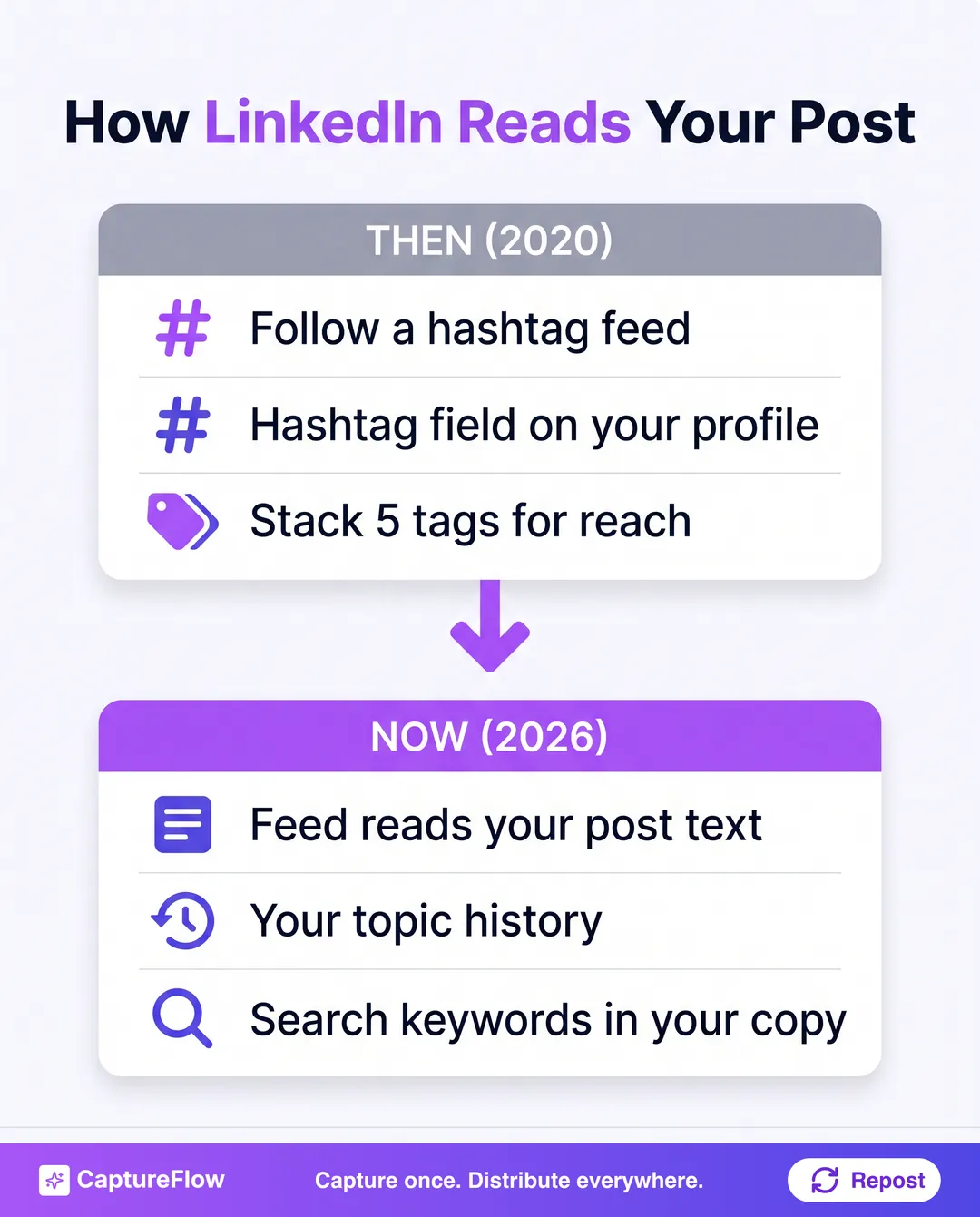 The old system needed your labels. The new one reads the post.
What the data says
The best independent read on this comes from Richard van der Blom's Algorithm Insights Report 2025, which analyzed roughly 1.8 million posts, 58,000 profiles, and 31,000 company pages over a year ending February 2025.
The report's takeaway on tags is consistent with LinkedIn's own messaging: the platform has shifted toward search and intent-based discovery, scanning the words in your copy rather than leaning on hashtags to expand reach. Its practical guidance is to keep hashtags to a small number of highly relevant tags placed inline, not stacked in a block at the bottom.
In other words, the people who study the feed at scale and the people who build the feed agree: stop treating hashtags as a reach dial, because that dial is no longer connected to anything.
So how many hashtags should you use?
Here is the honest rule for 2026:
Use 1 to 3 hashtags, and only ones that genuinely describe the post. If a tag would not help a human understand what the post is about, it will not help the algorithm either. When in doubt, use fewer.
| The old habit (2020) | What works now (2026) | |
|---|---|---|
| How many | 3 to 5, often more | 1 to 3, relevant only |
| Placement | Stacked block at the bottom | Inline or a short line at the end |
| Job they do | Expand reach to tag followers | Light topic and search signal |
| What drives reach instead | The hashtags themselves | Keyword-rich copy and topic consistency |
A couple of relevant tags still add a small categorization and search signal, and they cost you nothing. Five or more crossed into spam-signal territory and never bought the reach people believed they did. If you want to sanity-check which tags are actually specific to your topic rather than generic filler, our free hashtag generator is built for exactly that triage.
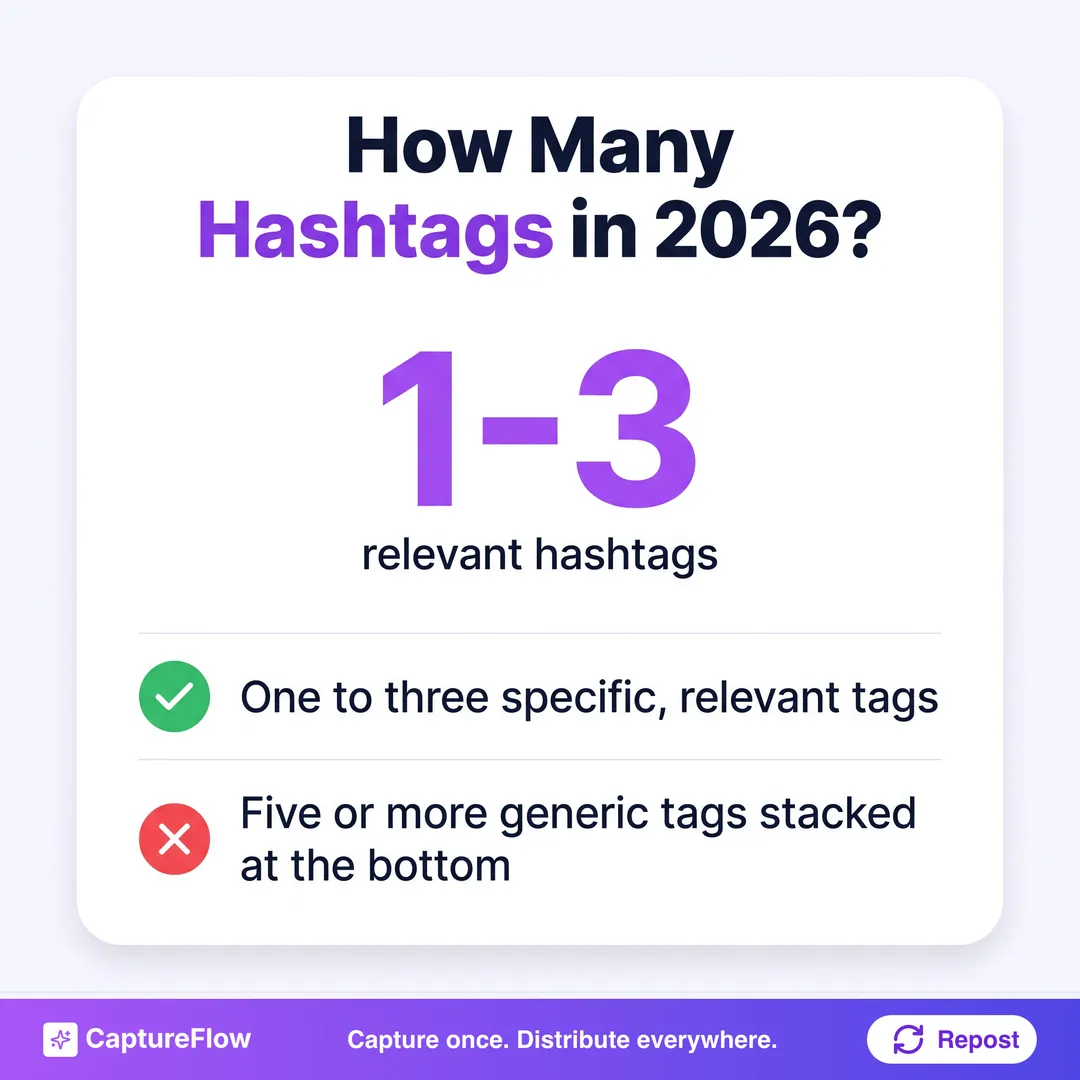 Fewer, specific, relevant. That is the entire rule.
What to do instead of chasing hashtags
If hashtags are no longer the lever, what is? The answer is almost freeing: write for the reader, and the algorithm follows.
Because the feed reads your words, the terms your audience actually searches for belong in the post itself, in the hook, the first line, the body, not hidden in a tag. That is real keyword optimization, and it is a core part of any serious LinkedIn content strategy. The second lever is consistency: posting on a recognizable topic over time builds the exact authority signal hashtags used to approximate. Van der Blom's data and LinkedIn's own statements both point at the same thing, and so does the way strong posts are written line by line.
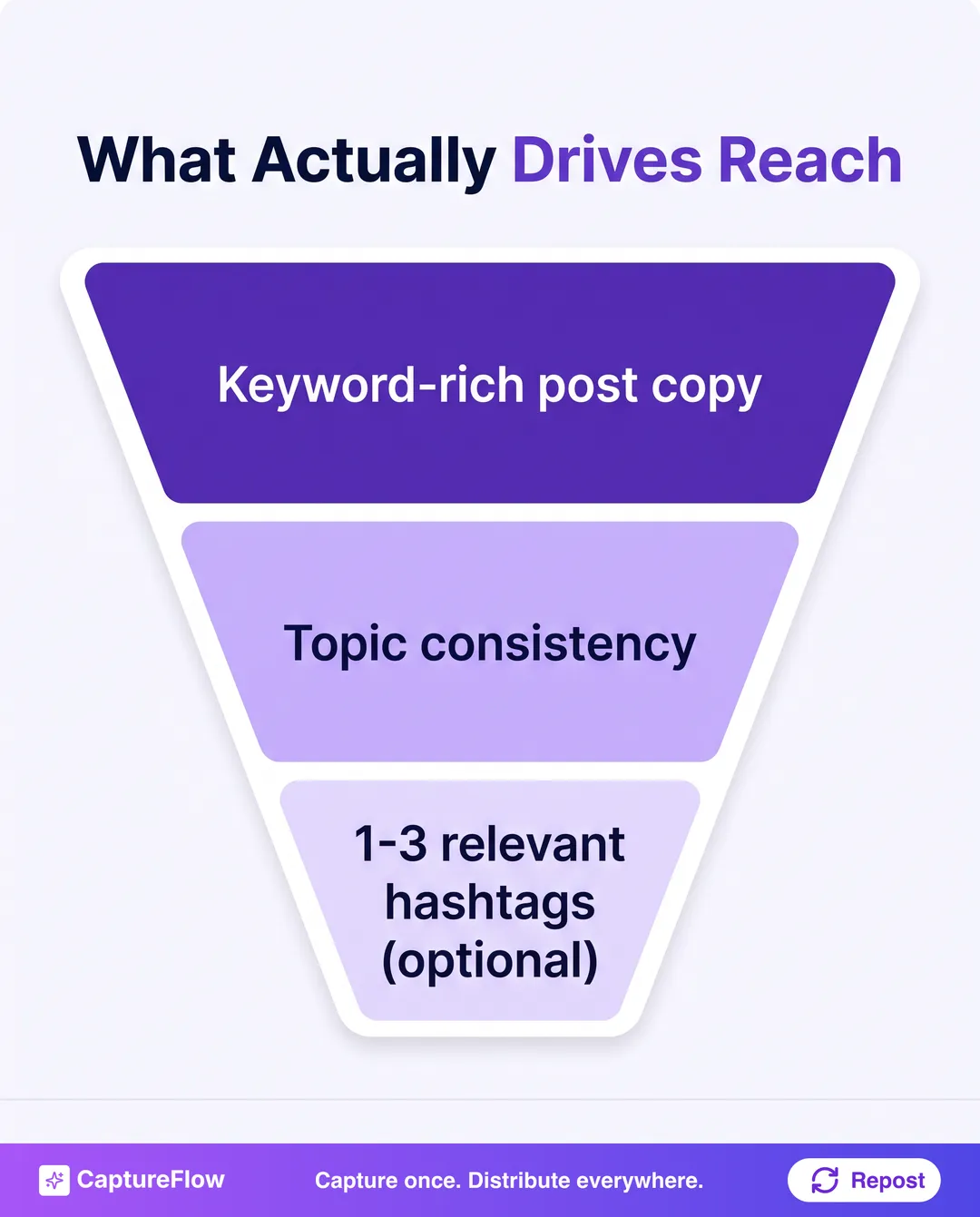 Words first, consistency second, hashtags a distant, optional third.
The 2026 hashtag ruleHashtags used to be how you told LinkedIn what your post was about. Now the post tells LinkedIn. Write it so it is obvious to a human, and the tags become a rounding error.
This is where consistency stops being a willpower problem. CaptureFlow is an AI content agent that turns your expertise into weeks of on-brand content for every platform. You capture one idea, and it reshapes that single input into native posts, carousels, quote images, and short video, each written in your voice and on your topic, which is precisely the keyword-and-consistency signal the modern feed rewards. The hashtags become the easy part, an afterthought, once the words are doing the work.
The move
Drop the five-hashtag reflex. Keep one to three genuinely relevant tags if you like them, put the searchable keywords in the actual copy, and stay consistent on your topic. That is what moves reach in 2026, and unlike the old hashtag game, it is a habit you can actually build.
If showing up on-topic every week is the bottleneck, that is the exact problem CaptureFlow is built to remove. See how it works, or compare it to the single-purpose tools on the compare hub.
Sources
- Social Media Today, LinkedIn Stops Resurfacing Old Posts, Shares Updates on Hashtags and AI Functions (July 2025), quoting LinkedIn feed product lead Rishi Jobanputra.
- Rishi Jobanputra, on whether to use hashtags on LinkedIn ("a nice to have, not a need to have").
- Richard van der Blom, Algorithm Insights Report 2025 (1.8 million posts analyzed).
Frequently asked questions
Do hashtags still work on LinkedIn in 2026?+
Not as a reach tool. LinkedIn's feed now classifies a post by reading its actual text and the author's topic history, so hashtags no longer expand distribution the way they did in 2020. They still add a small, useful categorization and search signal, which is why a couple of relevant ones are worth keeping.
How many hashtags should I use on a LinkedIn post?+
One to three highly relevant hashtags. Richard van der Blom's 2025 analysis of 1.8 million posts recommends keeping tags few and specific, placed inline or at the end. Stacking five or more looks like spam and does nothing for reach.
What replaced hashtags for LinkedIn reach?+
Keyword-rich post copy and topic consistency. Because the algorithm reads your words, the terms your audience actually searches for belong in the post itself, not hidden in a tag. Posting on a consistent topic builds the authority signal that hashtags used to stand in for.
Chris is the founder and CEO of CaptureFlow, which he builds so founders can turn their expertise into content without hiring a team. After 10+ years building products and growing audiences from scratch, he writes about founder-led content, AI, and distribution from inside the problem he is solving: distributing consistent, on-brand content as a team of one.
Founder & CEO of CaptureFlow · 10+ years building products and audiences
One playbook a week from founders who actually create and distribute lots of content. No spam, unsubscribe anytime.
Keep reading
LinkedIn Marketing for B2B Companies
For B2B, LinkedIn is not one channel among many. It is the channel. Here is how B2B companies actually win on it: the stack, the pillars, and the cadence.

How to Turn Meeting Recordings Into Content
Your best ideas get said out loud in meetings, then vanish. Here is how to turn a single recording into a week of social posts, in about 5 minutes.
Content Operations for B2B Teams: Build a Scalable System
More content is demanded than any B2B team can produce, so the work fragments across five tools and quality slips. Content operations is the fix. Here is the system.