Best Time to Post on X (Twitter) in 2026 (Data-Backed)
The best time to post on X is weekday late morning through early afternoon. Here is the real data on X's audience, and why timing matters less than you think.


You fire off a sharp take at midnight because that is when it finally clicked, and it sits at 40 views until you quietly delete it the next morning. Post the same line at 10 am on a Wednesday, and it is a reply thread by lunch. Same account, same followers, same joke.
So here is the direct answer to the best time to post on X in 2026. Based on the clean, non-vendor data available, it is weekday late morning through early afternoon, avoiding late nights and weekends. That is a wider, softer window than you'll find on LinkedIn, because X runs faster, more conversational, and on real time rather than a 9-to-5 rhythm. This guide covers what is actually sourced, is honest about what is not, and ends with a way to find your own best time instead of borrowing one built for somebody else's audience. It pairs well with how the X algorithm works, since timing and ranking are two halves of the same distribution question.
What is the best time to post on X?
The best time to post on X is late morning through early afternoon on a weekday, the window when the platform's real-time, always-on audience is most likely to be scrolling.
That framing comes from HubSpot's own social media timing research, one of the few non-vendor sources that publishes timing guidance for X specifically rather than folding it into a generic "social media" chart. Their read is worth quoting directly, because it is also an honest admission of how different X is from every other feed they cover: "Due to the nature of this platform, you can post more frequently and don't have to worry as much about strict windows. Try late morning and early afternoons on weekdays, and avoid late night posts on the weekends."
That is a real, if qualitative, answer, and it is the most defensible one available without leaning on a vendor's proprietary dataset. Compare it with our LinkedIn timing research, where HubSpot and LinkedIn's own marketing blog agree on a tight Tuesday-through-Thursday, 9-am-to-noon window. X simply does not have an equivalent, precise, platform-official answer, and we would rather tell you that plainly than invent one.
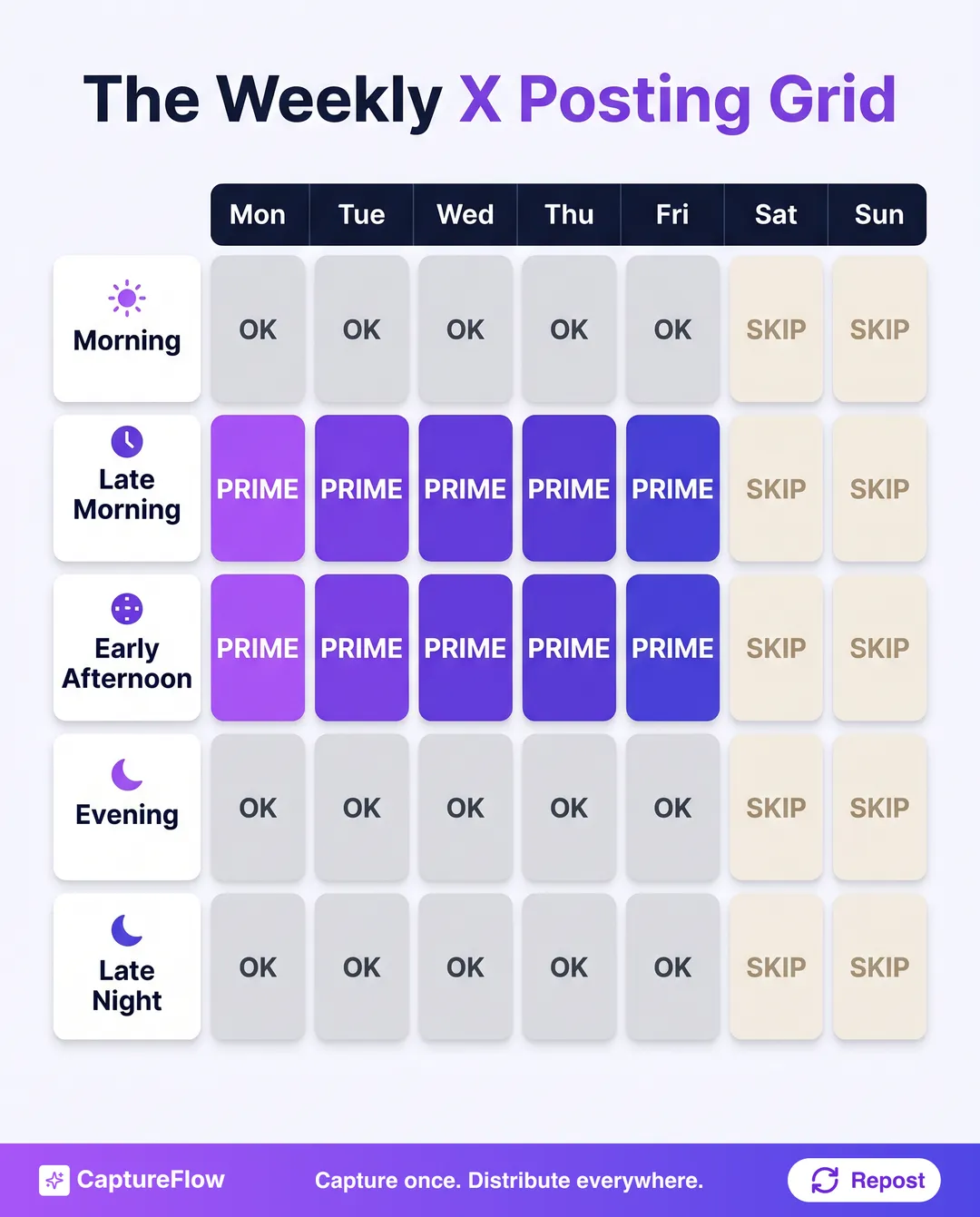 The week at a glance, built from HubSpot's own weekday guidance. Prime means start here, OK is a fine backup, skip means schedule around it.
Most "9 am on Tuesday is your magic hour" charts online come from scheduling tools analyzing their own customers' posts, proprietary, self-selected data, not independent research. What you are reading instead is what platform-official and research-firm sources actually support.
Who is actually on X, and when?
The absence of a precise hourly chart does not mean there is no usable data. It means the useful data is about the audience, not the clock.
X's own advertising tools, analyzed by DataReportal / Kepios, put X's global ad reach at 586 million users, with the platform's audience skewing 63.7 percent male to 36.3 percent female, and an average user age between 25 and 34. Men aged 25 to 34 make up the single largest demographic slice at 24.5 percent of the ad audience, ahead of men aged 18 to 24 at 18.9 percent. That is a working-age, chronically-online crowd.
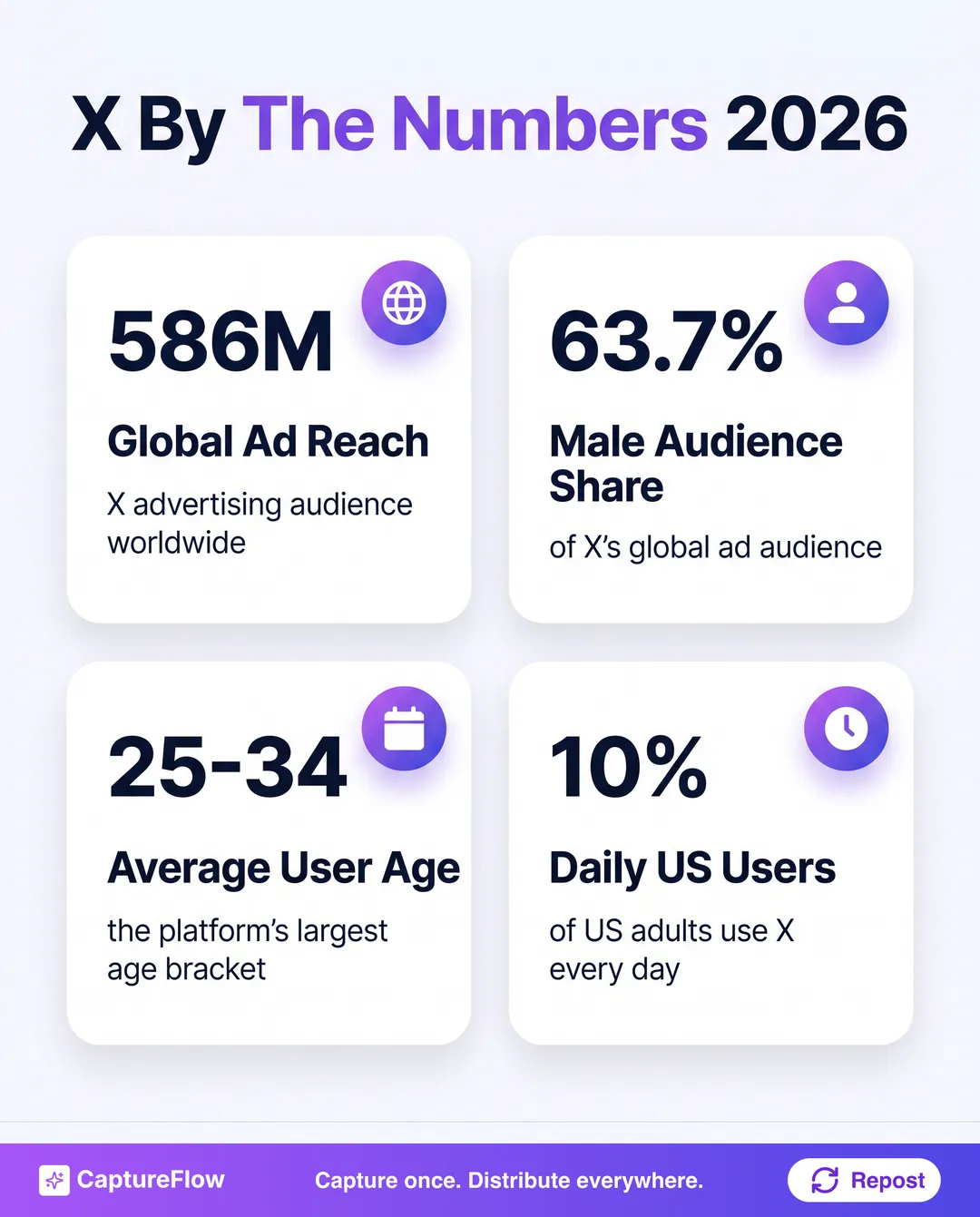 The platform behind the timing question, per DataReportal/Kepios and Pew Research Center.
Pew Research Center's 2025 survey adds an important qualifier: only 10 percent of US adults report using X daily, well behind Facebook and YouTube, where roughly half of adults check in every day. Pew's data also shows X's US audience leans slightly Republican, with 24 percent of Republicans reporting they use the platform compared with 19 percent of Democrats, a gap that has actually flipped since 2023, when Democrats were more likely to be on the platform.
Put together: X's audience is smaller and less habitual than Facebook's or YouTube's, skews toward working-age men, and treats the platform as a real-time check-in rather than a scrolling default. That is why "post inside a wide weekday window" beats "hit this exact hour," which is the pattern HubSpot's own guidance reflects.
Why timing matters less than you think
Here is the part every magic-hour chart skips: on X, posting time is not a ranking factor. It is a sampling factor, and the mechanism is nearly identical to LinkedIn's.
Every time you open X, the feed pulls roughly 1,500 candidate posts, split close to evenly between people you follow and people you do not, then scores each one with a neural network called the heavy ranker, which X open-sourced in 2023. We covered the full mechanics in how the X algorithm works; the short version is that the model predicts how likely you are to reply, dwell, or otherwise engage, and that score, not the clock, decides distribution.
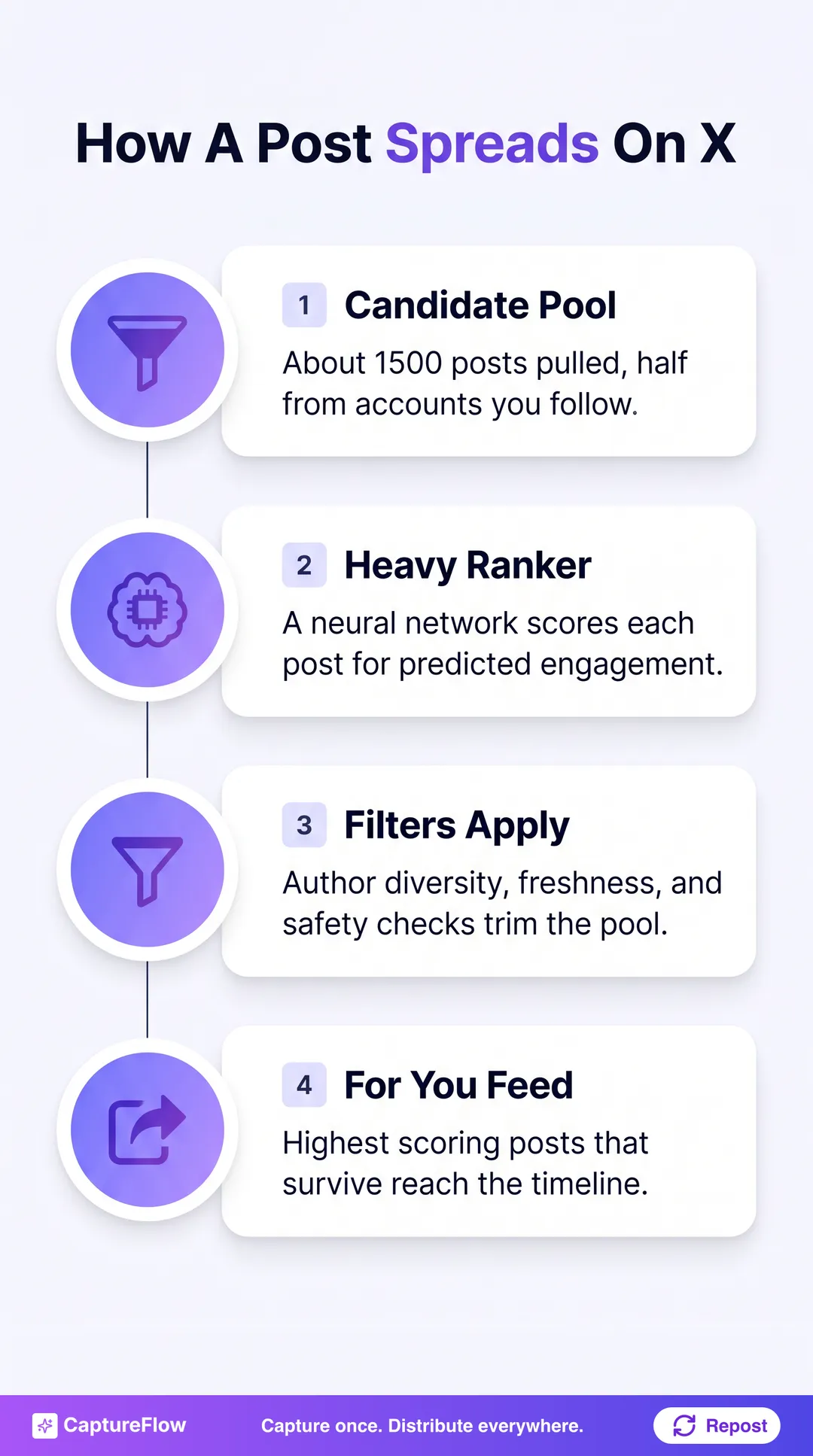 Timing only affects how many real people are awake for step 1. Content quality decides steps 2 through 4.
A strong post at an average hour beats an average post at the perfect hour. On X, timing sizes your first audience. Everything after that is scored by the algorithm, not the clock.
Posting inside a busy window does one real thing: it puts more of your actual audience online to generate that crucial early signal, the replies and dwell time the heavy ranker uses to decide whether to push your post further. It cannot make a weak post rank. This is also why X's own guidance leans toward "post more, worry less about the exact hour" rather than a precision chart: a platform built on real-time replies rewards being present often over being present at one perfect minute.
How do you find your own best time on X?
Industry guidance gets you into the right neighborhood: weekday, daytime, not too late, not too early. Your own analytics get you to the right door. Here is a system that costs nothing but two weeks of consistency.
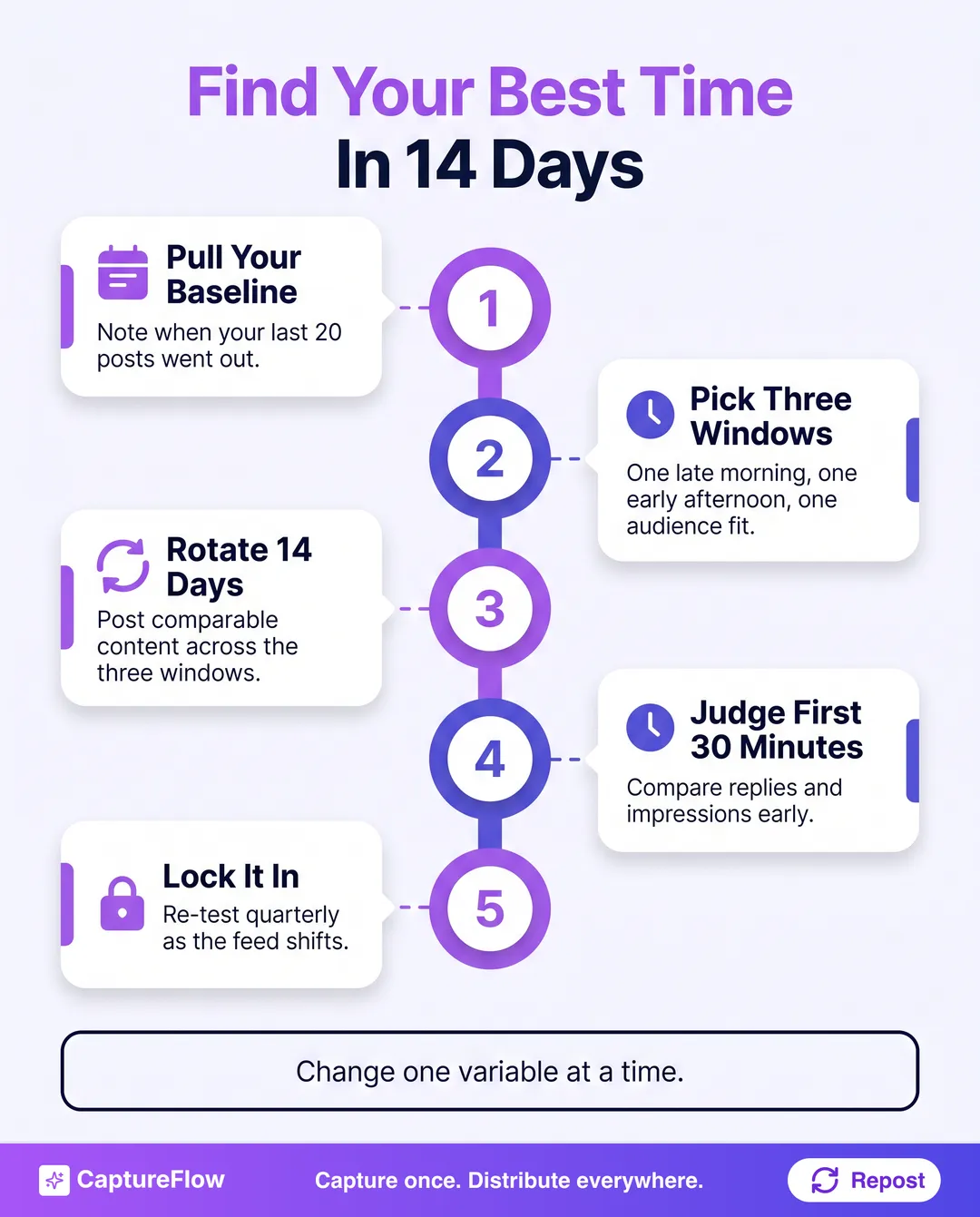 Fourteen days, five steps, an answer built from your own audience instead of an average.
- Pull your baseline. Open your last 15 to 20 posts and note when each went out, and what it did in replies and impressions. Most accounts discover their "schedule" was accidental, which is exactly why a generic chart feels true: almost anything beats posting at random.
- Pick three weekday windows. Start from what is actually sourced: one late-morning slot, one early-afternoon slot, and a third that fits how you know your specific audience behaves (technical audiences often skew earlier or later than the office-hours crowd).
- Rotate for 14 days. X's fast pace means two weeks is enough sample size, unlike LinkedIn where a slower feed needs closer to a month. Keep the content style consistent, or you will not know whether the hour or the post caused the result.
- Judge the first 30 minutes. X's candidate pool refreshes constantly, so the earliest replies and impressions are the cleanest signal that your window actually found people awake.
- Lock it in, then re-test quarterly. X's audience and news cycles move fast enough that a window worth trusting in January can go quiet by summer.
Change one variable at a time. If you swap the hour, the format, and the topic in the same week, you cannot credit the result to any of them. Hold everything else steady and let the clock be the only thing that moves.
How often should you post on X?
X's own content lifespan is measured in hours, not days, which is why our broader cadence research puts the floor at 1 to 2 posts a day, with more being reasonable if you can sustain the quality. A volume that would feel spammy on LinkedIn barely registers on a feed that refreshes constantly. The tools that make that pace survivable are covered in our roundup of the best X growth tools.
The real bottleneck is rarely the clock. It is the queue. Knowing your best window is worthless if you have nothing ready to post into it.
The honest take: timing buys you an audience, not an outcome
Settle the timing question in one sitting: post inside the weekday late-morning-to-early-afternoon window, avoid late nights and weekends, run the 14-day test, and lock in your version of it. What is left is the harder 90 percent: having something worth posting once or twice a day, in your own voice, without it turning into a second job.
That is the problem CaptureFlow is built for. CaptureFlow is an AI content agent that turns your expertise into weeks of on-brand content for every platform. You talk about what you know for a few minutes, on video, a voice note, a file, or a link, and 5 minutes later you have a set of native posts in your voice, ready to drop into the window you just validated. If you write threads from a video and also want a version ready for LinkedIn, our X post to LinkedIn post converter is a free way to see that reshaping in action before you commit to anything.
So use the data: weekday, late morning through early afternoon, and lean toward more frequent rather than less. Then make the exact hour matter less by never letting the window go empty. If the supply side, not the clock, is your actual constraint, see how CaptureFlow works.
Sources
- HubSpot: The Best Times to Post on Social Media in 2025
- DataReportal / Kepios: X Users, Stats, Data & Trends
- Pew Research Center: Americans' Social Media Use 2025
- X Engineering: Twitter's Recommendation Algorithm
- X / GitHub: the-algorithm (candidate sources and ranking pipeline)
Frequently asked questions
What is the best time to post on X (Twitter)?+
Weekday late morning through early afternoon, per HubSpot's own guidance, while avoiding late nights and weekends. Because X is a real-time, high-frequency platform, that window is wider and less rigid than on a more scheduled feed like LinkedIn.
Is it OK to post on X multiple times a day?+
Yes. A post's shelf life on X is measured in hours, not days, so a higher daily cadence is normal, unlike on LinkedIn or Instagram where too many posts a day can compete with your own reach. One to two posts a day is a reasonable floor.
Does posting time affect the X algorithm?+
Only indirectly. X's open-sourced heavy ranker scores each post by predicted engagement the moment it enters the candidate pool, not by the clock. Posting when your audience is online just gives that first score a bigger, faster sample to work with.
Why is there so much disagreement about the best time to post on X?+
Most of the specific, to-the-minute charts online come from scheduling-tool studies of their own customer data, which is not independently verifiable and skews toward whoever already uses that tool. Platform-official and research-firm data on X specifically is thinner than on LinkedIn, so this guide sticks to what is actually sourced and is upfront about the gap.
Chris is the founder and CEO of CaptureFlow, which he builds so founders can turn their expertise into content without hiring a team. After 10+ years building products and growing audiences from scratch, he writes about founder-led content, AI, and distribution from inside the problem he is solving: distributing consistent, on-brand content as a team of one.
Founder & CEO of CaptureFlow · 10+ years building products and audiences
One playbook a week from founders who actually create and distribute lots of content. No spam, unsubscribe anytime.
Keep reading

How the X (Twitter) Algorithm Works in 2026 (Backed by Data)
The X algorithm is not a lottery. It is a scoring system, and X open-sourced most of it, so you can read the rules instead of guessing.

LinkedIn Marketing for B2B Companies
For B2B, LinkedIn is not one channel among many. It is the channel. Here is how B2B companies actually win on it: the stack, the pillars, and the cadence.

How to Turn Meeting Recordings Into Content
Your best ideas get said out loud in meetings, then vanish. Here is how to turn a single recording into a week of social posts, in about 5 minutes.