Social Media Approval Workflow: 5 Stages, No Chasing
A social media approval workflow for teams of 3 to 15: five stages, one owner each, a time limit per stage, and approval tiers so low-risk posts move fast.


Your posts aren't late because your team is slow. They're late because nobody can say who approves what, or by when. A social media approval workflow fixes that: five stages, one named owner per stage, and a time limit on every handoff, so a post moves from draft to scheduled in about two business days instead of drifting around Slack for a week.
This playbook is for marketing teams and agencies of roughly 3 to 15 people. It covers the stages, who owns each one, realistic turnaround targets, the approval tiers that let low-risk posts skip the queue, and the six ways approval usually breaks.
Here's the definition I'll use throughout.
A social media approval workflow is the documented path a post takes from brief to published, with one owner and one deadline at every stage.
The word doing the work there is "documented." If the path only lives in someone's head, you don't have a workflow. You have a habit.
Why does social media approval take so long?
Because most teams don't have an approval process. They have a habit of asking for approval, which is a different thing.
A habit looks like this: someone finishes a draft, pastes it into whichever channel feels right, tags whoever seems senior, and writes "can you take a look?" No deadline. No context. No record of which version got the thumbs-up.
You're not alone in this. In the Content Marketing Institute's B2B research, 41% of B2B marketers said they have issues with workflow and content approval, more than said they struggle to reach subject-matter experts. And approvers aren't sitting idle waiting for your draft: Microsoft's 2025 Work Trend Index found that during core hours, employees are interrupted every 2 minutes by meetings, emails, or pings. An open-ended "take a look" is just one more ping in that pile.
When approval runs on habit, three things keep happening:
- One person becomes the bottleneck. Usually the most senior person around, who ends up approving everything whether or not it needs them.
- Feedback arrives out of order. The client flags a brand issue after the content lead already signed off the copy. Now a "done" post gets rewritten.
- Nothing has a deadline. So it competes with everything else in the approver's day, and it loses.
Approval isn't one event. It's a short relay, and every leg needs a runner and a clock.
The 5-stage social media approval workflow
Each stage has one owner, one output, and one time limit. That's the whole trick, honestly. The stages below assume a normal cadence of three to five posts per week per brand.
| Stage | Owner | Output | Target turnaround |
|---|---|---|---|
| 1. Brief | Content lead | Approved brief | Before drafting starts |
| 2. Draft | Content creator | Copy and assets per platform | 24 hours |
| 3. Internal review | Content lead | Edited draft, marked ready | 4 business hours |
| 4. Final approval | Client contact or brand stakeholder | Yes, or specific changes | 24 hours |
| 5. Schedule and check | Coordinator | Post queued, then verified live | 2 hours, plus a check after publish |
These turnaround numbers are the targets we recommend, not an industry law. Tighten or loosen them, but write them down.
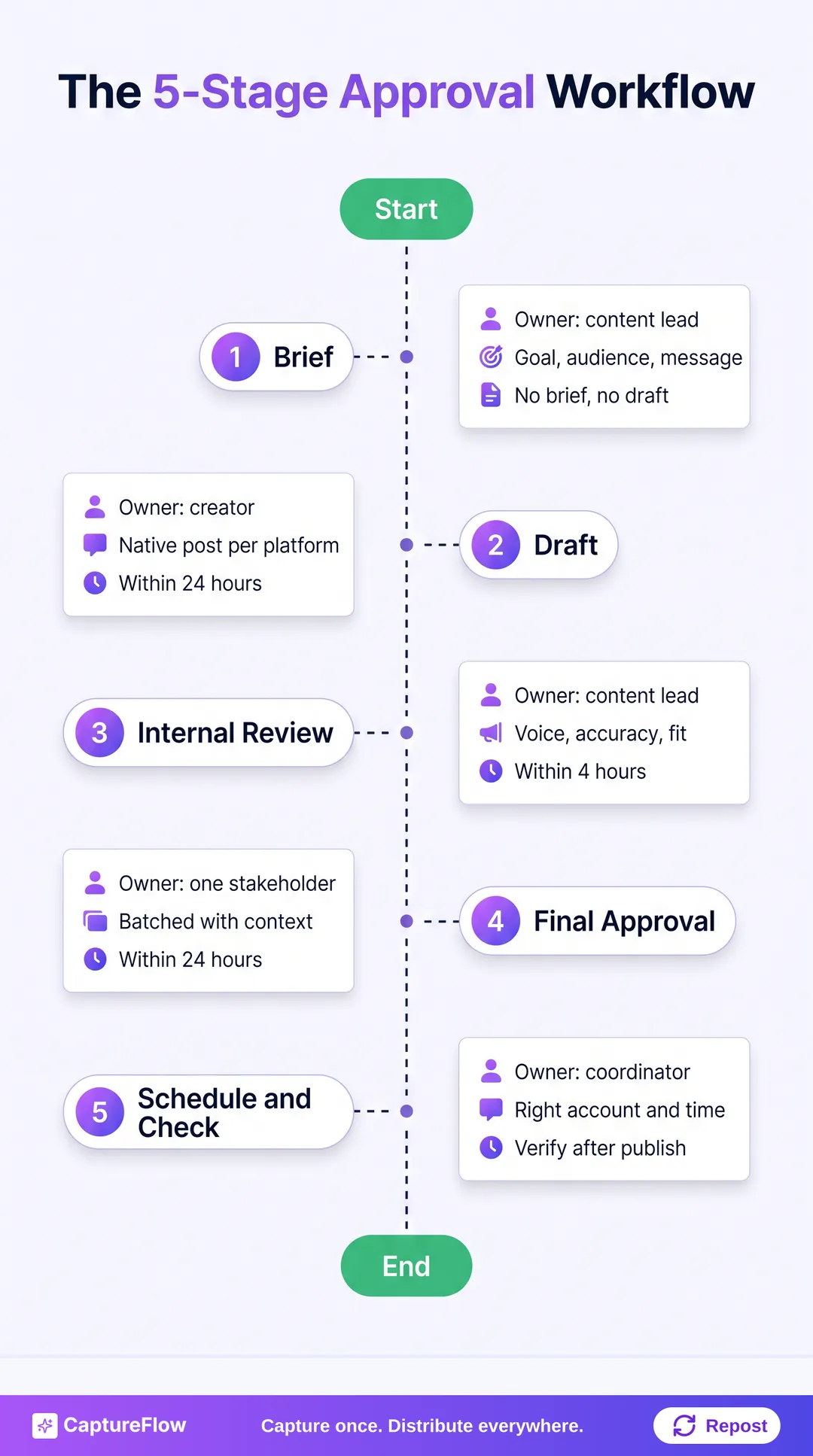 The five stages, from brief to a verified live post.
Stage 1: Brief
The brief is where approval actually starts, even though nobody calls it that. If the strategy gets agreed here, the later stages only have to judge execution.
Keep it to five fields: the goal, the audience, the key message, the platforms, and the content pillar. If a field is blank, drafting doesn't start. That one rule removes most of the "this isn't what I meant" feedback that shows up three days later.
Have the person who gives final approval sign off on the brief, not just the post. Ten seconds of "yes, that's the angle" at the start saves a full rewrite at stage 4.
Stage 2: Draft
The creator turns the brief into finished posts: copy for each platform, the visual or video, a proposed publish date, and the pillar tag. One idea usually becomes several native versions here, a LinkedIn post, an X thread, a carousel, a short clip.
This is the stage AI changes most. CaptureFlow is an AI content agent that turns your expertise into weeks of on-brand content for every platform. You capture one idea in 5 minutes (a voice note, a video, a file, or a link), and the content agent, trained on your brand voice and past posts, drafts the native version for each channel. The draft lands in a review queue instead of a DM, which matters for stage 3.
What the draft should not include: questions about strategy. Those belonged in the brief.
Stage 3: Internal review
The content lead checks the draft against four things, in this order:
- Voice. Does it sound like the brand, or like a press release?
- Accuracy. Are the numbers, names, and links right?
- Platform fit. Right length, right format, a hook that lands in the first line.
- Goal. Does it do what the brief said it would?
The lead either fixes small things directly or sends it back with specific notes. "This doesn't feel right" isn't a note. "The opening buries the hook, move the 41% stat to line one" is.
Internal review always comes before external approval. Every time. Sending a client something your own team hasn't checked is how one revision round becomes three.
Stage 4: Final approval
This stage catches what your team can't know on its own: legal sensitivities, an executive's preferences, a launch date that moved, a partner you're not allowed to name yet.
Four rules keep it moving:
- Batch it. Send one package a week (or two), not posts one by one as they're ready.
- Send context with it. The campaign goal, the publish dates, and one sentence per post on what it's for.
- Ask for a reply-by time. "Please confirm or flag changes by Thursday 2pm" gets answered. "Thoughts?" doesn't.
- Decide what silence means, in advance. If the deadline passes with no reply, does the post publish or slip? Agree on it once, in writing, before it comes up.
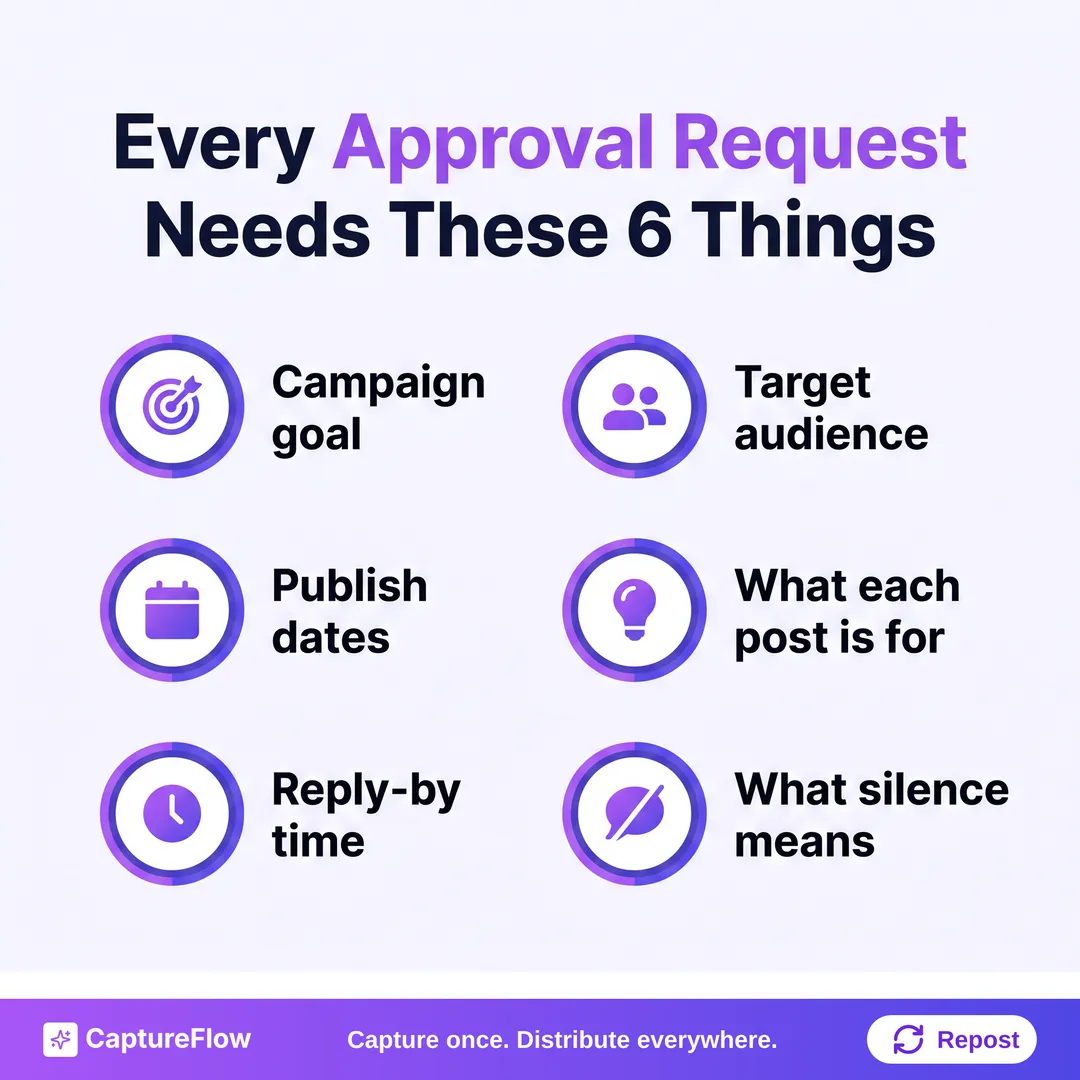 If a request is missing one of these, expect a slow or vague answer.
For agencies, this is where most of the week disappears. We wrote a longer piece on batching client approvals across many accounts; the short version is a standing weekly review slot per client.
Stage 5: Schedule and check
Once a post is approved, it's an operations job. The coordinator queues it on the right account at the right time and confirms the final asset is the approved one. Then, after it publishes, someone checks it went out on the right account, the visual rendered properly, and the links work.
The classic failure here is boring and expensive: a post scheduled to the wrong client's account, or an asset someone tweaked after approval going out without anyone re-checking. A shared content calendar where every post has a visible status (in review, approved, scheduled, live) catches most of it, because everyone can see the queue.
Who owns each stage?
Small teams double up on roles. That's fine. Leaving a role unassigned isn't, because then nobody owns it.
| Role | Team of 3 to 5 | Team of 6 to 15 |
|---|---|---|
| Content creator | Social media manager or generalist marketer | Dedicated social writer or specialist |
| Content lead (review) | Marketing manager | Senior social manager or content strategist |
| Final approver | Founder, CEO, or client contact | Account manager (agency) or brand/comms lead (in-house) |
| Coordinator (schedule and check) | The social media manager again | Junior coordinator or ops person |
On a three-person team, the same person often reviews and schedules. Fine, as long as review happens first and isn't done in the same breath as scheduling.
The role most small teams are missing is the coordinator. Without one, scheduling falls on the content lead, who's already reviewing, so it happens late or not at all. If you can't hire for it, give it to one named person as a time-boxed task on specific days. If you're two people, our weekly workflow for a small marketing team shows how to split the whole job between an owner and an operator.
Which posts need the full approval chain?
Not all of them. Sending every post to the CEO is how the bottleneck in the first section gets built.
Sort posts by two questions: how risky is it (new claims, numbers, sensitive topics, legal exposure), and how much reach does it carry (a launch, a paid boost, a big partner mention)? That gives you four lanes.
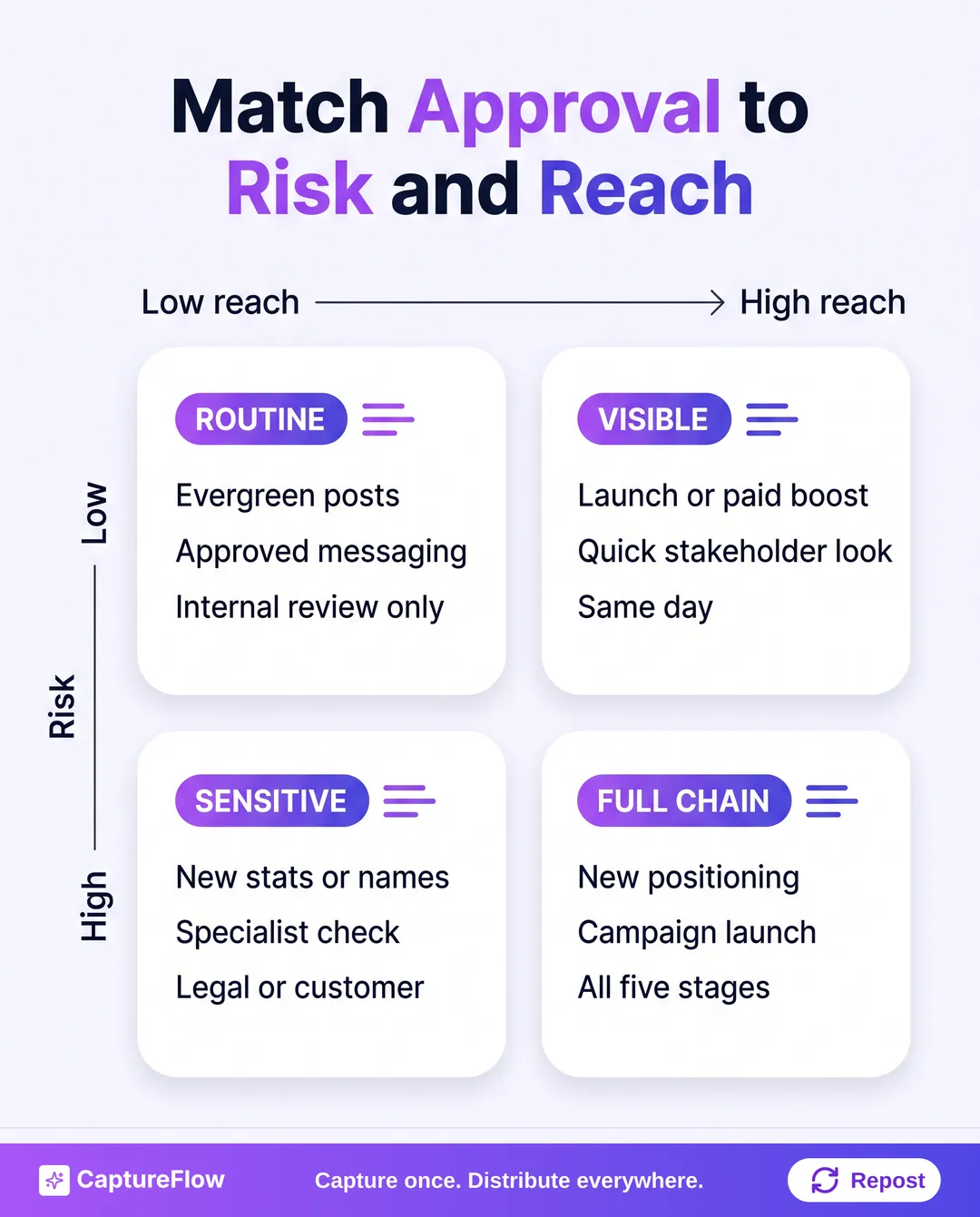 Match the approval chain to the post, not the other way round.
- Routine (low risk, low reach). Evergreen posts repeating messaging you've already approved. Internal review, then the calendar. No final sign-off.
- Visible (low risk, high reach). A launch post or a paid boost. Quick stakeholder look, same day.
- Sensitive (high risk, low reach). A new stat, a customer name, a reply to something in the news. Route it to whoever can check the specific risk, legal or the customer's contact.
- Full chain (high risk, high reach). New positioning, a campaign launch, anything you'd hate to see screenshotted. All five stages.
Regulated industries need a stricter rule than this. In US financial services, FINRA's guidance says most static social content must be approved by a registered principal prior to use, while interactive replies are supervised instead. And if a post involves a paid partnership or an endorsement, the FTC's Endorsement Guides say that connection should be disclosed clearly and conspicuously, so "is the disclosure there?" belongs on the reviewer's checklist.
This tiering is also where automation fits. In CaptureFlow, recurring routines leave drafts in your review queue, and you can let the trusted ones publish themselves while everything else waits for a tap. That's the routine lane above, made literal.
Realistic turnaround targets
Here's what a working system should hit, by content type. Again, these are our recommended defaults for a three-to-five-posts-a-week cadence.
| Stage | Standard post | Campaign post | Reactive post |
|---|---|---|---|
| Draft | 24 hours | 48 hours | 2 hours |
| Internal review | 4 business hours | 4 business hours | 1 hour |
| Final approval | 24 hours | 48 hours | Same day, one approver |
| Schedule and check | 2 hours | 2 hours | 30 minutes |
| End to end | About 2 business days | About 4 business days | Same day |
Reactive content needs its own lane, agreed in advance: one named approver, a short list of topics you will and won't comment on, and permission to skip the batch. Without that lane, the moment has passed by the time the post is approved.
If a stage keeps blowing its target, look at what it received before blaming the person who owns it. A slow review is usually a weak draft, and a weak draft is usually a thin brief.
Six ways approval workflows break (and the fix for each)
Most teams have at least three of these running at once.
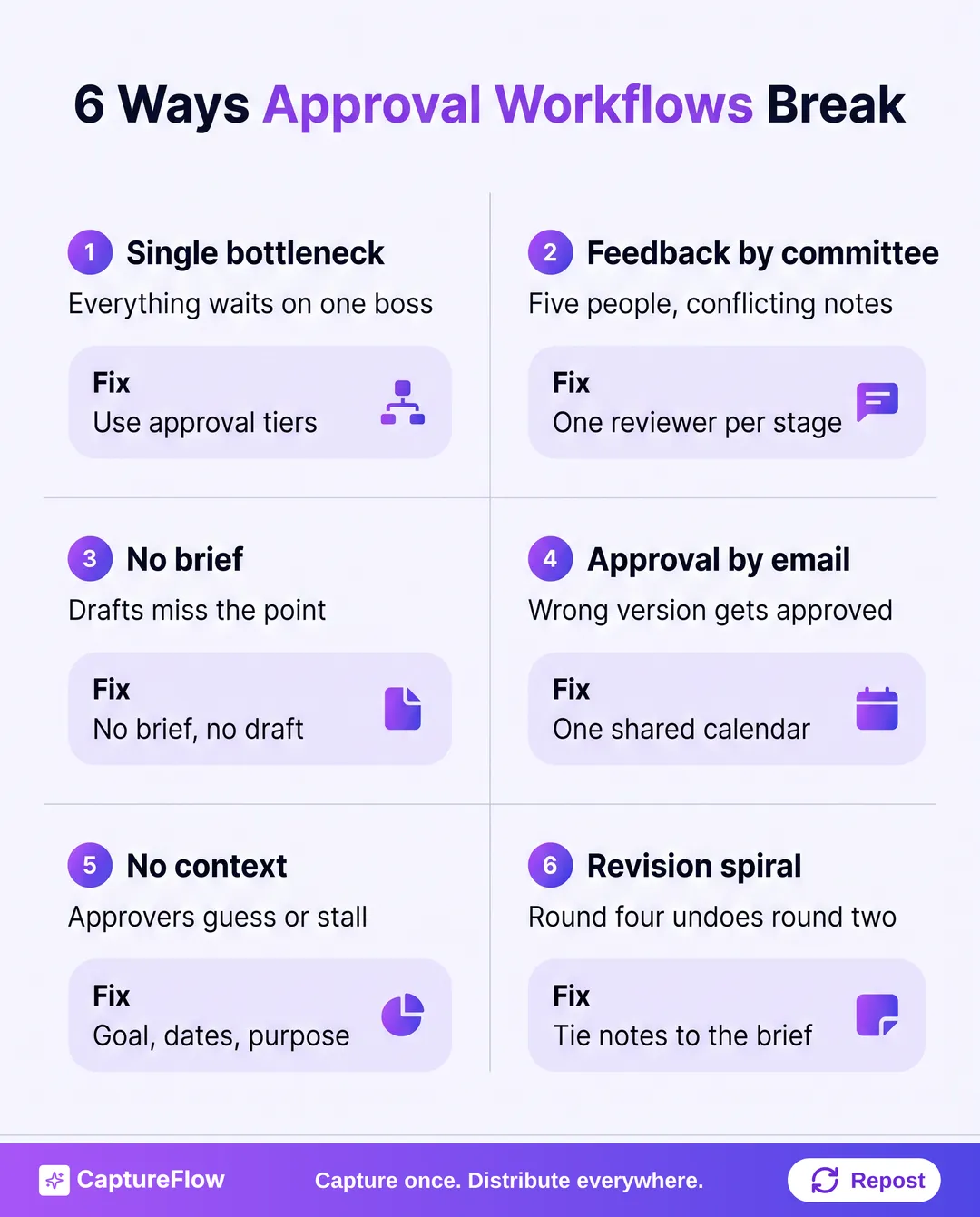 Six failure modes and the fix for each.
1. The single bottleneck. Everything waits on one senior person. Fix: approval tiers, so the routine lane never reaches them.
2. Feedback by committee. Five people comment, two contradict each other, and the creator doesn't know whose note wins. Fix: one reviewer per stage. Others can watch; only the stage owner's feedback triggers a revision.
3. No brief. The draft misses the point, the lead rewrites it from scratch, and nobody learns anything. Fix: the five-field brief, and no drafting until it's complete.
4. Approval by email. Someone replies to an old thread and approves version two while version four is in the calendar. Fix: drafts live in one shared place with a visible status. If you change one thing after reading this, make it this one.
5. Approval without context. The client gets twelve posts with no dates and no goals, so they either approve everything vaguely or reject it out of confusion. Fix: the six-part approval request above.
6. The revision spiral. Round four contradicts round two and the brief is long forgotten. Fix: every piece of feedback has to point at a brief criterion (voice, accuracy, platform fit, or goal). If it can't, the content lead can push back, politely.
How to roll this out this week
You don't need a reorg. You need about an hour, spread over a few days.
- Name the owners (20 minutes). Walk the team through the five stages and put one name next to each. Write it down where everyone can see it.
- Write the brief template. Five fields. No brief, no draft.
- Publish the targets. Send the team, and your clients, a one-page summary with the turnaround times and the silence rule. People respond to deadlines they've seen.
- Move drafts out of email and DMs. Put every post in one calendar with a visible status. This is the step that makes the other three stick.
If you're scaling output on a small team, the approval workflow is usually what caps you first, before writing does. We covered the rest of that problem in how to scale content production with a small team and, for bigger orgs, in content operations for B2B teams.
A documented process, even a rough one, beats the "can you take a look?" habit every week you run it. If you want the drafting, the review queue, the approval workflows, and the calendar in one place, see what CaptureFlow does or pick a plan. Agencies running this across many clients should start with CaptureFlow for agencies.
Sources
- Content Marketing Institute: B2B Content Marketing Benchmarks, Budgets, and Trends: Outlook for 2024
- Microsoft WorkLab: 2025 Work Trend Index Annual Report
- FINRA: Social Media (key topics)
- Federal Trade Commission: FTC's Endorsement Guides: What People Are Asking
Frequently asked questions
What is a social media approval workflow?+
It's the documented path a post takes from brief to published: who drafts it, who reviews it, who gives final sign-off, who schedules it, and how long each step is allowed to take. The point is that everyone knows their stage before the draft exists.
How long should social media approval take?+
For a team posting three to five times a week per brand, a working target is about two business days from finished draft to scheduled post. Reactive posts need a same-day lane with one approver, and campaign content can take longer because more people sign off.
Who should approve social media posts?+
One person per stage. A content lead owns internal review for voice, accuracy, and platform fit. A single stakeholder (the client contact, founder, or brand lead) owns final sign-off. Others can watch, but only the stage owner's feedback triggers a revision.
Do all social posts need final approval from a client or executive?+
No. Use approval tiers. Routine posts that repeat approved messaging can go straight from internal review to the calendar, while new claims, campaign launches, and sensitive topics get the full chain. Regulated industries are the exception: in financial services, FINRA expects most static posts to be approved by a registered principal before use.
How do agencies handle client approval for social media?+
Batch it. Send each client one approval package a week with the campaign goal, publish dates, and one line on what each post is for, plus a reply-by time. One predictable review slot beats ten ad-hoc requests.
Chris is the founder and CEO of CaptureFlow, which he builds so founders can turn their expertise into content without hiring a team. After 10+ years building products and growing audiences from scratch, he writes about founder-led content, AI, and distribution from inside the problem he is solving: distributing consistent, on-brand content as a team of one.
Founder & CEO of CaptureFlow · 10+ years building products and audiences
One playbook a week from founders who actually create and distribute lots of content. No spam, unsubscribe anytime.
Keep reading

The Weekly Content Workflow for a Small Marketing Team
Most small B2B teams do not have a content problem. They have a workflow problem. Here is the repeatable week that fixes it.

How to Scale Content Production With a Small Marketing Team
You cannot hire your way out of a content backlog this quarter. You can change the unit of work. Here is how a one to three person team produces more content without burning out.

Content Workflow Automation for Agencies (2026)
Every new client multiplies the manual work: another voice, another calendar, another five tools. Content workflow automation is how agencies scale output without scaling headcount.